

How to Avoid Common Pitfalls in Car Accident Claims in Las Vegas
After a crash, many people make honest mistakes that end up hurting their injury claim. A missed deadline, a poorly worded statement to an insurance adjuster, or incomplete documentation can all create problems later. If you are trying to avoid car accident claim mistakes Las Vegas drivers commonly face, it helps to know what to do early, what not to say, and when to involve a lawyer.
This FAQ guide from Injury Nation explains the most common claim pitfalls after a Las Vegas car accident, with practical steps you can take to protect your health, your rights, and your ability to recover compensation. If you need immediate help, Injury Nation offers free consultations and 24/7 emergency legal help for accident victims.
FAQ: Avoiding Car Accident Claim Mistakes in Las Vegas
What are the most common mistakes people make after a car accident in Las Vegas?
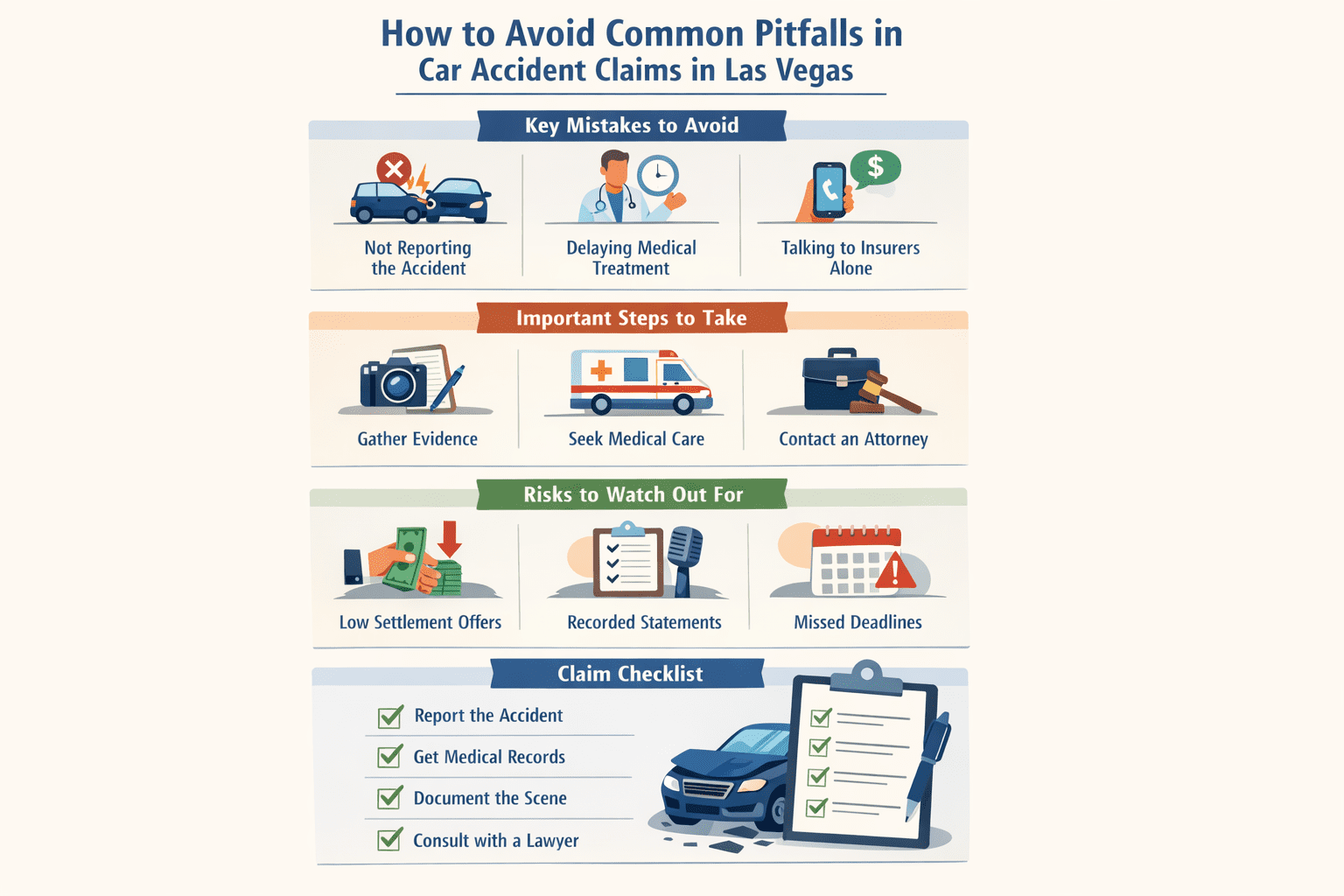
Some mistakes happen at the scene. Others happen days or weeks later when the claim process begins. Common problems include:
- Failing to call the police or report the accident promptly
- Not seeking medical attention right away
- Leaving the scene without gathering evidence
- Admitting fault or apologizing in a way that can be used against you
- Giving a recorded statement to the other driver’s insurance company too soon
- Accepting a low settlement before understanding the full extent of injuries
- Posting about the crash or injuries on social media
- Ignoring follow-up medical care
- Waiting too long to speak with a car accident lawyer
- Assuming a minor crash cannot turn into a serious legal or medical issue
Las Vegas claims can become complicated quickly. Heavy traffic on roads like I-15, US-95, the 215 Beltway, Flamingo Road, Sahara Avenue, Tropicana Avenue, and the Las Vegas Strip can lead to crashes involving tourists, rental vehicles, rideshare drivers, commercial vehicles, and out-of-state insurance carriers. That makes documentation and prompt action especially important.
Why is timely reporting so important after a Las Vegas car accident?
Timely reporting is one of the most important steps in protecting a car accident claim. Delays can create doubt about what happened, how severe the crash was, and whether your injuries are actually related to the collision.
Prompt reporting matters for several reasons:
- Police documentation: A police report can create an official record of the date, time, location, parties involved, witness information, and initial observations.
- Insurance compliance: Most insurance policies require prompt notice of an accident. Waiting too long can create unnecessary coverage disputes.
- Evidence preservation: Skid marks fade, vehicles are repaired, surveillance footage is overwritten, and witnesses become harder to find.
- Medical connection: If you report the crash and seek treatment quickly, it is easier to connect your injuries to the accident.
Even if a crash seems minor at first, reporting it can still matter. Soft tissue injuries, concussions, back injuries, and other symptoms may not fully appear until hours or days later. If you wait to report the crash, the insurer may argue that your injuries came from something else.
Should I always call the police after a car accident in Las Vegas?
In many situations, yes. Calling law enforcement is often a smart step, especially if anyone is injured, if there is significant vehicle damage, if fault is disputed, or if the other driver appears impaired, uninsured, aggressive, or unwilling to share information.
A police report can be valuable because it may include:
- Names and contact details for drivers and witnesses
- The location and time of the crash
- A description of vehicle damage
- Statements given at the scene
- Observations about road conditions, weather, and traffic controls
- Possible citations or suspected violations
Without an official report, the claim may become a simple disagreement between drivers. That can be a problem if the other side later changes their story.
What should I do at the accident scene to avoid damaging my claim?
What you do in the first 30 minutes after a crash can matter far more than many people realize. If you are physically able, focus on safety first and then evidence.
Here is a practical scene checklist:
- Move to a safer location if possible and call 911 if anyone may be hurt.
- Check for injuries and request medical assistance if needed.
- Call law enforcement.
- Exchange information with the other driver, including name, contact information, driver’s license number, plate number, and insurance details.
- Take photos and video of all vehicles, damage, debris, skid marks, traffic signs, lane positions, and surrounding conditions.
- Photograph the interior if airbags deployed or items were thrown inside the vehicle.
- Get witness names and phone numbers.
- Note nearby cameras, businesses, intersections, or hotels that may have surveillance footage.
- Avoid discussing fault.
- Seek medical evaluation as soon as possible.
In Las Vegas, nearby surveillance footage can be especially important. Crashes near casinos, hotels, large intersections, parking structures, rideshare pickup zones, and busy commercial corridors may be captured by private cameras. That footage may not be preserved for long, so quick action matters.
How should I document the accident scene properly?
Documenting the accident scene is not just about taking a few photos of bumper damage. Strong documentation tells the story of what happened and helps prove fault, vehicle impact, and injury causation.
Try to capture:
- Wide shots showing the full scene and where each vehicle ended up
- Close-up photos of damage to every vehicle involved
- License plates
- Road markings, intersection signals, stop signs, yield signs, and traffic lights
- Broken glass, debris, tire marks, fluid leaks, and scattered parts
- Weather and lighting conditions
- Visible injuries such as bruising, cuts, swelling, or seatbelt marks
- Photos of your clothing, child seats, helmets, or damaged personal property if relevant
You should also make written notes while the event is fresh in your memory. Record:
- The direction each vehicle was traveling
- Your speed and what you observed before impact
- What the other driver said
- Whether the driver seemed distracted, intoxicated, or confused
- Any witness comments
- Pain or symptoms you began to feel
These details may seem small, but they can become important if the insurance company later disputes liability or questions your injuries.
What if I did not take photos at the scene?
Do not assume your case is ruined. While scene photos are helpful, many claims are still proven through other evidence. You may still be able to gather:
- Police reports
- Vehicle repair estimates
- Medical records
- Witness statements
- Traffic or surveillance footage
- 911 call records
- Event data recorder information from vehicles
- Photos taken later showing bruising, swelling, or vehicle damage
The key is to act quickly. A lawyer can help identify where evidence may still exist and how to preserve it before it disappears.
Why is getting medical care quickly so important?
Medical care protects both your health and your claim. Many injuries are not immediately obvious after a collision. Adrenaline can mask pain. People often think they are “fine” at the scene, only to develop neck pain, headaches, numbness, dizziness, back pain, or mobility issues later.
Early medical attention helps because it:
- Creates a medical record tying your injuries to the crash
- Identifies hidden injuries before they worsen
- Shows that you took the incident seriously
- Prevents insurers from arguing that treatment was delayed because you were not really hurt
If you visit an ER, urgent care clinic, primary care provider, or specialist, be honest and complete when describing your symptoms. Mention all areas of pain and all symptoms, even if they seem minor. If you leave something out, the insurance company may later argue that it was not caused by the accident.
Can delaying medical treatment hurt my Las Vegas car accident claim?
Yes. Delays in treatment are one of the most common problems in personal injury claims. Insurance companies frequently point to treatment gaps and argue:
- Your injuries were not serious
- You were hurt somewhere else after the accident
- You made your condition worse by not following medical advice
- Your complaints are exaggerated
This does not mean every delay destroys a case. There may be valid reasons for postponed treatment, such as lack of transportation, inability to get an appointment, or delayed symptom onset. But a delay often gives the insurer an opening to challenge your claim. That is why it is smart to get checked out as soon as possible and to follow recommended care.
Should I talk to the other driver’s insurance adjuster?
You should be careful. The other driver’s insurance adjuster is not there to protect your interests. Their job is to investigate the claim and limit what the insurance company pays.
You may need to confirm basic facts such as your name, contact information, and the date and location of the crash. But you should be cautious about discussing fault, your injuries, or the value of your claim before you understand the full picture.
People often make mistakes like:
- Guessing about speed, distance, or timing
- Minimizing their pain by saying they are “okay”
- Accepting blame out of politeness
- Agreeing to a recorded statement without preparation
- Discussing prior injuries without context
Once something is recorded, it may be used later to challenge you. If an adjuster contacts you soon after a crash, it may be wise to speak with a lawyer before giving detailed statements.
Why are recorded statements risky?
Recorded statements are risky because they lock you into wording before the full facts are known. In the days after a crash, you may not yet know:
- The full extent of your injuries
- Whether symptoms will worsen
- What witnesses saw
- Whether traffic or surveillance footage exists
- Whether the other driver has changed their story
An adjuster may ask questions in a friendly tone, but the structure of those questions can still create problems. For example, they may ask you to estimate speed or distance, or whether you “had enough time to stop.” They may ask whether you had any prior pain in the same part of your body. They may ask whether you felt okay right after the crash. Inaccurate or incomplete answers can later be used to undermine your claim.
What should I say to an insurance adjuster after a Las Vegas accident?
Keep it limited and factual until you get legal guidance. You can usually say:
- Your name and contact information
- The date and location of the accident
- The vehicles involved
- That you are receiving or seeking medical evaluation
- That you are not prepared to give a detailed statement yet
You do not need to speculate, debate fault, or describe your injuries in depth before you understand them. If you are represented by counsel, direct the adjuster to your lawyer.
Is it a mistake to accept the first settlement offer?
Often, yes. Early settlement offers can arrive before you know how long recovery will take, what treatment will cost, whether you will miss work, or whether you will have lasting pain or limitations.
Once a settlement is accepted and releases are signed, you may not be able to pursue additional compensation later, even if your condition gets worse. That is why it is dangerous to settle based only on early assumptions.
Before accepting an offer, you should understand:
- Your current medical expenses
- Expected future treatment needs
- Lost wages and any loss of earning capacity
- Pain and suffering impact
- Property damage issues
- Any insurance liens, medical reimbursement claims, or related obligations
A lawyer can help evaluate whether an offer reflects the real value of your claim or simply closes the case cheaply for the insurer.
How can social media hurt a car accident claim?
Social media can create serious problems, even when you think a post is harmless. Insurance companies may look for posts, photos, videos, location tags, and comments that appear inconsistent with your injuries or your version of events.
Common social media mistakes include:
- Posting photos from events, travel, or outings that make you appear uninjured
- Talking about the crash online
- Arguing with the other driver or commenters
- Posting about physical activities
- Letting friends tag you in content that can be misinterpreted
Even a smiling photo does not prove you were not in pain, but insurers may still use it that way. It is usually best to avoid posting about the accident, your injuries, or your daily activities while the claim is pending.
What if the accident involved a rental car, rideshare, or tourist driver in Las Vegas?
Las Vegas has heavy tourism traffic, which often means crashes involve rental vehicles, out-of-state drivers, rideshare vehicles, hotel shuttles, taxis, or visitors unfamiliar with local roads. These claims can be more complicated than standard two-car accidents.
Potential issues include:
- Multiple insurance policies
- Commercial or rideshare coverage questions
- Out-of-state drivers with different policy structures
- Vehicle ownership and permissive use disputes
- Preservation of app data, dispatch records, or rental agreements
For example, if the crash involved an Uber or Lyft driver near the Strip, Harry Reid International Airport, downtown, or a resort corridor, the driver’s status in the app at the time of the crash may matter. If the crash involved a rental car, there may be additional questions about who rented the vehicle, who was authorized to drive it, and what insurance coverage applies.
These are strong examples of when early legal review can prevent avoidable claim problems.
How does fault affect a Las Vegas car accident claim?
Fault is central to most car accident claims. The insurer will look at who caused the crash and whether your own conduct contributed to it. In real life, many crashes involve conflicting stories. One driver says the light was green. The other says the same. One says the lane change was unsafe. The other says they were rear-ended after merging properly.
Evidence that can affect fault analysis includes:
- Police report details
- Vehicle damage patterns
- Scene photos
- Witness statements
- Traffic camera or private surveillance footage
- Phone records in distracted driving claims
- Crash reconstruction in more serious cases
Mistakes in describing the collision can weaken your position. That is why it is important to avoid guessing or overstating what happened.
What if I may have been partly at fault?
Do not assume you have no case. Many injured drivers wrongly believe that if they did anything imperfectly, they cannot recover compensation. That is not always true. Fault may be shared, and the legal analysis can be more nuanced than people expect.
For instance, maybe you were changing lanes when another driver was speeding, distracted, or running a light. Maybe visibility was poor, or the other driver made a sudden unpredictable move. You should not decide on your own that your claim is lost without getting legal advice. What matters is how the facts, evidence, and applicable law fit together.
Why is consistency so important in a car accident claim?
Insurance companies look for inconsistencies across the record. They compare:
- What you said at the scene
- What you told doctors
- What you wrote in insurance forms
- What appears in social media content
- What your vehicle damage shows
This does not mean you need perfect memory after a traumatic event. But it does mean you should be careful, truthful, and consistent. If you are unsure of an answer, it is better to say you do not know than to guess. If symptoms changed over time, explain that clearly rather than simplifying the story in a way that later appears inaccurate.
What records should I keep after a Las Vegas car accident?
Good recordkeeping can make a major difference. Keep a file with:
- Police report information
- Photos and videos
- Medical records and discharge paperwork
- Medical bills and receipts
- Prescription costs
- Physical therapy records
- Proof of missed work and lost income
- Repair estimates and towing bills
- Rental car receipts
- Insurance letters, emails, and claim numbers
- A pain journal describing symptoms and limitations
A pain journal can be especially useful when documenting day-to-day effects. You can note sleep disruption, headaches, inability to lift, trouble driving, missed family activities, emotional distress, and work limitations. These details may help show how the injury affected your life beyond just medical charges.
Can missing follow-up appointments hurt my claim?
Yes. Missed appointments and treatment gaps can be used by insurers to argue that your injuries were not serious or that you failed to take reasonable steps to recover. If a provider recommends follow-up care, physical therapy, imaging, or specialist review, it is generally important to comply unless there is a legitimate obstacle.
If something prevents you from attending, document it. Transportation problems, scheduling issues, insurance delays, or family emergencies can happen. But unexplained noncompliance can weaken your case.
What if the insurance company says my injuries were pre-existing?
This is a common defense, especially for neck, back, shoulder, and joint injuries. The insurer may argue that your pain came from an old condition instead of the crash. That does not automatically defeat your claim. A collision can aggravate a pre-existing condition or make a previously manageable issue much worse.
The key is medical documentation. Your medical history, baseline condition, and post-accident symptoms need to be understood in context. If your pain level, mobility, treatment needs, or imaging findings changed after the crash, that may support your claim. This is another reason to be accurate with your providers and avoid downplaying symptoms early on.
When should I seek legal help after a Las Vegas car accident?
You should consider legal help as early as possible, especially if any of the following apply:
- You suffered injuries that required medical treatment
- Fault is disputed
- The insurer is pressuring you for a recorded statement
- You received a low settlement offer
- The crash involved a rideshare, rental car, commercial vehicle, or uninsured driver
- You are missing work
- Your injuries are getting worse
- The insurer is delaying, denying, or minimizing your claim
- You are unsure what your case may be worth
Seeking legal help early does not mean you are escalating things unnecessarily. It often means you are protecting yourself from mistakes that become much harder to fix later.
What are warning signs that I should contact a lawyer immediately?
Some situations call for prompt legal attention. Watch for these red flags:
- The insurance adjuster keeps calling and pushing for a statement
- You are blamed for the crash despite evidence suggesting otherwise
- Your claim is denied quickly without a fair investigation
- You have serious injuries, surgery recommendations, or long-term symptoms
- There were multiple vehicles involved
- The at-fault driver was uninsured or underinsured
- The crash involved a company vehicle or on-duty driver
- Evidence may disappear soon, such as business surveillance footage
In these cases, waiting can make the claim harder to prove.
How can a lawyer help me avoid claim mistakes?
A lawyer can help you avoid common errors by taking over key parts of the process and making sure the claim is built properly from the start. Depending on the case, that may include:
- Investigating liability
- Preserving evidence
- Communicating with insurance adjusters
- Reviewing medical records and damages
- Tracking deadlines
- Evaluating settlement offers
- Addressing disputed fault arguments
- Preparing the claim for negotiation or litigation if necessary
This is especially important when injuries are significant or the insurance company is already trying to limit exposure.
What if the other driver has little or no insurance?
That situation can still leave options, but it requires careful review. There may be other sources of coverage depending on the facts, such as your own policy provisions, additional liable parties, vehicle ownership issues, or commercial involvement.

Claims involving uninsured or underinsured drivers can become technical quickly. Many people make mistakes by assuming there is nowhere to turn or by speaking with insurers without understanding all coverage possibilities first.
What should I expect during the car accident claims process?
While every case is different, many claims follow a general path:
- Initial reporting: The accident is reported to insurance carriers and, if applicable, law enforcement.
- Medical treatment: You are evaluated and begin appropriate care.
- Investigation: Evidence is gathered, including photos, reports, witness statements, and records.
- Liability review: Fault is analyzed.
- Damage assessment: Medical costs, wage loss, pain impact, and other damages are reviewed.
- Negotiation: Settlement discussions may begin once the claim is properly supported.
- Litigation if needed: If the insurer does not handle the claim fairly, filing suit may become necessary.
The biggest mistakes often happen when people rush one of these stages, especially before they know the full medical picture.
Are minor car accidents in Las Vegas really worth taking seriously?
Yes. So-called minor collisions can still cause meaningful injuries. Low-speed rear-end crashes, parking lot impacts, side-swipes, and intersection collisions can all lead to pain, missed work, and treatment needs. In Las Vegas, stop-and-go traffic near resort areas, event venues, construction zones, and major arterial roads can create frequent impact scenarios where vehicle damage looks limited but occupants still get hurt.
Another issue is that insurance carriers often treat low-damage claims skeptically. If you are hurt in one of these crashes, clear medical documentation and early legal guidance can be especially important.
What local Las Vegas factors can complicate car accident claims?
Las Vegas presents several local realities that can affect a claim:
- Tourism traffic: Out-of-state and international drivers may be unfamiliar with local roads.
- Rideshare volume: High Uber and Lyft use around hotels, casinos, and entertainment districts increases commercial claim complexity.
- Heavy pedestrian and vehicle congestion: Busy intersections and resort corridors can produce conflicting witness accounts and complex scene dynamics.
- Late-night traffic: Crashes involving fatigued or impaired drivers may occur more often in nightlife areas.
- Road construction and detours: Temporary lane changes, barriers, and unclear traffic flow can contribute to disputes over fault.
- Heat and vehicle issues: Extreme temperatures can affect tire condition, breakdowns, and roadway hazards.
Because these factors can complicate accident reconstruction and insurance review, it is important not to treat a Las Vegas crash as a routine paperwork matter.
Can I handle the claim myself if it seems straightforward?
Even claims that look simple at first can become complicated once medical treatment develops, fault is disputed, or the insurer starts minimizing damages. This is why legal advice matters. You do not have to assume a claim is simple just because the other driver admitted fault at the scene or because your vehicle damage appears limited.
It is especially risky to move forward alone if you have ongoing symptoms, missed work, multiple insurance issues, or pressure from an adjuster. Getting legal guidance early can help you avoid costly mistakes without encouraging you to take on the claim process without support.
What practical steps should I take in the first week after a Las Vegas car accident?
The first week is critical. Here is a useful action list:
- Report the accident to your insurer promptly.
- Get medical evaluation right away and follow treatment advice.
- Request or obtain police report information.
- Save all photos, videos, and witness contacts.
- Write down your memory of the crash in detail.
- Track symptoms daily.
- Do not post about the accident on social media.
- Be cautious with insurance adjusters, especially recorded statements.
- Keep receipts and documents related to the crash.
- Contact a car accident lawyer for a free consultation if injuries or liability issues are involved.
What does Injury Nation want injured drivers in Las Vegas to understand most?
The main message is simple: small mistakes can have big consequences in a car accident claim. Many people hurt their cases without realizing it. They wait to report the crash, delay medical care, say too much to an adjuster, accept an early offer, or assume they can sort everything out later.
By the time the problems become obvious, the insurance company may already have the advantage.
If you want to avoid car accident claim mistakes Las Vegas claimants commonly make, act early, document thoroughly, and get legal guidance before making decisions that may affect your rights.
Examples of Common Claim Pitfalls and Better Alternatives
Pitfall: Saying “I’m fine” at the scene
Many people say this automatically out of shock or politeness. Later, when pain develops, the insurer points to that statement.
Better approach: If you are unsure, say you are shaken up and intend to get checked out. Do not minimize what you are feeling.
Pitfall: Taking only one photo of the vehicles
A single damage photo rarely captures the full story of an accident.

Better approach: Take wide and close-up shots from multiple angles, including the road, signals, debris, and surrounding area.
Pitfall: Giving a detailed statement the same day
Your memory may still be incomplete, and your medical condition may not yet be clear.
Better approach: Provide only limited basic facts until you understand the situation and have legal advice if needed.
Pitfall: Waiting a week to see a doctor
This creates a gap that insurers often use against you.
Better approach: Seek evaluation promptly, even if symptoms seem mild at first.
Pitfall: Accepting a settlement before treatment is complete
This may close the claim before the true extent of injury is known.
Better approach: Make sure your damages are understood before considering resolution.
Pitfall: Ignoring legal help because the case seems simple
Claims often become more difficult after the insurer reviews them.
Better approach: Use a free consultation to understand your options early.
Questions to Ask Before Speaking in Depth With an Insurance Company
If you have been contacted by an adjuster, ask yourself:
- Do I know the full extent of my injuries yet?
- Have I reviewed the police report?
- Do I know whether witnesses support my version of events?
- Have I gathered my photos and documents?
- Am I being asked for a recorded statement?
- Do I understand what my claim may include beyond vehicle damage?
- Would legal advice help me avoid saying something incomplete or harmful?
If the answer to several of these is no, it may be too early to give a detailed statement.
What to Expect When You Contact Injury Nation
When you contact Injury Nation about a Las Vegas car accident claim, the goal is to help you understand where you stand and what steps make sense next. During a free consultation, you can discuss:
- How the accident happened
- What injuries and symptoms you are experiencing
- Whether you have reported the crash and sought medical care
- What the insurance company has asked from you
- Whether fault is disputed
- What evidence should be preserved right away
This kind of early review can help identify avoidable mistakes before they become bigger problems.
Protect Your Claim by Acting Early and Getting the Right Help
Car accident claims in Las Vegas can go off track quickly when important steps are missed. Timely reporting, proper accident scene documentation, careful communication with insurance adjusters, and early legal guidance all play a major role in protecting your case. Whether your crash happened near the Strip, on I-15, along US-95, or on a neighborhood road anywhere in the Las Vegas area, the same rule applies: do not wait until the insurance company has already shaped the story.
If you were hurt in a crash and want help understanding your options, contact Injury Nation for a free consultation and immediate legal assistance. Our team is available with 24/7 emergency legal help to discuss your Las Vegas car accident claim and help you avoid the mistakes that can reduce or derail your recovery.