What You Need to Know About Accident Settlement Amounts
Accident settlement amount calculations can feel like a mystery when you’re dealing with injuries and mounting bills. The simple truth? Most car accident settlements in the United States average around $30,416 for cases involving injuries, though this number varies dramatically based on your specific situation.
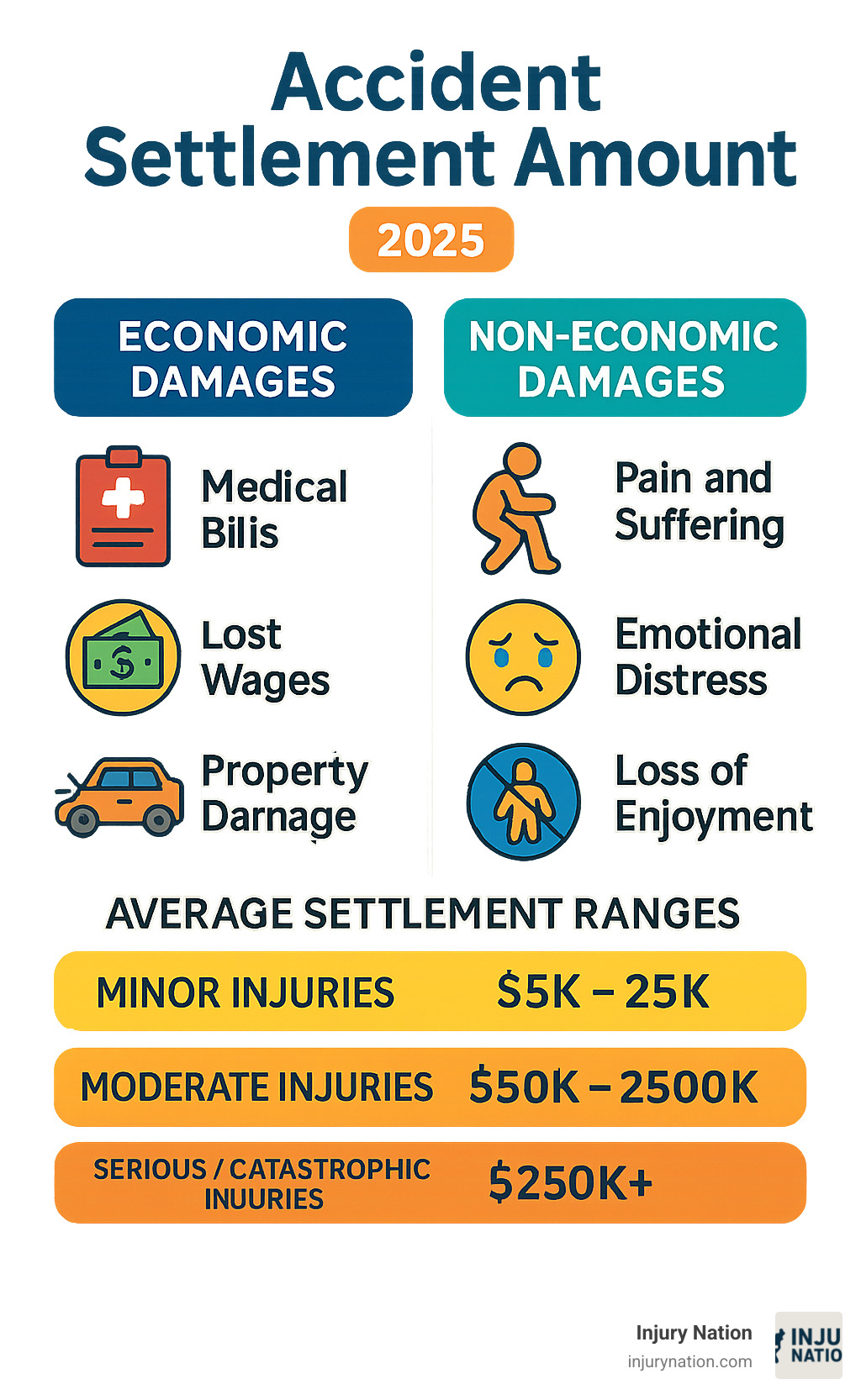
Quick Answer: Typical Settlement Ranges
- Minor injuries: $5,000 – $25,000
- Moderate injuries: $50,000 – $250,000
- Serious/catastrophic injuries: $250,000 – $1,000,000+
- Property damage only: $3,000 – $6,000
The amount you receive depends on two main categories of damages:
Economic Damages (measurable costs):
- Medical bills and future medical care
- Lost wages and earning capacity
- Property damage
- Out-of-pocket expenses
Non-Economic Damages (harder to measure):
- Pain and suffering
- Emotional distress
- Loss of enjoyment of life
Your settlement also depends on factors like who was at fault, your insurance coverage limits, the strength of your evidence, and whether you have legal representation. Research shows that hiring an attorney can increase your payout by nearly 400% compared to handling the claim yourself.
Every accident is unique. A rear-end collision might settle for $10,000, while a catastrophic injury case could reach millions. The key is understanding how insurance companies and lawyers calculate these numbers – and that’s exactly what we’ll break down for you.
The Building Blocks: How a Settlement is Calculated
When you’re trying to figure out your accident settlement amount, think of it like putting together a puzzle. Each piece represents a different way the accident has affected your life – from the medical bills piling up on your kitchen table to the sleepless nights and missed family gatherings.

The legal system aims to make you “whole” again – though we all know money can’t undo an accident. What it can do is help you move forward without financial stress weighing you down. Your settlement is built on three main types of damages: economic damages (the bills you can count), non-economic damages (the harder-to-measure impacts), and occasionally punitive damages in extreme cases.
While there’s no magic formula that spits out your exact settlement number, lawyers and insurance companies often use methods like the multiplier method or per diem method as starting points. These give everyone a framework for negotiations – though your unique situation will ultimately determine the final amount.
Breaking Down Economic (Special) Damages
Economic damages are the straightforward part of your claim – they’re the costs you can actually point to on paper. These special damages include everything you’ve paid or will need to pay because of the accident.
Medical bills typically make up the biggest chunk of economic damages. This covers your emergency room visit, ambulance ride, hospital stay, doctor appointments, prescription medications, and physical therapy sessions. But it’s not just about what you’ve already spent – it also includes future medical care you’ll need.
If you’re looking at years of physical therapy or future surgeries, those projected costs get factored in too. Even chiropractic care counts as a legitimate medical expense, especially for injuries like whiplash that benefit from ongoing treatment. The key is keeping detailed records of every medical expense, no matter how small it seems.
Lost wages cover the paychecks you’ve missed while recovering. This includes your regular salary, any overtime you would have worked, commissions you didn’t earn, and bonuses you missed out on. Your lawyer will need your pay stubs and a doctor’s note explaining why you couldn’t work to prove these losses.
Lost earning capacity goes deeper than just missed paychecks. If your injuries permanently affect your ability to do your job – maybe you can’t lift heavy objects anymore or you had to switch to a lower-paying position – you can claim compensation for that reduced earning power. This often requires expert testimony to calculate what you’ll lose over your entire career.
Property damage covers fixing or replacing your car and any personal items that got damaged – your glasses, laptop, phone, or anything else that was in the vehicle. Out-of-pocket expenses round out this category, including things like gas money for medical appointments, rental car fees, crutches or other medical equipment, and even hiring help for household tasks you can’t manage while injured.
Understanding Non-Economic (General) Damages
Non-economic damages are where things get more complicated – and more personal. These general damages compensate you for how the accident has changed your life in ways that don’t come with receipts.
Pain and suffering is the big umbrella term here. It covers the physical pain you’ve endured and continue to deal with, plus the mental and emotional toll. This isn’t just about how much your back hurts – it includes the anxiety you feel getting into a car, the depression from being stuck at home, and the frustration of not being able to do simple tasks.
Emotional distress can be a significant part of your claim. Many accident victims develop PTSD, severe anxiety, or depression that affects their daily life long after their physical injuries heal. Loss of enjoyment of life compensates you for missing out on activities you used to love – whether that’s playing softball, gardening, or just being able to play with your kids without pain.
In serious cases, loss of consortium allows spouses and family members to seek compensation for how your injuries have affected your relationships and their lives too.
Here’s something important to know: if you’re in Canada, there’s a legal cap on pain and suffering damages. The Supreme Court of Canada set this limit back in 1978 at $100,000, and it’s been adjusted for inflation over the years. As of 2023, the cap sits at approximately $450,000. You can learn more about the legal cap on pain and suffering and how it might affect your case.
The Multiplier Method: A Common Formula for Your Accident Settlement Amount
Since there’s no price tag on pain and suffering, lawyers and insurance companies need some way to estimate what it’s worth. The multiplier method is one of the most common approaches, and it’s actually pretty straightforward.
Here’s how it works: First, you add up all your economic damages – medical bills, lost wages, property damage, and out-of-pocket expenses. Then you multiply that total by a number between 1.5 and 5 to estimate your non-economic damages.
The multiplier you get depends on several factors. Injury severity is the biggest one – a broken wrist that heals in six weeks gets a lower multiplier than a traumatic brain injury that changes your life forever. Recovery time matters too, along with how much the accident has impacted your daily life and future potential.
For minor injuries with quick recovery and minimal long-term effects, the multiplier usually falls between 1.5 and 2. More moderate injuries that require longer treatment and cause some permanent impact typically see multipliers of 3 to 4. The highest multipliers of 4 to 5 are reserved for severe or catastrophic injuries that result in permanent disability, chronic pain, or the need for extensive long-term care.
Let’s say you have $50,000 in economic damages and your case warrants a multiplier of 3. Your estimated non-economic damages would be $150,000, giving you a total accident settlement amount of $200,000. This gives everyone a starting point for negotiations, though your final settlement will depend on the unique details of your case.
Some lawyers also use the per diem method, which assigns a daily dollar amount for each day you experience pain and suffering from the accident until you reach maximum recovery. While less common, it can be effective for certain types of cases.
Key Factors That Can Increase or Decrease Your Payout
While the multiplier method gives us a starting point, many other factors can significantly impact your final accident settlement amount. Think of it like a recipe – even with the same basic ingredients, small changes can completely transform the final dish. Understanding these variables can help you set realistic expectations and work strategically with your attorney.

The reality is that two nearly identical accidents can result in vastly different settlement amounts. One person might receive $50,000 while another gets $150,000, even with similar injuries. The difference often comes down to factors like fault determination, insurance policy limits, the strength of your evidence, and even where the accident happened.
Your location matters more than you might think. Different states have different laws about how fault is determined and what damages you can recover. The statute of limitations – basically your deadline to file a claim – also varies by location. Miss this deadline, and your case could be dismissed entirely, regardless of how strong it is.
Insurance policy limits create a hard ceiling on many settlements. If the at-fault driver only carries $50,000 in coverage and your damages are $100,000, you’ll likely need to look to your own uninsured/underinsured motorist coverage or pursue the driver’s personal assets to recover the difference.
The Role of Fault: Comparative and Contributory Negligence
Who caused the accident plays a massive role in determining your accident settlement amount. But here’s where it gets interesting – you don’t have to be completely innocent to recover damages. Most states recognize that accidents often involve shared responsibility, and they’ve developed different systems to handle these situations.
Pure comparative negligence is the most forgiving system. Even if you were 90% at fault, you can still recover 10% of your damages. If your total damages are $100,000 and you were 30% at fault, you’d receive $70,000. States like California and New York follow this approach.
Modified comparative negligence has two variations. In the 50% rule states, you can recover damages as long as you’re less than 50% at fault. The 51% rule states allow recovery if you’re 50% or less at fault. Cross that threshold, and you get nothing. Texas and Pennsylvania use the 51% rule, while Colorado and Georgia follow the 50% rule.
Contributory negligence is the harshest system and only exists in a few jurisdictions like Alabama and Washington D.C. Under this rule, if you contributed to the accident in any way – even just 1% – you cannot recover any damages.
| Negligence Type | Recovery Rule | Example |
|---|---|---|
| Pure Comparative | Recover even if 99% at fault | 70% at fault = 30% of damages |
| Modified (50% rule) | Recover if less than 50% at fault | 49% at fault = 51% of damages |
| Modified (51% rule) | Recover if 50% or less at fault | 50% at fault = 50% of damages |
| Contributory | No recovery if any fault | 1% at fault = $0 recovery |
Understanding your state’s fault system is crucial for setting realistic expectations about your potential settlement.
Deadlines and Dollars: Statutes of Limitation and Insurance Caps
Time is not on your side when it comes to personal injury claims. Every state has a statute of limitations that sets a deadline for filing your lawsuit. In most states, you have two years from the date of the accident to file a personal injury claim. Miss this deadline, and even the strongest case becomes worthless.
Some states are more generous with three-year deadlines, while others give you just one year. The clock typically starts ticking on the date of the accident, but there are exceptions. If you didn’t find your injury right away, the deadline might start when you reasonably should have finded it.
Insurance policy limits create another major constraint on settlements. Every driver is required to carry minimum insurance coverage, but these minimums are often shockingly low. Some states require as little as $25,000 in bodily injury coverage per person. If your medical bills alone exceed this amount, you’re looking at a problem.
This is where your own uninsured/underinsured motorist coverage becomes invaluable. This coverage steps in when the at-fault driver doesn’t have enough insurance to cover your damages. Many people skip this coverage to save money, but it’s often the difference between a full recovery and a financial disaster.
The insurance company’s goal is to pay as little as possible, and they’ll use every tool at their disposal. They might argue that your injuries aren’t as severe as claimed, that you were partially at fault, or that some of your medical treatment was unnecessary. Having strong evidence and experienced legal representation becomes critical in pushing back against these tactics.