

Why Filing a Hearing Loss Claim Is Critical for Your Future
A hearing loss claim provides the compensation and medical support you need after workplace noise exposure damages your hearing. Here’s what you need to know:
Key Steps to File Your Claim:
- Get an audiogram from a licensed audiologist
- Document your noisy work history
- File the correct claim forms (e.g., CA-2 for federal employees)
- Gather medical records and witness statements
- Submit your claim before the deadline
Potential Compensation:
- Medical care and hearing aids
- Lost wages
- Permanent impairment benefits
- Up to 200 weeks of pay for federal employees
According to the CDC, 22 million workers are exposed to hazardous noise at work each year. Many don’t realize their gradual hearing loss qualifies for workers’ compensation until it severely impacts their quality of life.
If you struggle to hear conversations, experience ringing in your ears, or turn up the TV volume, your workplace may be responsible. The good news is that you have legal rights and options for compensation.
Filing a claim can seem overwhelming, but understanding the process is key to getting the support you deserve instead of shouldering the costs alone. This guide covers every step, from medical tests to working with legal professionals who specialize in occupational hearing loss.
Is Your Job Affecting Your Hearing? Causes and Symptoms
Asking people to repeat themselves or turning up the TV volume might seem like normal aging, but if you work in a noisy environment, your job could be the cause.
Noise-induced hearing loss (NIHL) is the main culprit behind most workplace hearing problems. It often develops gradually, so you may not notice it until you’re struggling to follow conversations or miss details at work.

Besides noise, ototoxic chemicals can also damage your inner ear, especially when combined with loud sounds. These toxic substances are absorbed into the body and attack delicate hearing structures.
Occupational hearing loss can be gradual (from years of exposure) or sudden (from an explosion). Both types can significantly impact your quality of life, affecting relationships, work performance, and daily enjoyment.
Warning signs your job might be affecting your hearing include:
- Tinnitus: Ringing, buzzing, or hissing sounds in your ears. This affects nearly 15% of American adults and is the most common disability among Veterans.
- Muffled sounds: Conversations and everyday noises seem unclear or distorted.
- Difficulty understanding speech: Especially noticeable in noisy places like restaurants or busy offices.
- Temporary hearing loss after work: This may seem harmless, but it’s a red flag that permanent damage is building up.
- Constantly yelling to communicate: A clear sign your workplace is dangerously loud.
The damage to the tiny nerve cells in your inner ear is permanent, as they don’t grow back. However, this hearing loss could qualify you for a hearing loss claim and compensation.
Common Causes of Occupational Hearing Loss
Your workplace might be harming your hearing in ways you haven’t considered. Loud machinery like jackhammers and industrial saws create sustained noise that chips away at your hearing. Power tools become dangerous with daily use without proper protection.
Explosions can cause immediate, severe damage. Confined spaces amplify sound, turning moderately loud equipment into a hearing hazard.
Don’t overlook ototoxic chemicals. These substances can poison your inner ear, and when combined with noise, they create a devastating one-two punch against your hearing. The impact of hearing loss on Americans shows just how widespread this problem is.
For more detailed information about how hearing loss develops and affects your daily life, check out our comprehensive guide: More info about Hearing Loss.
Industries and Jobs with High Risk
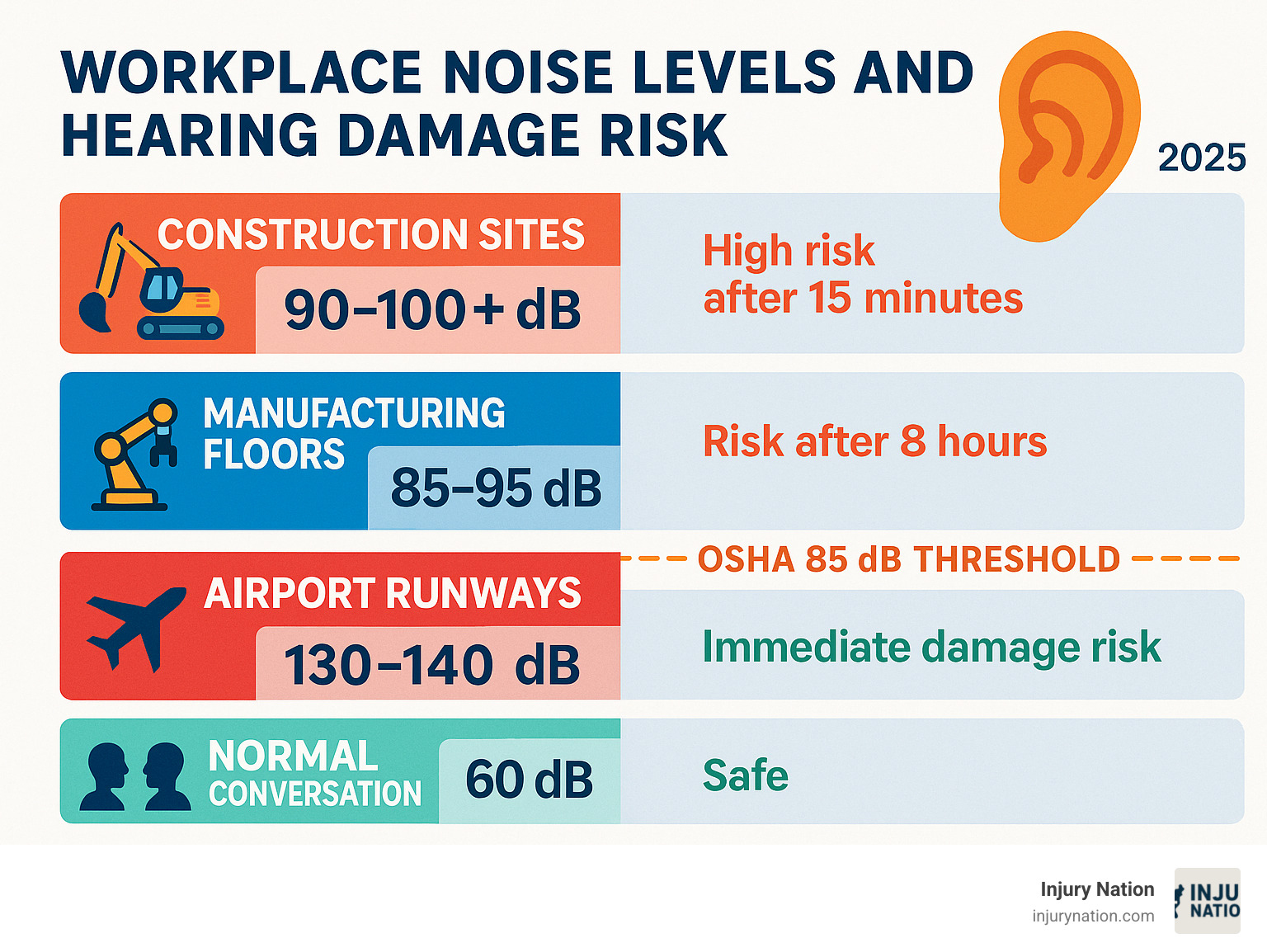
Some jobs are notorious for causing hearing problems. Construction workers face constant exposure to jackhammers and heavy machinery. Manufacturing employees work around loud assembly lines. Aviation workers deal with some of the loudest sounds imaginable from jet engines. Shipyard workers are at high risk, especially in confined spaces with pneumatic tools.
Federal employees in defense and transportation often face significant noise exposure. Military service members and Veterans frequently develop hearing loss from combat and equipment noise. Even agriculture workers are at risk from long hours exposed to loud farm machinery.
If this sounds familiar, it might be time to explore filing a hearing loss claim. Your hearing loss isn’t just bad luck—it could be a compensable workplace injury.
Your Rights Under the Law: OSHA Rules and Compensation
Your employer is legally required to provide hearing protection. The Occupational Safety and Health Administration (OSHA) has strict rules to protect workers from hazardous noise. When employers violate these rules, you have legal options for compensation.
OSHA Regulations Regarding Workplace Noise Exposure and Hearing Conservation
OSHA’s Noise Standard requires employers to act when workplace noise reaches an average of 85 decibels over an eight-hour day. At this level, which is comparable to heavy city traffic, a hearing conservation program is mandatory.
This program must include:
- Regular noise monitoring to identify dangerous areas.
- Free hearing protection (e.g., earplugs, earmuffs) with proper training.
- Annual hearing tests (audiograms) to create a baseline and track changes.
- Comprehensive training on noise effects, hearing protection, and program details.
Employers should also try to reduce noise at its source through engineering controls (modifying equipment) or administrative controls (rotating workers).
Crucially, employers cannot retaliate against you for reporting hearing problems or filing an injury report. Doing so can result in serious citations. For details, review the official OSHA regulations regarding workplace noise. When employers fail to follow these rules, workers’ compensation insurance should cover your costs. You can learn more about the claims process at our More info about Hearing Loss Claims page.
Types of Compensation You Can Receive
A successful hearing loss claim can provide comprehensive compensation for the full impact of your injury.
- Medical treatment coverage: This includes diagnostic tests, specialist appointments, and necessary medical procedures.
- Hearing aids and batteries: Quality hearing aids can cost thousands. Workers’ comp typically covers the initial devices, batteries, maintenance, and replacements every few years.
- Lost wages: This compensation applies if your hearing loss prevents you from working or requires time off for medical appointments.
- Schedule awards for permanent impairment: These provide additional compensation based on your degree of hearing loss, determined by state-specific schedules.
- Federal employees: Civil service employees with compensable hearing loss in both ears could receive up to 200 weeks of compensation at 75% of your salary.
Benefits vary by state and circumstance. For additional resources, you can visit Workers’ comp for hearing loss.
Eligibility Criteria for a Hearing Loss Claim
To file a successful hearing loss claim, you must meet several key criteria. Most workers with legitimate workplace-induced hearing damage can qualify.
- Work-related injury: You must prove your hearing loss was directly caused by your work environment.
- Objective medical evidence: An audiogram from a licensed professional provides the required proof.
- Diagnosis from an audiologist: A licensed audiologist must examine you and provide detailed reports on your condition and its likely causes.
- State-specific requirements: Each state has its own workers’ compensation system with different filing deadlines and rules.
- Causal link: You must demonstrate that workplace noise was the primary cause of your hearing damage, not aging or other non-work factors.
Even if you worked for multiple noisy employers, you might still qualify by showing that your cumulative occupational exposure contributed to your hearing loss. Don’t assume you’re ineligible just because your hearing loss developed gradually.
Step-by-Step Guide to Filing Your Hearing Loss Claim
Filing a hearing loss claim is manageable if you break it down into clear, proactive steps and keep detailed records. Don’t delay filing because you think it’s too complicated. If your job damaged your hearing, you deserve compensation.

Step 1: Get a Medical Diagnosis
Your claim starts with professional medical proof. Avoid free mall screenings and schedule an appointment with a licensed audiologist as soon as possible. Their findings will be the foundation of your claim.
The audiogram test is your most important piece of evidence. It objectively measures what sounds you can and can’t hear. Your audiologist will likely perform a Puretone Audiometry Test (measuring hearing thresholds) and a Speech Discrimination Test (checking speech comprehension). These are the gold standard tests that insurance companies and courts rely on.
Dig up any old hearing tests you might have. Pre-employment screenings or military physicals can serve as a baseline, proving your hearing was better before the workplace damage occurred.
Step 2: What Evidence Do I Need for a Hearing Loss Claim?
Next, build a strong case connecting your hearing loss to your job. The more evidence you gather, the stronger your hearing loss claim becomes.
- Medical reports and audiogram results are your primary proof.
- Create a detailed work history listing every employer, your job titles, and the loud equipment or environments you worked around. Be specific, whether it was jet engines, factory machines, or jackhammers.
- Witness statements from coworkers can be incredibly powerful. These “buddy statements” can confirm how loud your workplace was or that they noticed your hearing worsening over time.
- Pay stubs and employment records verify your work history and help calculate lost wages.
- Workplace safety documentation, like noise monitoring reports, can show whether your employer followed safety rules.
Step 3: Formally Report and File Your Claim
Once you have your evidence, it’s time to file. Be mindful of strict deadlines.
Tell your employer about your hearing loss immediately, even if you no longer work there. Missing the deadline for reporting workplace injuries can jeopardize your claim.
Next, fill out the correct paperwork. Every state has different claim forms. Federal employees typically file Form CA-2 for occupational diseases. You can file this form even if your hearing loss isn’t completely disabling yet, which creates an official record.
Watch the statute of limitations carefully. For gradual hearing loss, the clock usually starts when you knew (or should have known) that your job caused your hearing problems.
You can often file claims against past employers, not just your current one. Even if an old company is out of business, its workers’ compensation insurance may still be responsible. This is critical for hearing loss that accumulates over a career.
Navigating the Process: Timelines and Legal Support
After filing your hearing loss claim, the waiting period begins. The timeline can feel out of your control as your case is reviewed.
During claim adjudication, the insurance company or state agency reviews your evidence to determine if the hearing loss is work-related, its severity, and the appropriate compensation.
Be prepared for challenges. Insurance companies aim to minimize payouts and will scrutinize every detail of your claim. Understanding this helps you prepare for potential disputes.
How Long Does the Claims Process Typically Take?
Hearing loss claims typically take 12 to 24 months to resolve. While this may seem long, the process is often complex. For federal employees, a Form CA-2 claim adjudication usually takes around 180 days.
Several factors influence the timeline:
- Straightforward cases with clear evidence and no disputes move faster.
- Complex cases involving multiple employers or questions of cause take longer to investigate.
- State backlogs at workers’ compensation boards can cause delays.
- Disputes from the insurance company can stretch the process significantly, sometimes for years.
Why Hire an Attorney for Your Hearing Loss Claim?
The workers’ compensation system is incredibly complex. An attorney can help you steer it and avoid settling for less than you deserve.
- Expertise: Experienced attorneys know what documentation is needed and how to build a strong case that anticipates challenges from insurers.
- Negotiation: They level the playing field when negotiating with insurance adjusters who are trained to minimize payouts.
- Representation: If your claim goes to a hearing, an attorney will handle the legal procedures and present evidence effectively, dramatically improving your chances of a positive outcome.
- Maximizing Your Settlement: A lawyer understands the true, long-term value of your claim, including future medical costs and impacts on your quality of life.
Most hearing loss claim attorneys work on a contingency fee basis, meaning you pay nothing unless you win. This removes the financial barrier to getting expert legal help.
If you’re ready to explore your legal options, we can connect you with qualified professionals who specialize in hearing loss cases: Find a Hearing Loss Attorney.
Your hearing loss is a significant, permanent injury. Pursuing compensation with the right legal support is an investment in your future well-being.
Frequently Asked Questions about Filing for Hearing Loss
Filing a hearing loss claim can be confusing. Let’s clear up some of the most common questions and concerns.
How much does it cost to file a claim?
Filing a hearing loss claim usually costs nothing upfront. Most workers’ compensation attorneys work on a contingency fee basis, meaning they only get paid if you win your case.
There are no upfront costs or surprise bills. The attorney’s fee is taken as a percentage of your final settlement or award. This ensures your lawyer is fully invested in winning your case. The initial cost of an audiogram is also typically reimbursed as part of your medical expenses once your claim is successful.
Can I still file a claim if my old employer is out of business?
Yes, you can still file a claim even if a former employer is out of business. The workers’ compensation insurance that covered the company when you worked there is still valid.
An attorney can act as a detective, using your detailed work history to track down the correct insurance carrier responsible for your claim. Don’t let a former employer’s business status discourage you from pursuing the compensation you deserve. Many successful hearing loss claims involve companies that closed years ago.
Is tinnitus covered in a hearing loss claim?
Yes, tinnitus is covered in hearing loss claims. That constant ringing, buzzing, or hissing in your ears is one of the most common and disruptive symptoms of noise-induced hearing loss.
Tinnitus is almost always compensated as part of your overall hearing loss claim. It is widely recognized as a serious condition. To put this in perspective, tinnitus is the most prevalent service-connected disability among American Veterans. As of fiscal year 2020, more than 2.3 million Veterans received disability compensation for tinnitus alone.
When you see an audiologist, describe your tinnitus symptoms in detail. This information strengthens your overall hearing loss claim and helps ensure you receive full compensation for all aspects of your injury.
Take the Next Step Towards Your Compensation
You now understand the causes of occupational hearing loss, your legal rights, and the steps to file a claim. The key takeaway is that hearing loss is a serious, compensable injury. You shouldn’t have to bear the financial burden alone when your workplace caused the damage.
However, the clock is ticking. Strict deadlines apply to these claims, so don’t wait and risk missing your opportunity for compensation. You’ve already lost enough due to your hearing damage; don’t lose your chance at financial recovery too.
Filing a hearing loss claim doesn’t have to be overwhelming. You don’t have to steer this maze alone.
At Injury Nation, we understand how hearing loss can impact your life—from missing conversations with loved ones to struggling in work meetings. We are here to help.
Our network connects you with experienced personal injury lawyers who specialize in hearing loss claims. They know how to build a strong case, deal with insurance companies, and maximize your compensation. Most work on contingency, so you pay nothing unless you win.
Your hearing loss happened because you weren’t properly protected. Now it’s time to protect yourself by getting the compensation to cover your medical bills, hearing aids, and lost wages.
Ready to take the first step? We’re here to connect you with the right legal advocate to fight for you.
Find a qualified personal injury lawyer in your area to help with your claim