How to Keep Your Personal Injury Case on Track in Houston
After an accident, most people are not thinking about file organization, response times, or legal deadlines. They are thinking about pain, missed work, family pressure, vehicle damage, and how life suddenly became more complicated. That is exactly why so many valid injury claims lose momentum. The problem usually is not that the injury is unimportant. The problem is that the case is not managed carefully from the start.
If you want to maintain personal injury case Houston progress after a car crash, workplace injury, slip and fall, or another serious incident, you need a practical system. That means timely communication, organized records, close attention to treatment, and legal guidance you can rely on when the process starts to feel overwhelming. Injury Nation helps injured people in Houston keep their cases moving with clear direction, responsive support, and experienced personal injury legal representation.
This guide explains what tends to slow cases down, what you can do to prevent avoidable problems, and how a legal team can help you protect your claim while you focus on recovery.
Why Personal Injury Cases Go Off Track in Houston
Houston is a busy, fast-moving city with crowded freeways, heavy commercial traffic, active construction zones, large medical systems, and employers across many industries. Accidents happen in all kinds of settings here, from Interstate 45 and the Katy Freeway to neighborhood intersections, warehouses, job sites, retail stores, and apartment complexes. But no matter where the injury happens, many case-management problems tend to look the same.
A case can lose momentum when:
- Medical treatment is delayed or inconsistent
- Important documents are scattered across phones, emails, and paper folders
- The injured person misses calls, letters, or requests for information
- Insurance adjusters get statements before the full picture is clear
- Deadlines are misunderstood or ignored
- There is confusion about what the lawyer needs and when
- The injured person assumes the claim is moving without checking in
None of these issues means your case is hopeless. They do mean your claim may need stronger structure. A personal injury case is not just about proving that something bad happened. It is about documenting liability, injuries, treatment, damages, and timelines in a way that supports a fair legal claim.
In Houston, where insurers often handle a high volume of accident claims, delays and gaps can be used against injured people. If records are incomplete, if communication breaks down, or if deadlines are missed, an insurance company may argue that your injuries are less serious than you claim or that your damages are unclear. That is why case maintenance matters so much.
What It Means to Maintain a Personal Injury Case in Houston
When people search for ways to maintain personal injury case Houston claims, they are usually trying to solve a practical problem: how do you keep a case active, organized, and strong while you are also trying to heal?
Maintaining a personal injury case generally means:
- Keeping medical treatment and records up to date
- Responding quickly to your legal team
- Preserving evidence and documentation
- Following legal advice about statements, social media, and paperwork
- Tracking expenses, symptoms, work loss, and recovery impact
- Meeting deadlines tied to insurance claims and legal filings
- Reporting major developments right away
Think of it this way: the strength of your case depends not only on the accident itself, but on what can be shown clearly and consistently afterward. Good case maintenance helps your attorney tell the full story of what happened and what the injury has cost you.
The Importance of Timely Communication
One of the biggest reasons injury cases stall is delayed communication. It is very common. Someone is in pain, juggling appointments, trying to get their car repaired, worrying about rent or mortgage payments, and handling family responsibilities. A missed voicemail or unread email might not seem serious in the moment. But in a legal claim, small communication lapses can create bigger problems.
Why quick responses matter
Your attorney may need information to:
- Verify medical treatment dates
- Respond to an insurance request
- Confirm lost wage details
- Gather photographs or witness names
- Review a new medical bill
- Address a dispute raised by the insurer
- Prepare a demand package or filing
If your legal team asks for something and does not get a response for days or weeks, the case can slow down. In some situations, delay can affect negotiations or make it harder to secure records while memories are still fresh.
What timely communication looks like
You do not have to be available every minute of the day. Timely communication usually means:
- Checking voicemail and email regularly
- Reading texts from your legal team
- Returning calls as soon as reasonably possible
- Letting your attorney know if your phone number or address changes
- Updating your lawyer about emergency room visits, new providers, or major changes in symptoms
- Asking questions when you do not understand next steps
Simple ways to make communication easier
If you are overwhelmed, use a system. A few practical habits can make a major difference:
- Save your lawyer’s office number and main contact names in your phone
- Create an email folder for all case-related messages
- Keep a note on your phone with questions to ask during your next check-in
- Pick one family member to help you stay organized if needed
- Tell your legal team the best time and method to reach you
Good communication is not about pressure. It is about keeping your case moving and reducing avoidable confusion.
Organizing Medical and Legal Documents the Right Way
After an injury, documents start arriving fast. Hospital paperwork, discharge instructions, imaging reports, prescriptions, work notes, repair estimates, insurance letters, bills, receipts, claim numbers, and emails can pile up almost immediately. If they are not organized early, finding the right record later becomes much harder.
Strong case management depends on clear documentation. If your legal team has to spend extra time hunting down missing dates, provider names, or billing details, that can slow the case. More importantly, incomplete documentation can weaken the presentation of your damages.
Documents you should keep
Try to save copies of anything connected to the accident or injury, including:
- Police or incident reports
- Photos of the scene, vehicles, hazards, and visible injuries
- Emergency room records
- Urgent care and primary care records
- Specialist reports
- Physical therapy notes
- Prescription receipts and medication lists
- Imaging reports such as X-rays, CT scans, or MRIs
- Medical bills and insurance explanations of benefits
- Work restriction notes
- Pay stubs or proof of missed income
- Towing invoices, rental car bills, and repair estimates if relevant
- Letters, emails, or messages from insurance companies
- Any forms you sign related to the claim
How to organize records without making it complicated
You do not need an elaborate legal filing system. Use whatever method you can stick with consistently.
For paper records:
- Use one binder or accordion folder
- Label sections: accident reports, medical treatment, bills, lost wages, insurance letters, receipts
- Arrange papers by date
For digital records:
- Create folders on your phone or computer
- Name files clearly, such as “ER visit 03-02-2026” or “Physical therapy invoice April”
- Back up photos and PDFs to cloud storage if possible
Why date order matters
Injury claims are built on timeline clarity. Your legal team may need to show:
- When the accident happened
- How quickly you sought treatment
- How your symptoms developed
- What providers you saw and in what order
- How long work restrictions lasted
- When bills and losses started increasing
A well-organized timeline can help connect the accident to the injuries and the injuries to your financial and personal losses.
Following Medical Care Consistently
One of the most misunderstood parts of maintaining a personal injury case is the role of ongoing medical care. Your legal claim depends heavily on the medical picture. If you are injured, evaluation and treatment do more than help your health. They also create records that document the severity of your injuries, the course of your recovery, and the real impact on your daily life.

Why treatment gaps can create problems
Insurance companies often look for any reason to argue that an injury is not as serious as claimed. A long gap in treatment may lead them to question:
- Whether the injury was actually caused by the accident
- Whether symptoms improved faster than expected
- Whether another event caused the current complaints
- Whether the person is overstating pain or limitations
That does not mean every missed appointment ruins a case. Real life happens. Transportation issues, scheduling conflicts, work demands, child care needs, and provider access challenges are all common. But if you are struggling to continue care, tell your attorney. Silence creates more risk than honest communication.
How to help your medical records reflect reality
When you attend appointments:
- Describe your symptoms accurately
- Mention pain locations, intensity, and limitations
- Explain if you cannot sleep, work normally, drive, lift, bend, or care for yourself as before
- Tell providers if symptoms worsen or spread
- Report emotional effects if the injury has affected anxiety, mood, or concentration
Medical records often become some of the most important evidence in a personal injury case. If your records are vague because you minimized your symptoms or forgot to mention changes, it may be harder later to show the full extent of harm.
Keep track of your treatment plan
It helps to maintain a simple treatment log with:
- Provider name
- Appointment date
- Reason for visit
- Recommendations made
- Next scheduled appointment
This log can help you stay organized and help your legal team understand where your case stands medically.
Following Legal Advice and Deadlines
Another key part of maintaining a case is following legal advice and staying aware of deadlines. Personal injury claims involve more than negotiations. There may be notice requirements, document requests, treatment updates, claim submissions, lien issues, settlement reviews, and, when needed, lawsuit filing deadlines.
Why deadlines matter so much
Every case has time-sensitive parts. Some deadlines are obvious, and others are not. Waiting too long to act can make it harder to gather evidence, locate witnesses, obtain surveillance footage, or preserve records from businesses, employers, or third parties.
In Texas, injury claims are also shaped by legal timing rules. The exact deadlines that apply can depend on the facts of the case, the parties involved, and whether a government-related claim or workplace issue is involved. That is one reason local legal guidance is important. A deadline mistake can seriously limit your options.
Examples of instructions you should take seriously
Your attorney may advise you to:
- Not give a recorded statement to the other side
- Send every insurance letter to the office immediately
- Avoid posting about the accident on social media
- Continue medical treatment as recommended
- Preserve damaged property or product evidence
- Complete and return forms promptly
- Do not settle directly with an insurer without legal review
These instructions are not formalities. They are part of protecting your case from preventable damage.
If you do not understand the advice, ask
Legal guidance should be clear and usable. If your attorney tells you not to do something and you are unsure why, ask for a practical explanation. The goal is not blind compliance. The goal is informed decision-making that protects your rights.
Common Houston-Specific Issues That Can Affect Case Progress
Every city has its own claim environment, and Houston presents some distinct case-management challenges. Local conditions can make both accidents and claims more complicated.
Heavy traffic and serious vehicle collisions
Houston’s major roadways can lead to complex crash claims involving multiple vehicles, commercial drivers, disputed fault, and significant medical treatment. If your injury case started with a car accident, truck collision, rideshare incident, or freeway crash, there may be more evidence sources to collect, including:
- Crash reports
- Dashcam or surveillance footage
- Vehicle damage photos
- Witness contact details
- Emergency response records
- Repair and inspection documentation
The longer collection is delayed, the harder some of this evidence can be to secure.
Large medical systems and record delays
Houston has major hospitals, specialty providers, and busy treatment networks. That can be helpful medically, but obtaining full records and billing can take time. If you are treating with multiple providers, the paperwork can become difficult to track. Good organization and legal follow-up are especially important in these cases.
Work-related injuries in industrial and service sectors
Houston workers may be hurt in construction, transportation, warehousing, healthcare, manufacturing, retail, and office settings. A workplace injury can raise separate questions about workers compensation, employer reporting, third-party liability, and medical documentation. If there is any overlap between a work injury and a broader injury claim, legal direction matters even more.
How to Track the Real Impact of Your Injury
Many injured people save the big records but forget the details of daily impact. Yet those details often matter when it comes time to present damages. Bills show one part of the loss. Your lived experience shows another.
Start a recovery journal
A simple injury journal can help document how the accident affected your life. You do not need to write pages every day. A few short notes several times a week can be enough.
You might track:
- Pain levels and symptom changes
- Sleep problems
- Mobility limits
- Missed events or family activities
- Work restrictions or lost tasks
- Side effects from medication
- Emotional strain and stress
For example, instead of writing “bad day,” a more useful entry would be: “Could not stand long enough to cook dinner. Missed physical therapy exercises because lower back pain increased after sitting at work. Woke up twice overnight from shoulder pain.”
Track out-of-pocket expenses
Even smaller costs can add up after an injury. Save receipts for:
- Prescription medications
- Medical equipment
- Parking at appointments
- Transportation to treatment
- Over-the-counter pain supplies
- Bandages, braces, or supports
These records help show the practical costs of recovery.
What Not to Do If You Want to Keep Your Case Strong
Protecting your case is not only about what you should do. It also helps to understand the habits that commonly create problems.
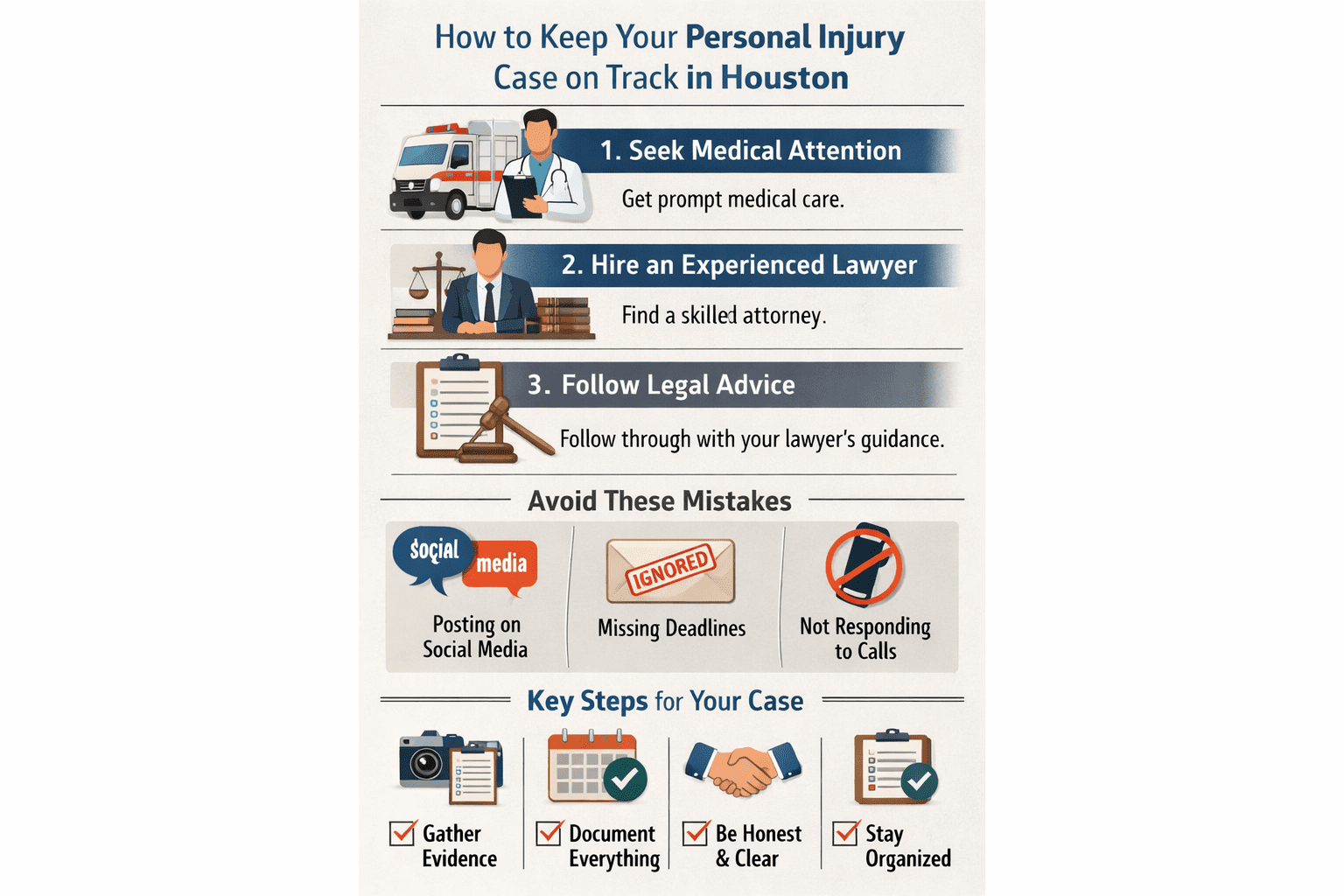
Do not assume the insurance company is keeping things fair
Insurers evaluate claims based on documentation, exposure, and strategy. Their interests are not the same as yours. If you are being asked for a quick statement, broad medical authorization, or fast settlement before treatment is complete, that may not be in your best interest.
Do not post casually about the accident or your activities
Social media posts can be taken out of context. A smiling photo at a family gathering does not prove you are uninjured, but it may still be used that way. Avoid discussing the case, your injuries, or your physical activities online while the claim is pending.
Do not ignore letters or forms
If you receive something from an insurance company, employer, provider, or another party connected to the case, send it to your lawyer right away. Even routine-looking documents can affect the claim.
Do not downplay new symptoms
Some injuries evolve over time. Neck pain, back pain, headaches, numbness, dizziness, and soft tissue injuries may become more noticeable days after the incident. Report changes promptly to your providers and legal team.
Warning Signs Your Personal Injury Case May Be Falling Behind
Sometimes a case slows so gradually that people do not notice until they feel stuck. The earlier you spot problems, the easier they are to address.
Signs to watch for
- You cannot quickly locate basic case documents
- You have missed multiple medical appointments
- You are not sure what treatment is next
- You have not updated your lawyer about major developments
- You receive insurer calls or letters you do not understand
- You are unsure whether work loss records were submitted
- You have changed numbers, jobs, or providers and have not reported it
- You are confused about the current stage of the claim
If any of these apply, the answer is not panic. The answer is to re-establish structure. Reach out to your legal team, gather what you have, identify missing pieces, and create a plan for next steps.
A Step-by-Step Approach to Keeping Your Houston Injury Case Organized
If you want a practical roadmap, use the following process.
Step 1: Create a single case hub
Choose one place for all case information. That can be a folder, binder, shared drive, or secure digital file. The important point is consistency.
Step 2: Build a basic timeline
List the accident date, emergency treatment, follow-up visits, missed work dates, major symptoms, and insurer contacts. Add to it as things happen.
Step 3: Save every medical and insurance document
Do not sort later. Save now, organize later if needed. It is better to have too much documentation than too little.
Step 4: Respond to your legal team promptly
If your attorney asks for an item, send it as soon as you can. If you need more time, let them know.
Step 5: Stay engaged with treatment
Attend appointments, follow instructions, and tell providers when symptoms change.
Step 6: Report major life changes
New job, job loss, surgery recommendation, new diagnosis, worsening pain, change of address, or insurance communications should all be reported quickly.
Step 7: Ask for status updates when needed
You should understand where your case stands. A good legal team can explain the current phase and what is needed next.
How Injury Nation Supports Case Management in Houston
Keeping a case on track is easier when you are not trying to do everything alone. Injury Nation supports injured people in Houston by combining personal injury legal representation with practical case guidance. The goal is not just to open a claim. The goal is to help move it forward in an organized, informed way.
Clear communication from the start
Injury Nation helps clients understand what information matters, what to save, what to avoid saying to insurers, and how the process typically unfolds. That clarity can reduce stress and prevent early mistakes.
Help gathering and reviewing records
Medical records, billing records, accident reports, wage loss documentation, and other evidence are central to a strong injury claim. Injury Nation helps clients identify and organize the records that support the case.
Guidance on deadlines and next steps
When people are hurt, it is easy to lose track of legal timing issues. Injury Nation helps clients stay aware of key steps, requests, and deadlines so important opportunities are not lost.
Responsive support during active treatment and recovery
Cases change over time. A person may need additional imaging, specialist care, surgery consultation, work restrictions, or workers compensation guidance. Injury Nation provides ongoing support so new developments are factored into the legal strategy.
Representation designed for real-life urgency
Injury Nation offers free legal consultations and 24/7 emergency legal help. That matters when someone in Houston is facing immediate questions after a serious accident and does not know what to do next.
What to Expect During the Life of a Personal Injury Case
Many people feel anxious simply because they do not know what phase comes next. While every case is different, most injury claims involve a series of predictable stages.
Early investigation
This stage may include gathering accident details, identifying parties, collecting reports, securing photos, and reviewing initial medical treatment.
Active medical treatment
As treatment continues, the case record develops. Your attorney may monitor records, bills, and liability evidence while you focus on recovery.
Damage evaluation
Once there is enough information about your injuries, treatment, expenses, and losses, your legal team can better assess the value and needs of the claim.

Negotiation
Settlement discussions may begin once the evidence is organized and your damages are sufficiently documented. The timing depends on your medical progress and the specific facts of the case.
Litigation if necessary
If the matter does not resolve fairly, filing suit may become necessary. This adds formal procedures, deadlines, and evidence exchange, making strong case organization even more important.
At every stage, communication and documentation remain critical. A claim rarely moves well on assumptions alone.
Decision Factors When Choosing Legal Help for Case Maintenance
If your current concern is not just compensation but keeping the claim from falling apart, the right legal support matters. When evaluating representation, look for practical strengths, not just slogans.
Ask whether the firm emphasizes communication
You want a legal team that explains what they need, how to submit it, when to expect updates, and how to reach them with questions.
Ask how records and evidence are handled
Strong case management requires organized record collection and review. You should know how documents will be used and what you should continue saving.
Ask how the firm helps clients stay on schedule
A good legal team should help you understand key milestones and reduce the risk of avoidable delay.
Ask about local familiarity
Houston cases can involve local roads, providers, employers, and claim patterns. Local awareness can help a legal team respond more effectively.
Example Situations Where Good Case Maintenance Makes a Difference
Real injury claims vary, but these common situations show why organization and communication matter.
Example 1: Car accident on a Houston freeway
A driver is rear-ended in heavy traffic on I-10. At first, the person believes the pain will pass. Three days later, neck pain and headaches worsen. Because the driver sought treatment, saved discharge papers, photographed the vehicle, and informed legal counsel quickly, the case timeline remains clear. The records connect the crash, symptoms, treatment, and missed work.
Example 2: Workplace injury with multiple moving parts
A warehouse worker suffers a back injury while lifting on the job. The worker has employer reports, urgent care records, work restriction notes, and missed wage documentation. Because the records are kept in one place and legal guidance is followed, it is easier to understand what relates to workers compensation issues and what may involve third-party liability.
Example 3: Slip and fall with delayed symptom progression
A customer falls in a commercial property and initially feels embarrassed more than injured. Later, hip and shoulder pain increase. Because the individual documented the incident, preserved photos, and updated the legal team when symptoms worsened, the claim does not depend solely on memory months later.
Frequently Asked Questions About Keeping a Personal Injury Case on Track in Houston
How often should I communicate with my lawyer?
There is no one-size-fits-all schedule, but you should respond promptly whenever your legal team contacts you and provide updates whenever there is a meaningful change in treatment, symptoms, employment, or insurance communication. If you have not heard anything in a while and are unsure of the current stage, it is reasonable to ask for a status update.
What if I lost some of my paperwork?
Do not assume your case is ruined. Tell your attorney what is missing. Many records can be requested again, though it is easier and faster if you save them from the start. Begin organizing what you still have right away.
Can missing medical appointments hurt my case?
They can create questions, especially if there are repeated gaps with no explanation. If you miss care because of transportation, cost, work, or other real-world barriers, communicate that to both your provider when appropriate and your attorney. Context matters.
Should I speak directly with the insurance company?
In many situations, it is best to be cautious and get legal guidance first, especially before giving recorded statements, signing releases, or discussing settlement. What seems like a simple conversation can affect how your claim is evaluated.
Do I need to save small receipts too?
Yes. Prescription costs, parking, over-the-counter supplies, and similar expenses can reflect the day-to-day financial effect of your injury. Small amounts can add up.
What if my symptoms changed after the first doctor visit?
That is not unusual. Some injuries become more noticeable with time. Report new or worsening symptoms as soon as possible so your medical records reflect what is really happening.
How do I know if my case is progressing normally?
Progress depends on injury severity, treatment length, record collection, liability disputes, and negotiation posture. The best way to understand your case is to ask your legal team what phase it is in, what they are waiting on, and what you should be doing now.
Practical Checklist to Maintain Personal Injury Case Houston Claims
If you want a quick summary, use this checklist:
- Seek medical attention promptly after an accident
- Attend follow-up appointments and follow treatment guidance
- Save all medical, billing, insurance, and wage-loss records
- Keep accident photos and incident reports in one place
- Respond quickly to your attorney’s calls, texts, and emails
- Tell your legal team about new symptoms or providers
- Track out-of-pocket expenses and missed work
- Avoid discussing the case on social media
- Do not sign insurer documents without legal review
- Ask questions if you are unclear about deadlines or next steps
The Bottom Line: Consistency Protects Your Case
Personal injury cases do not usually fall apart because one single dramatic thing goes wrong. More often, they weaken because of small preventable issues: missed communication, scattered documents, unexplained treatment gaps, unreported changes, or deadlines that were not taken seriously. The good news is that these problems can often be reduced with a better system and the right legal support.
If you are trying to maintain personal injury case Houston progress after an accident, focus on the fundamentals. Communicate promptly. Organize your records. Follow medical and legal guidance. Keep track of how the injury affects your life. And do not wait until the case feels stalled to get help.
Injury Nation provides professional, empathetic, and accessible personal injury legal representation for people in Houston who need clear direction and responsive support. If you were injured and want help keeping your claim organized, protected, and moving forward, contact Injury Nation for a free consultation and immediate legal assistance. Help is available 24/7 when you need answers most.