

Can a Gap in Medical Treatment Hurt Your Car Accident Case in Las Vegas?
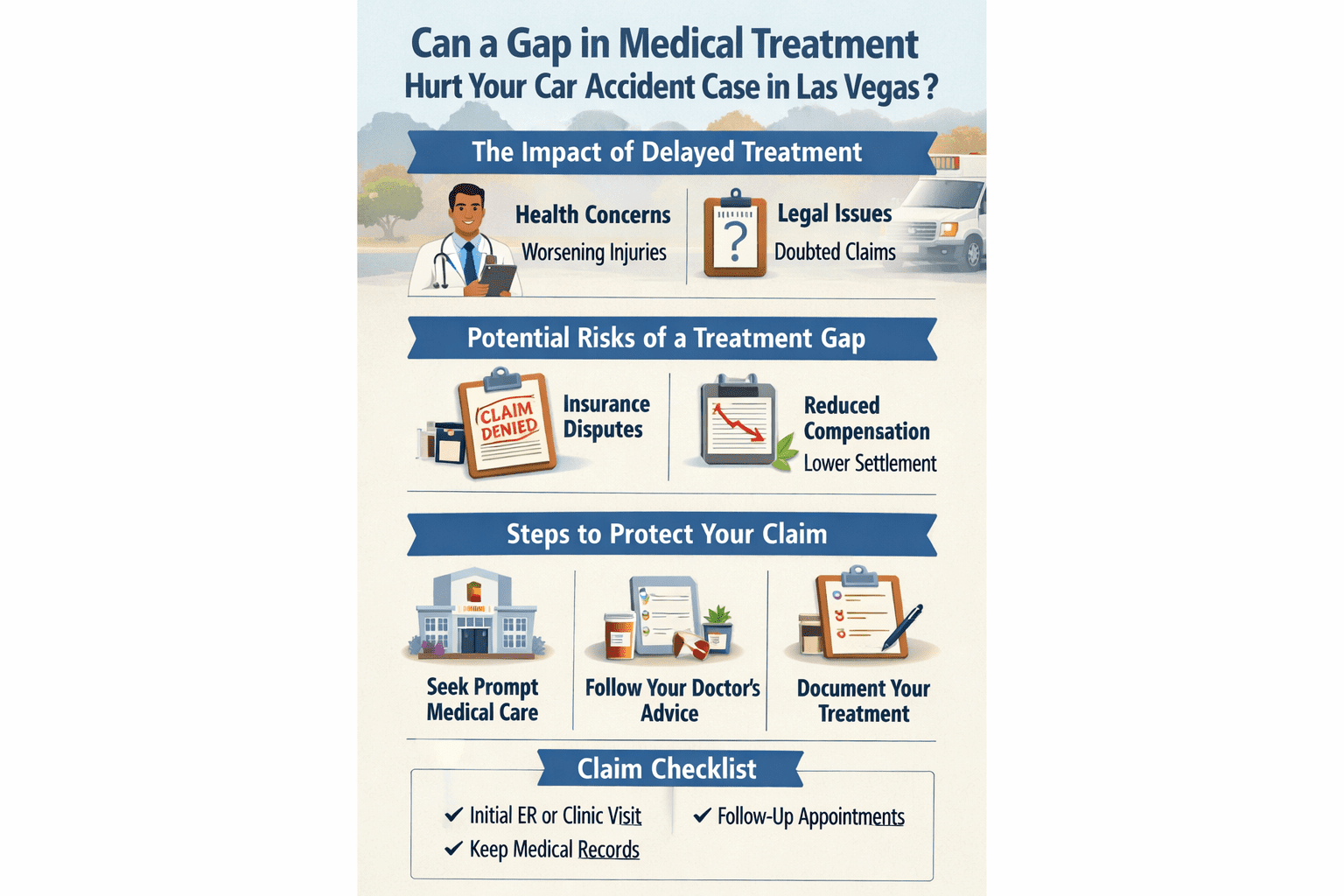
If you were injured in a crash and there was a break in your medical care, you may be worried about what that means for your claim. It is a common concern, and in many cases, it is a valid one. A treatment gap can become a major issue in a personal injury claim because insurance companies often use it to question how badly you were hurt, whether the crash really caused your condition, or whether your injuries fully healed sooner than you say they did.
That said, a gap in care does not automatically destroy a case. Real life gets in the way. People in Las Vegas miss appointments because they cannot get in to see a specialist, they are waiting on imaging approval, they are dealing with work schedules on the Strip, they lack transportation, or they simply do not understand how closely insurers will examine the timeline. What matters is how the gap happened, what records exist, and how clearly the story can be documented.
This FAQ explains the practical issues behind a las vegas car accident treatment gap claim, why insurers focus on treatment gaps, what legitimate reasons may explain them, and what steps may help protect your case. If you are dealing with a delay in care after a crash, it may help to speak with a local personal injury lawyer for a free consultation today.
FAQ: Treatment Gaps and Las Vegas Car Accident Claims
What is a treatment gap in a car accident case?
A treatment gap is a period of time when an injured person does not receive medical care related to the crash, even though they were previously being treated or later claim continuing symptoms. The gap might be short, such as missing a few weeks of recommended follow-up care, or much longer, such as several months without seeing any provider.
In a Las Vegas car accident claim, a treatment gap can show up in many ways, including:
- Waiting a long time after the crash before getting the first medical evaluation
- Stopping physical therapy before the prescribed course is finished
- Missing follow-up appointments with a primary doctor, orthopedist, neurologist, or pain specialist
- Delays between referral and specialist care
- Long periods with no documented complaints, then returning to treatment later
- Not following discharge instructions or home care recommendations
Not every pause is harmful. The issue is whether the break makes it harder to prove that your injuries were serious, ongoing, and caused by the collision.
Why do insurance companies care so much about treatment gaps?
Insurance companies focus on treatment gaps because they are looking for ways to reduce what they pay. A break in medical care can give the adjuster several arguments, even if those arguments are incomplete or unfair.
Common insurer arguments include:
- You were not really hurt that badly. The insurer may say that if your pain was serious, you would have kept treating consistently.
- Your injury got better quickly. A long pause in care may be framed as evidence that your symptoms resolved.
- Something else caused your later symptoms. If you return to treatment after a gap, the insurer may argue a new event, prior condition, or everyday activity caused the problem.
- You failed to mitigate your damages. This means they may claim you did not take reasonable steps to address your injuries and limit the harm.
- Your complaints are exaggerated. Insurers often compare what you say now with what the records show at each stage of treatment.
In other words, treatment gaps create uncertainty. Insurance companies often try to turn that uncertainty into leverage during settlement negotiations.
Can a treatment gap actually reduce the value of a Las Vegas car accident claim?
Yes, it can. A treatment gap may affect both liability arguments and damages arguments, but it most often affects damages. If the insurer believes the records do not support continuing pain, limitations, or the need for future care, it may offer less for medical costs, pain and suffering, lost earning capacity, or other parts of the claim.
The value impact depends on factors such as:
- How long the gap lasted
- When the gap happened in relation to the crash
- Whether you had documented symptoms before and after the gap
- Whether there is a clear explanation for the delay
- Whether provider notes say you improved, plateaued, or still needed care
- Whether the gap involved basic follow-up care or specialist treatment that was difficult to schedule
A short delay with good documentation may be manageable. A long unexplained break can create more serious problems. Still, the outcome is highly fact-specific. That is why presentation of the medical timeline matters so much.
Does waiting a few days after a car accident to get checked out count as a treatment gap?
It can, depending on the circumstances, but it is not always fatal to a claim. Many people do not feel the full extent of a neck, back, shoulder, or soft tissue injury immediately after a crash. Adrenaline, shock, and confusion can mask pain. Some people think they will feel better after rest, only to wake up a day or two later with worsening symptoms.
What matters is whether the timing makes sense and whether you sought care once you realized something was wrong. If you waited because symptoms appeared later, document that. If you tried to get an appointment but could not be seen right away, save the scheduling records. If you were evaluated at urgent care, an emergency room, a primary doctor, or another provider soon after symptoms began, that may help establish a reasonable timeline.
The bigger concern is usually a long delay with no records and no documented explanation.
Why is this issue especially important in a Las Vegas car accident claim?
Las Vegas has heavy tourist traffic, busy commuter corridors, rideshare activity, delivery vehicles, commercial traffic, and frequent crashes across major routes like I-15, US-95, the 215 Beltway, and busy surface streets. After a collision, people often face practical barriers to treatment. Some are local residents balancing casino, hospitality, healthcare, warehouse, or service jobs with unpredictable shifts. Others may have been visiting Las Vegas when the crash happened and then returned home before treatment could continue.

Those local realities matter because a treatment gap is not always about ignoring care. It may reflect:
- Difficulty getting timely appointments in a crowded medical system
- Referral delays between urgent care, primary care, imaging, and specialists
- Transportation problems after a vehicle was damaged or totaled
- Out-of-state follow-up for visitors injured in Las Vegas
- Work schedules that make weekday treatment difficult
- Insurance and payment confusion after the crash
A local lawyer handling a las vegas car accident treatment gap claim may be able to explain these practical issues in a way that makes the timeline more understandable.
Why Insurers Focus on Treatment Gaps
They are looking for inconsistencies in the story
Insurance adjusters do not just read one medical record. They look for a pattern. If someone says they had constant pain for six months but there is no treatment for ten weeks in the middle, the insurer may argue the records do not match the claim.
That does not always mean the person is being dishonest. It may mean life got complicated. But from the insurer’s perspective, the lack of records is an opening.
Medical records drive settlement discussions
In most personal injury claims, the records carry enormous weight. Adjusters, defense lawyers, and sometimes juries rely on those records to understand:
- What symptoms started after the crash
- How severe those symptoms were
- What treatment was recommended
- Whether treatment was followed
- How long recovery lasted
- Whether any ongoing problems remain
If care stops without explanation, the paper trail weakens. And when the paper trail weakens, the insurer may push back harder.
Gaps help insurers argue alternative causes
Suppose a person receives treatment for three weeks, stops for two months, then returns complaining of worse back pain. The insurer may ask:
- Did the person reinjure themselves at work?
- Was there another fall or incident?
- Was the pain actually caused by a preexisting condition?
- If the crash caused the pain, why was there no treatment during the gap?
Even when these arguments are weak, they can still delay resolution or reduce offers if the timeline is not clearly explained.
They may use gaps to challenge pain and suffering damages
Pain and suffering claims are often evaluated through both records and daily impact. If an insurer sees a lengthy break in treatment, it may say the person was functioning better than claimed. That can affect the non-economic portion of the case, not just reimbursement of medical bills.
Legitimate Reasons Treatment Gaps Happen
Scheduling delays with specialists
One of the most common legitimate reasons for a gap is simply that appointments are not available right away. A primary doctor may refer you for physical therapy, an orthopedic consultation, neurology, pain management, or imaging, but the next available appointment may be weeks away.
This is especially important where the records show:
- A referral was made promptly
- Your symptoms continued during the waiting period
- You attended the appointment once it became available
If the delay was outside your control, documentation matters.
Referral and authorization problems
Sometimes care is delayed because one office is waiting on paperwork from another, or because there is confusion about where records should be sent. In some situations, a patient may not realize the referral was incomplete until days or weeks later.
Those are real-world problems, not signs that the injury disappeared. Still, if no one documents them, the insurer may simply treat the period as unexplained noncompliance.
Transportation issues after the crash
Many injured people lose access to reliable transportation after a collision. Their car may be in the shop, declared a total loss, or unsafe to drive. In a city like Las Vegas, where getting across town for treatment is not always simple, transportation can become a real barrier.
If this affected your ability to attend treatment, keep notes about:
- When the vehicle became unavailable
- How long repairs or replacement took
- Why rides or alternative transportation were limited
Work conflicts and lost-income pressure
Many crash victims feel forced to choose between attending treatment and keeping a paycheck. This is common in hospitality, food service, warehouse, gig work, tourism, and shift-based jobs in the Las Vegas area. Missing repeated appointments during business hours may not be easy when someone is already dealing with reduced income after a crash.
This does not mean treatment should be ignored, but it does help explain why gaps happen. If work conflicts were part of the problem, try to preserve schedules, messages, or other records showing the issue.
Family obligations
Childcare, elder care, and other family responsibilities can interrupt treatment. Again, the issue is not whether life became difficult. The issue is whether there is a clear, credible explanation that can be presented if the insurer questions the gap.
Confusion about whether symptoms would improve on their own
Some injuries do not seem severe at first. A person may think soreness will fade with rest, only to realize later that headaches, numbness, range-of-motion problems, or back pain are not going away. Delayed recognition of the need for continued treatment is common, especially with soft tissue injuries.
This is one reason it is important to tell your providers when symptoms persist, worsen, or return.
Out-of-town or tourist-related complications
Las Vegas sees many visitors. If a tourist is injured in a crash, they may receive initial care locally and then continue treatment after returning home. That can create what looks like a gap if the records are scattered across providers in different states. It can also create confusion if the claim is being handled in Nevada but treatment continued elsewhere.
In that situation, collecting complete records from every provider becomes especially important.
Provider-directed pauses or discharge confusion
Sometimes the patient believes treatment is complete because a provider says to return only if symptoms continue. Later, pain returns or worsens. In other cases, someone may finish one stage of treatment and wait for next-step recommendations. These situations are not the same as simply abandoning care, but they should still be documented carefully.
What You Should Do if a Treatment Gap Has Already Happened
Do not assume your claim is ruined
Many people make the mistake of giving up after a lapse in care. A gap may create challenges, but it does not automatically end a viable claim. The next steps matter. The goal is to restore a clear record and preserve the reasons for the interruption.
Resume appropriate follow-up care as soon as reasonably possible
If you are still having crash-related symptoms, follow up with a qualified provider. This is not about inflating treatment. It is about making sure your current condition is documented. The longer symptoms continue without records, the harder the claim may become.
When you see the provider, be clear about:
- What symptoms you are experiencing now
- When those symptoms improved, worsened, or returned
- Why there was a gap in care
- Whether you were waiting on scheduling, referrals, transportation, or other issues
Accurate reporting helps create a more complete medical timeline.
Document why the gap happened
If the gap was caused by practical barriers, gather proof where possible. Helpful examples may include:
- Appointment request logs
- Referral paperwork
- Voicemails, portal messages, or emails with medical offices
- Notices showing the next available appointment date
- Transportation records
- Repair or total-loss paperwork showing loss of vehicle access
- Work schedules or employer communications
- Insurance correspondence showing delays or confusion
You do not need every piece of evidence on day one. But the more of the timeline you can support, the easier it may be to explain the gap later.
Write out your own timeline while details are fresh
Memory fades quickly. It can help to create a simple written timeline that includes:

- Date of the crash
- Date symptoms first appeared or worsened
- Each medical appointment attended
- Recommendations made by providers
- Dates when you tried to schedule follow-up care
- Reasons appointments were delayed or missed
- Dates symptoms interfered with work or daily life
This is not a substitute for medical records, but it can help you and your lawyer organize the facts and spot missing documents.
Be careful what you say to the insurance company
If the adjuster asks why you stopped treating, avoid guessing, minimizing, or giving a vague answer that can be taken out of context. Statements like “I was fine for a while” or “It was not that bad” can be used against you later even if they do not reflect the full picture.
Before giving a detailed recorded statement about treatment interruptions, it may be wise to speak with a lawyer.
How to Document Scheduling or Referral Delays
Save every referral and appointment instruction
When a provider refers you to another provider, imaging center, or therapy office, keep a copy of the referral. If the first office gives verbal instructions only, ask for them in writing or confirm them through a patient portal message if available.
This may help show that continued care was recommended and that any delay happened during the handoff process, not because you ignored treatment.
Call promptly and keep a log
If you are referred for follow-up care, try to schedule as soon as reasonably possible. Keep a record of:
- Date and time you called
- Name of the office
- Who you spoke with, if known
- Earliest appointment offered
- Any issue raised, such as missing referral paperwork or unavailable records
A basic note in your phone, calendar, or notebook can be surprisingly useful later.
Use patient portals or email when possible
Written communication creates a better record than a purely verbal exchange. If a provider has an online portal, use it to ask about referrals, appointment availability, cancellations, and wait lists. If the office communicates by email or text, save those messages.
Ask to be placed on a cancellation list
If the first available specialist appointment is far away, ask whether the office has a cancellation list. If you do this, note the request. It can help show that you were trying to be seen sooner.
Confirm when paperwork is missing
A common source of delay is incomplete paperwork. If the specialist says they did not receive the referral, imaging order, or records, contact the referring office and document the problem. Save any messages that show you were actively trying to move the process along.
Keep proof of completed steps
When you finally get the appointment, save the scheduling confirmation and attend the visit if you can. That final piece helps connect the timeline. It shows there was a delay, but also that you followed through once access became available.
Why Following Provider Instructions Matters
It supports the seriousness of your claim
Following medical advice does not guarantee a successful case, but it usually helps show that you took your injuries seriously. If a provider recommends follow-up care, therapy, imaging, restrictions, or reevaluation, doing your best to follow those instructions can strengthen the record.
It reduces insurer arguments about avoidable worsening
When a person ignores clear treatment recommendations, the insurer may argue that some of the ongoing problems were made worse by failure to follow care instructions. That does not excuse the at-fault driver, but it can complicate the damages discussion.
It creates a consistent medical narrative
A claim is easier to understand when the records tell a clear story:
- Crash occurred
- Symptoms appeared
- Treatment began
- Provider made recommendations
- Patient followed through
- Recovery or ongoing limitations were documented
Treatment gaps and missed instructions interrupt that story. If a break is unavoidable, explaining it becomes even more important.

What if you could not follow the instructions?
If you could not follow a provider’s instructions because of scheduling issues, cost concerns, work barriers, transportation problems, or confusion about next steps, say so promptly and respectfully. Ask the office to note the issue. Again, the problem is often not the obstacle itself. The problem is when the obstacle is real but undocumented.
Examples of How a Treatment Gap May Be Interpreted
Example 1: Short delay with documentation
A Las Vegas driver is rear-ended on Flamingo Road. They go to urgent care two days later with neck pain and headaches. The provider refers them to physical therapy. The first available therapy appointment is three weeks out. The patient keeps the referral, portal messages, and appointment confirmation, then attends regularly. In this situation, the insurer may still point to the delay, but there is a reasonable, documented explanation.
Example 2: Long pause with no records
A passenger is injured in a crash near the 215. They treat for two weeks, then stop for nearly three months. Later they return complaining of severe back pain, but there are no records showing why care stopped or what symptoms existed during the gap. The insurer is more likely to argue the injury resolved or that something else caused the later complaints.
Example 3: Transportation and work barriers
A hospitality worker’s car is totaled after a downtown Las Vegas collision. They miss several therapy sessions because they are relying on others for rides and cannot repeatedly miss shift work. If they preserve vehicle loss documents, work schedules, and appointment records, those facts may help explain the interruption more credibly.
Example 4: Tourist injured in Las Vegas
A visitor receives emergency treatment after a crash near the airport, returns home, and continues care there. If the records from Nevada and the home-state providers are not collected together, it may look like there was a gap. But once the records are assembled, the treatment timeline may actually be consistent.
Warning Signs That a Treatment Gap Could Become a Bigger Claim Problem
- You waited a long time after the crash to seek any medical care
- You stopped treatment while still having significant symptoms
- You returned to care only after hearing from an insurance adjuster or lawyer
- There are no records showing attempts to schedule follow-up care
- Your medical records mention improvement that does not match your current claim
- You missed multiple appointments without explanation
- You have a prior injury in the same body area and the timeline is unclear
- You gave the insurance company a statement minimizing your symptoms
- You changed providers and records have not been gathered from all locations
These issues do not always defeat a case, but they are signs that careful claim handling is important.
How a Lawyer May Help Present the Timeline Clearly
Organizing the records into a readable chronology
One of the most useful things a lawyer can do in a treatment gap case is turn a confusing stack of records into a clear timeline. That may include:
- Dates of treatment
- Provider recommendations
- Referral dates
- Scheduling delays
- Imaging dates
- Periods of documented symptoms
- Reasons for missed or delayed care
Insurance adjusters often respond differently when the sequence is presented clearly instead of leaving them to interpret gaps on their own.
Gathering missing records and communications
Important records are often missing at the start of a claim. A lawyer may help request:
- Urgent care and emergency room records
- Primary care records
- Therapy notes
- Imaging reports
- Specialist records
- Referral orders
- Billing records
- Scheduling notes or office communications, when available
In an out-of-state or multi-provider case, this can make a major difference.
Addressing insurer arguments before they gain momentum
If a treatment gap exists, a lawyer may be able to explain it early rather than waiting for the insurer to define it first. That proactive approach can help frame the issue more fairly.
Connecting symptoms before and after the gap
Sometimes the key issue is continuity. Did the same symptoms continue throughout the gap, even if appointments did not? Were there records before the gap and after the gap showing similar complaints? Did the next provider record that symptoms had persisted? A lawyer may help identify and emphasize those connecting points.
Protecting you from damaging communications
Insurance adjusters may ask questions in ways that oversimplify what happened. A lawyer can help you avoid statements that make a complex treatment history sound like a lack of injury.
What to Expect if the Insurer Raises a Treatment Gap Issue
You may receive more questions about your medical history
Expect the insurer to look closely at prior injuries, preexisting conditions, past treatment in the same body area, and anything that happened during the gap. This does not mean they are right. It means they are trying to find alternate explanations.
The insurer may ask for broader records
They may request additional records beyond the initial treatment providers. It is wise to understand what is being requested and why before signing broad releases.

The settlement offer may come in low
When treatment is inconsistent, insurers often discount the claim. They may argue only the earliest treatment was related to the crash, or that later treatment is unsupported. This is one reason careful documentation is important from the start.
The claim may take longer to resolve
A straightforward claim can become more contested when the medical timeline is unclear. Extra record collection, explanation, and negotiation may be needed.
Practical Steps to Strengthen a Las Vegas Car Accident Treatment Gap Claim
- Get evaluated promptly if symptoms appear. Early documentation helps connect the injury to the crash.
- Follow through on referrals as soon as you reasonably can. If there is a wait, document it.
- Keep every record. Save discharge papers, referrals, after-visit summaries, and scheduling confirmations.
- Track symptoms in a simple journal. Note pain levels, limitations, headaches, sleep issues, missed work, and daily disruptions.
- Explain obstacles to your provider. If you cannot get in, cannot travel, or are waiting on a specialist, tell the office.
- Do not guess with the insurance company. Incomplete explanations can hurt your case.
- Gather records from all locations. This is especially important if treatment happened in Las Vegas and elsewhere.
- Speak with a lawyer early if the timeline is messy. Early help may prevent avoidable damage.
Frequently Asked Questions About Treatment Gaps After a Las Vegas Crash
If I missed physical therapy appointments, is my case over?
No. Missed therapy appointments can be used against you, but they do not automatically end the case. The key questions are why the appointments were missed, whether your symptoms continued, whether the provider recommended additional care, and whether you resumed treatment. Supporting records can make a difference.
What if I could not afford treatment?
Access to care is a real issue for many people. While cost concerns can still complicate a claim, they are not unusual. If affordability affected your treatment, document what happened and discuss it with a lawyer. It is better to explain the issue clearly than to leave the gap unexplained.
Can I still recover compensation if I felt better for a while and then symptoms came back?
Possibly. Some injuries improve and then flare up, especially when activity levels increase or the person returns to work. The challenge is proving the continued connection to the crash. Records before and after the return of symptoms matter, as does the absence or presence of another possible cause.
Should I go back to the same provider after a gap?
Not always, but continuity can help if appropriate. If you change providers, make sure the new provider has enough background to understand the crash history and prior treatment. The records need to connect the dots.
Does a referral delay count against me if the doctor was the one who took too long?
It should not be treated the same as voluntarily abandoning care, but you still may need proof of what happened. Save messages, referral slips, and appointment records showing the delay was not your fault.
What if I was injured in Las Vegas but live somewhere else?
You may still have a valid claim, but the records need to be assembled across state lines. Initial Nevada treatment and follow-up care back home should be collected into one clear timeline.
Can social media make a treatment gap look worse?
Yes. If your records show a long break in care but your social media posts suggest intense physical activity, travel, or statements about being “back to normal,” the insurer may use that to challenge the claim. Be cautious about public posts while your case is pending.
Should I talk to a lawyer before giving a recorded statement?
If there is any treatment gap, prior injury issue, or confusing timeline, that is often a wise step. Recorded statements can lock you into wording that later becomes hard to explain.
Decision Factors: When to Contact a Lawyer About a Treatment Gap
You may want to contact a personal injury lawyer promptly if:
- You have a gap of several weeks or more
- The insurer is already asking pointed questions about delayed care
- You were referred out and the scheduling process became complicated
- You have prior medical history involving the same body part
- You are being blamed for delays outside your control
- You were treated in more than one city or state
- You are unsure which records matter
- The settlement offer seems far lower than expected
These are the situations where legal help may be especially valuable in shaping how the claim is presented.
Key Takeaway for Las Vegas Injury Claims
A gap in treatment can hurt a car accident case, but it is not always decisive. Insurance companies focus on gaps because they want to argue that injuries were minor, healed quickly, or came from something else. Real life, however, is often more complicated. In Las Vegas, delays can happen because of specialist backlogs, referral issues, transportation problems, work conflicts, tourist travel, or confusion after a stressful crash.
The most important thing is to avoid leaving the gap unexplained. Follow provider instructions when you can. If delays happen, document them. Save referrals, scheduling messages, and anything else that shows you were trying to get care. If the timeline is already messy, a lawyer may help organize the records, explain the interruption, and present your claim more clearly.
Conclusion
If you are worried that a treatment delay may affect your las vegas car accident treatment gap claim, do not guess about your next steps. A treatment gap can raise real challenges, but many of those challenges can be addressed with the right records, a clear timeline, and practical legal guidance. Injury Nation provides access to local personal injury lawyer resources for people dealing with difficult claim issues after a crash. Contact a local personal injury lawyer for a free consultation today and get help understanding how your medical timeline may affect your Las Vegas car accident claim.