Why Negotiating Your Own Settlement Can Save You Money and Time
Learning how to negotiate a car accident settlement without a lawyer is possible for many minor to moderate claims, and could save you thousands in attorney fees while putting you in control of your case timeline.
Quick Answer: 6 Steps to Negotiate Without a Lawyer
- Document everything – Photos, police reports, medical records, receipts
- Calculate total damages – Medical bills + lost wages + pain/suffering (1.5-5x medical costs)
- Write a demand letter – Detail the accident, injuries, and compensation request
- Start negotiations high – Insurance companies expect to negotiate down
- Stay professional – Stick to facts, avoid recorded statements
- Know when to walk away – Have a minimum acceptable amount in mind
Getting into a car accident is overwhelming, but you don’t always need a lawyer to secure a fair settlement. Many of the approximately 6 million car accident victims each year successfully handle their own claims for straightforward cases. While lawyers typically take 33% or more of your settlement, handling negotiations yourself means you keep 100% of what you recover.
This approach isn’t for everyone. Serious injuries, disputed fault, or complex cases often require professional help. But for clear-cut accidents with minor injuries, self-negotiation can be both effective and financially smart. This guide walks you through the process, from calculating damages to finalizing your settlement.

Pre-Negotiation Prep: Building Your Case and Calculating Damages
Think of building your claim like assembling a puzzle – every piece of evidence strengthens your position when learning how to negotiate a car accident settlement without a lawyer.

After an accident, prioritize safety, then call 911. A police report provides a neutral, third-party account. At the scene, exchange information with all drivers: names, phone numbers, insurance details, and license plates. Get contact information from any witnesses.
Use your smartphone to take photos of everything: vehicle damage, the accident scene, road conditions, traffic signs, skid marks, and visible injuries. Your photos tell the story to the insurance adjuster.
Seek medical attention immediately, even if you feel fine. Some injuries, like whiplash, have delayed symptoms. Waiting to see a doctor gives the insurance company a reason to argue your injuries aren’t from the accident.
Keep every medical record, bill, and accident-related document in a dedicated folder. This includes the police report, lost wage statements, and repair estimates. Organization shows you’re serious. Your goal is to prove liability (who was at fault) and damages (what you lost). For more on building a strong case, check out our blog.
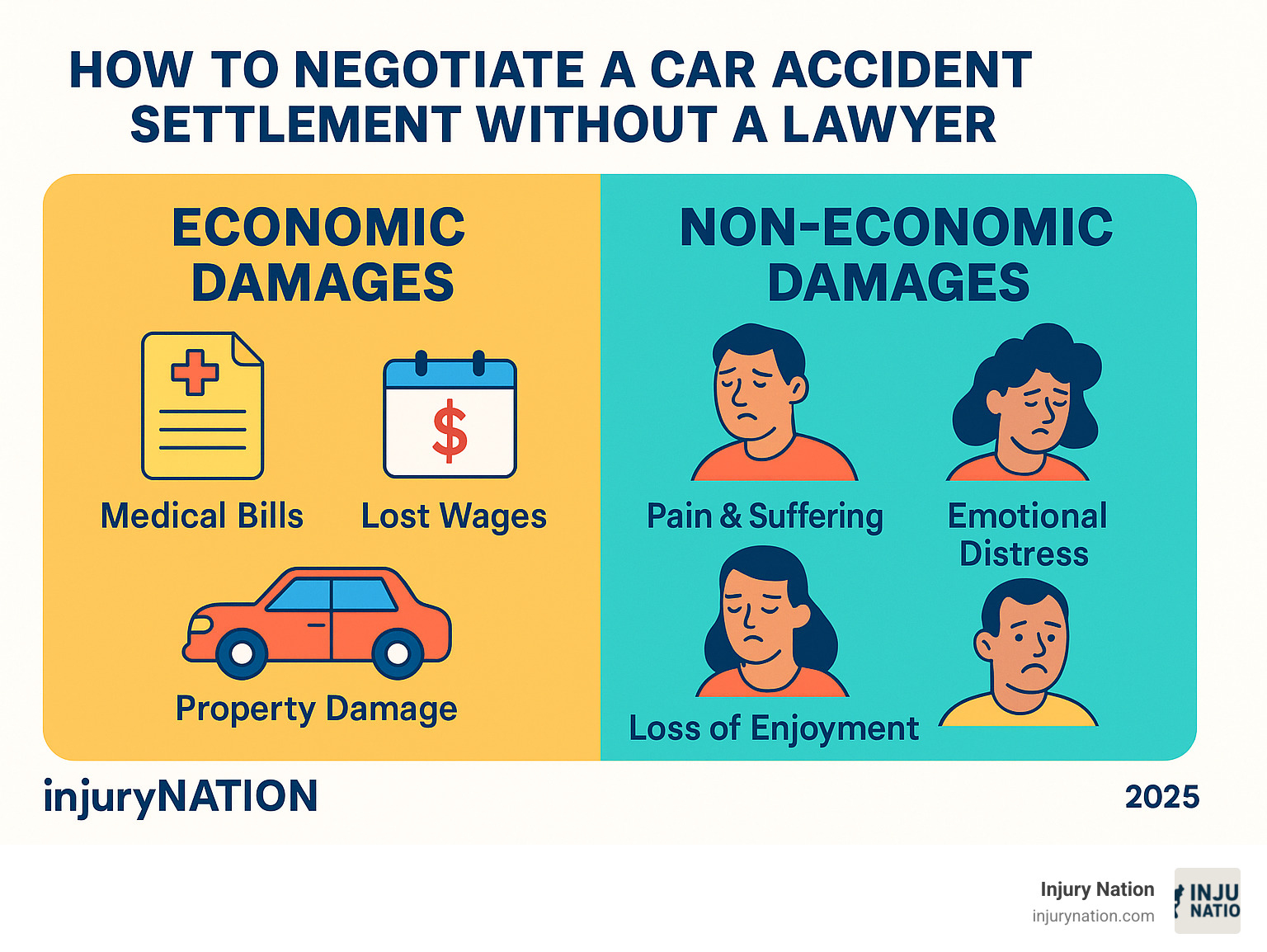
How to Accurately Calculate Your Economic Damages
Special damages (or economic damages) are your direct financial losses.
- Medical bills: Include everything from the ambulance ride and hospital stay to physical therapy, prescriptions, and future medical care your doctor anticipates.
- Lost wages: Document any time missed from work. This includes salary, commissions, bonuses, and sick or vacation days used for recovery. Get a letter from your employer confirming your pay rate and time missed.
- Future income loss: If your injuries impact your long-term earning ability, you can claim this, but it can be complex to prove on your own.
- Property damage: Get repair estimates for your vehicle. If it’s totaled, research its fair market value. Include towing, storage, and rental car costs.
- Out-of-pocket expenses: Track other costs like gas for medical appointments or childcare needed during your recovery.
How to Value Your Non-Economic Damages (Pain and Suffering)
General damages compensate for non-financial losses like physical pain, emotional distress, and loss of enjoyment of life.
The multiplier method is the standard approach. You multiply your total economic damages by a number between 1.5 and 5.
- Minor injuries (quick recovery): Use a multiplier of 1.5 to 2.
- Moderate injuries (longer recovery): Use a multiplier around 3.
- Severe or permanent injuries: Use a multiplier of 4 to 5 (or higher).
For example, if your economic damages are $10,000 and you had moderate injuries, a 3x multiplier suggests $30,000 for pain and suffering, making your initial negotiation point $40,000.
To justify your multiplier, document your injury severity, recovery time, and the impact on your daily life. Keep a pain journal detailing your daily pain levels, activities you missed, and emotional state. This personal record is powerful evidence. For a deeper look at these damages, read more about what is pain and suffering.
The insurance company’s job is to pay as little as possible. Your job is to document every way the accident affected you, financially and personally.
The Negotiation Playbook: How to Negotiate a Car Accident Settlement Without a Lawyer
You’ve gathered evidence and calculated your damages. Now it’s time to negotiate. This process centers on your demand letter, communication with the adjuster, and countering their tactics.

Step 1: Writing a Compelling Settlement Demand Letter
Your demand letter sets the tone. It should be a logical, fact-based argument for the compensation you deserve.
- Factual Narrative: State what happened chronologically. “On [date], at [time], I was driving on Main Street when your insured ran a red light and struck my vehicle.” Include the police report number.
- Liability Argument: Clearly explain why their driver was at fault, using evidence like witness statements or traffic law violations.
- Itemized Damages: List every single expense with exact dollar amounts. Detail medical bills, lost wages (with employer verification), and property damage estimates.
- Non-Economic Damages: Describe how your injuries affected your daily life. Use your pain journal to support claims about sleepless nights or being unable to perform daily activities.
- Supporting Evidence: Attach copies (never originals) of your police report, medical records, bills, wage verification, and photos.
- Initial Demand: State your total settlement demand. This should be higher than your minimum acceptable amount (e.g., 25-30% higher) to leave room for negotiation, but keep it reasonable to maintain credibility.
Step 2: Communicating and Negotiating with the Insurance Adjuster
After sending your letter, the adjuster will call. They are trained to minimize payouts.
- Stay Professional: Keep a calm, business-like tone. Anger and emotion will not help your case.
- Stick to Facts: Keep conversations focused on the accident, your injuries, and your documented damages. Avoid small talk.
- Document Everything: Note the date, time, adjuster’s name, and a summary of every conversation.
- Decline Recorded Statements: You are generally not required to provide a recorded statement. They can be used against you. Offer to provide information in writing instead.
- Expect a Lowball Offer: The adjuster’s first offer will almost certainly be low. This is standard procedure. Don’t get discouraged.
- Negotiate and Counter: Politely reject the low offer and explain why it’s insufficient, referencing your evidence. “Your offer of $3,000 doesn’t cover my ongoing physical therapy.” When making a counter-offer, justify it with your documented losses. Many people learning how to negotiate a car accident settlement without a lawyer settle for less because they don’t advocate strongly for themselves.
Step 3: Countering Common Insurance Company Tactics
Be prepared for these common strategies designed to reduce your settlement.
- Lowball Offers: Their standard opening move. Reject it and counter with a fact-based argument for your higher demand.
- Delay Tactics: They may take weeks to respond or claim they need more information. Be persistently polite with follow-up emails and calls.
- Disputing Liability: They might argue you were partially at fault. Use your police report, witness statements, and photos to stick to the facts.
- Questioning Your Injuries: They may downplay soft tissue injuries or suggest pre-existing conditions. Counter with medical records, doctor’s notes, and your pain journal.
- Pressure to Settle Quickly: They may create false urgency. Never settle before you’ve reached maximum medical improvement and fully understand your long-term needs. Once you sign a release, you can’t ask for more money.
Know your minimum acceptable number—the lowest amount you’ll take. If the insurer won’t meet a reasonable demand backed by evidence, it may be time to consider other options.
Understanding the Rules, Risks, and When to Call for Backup
Learning how to negotiate a car accident settlement without a lawyer requires understanding the rules of the road. The legal landscape has its own complex rules, and ignoring them can be costly.

Car accident laws vary dramatically by state. What works in California might not in Virginia. Understanding these differences is essential.
Key Legal Concepts That Can Make or Break Your Claim
- At-Fault vs. No-Fault Systems: In at-fault states (like Nevada), the responsible driver’s insurance pays for your damages. In no-fault states, your own insurance pays for initial medical bills and lost wages through Personal Injury Protection (PIP), regardless of fault. In no-fault states, you can typically only sue the other driver if your injuries are severe.
- Negligence Laws: These rules determine how compensation is handled if you are partially to blame. A few states use contributory negligence, where you get nothing if you are even 1% at fault. Most states use comparative negligence, which reduces your settlement by your percentage of fault. For example, under Nevada’s “modified comparative negligence” rule, if you are 15% at fault for a $10,000 claim, you’d receive $8,500. You cannot recover anything if you are 51% or more at fault.
- Statute of Limitations: This is the absolute deadline to file a lawsuit. It can range from one to six years depending on your state and whether it’s for personal injury or property damage. In Maryland, you have three years. Miss this deadline, and your case is over.
The Risks of How to Negotiate a Car Accident Settlement Without a Lawyer
Handling your own claim comes with risks that could cost you thousands.
- Undervaluing Your Claim: It’s easy to underestimate future medical costs, ongoing pain, or long-term impacts on your earning ability.
- Missing Critical Deadlines: Beyond the statute of limitations, there are deadlines for reporting accidents and filing claims. Missing them can void your claim.
- Falling for Adjuster Tactics: Adjusters are skilled at getting you to say things that hurt your case, such as in recorded statements.
- Accepting a Bad Deal: Once you sign a settlement release, you can never go back for more money, even if your injuries worsen.
- Admitting Fault: Even saying “I’m sorry” at the scene can be used against you. Avoid speculating or accepting blame.
When to Reconsider How to Negotiate a Car Accident Settlement Without a Lawyer
Some cases are too complex to handle alone. The following are clear red flags that you need professional help:
- Severe or permanent injuries (broken bones, head trauma, spinal injuries, surgery).
- Disputed fault or accusations that you were negligent.
- Accidents involving multiple parties or commercial vehicles (like large trucks).
- The insurance company denying your claim or making unacceptably low offers.
- An accident involving a government entity.
- You are struggling to gather evidence or understand legal terms.
Many personal injury lawyers offer free consultations. There’s no harm in getting a professional opinion on your case. If you feel overwhelmed, you can connect with a professional for guidance in your area.
Finalizing the Deal: From Agreement to Payout
You’ve negotiated a settlement amount. Now it’s time to finalize the deal. Before you celebrate, there are crucial final steps.

The insurance company will send you a settlement agreement and a release of all claims form. This is a legally binding contract. Read every word carefully. By signing the release, you agree that you will never seek more money for this accident from the at-fault party or their insurer. This finality is why you must be certain about your decision. Once you sign, there’s no going back, even if your injuries worsen.
Your settlement can be paid as a lump sum (the entire amount at once) or a structured settlement (installments over time). Most people prefer a lump sum for smaller settlements.
Before you get paid, you must address any liens. If your health insurance, Medicare, or workers’ compensation paid for your medical bills, they have a legal right to be reimbursed from your settlement. The good news is that many liens are negotiable, and you may be able to convince them to accept a lower amount.
After you sign the release and handle any liens, the insurance company will issue your check. This process typically takes two to four weeks. When the check arrives, you’ll have successfully steerd the claims process on your own, keeping 100% of the settlement without paying attorney fees.
Frequently Asked Questions about Car Accident Settlements
When you’re learning how to negotiate a car accident settlement without a lawyer, these common questions often arise.
How long do I have to file a car accident claim?
This deadline is called the statute of limitations, and it’s critical. Every state has different rules, with deadlines ranging from one to six years. There are often different time limits for personal injury versus property damage claims. For example, you might have three years to sue for injuries but only two for your car. If a government vehicle was involved, the deadline could be as short as 90 days. Don’t wait. Missing the statute of limitations means you lose your right to compensation forever.
What should I do if the insurance company’s first offer is too low?
Remember this rule: their first offer is almost never their best offer. Do not accept a lowball offer. Instead, compare it to your calculated damages (medical bills, lost wages, pain and suffering).
Respond with a professional counter-offer in writing. Explain why their offer is insufficient, referencing your documented expenses and the impact of your injuries. If you have new medical bills or a doctor’s note about your prognosis, provide that as additional evidence. Be patient; good settlements take time. If you can justify your demand with facts, you’re in a strong position.
Can I reopen my claim after I’ve accepted a settlement?
No. Once you sign the settlement agreement and cash the check, the case is closed forever. You will sign a release of all claims, a legally binding document that prevents you from seeking any more money for that accident.
This means that even if your injuries get worse or you find you need surgery later, you cannot reopen your claim. This is why it is crucial to ensure all your medical treatment is complete (or future costs are accounted for) and you understand the full extent of your damages before you sign anything. The importance of this step cannot be overstated.
Conclusion
Congratulations! You now know how to negotiate a car accident settlement without a lawyer. With proper preparation, documentation, and negotiation skills, you can take control of your claim and avoid hefty attorney fees. You are no longer at the mercy of adjusters who rely on your inexperience.
However, some cases are too complex to handle alone. If you’re dealing with serious or long-term injuries, disputed fault, or an accident involving a commercial company, the stakes are too high to go it alone.
Experienced personal injury professionals often recover significantly more money for their clients, even after their fees. They know the insurance companies’ playbooks, understand the true value of complex injuries, and are not intimidated by aggressive tactics.
At Injury Nation, we believe knowledge is power. Whether you handle your claim yourself or seek professional help, you can now make that choice from a position of strength. For serious or complex cases, don’t gamble with your future. Sometimes the best way to maximize your payout is to invest in an expert.
Find an experienced personal injury professional to maximize your settlement.