
The Growing Reality of Uber and Accidents on Our Roads
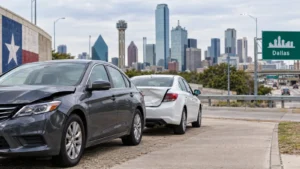
Uber and accidents are an increasingly common reality as rideshare services have become a key part of American transportation. While convenient, this shift comes with measurable risks. Research from the University of Chicago found that the rise of ridesharing is linked to a 3% annual increase in auto fatalities nationwide, equating to nearly 1,000 additional deaths each year.
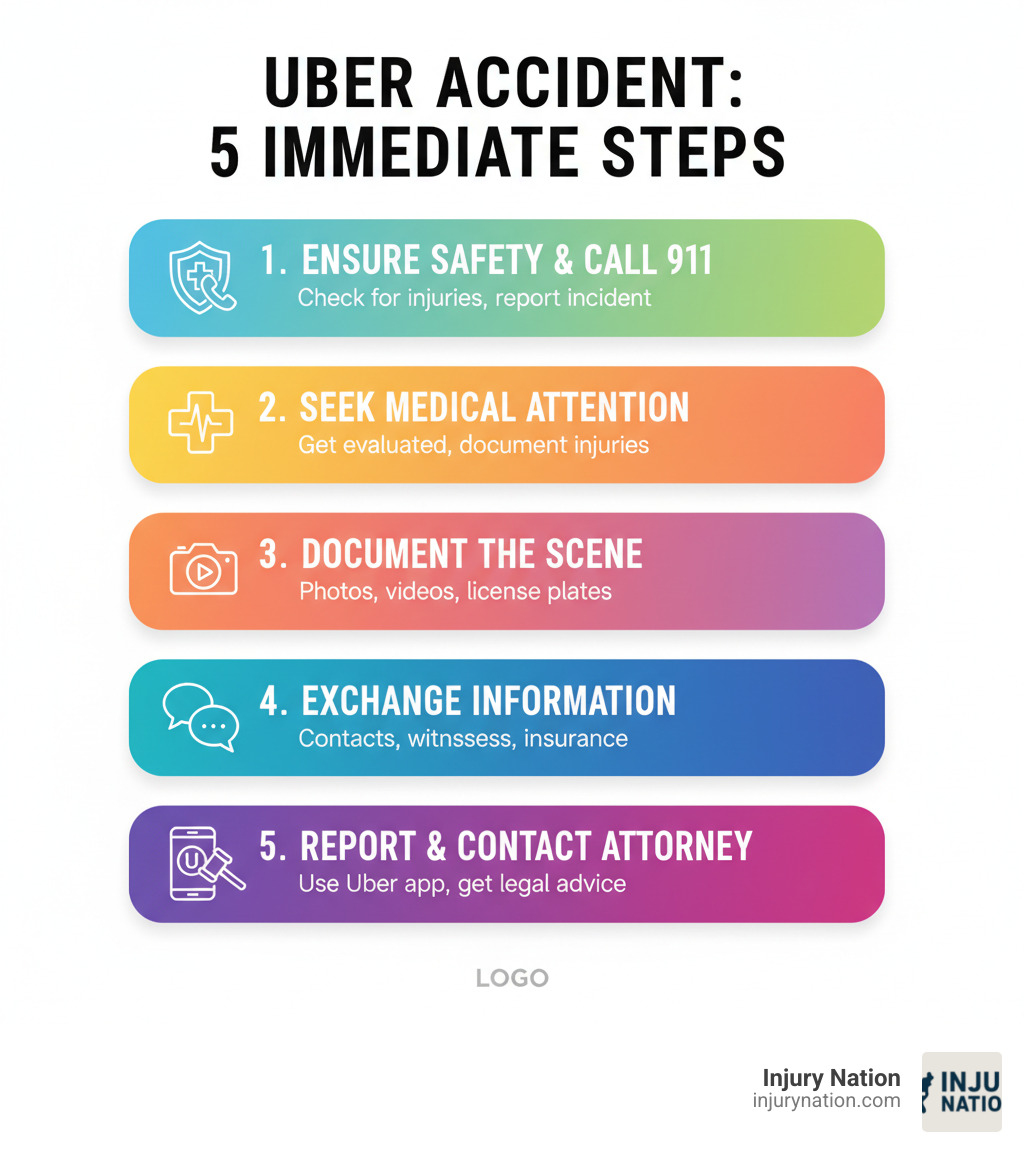
If you’ve been in an Uber accident, take these immediate steps:
- Check for injuries and call 911 for medical emergencies.
- Document the scene with photos of vehicles, license plates, and the area.
- Report the crash through the Uber app’s Safety Toolkit.
- Seek medical evaluation, as some injuries have delayed symptoms.
- Contact a rideshare accident attorney before accepting any settlement.
What makes these accidents so complex is Uber’s business model. Drivers are independent contractors, not employees, which creates a confusing web of insurance coverage that depends on the driver’s status in the app. Unlike traditional car wrecks, an Uber accident can involve multiple insurance policies and corporate legal teams.
Whether you were a passenger, another driver, or a pedestrian, the steps you take after the crash are critical to protecting your right to fair compensation for your injuries, medical bills, and lost wages.
The Aftermath: What to Do Immediately After an Uber Wreck
The steps you take immediately after an Uber crash can protect your health and your legal rights. Adrenaline can mask injuries, so act methodically.
Prioritize safety first. Check yourself and others for injuries. If anyone is hurt or the crash is serious, call 911 immediately to get police and paramedics on the scene.
Even if you feel fine, seek medical attention as soon as possible. Injuries like whiplash, concussions, and internal damage often appear hours or days later. A medical record creates an official link between your injuries and the accident, which is crucial for any future claim.
Next, document the scene. Use your smartphone to take photos and videos of everything: vehicle damage, car positions, traffic signs, skid marks, and any visible injuries. The more evidence you have, the stronger your case.
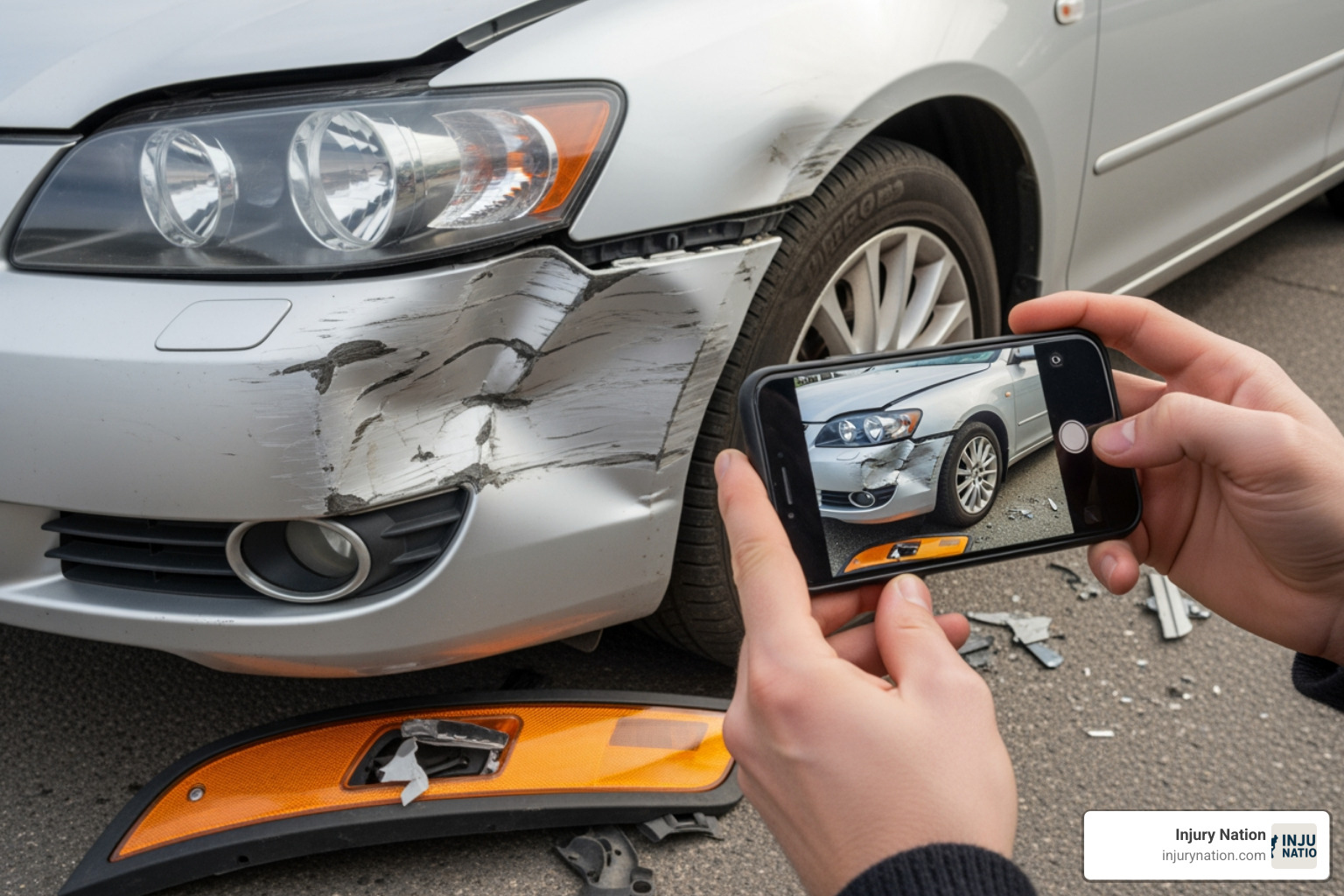
Then, exchange information with the Uber driver, other drivers, and any witnesses. Get names, phone numbers, and insurance details. A critical point: do not admit fault. Even saying “I’m sorry” can be used against you. Stick to the facts of what you observed.
Finally, report the incident to Uber. Passengers can use the app’s Help menu or Safety Support team. Drivers should use the Safety Toolkit in their app to file a crash report.
Key Information to Collect
Gathering thorough information at the scene will strengthen your claim. Treat it like collecting evidence for your own case.
- Driver’s Name and Contact Information: Full name, phone number, and email.
- Driver’s Personal Insurance: Get their policy details, as it may be relevant.
- License Plate Numbers: For the Uber and all other vehicles involved.
- Other Drivers’ Information: Names, contact details, and insurance information.
- Witness Contacts: Get names and phone numbers from anyone who saw the uber and accidents occur.
- Police Report Number: Ask the responding officer for the report number, their name, and badge number.
- Photos and Videos: Capture the damage, the surrounding area, traffic signals, and weather conditions.
Unpacking the Insurance Maze: How Uber’s Coverage Works
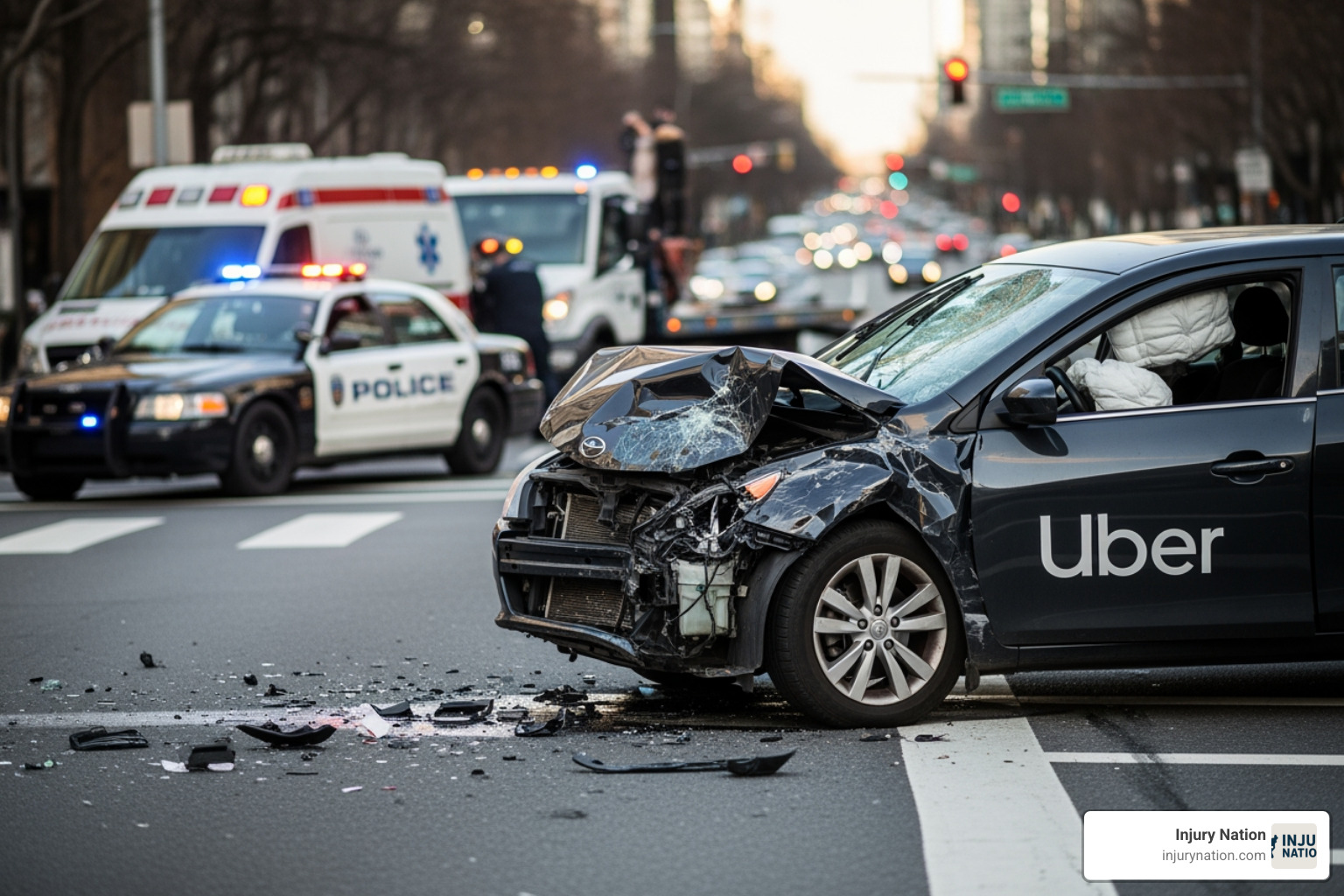
Insurance for Uber and accidents is far more complex than a standard auto policy. Uber’s coverage operates on a tiered system that changes based on the driver’s status in the app at the time of the crash. This is crucial because a driver’s personal auto insurance almost never covers commercial driving, creating a potential gap.
Uber’s coverage activates when the app is on, but the amount varies significantly.
-
App Off: When the driver is offline, Uber provides no coverage. Any claim must be filed against the driver’s personal auto insurance.
-
App On, Waiting for a Request: Once a driver is online and available, Uber’s contingent liability coverage applies. This includes $50,000 per person for bodily injury ($100,000 max per accident) and $25,000 for property damage. These limits can be quickly exhausted in a serious crash.
-
En Route to Pickup or On a Trip: When the driver has accepted a ride or is transporting a passenger, Uber’s full $1 million third-party liability policy is in effect. This also includes uninsured/underinsured motorist coverage.
Some states, like Nevada, add another layer, requiring the driver’s personal insurance to pay first if an accident occurs while en route to a pickup. This can lead to disputes between multiple insurance companies. You can find more details on Uber’s insurance policies, but navigating these rules often requires legal expertise.
[TABLE] comparing Uber’s Insurance Coverage by Driver Status
| Driver Status | Coverage Type | Key Limits |
|---|---|---|
| Offline (App Off) | Driver’s Personal Policy | Varies by personal policy; No Uber coverage. |
| Online, Waiting for Request | Uber’s Contingent Liability | $50,000/person bodily injury, $100,000/accident bodily injury, $25,000/accident property damage. |
| En Route or On a Trip | Uber’s Full Commercial Policy | $1,000,000 third-party liability; Uninsured/underinsured motorist coverage. |
An experienced attorney who understands these insurance mazes can identify which policies apply and fight the disputes that arise when multiple insurers are involved.
Determining Fault: Who is Liable in Uber and Accidents?
Figuring out who is responsible after an Uber and accidents incident is complicated by Uber’s business model and the multiple parties who may share blame. Most states use at-fault laws, where the person who caused the crash is liable for damages. Many also apply comparative negligence, which reduces your compensation by your percentage of fault.
Because Uber classifies drivers as independent contractors, the company often denies direct responsibility for their actions. This makes proving negligence more complex, as you may need to build a case against the driver, Uber, and/or a third party. For help with these complex liability issues, you can Find help from Car Accident Lawyers.
The Uber Driver’s Liability
In most cases, the Uber driver’s actions are examined first. They have a duty to operate their vehicle safely. Common forms of driver negligence include:
- Distracted Driving: Interacting with the app, GPS, or passengers instead of focusing on the road.
- Speeding: Rushing to complete more trips to maximize earnings.
- Driver Fatigue: Working long hours can impair judgment and slow reaction times.
- Driving Under the Influence (DUI): Operating a vehicle while impaired by alcohol or drugs.
- Traffic Law Violations: Running red lights, failing to yield, or making illegal turns.
Uber’s Potential Corporate Liability
While Uber uses the independent contractor model as a shield, the company can be held liable in certain situations:
- Negligent Hiring: If Uber failed to conduct a proper background check on a driver with a history of reckless driving.
- Platform Liability: If features within the Uber app itself encourage unsafe driving behavior.
- Vicarious Liability: An argument that Uber exerts enough control over its drivers to be held responsible for their actions.
- Failure to Enforce Safety Standards: If Uber knew a driver was dangerous from user complaints but failed to act.
Third-Party Liability in Uber and Accidents
Sometimes, another party is partially or fully at fault:
- Other At-Fault Drivers: If another vehicle’s driver caused the collision.
- Vehicle Manufacturers: If a defective part like brakes or tires contributed to the crash.
- Government Entities: If poor road maintenance, such as potholes or missing signs, was a factor.
The Broader Impact: Rideshare Accident Statistics and Safety
The rise of ridesharing has had a complex effect on road safety. While services like Uber offer an alternative to drunk driving, they also add millions of vehicle miles to city streets, increasing traffic congestion and the potential for accidents.

Research shows a mixed picture, with some studies pointing to safety benefits while others raise alarms about increased crash rates. The available data provides a sobering look at the overall impact.
Uber Accident Statistics and Fatalities
Uber’s own safety reports provide insight into the risks. Between 2019-2020, there were 91 fatal incidents resulting in 101 deaths involving Uber vehicles. While rare compared to billions of trips, these numbers represent devastating losses.
The data shows that vulnerable road users are most at risk, with pedestrians, bicyclists, and scooter riders accounting for 42% of fatalities. The leading causes of these fatal Uber and accidents were speeding (32% of crashes) and alcohol-impaired driving (23%), followed by distracted driving and fatigue. You can find more recent data in Uber’s 2021-2022 safety report.
The Link Between Ridesharing and Overall Traffic Fatalities
Independent research from the University of Chicago suggests a troubling trend. Their study found that the introduction of ride-hailing services is associated with a 3% increase in motor vehicle fatalities, which translates to an estimated 987 additional roadway deaths each year in the U.S.
The Research on traffic fatalities attributes this increase largely to increased congestion. Rideshare drivers often cruise or circle while waiting for a fare, adding to the number of cars on the road. This increased traffic density creates more opportunities for collisions. The estimated annual economic cost of accidents linked to ride-hailing is around $10 billion. The convenience of ridesharing comes with societal costs that we are only beginning to fully measure.
Navigating Your Claim: Legal Options and Compensation
After an Uber and accidents incident, securing financial compensation is a key part of recovery. The process usually begins by filing an insurance claim and entering a negotiation process with claims adjusters. Be wary of initial settlement offers, as they are often far below the true value of your claim.
It is crucial to act quickly due to the statute of limitations, a strict deadline for filing a personal injury lawsuit. This deadline varies by state; for example, you generally have two years from the accident date in Nevada and Arizona. In North Carolina, G.S § 1-52 also sets a two-year deadline. Missing this deadline can mean losing your right to compensation forever. For more information, see A complete guide from a Vehicle Injury Attorney.
Types of Damages You Can Recover
Compensation, or “damages,” covers all your accident-related losses, which fall into two categories.
-
Economic Damages: These are your tangible, calculable financial losses. This includes all past and future medical bills, lost wages from missed work, reduced future earnings capacity, and property damage to your vehicle or belongings.
-
Non-Economic Damages: These compensate for intangible losses that are harder to quantify but just as real. This includes pain and suffering for your physical pain, and emotional distress for the psychological impact like anxiety, depression, or PTSD.
The Legal Process for Uber and Accidents
If negotiations with the insurance company fail, filing a lawsuit may be necessary before the statute of limitations expires. This initiates the findy phase, where both sides formally exchange information through written questions and depositions. Most cases are resolved through a settlement, often reached during mediation, but some may proceed to trial where a judge or jury determines fault and damages.
Why a Specialized Rideshare Lawyer is Crucial
Handling an Uber accident claim alone is risky. Insurance companies have legal teams dedicated to minimizing payouts. A specialized rideshare attorney provides critical advantages:
- Expertise in Complex Insurance: They understand Uber’s tiered policies and know which one applies.
- Proving Liability: They know how to build a case against an independent contractor and, if necessary, Uber itself.
- Experience with Corporate Teams: They are not intimidated by Uber’s large legal department.
- Maximizing Compensation: They calculate the full value of your claim, including future needs and non-economic damages, to prevent you from accepting a lowball offer.
- Navigating Regulations: They stay current on the evolving laws governing rideshare companies in states like Nevada and beyond.
Frequently Asked Questions about Uber Accidents
What are the most common injuries in an Uber accident?
Injuries in Uber and accidents vary by the type of collision but frequently include:
- Whiplash and Neck Injuries: Common in rear-end collisions, potentially leading to chronic pain.
- Traumatic Brain Injuries (TBIs): Ranging from mild concussions to severe brain damage, with symptoms that may be delayed.
- Broken Bones: Fractures to arms, legs, ribs, or facial bones are common.
- Spinal Cord Damage: A devastating injury that can result in paralysis or chronic pain.
- Soft Tissue Injuries: Sprains, strains, and deep bruises that can be painful and slow to heal.
Because symptoms can be delayed, seek a medical evaluation immediately after any crash.
Can I sue Uber if their driver caused the accident?
While suing Uber directly is difficult because its drivers are independent contractors, you have significant recourse. Your primary path to compensation is filing a claim against Uber’s commercial insurance policy, which provides up to $1 million in liability coverage when a driver is on a trip or en route to a pickup.
In certain cases, such as negligent hiring (if Uber failed to properly screen a dangerous driver) or negligent retention (if Uber kept a known unsafe driver on the platform), a direct lawsuit against the company may be possible. An experienced attorney can determine the best strategy for your case.
How long do I have to file a claim after an Uber accident?
Every state has a statute of limitations, which is a strict deadline for filing a personal injury lawsuit. If you miss this deadline, you lose your right to seek compensation.
The timeframe varies by state. For example, in Nevada, Arizona, and North Carolina, the statute of limitations for personal injury is generally two years from the date of the accident. Building a strong case takes time, so it is critical to contact an attorney as soon as possible to protect your legal rights and avoid having the insurance company use delay tactics against you.
Your Path to Recovery After an Uber Accident
If you’ve been in an Uber and accidents incident, you know how overwhelming the aftermath is. From the insurance complexity and determining liability to gathering the importance of evidence, the legal system can feel like a maze designed to protect large corporations.
You are not just dealing with paperwork; you are recovering from injuries, managing medical bills, and missing work, all while fending off lowball settlement offers. You don’t have to face this alone.
Injury Nation was created to connect accident victims with the legal help they deserve. An experienced rideshare accident attorney understands Uber’s tactics and knows how to fight for the full compensation you need to cover your bills, lost wages, and pain and suffering.
Your recovery and financial security matter. Don’t let the complexities of a rideshare accident claim stop you from getting justice. Find experienced rideshare accident attorneys in our directory today and take the first step toward rebuilding your life.