

Why Uber Accident Cases Are More Complex Than Regular Car Crashes
An Uber accident case has unique legal challenges compared to traditional car accidents. If you’ve been injured in a rideshare accident, here’s what you need to know:
Quick Answer: Key Legal Problems in an Uber Accident Case
- Multiple insurance policies may apply depending on the driver’s app status (offline, waiting for a request, or actively transporting)
- Driver classification as independent contractors makes suing Uber directly difficult in most situations
- Coverage amounts vary from $25,000 to $1 million based on the driver’s status at the time of the accident
- Statute of limitations typically gives you 2 years to file a claim, but varies by state
- Average settlements range from $10,000 for minor injuries to $100,000+ for severe injuries
Any car accident is stressful, but an injury involving an Uber driver makes the situation far more complicated.
Unlike traditional accidents where you file a claim against the at-fault driver’s insurance, Uber accidents involve multiple layers of insurance coverage. The amount you can recover depends on the driver’s app status, whether they had accepted a ride, and who was at fault.
Research shows that fatal accidents increased by 2-3% annually in cities where Uber was introduced. These aren’t just statistics—they represent real people like you who need to understand their legal options.
This guide breaks down the legal complexities of Uber accident cases into clear, actionable steps. You’ll learn who can be held responsible, how Uber’s insurance system works, what your case might be worth, and when you need an attorney by your side.
Understanding Liability: Who Is Responsible in an Uber Accident?
Figuring out who’s responsible after an Uber accident is the most important—and often hardest—part of your case. Unlike a regular car crash, an Uber accident case can involve the driver’s personal insurance, Uber’s commercial policy, and another driver’s policy. It’s a complex knot to untangle.
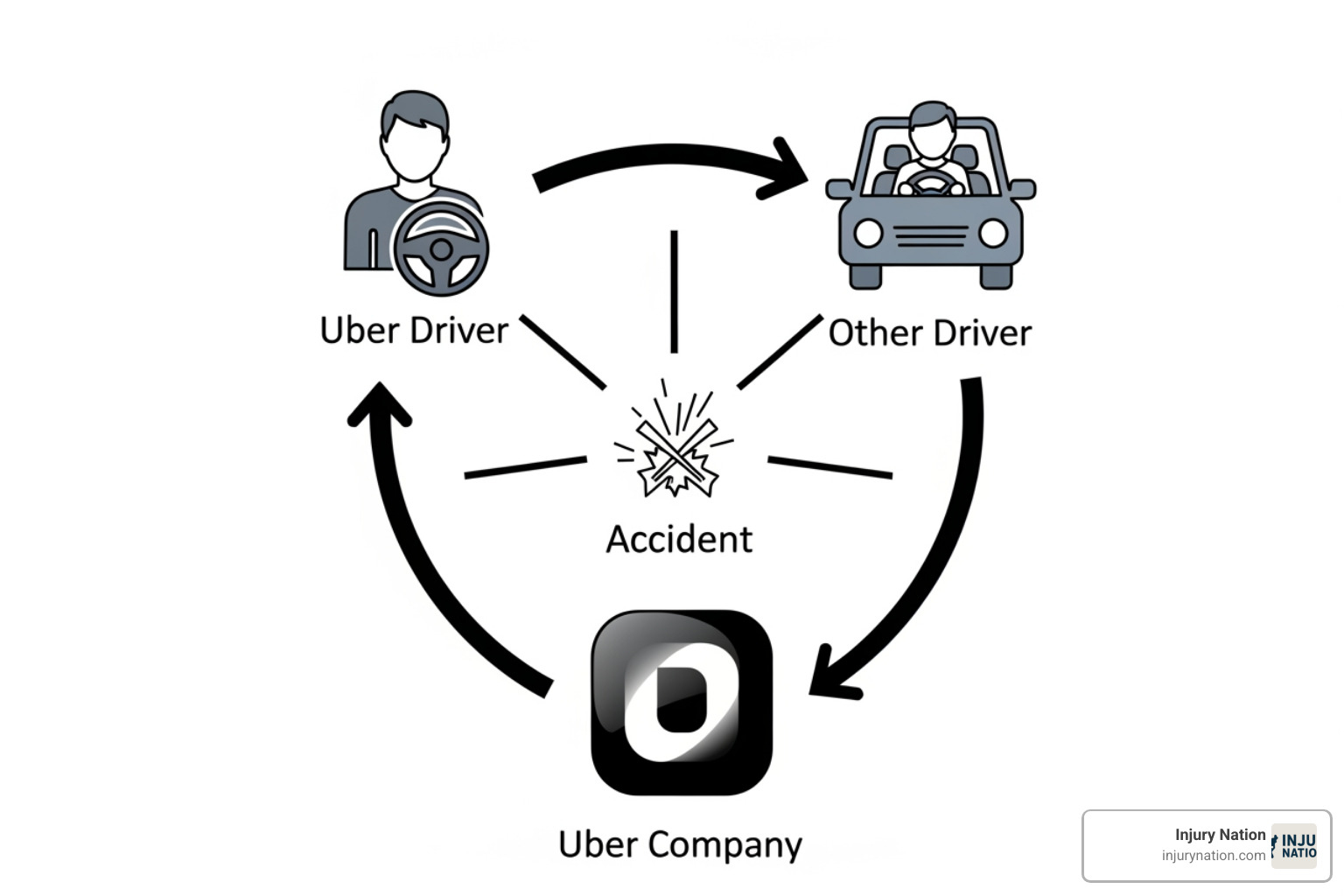
Most people don’t realize Uber drivers are classified as independent contractors, not employees. This legal distinction acts as a shield, making it much harder to sue Uber directly, as the company isn’t automatically responsible for a driver’s accident.
However, there are situations where Uber can be held accountable, especially if the company was negligent in hiring a dangerous driver or if its own systems contributed to your crash.
The key to any successful claim is proving who was at fault. Evidence is your best friend. Police reports are crucial—they document the scene and often include an officer’s opinion about who caused the accident. Witness statements can corroborate your version of events, and there may be dashcam footage or Uber’s own trip data showing the driver’s speed and route.
Without clear evidence of fault, insurance companies will fight your claim. They’re betting you won’t have the documentation to back up your claim. Don’t give them that advantage.
The Driver’s Status: Employee vs. Independent Contractor
The independent contractor classification isn’t just jargon; it fundamentally changes your legal options. This classification shields Uber from vicarious liability—the legal principle that holds employers responsible for their employees’ actions on the job. For independent contractors, the rules are different.
This means that in most cases, you can’t sue Uber for what their driver did. Your claim is against the driver and the applicable insurance coverage. The company gets to say “not our employee, not our problem.”
But there are cracks in that shield. You can sometimes go after Uber directly, usually by proving the company itself was negligent:
Negligent hiring or retention is the most common path. If Uber hired a driver with multiple DUIs and they caused an accident while drunk, you might have a case against Uber for putting a dangerous driver on the road. The same applies if Uber knew a driver was reckless from passenger complaints but kept them on the platform.
Company negligence involving technology or policy is another potential exception. If Uber’s app glitched and caused the driver to make a dangerous maneuver, or if a policy pressured drivers into unsafe conditions, these situations could open the door to suing Uber directly.
Court cases have examined whether Uber has a broader duty of care, but outcomes vary by location and the specifics of your case.
Proving company negligence against a billion-dollar corporation is no small feat. It requires detailed investigation and a legal team that knows what to look for. This is why having an experienced attorney is critical when trying to hold Uber accountable.
When Another Party is At Fault
Not every rideshare accident is the Uber driver’s fault. Sometimes another driver is to blame. When that happens, your claim starts with the third-party driver who caused the collision.
If you’re in an Uber and a texting driver hits you, that driver’s insurance should be the first to pay. This is more straightforward than dealing with Uber’s complex insurance tiers.
But what if the at-fault driver is uninsured or has minimal coverage that won’t cover your medical bills, lost wages, and pain and suffering? This is a common problem.
This is when Uber’s uninsured and underinsured motorist coverage becomes your safety net. If the at-fault party’s insurance is insufficient, Uber’s policy can step in to cover the difference. This protection means you’re not left empty-handed because someone else was driving without adequate coverage.
The challenge is that you may be dealing with multiple insurance policies, each trying to pay as little as possible. They will dispute your claim’s worth and delay the process. This juggling act is why many Uber accident cases require legal help. An experienced attorney knows how to identify all available coverage, handle each insurer’s tactics, and ensure you’re compensated from every applicable policy.
Uber’s Tiered Insurance System: How Driver Status Affects Your Claim
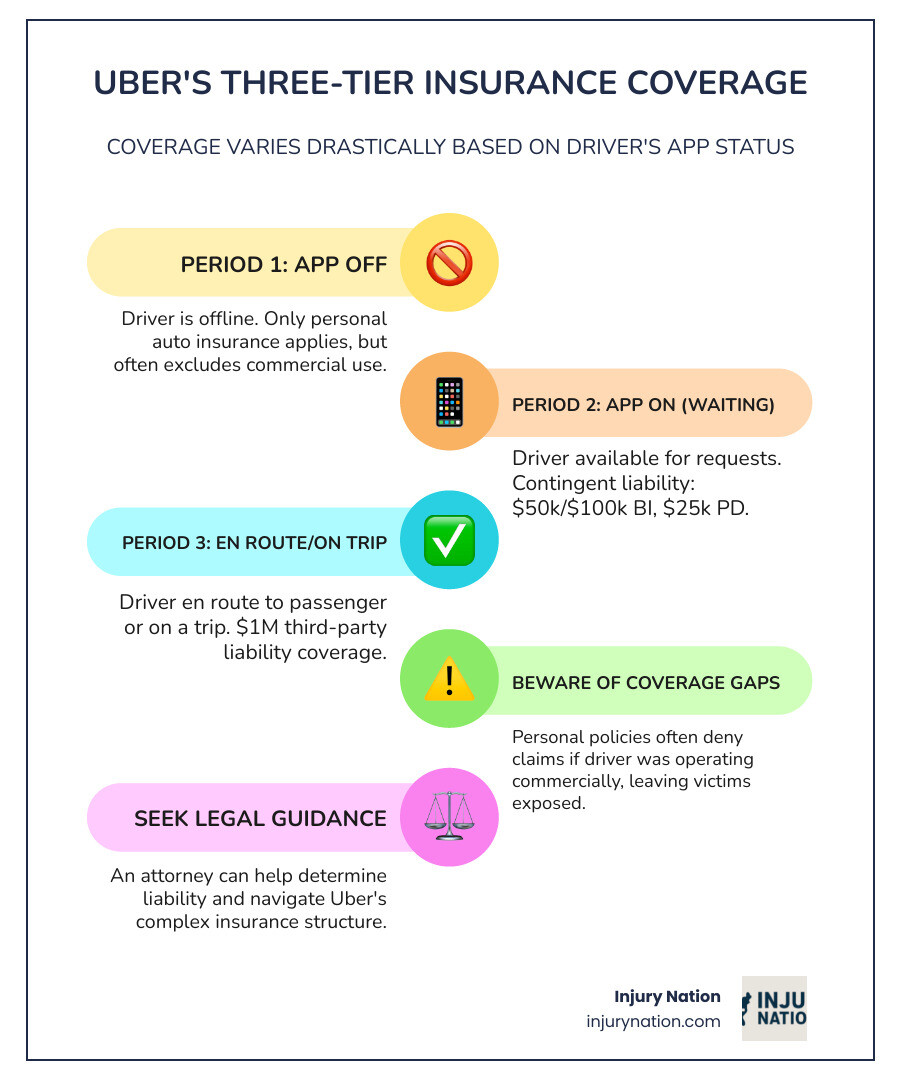
In an Uber accident case, the available insurance coverage can vary wildly depending on the driver’s status at the moment of the crash. Coverage can range from nothing to a full $1 million policy.
This tiered system is a confusing aspect of rideshare accidents that catches many victims off guard. Understanding which “period” applies to your situation is crucial because it directly determines how much compensation you can recover.
Uber structures its insurance into three periods based on the driver’s app status. Think of it as a traffic light: off, waiting, and active. Each period triggers different policies with different limits. You can find the full details in Uber’s insurance policy details, but we’ll break down what matters for your claim.
Here’s how Uber’s insurance coverage works depending on the driver’s status:
| Driver Status | Insurance Coverage | Notes |
|---|---|---|
| App Off | Driver’s personal insurance only | Commercial use often excluded; significant coverage gaps possible |
| App On (Waiting for Request) | Contingent liability: $50k/$100k bodily injury, $25k property damage | Uber’s coverage is secondary to driver’s personal policy |
| En Route/On Trip | $1 million liability coverage + uninsured/underinsured motorist protection | Full commercial coverage for passengers and third parties |
The difference between these periods can mean the difference between a $25,000 maximum payout and a $1 million policy. Let’s look at each period.
Period 1: Driver is Offline or App is Off
When the Uber app is off, the driver is like any other person on the road, and only their personal auto insurance applies. Uber provides zero coverage during this period.
This gets tricky: most personal auto policies have a commercial use exclusion. If the insurance company finds the driver was working for Uber, they might deny the claim entirely. Many drivers don’t realize their personal policy won’t cover them.
This creates a dangerous coverage gap. If you’re hit by an off-duty Uber driver whose insurance denies the claim, you could have limited recovery options. Documenting the driver’s status and having an attorney review all policies is critical.
Period 2: Driver is Available and Waiting for a Ride Request
Once the driver turns on the Uber app and is waiting for a ride, Uber’s contingent liability coverage kicks in. This provides $50,000 per person and $100,000 per accident for bodily injury, plus $25,000 for property damage.
The word “contingent” is important. This coverage only applies if the driver’s personal insurance denies the claim or is insufficient. Uber’s policy is a backup, not the primary source of compensation.
For minor accidents, this might be enough. But for serious injuries requiring extensive medical treatment, these limits can be exhausted quickly, leaving you responsible for the difference unless other insurance is available.
This period applies from when the driver logs in until they accept a ride request. If you’re hit by a driver waiting for their next passenger, this is the coverage tier that applies.
Period 3: Driver is En Route to a Passenger or On a Trip
This is where Uber’s insurance coverage is most robust. Once a driver accepts a ride request and is either heading to a pickup or transporting a passenger, Uber provides $1 million in liability coverage. This policy also includes uninsured and underinsured motorist protection at the same $1 million limit.
If you’re an Uber passenger injured during your ride, this coverage protects you. If you’re a pedestrian, cyclist, or driver in another vehicle hit by an Uber driver in this period, you’re also covered.
This $1 million policy is a commercial plan designed for serious accidents. It covers medical expenses, lost wages, pain and suffering, and other damages up to the limit. For most accidents, this is sufficient, though catastrophic injuries can exceed this amount.
The challenge is proving which period applied. Uber tracks this data, but obtaining it may require legal intervention. Insurers might dispute the active period to avoid paying from the larger policy. This is another reason why experienced legal representation in your Uber accident case can make a substantial difference.
Understanding Liability: Who Is Responsible in an Uber Accident?
If you’re injured in an Uber accident, the first question is: who pays? Unfortunately, the answer is rarely straightforward.
Unlike a typical fender bender, an Uber accident case can involve multiple insurance companies pointing fingers at each other. You might deal with the Uber driver’s personal insurance, Uber’s commercial policy, and another driver’s coverage simultaneously. It’s a complex puzzle.
The key to fair compensation is figuring out who was at fault. Was it the Uber driver, another motorist, or someone else? The answer determines which insurance policies apply and how much you can recover.
Here’s where it gets tricky: Uber drivers are classified as independent contractors, not employees. This legal distinction means you generally can’t sue Uber for a driver’s mistakes like you could a traditional employer. The company has built a legal wall between itself and its drivers—but that wall isn’t always solid.
There are situations where you can hold Uber directly responsible, particularly if the company was negligent in screening drivers or if its technology contributed to the crash. We’ll get to those exceptions in a moment.
For now, understand that determining liability requires solid evidence. Police reports are your foundation—they document the scene and often indicate fault. Witness statements can corroborate your story. Dashcam footage and Uber’s own trip data can also be crucial pieces of your case.
Without a clear determination of fault, insurance companies will drag their feet and try to pay as little as possible.
The Driver’s Status: Employee vs. Independent Contractor
The “independent contractor” classification is Uber’s legal shield. By classifying drivers this way, Uber avoids vicarious liability—the legal principle that makes employers responsible for their employees’ actions.
In plain English: if an Uber driver causes an accident, you typically can’t sue Uber directly. Your claim goes against the driver and the applicable insurance. Uber gets to say “not our problem.”
But that shield has cracks.
Negligent hiring or retention is a major exception. If Uber hired a driver with a history of DUIs who then caused your accident while impaired, you might have a case against the company. This applies if Uber failed to conduct a proper background check or ignored a driver’s dangerous history.
The same goes for negligent retention. If multiple passengers reported a driver for dangerous behavior but Uber ignored the complaints, the company could be liable for failing to remove them from the road.
Another exception involves technology or policy failures. If Uber’s app malfunctioned and directed the driver into traffic, or a company policy encouraged unsafe driving, you might be able to hold Uber accountable.
These cases are incredibly complex. You’re going up against a company with deep pockets and a dedicated legal team. Proving company negligence requires thorough investigation and a lawyer who knows rideshare law.
When Another Party is At Fault
Not every Uber accident is the Uber driver’s fault. Many are caused by other drivers.
If you’re in an Uber and a distracted driver hits you, that driver’s insurance is the primary target for your claim. The same applies if you’re hit by an uninsured drunk driver or a commercial truck. The at-fault party’s insurance should cover your damages.
But what happens when the at-fault driver is uninsured or their coverage is inadequate?
This is surprisingly common. Nevada has minimum insurance requirements, but they often don’t cover serious injuries. If someone with bare-minimum coverage causes a catastrophic accident, you could face huge unpaid medical bills.
That’s where Uber’s insurance policies act as a safety net. When the at-fault driver is uninsured or underinsured, Uber’s policy may cover the gap. This multi-layered system means you’re not left holding the bag because someone else was driving without adequate protection.
The challenge? Getting multiple insurance companies to cooperate is difficult. Each insurer will try to shift responsibility, hoping you’ll accept a low settlement. They’ll dispute fault, question your injuries, and drag out the process.
This is why an experienced attorney is critical. They know how to identify all available insurance policies, file claims with each, and push back when insurers try to dodge their responsibilities.
Uber’s Tiered Insurance System: How Driver Status Affects Your Claim
Here’s something that catches most people off guard: the insurance coverage available in your Uber accident case can swing from almost nothing to $1 million. It all depends on one simple factor—whether the driver’s app was on or off when the crash happened.
This is where things get complicated. Uber’s insurance policy details are structured around three distinct periods, each tied to the driver’s actions at the moment of the collision. Was the app off? Were they waiting for a request? Or were they transporting a passenger? Each scenario triggers different coverage levels, and understanding these distinctions is critical.
This system is genuinely complex, and many victims don’t realize how much the available insurance can vary. A driver’s personal policy might deny a claim for commercial use, while Uber’s policy may not apply if the driver was waiting for a ride. These coverage gaps can leave injured people scrambling for compensation.
Let’s break down exactly how this tiered system works in Nevada, so you know what to expect:
| Driver Status | Insurance Coverage | What This Means for You |
|---|---|---|
| Period 1: App is Off | Driver’s personal insurance only | The driver’s personal policy applies, but most exclude commercial use. This can create serious coverage gaps, and claims are often denied. |
| Period 2: App On, Waiting for Request | Uber’s contingent liability coverage: $50,000 per person / $100,000 per accident for bodily injury; $25,000 for property damage | This coverage only kicks in if the driver’s personal insurance denies the claim. The limits are low and may not cover serious injuries. |
| Period 3: En Route or Passenger On Board | Uber’s $1 million liability coverage, plus uninsured/underinsured motorist protection | This is the strongest coverage period. Whether you’re a passenger, pedestrian, or in another vehicle, this policy can cover your damages. |
Period 1: Driver is Offline or App is Off
When the Uber app is off, the driver is just another person on the road. In this scenario, only the driver’s personal auto insurance policy applies—and this is where it gets tricky.
Most personal policies have a “commercial use exclusion.” This means if the insurer finds the driver was engaged in commercial activity, they might deny coverage. Even if the app was off at the moment of the crash, adjusters will look for any reason to deny the claim.
This creates a potential coverage gap that can leave you without a clear path to compensation. If the driver’s personal insurance denies the claim and Uber’s coverage doesn’t apply, you might be in a difficult situation.
Period 2: Driver is Available and Waiting for a Ride Request
Things improve slightly when the driver has their app on and is waiting for a ride request. During this period, Uber provides contingent liability coverage.
This includes: $50,000 per person and $100,000 per accident for bodily injury, plus $25,000 for property damage. The key word is “contingent”—this coverage only applies if the driver’s personal insurance denies the claim first.
In practice, you’ll likely face a denial from the driver’s personal insurer before Uber’s policy steps in. While this coverage is better than nothing, the limits are modest. If you’ve suffered serious injuries, $50,000 might not come close to covering your actual damages.
This period is a middle ground in Uber’s insurance structure—coverage is available, but it’s not as robust as in Period 3.
Period 3: Driver is En Route to a Passenger or On a Trip
This is the golden period for insurance coverage in an Uber accident case. Once a driver accepts a ride request and is either heading to a pickup or transporting a passenger, Uber’s full $1 million liability policy kicks in.
This substantial coverage applies to injuries you suffer as a passenger, a pedestrian, or an occupant of another vehicle. The policy also includes uninsured and underinsured motorist coverage, protecting you if another driver causes the accident but lacks adequate insurance.
For passengers, this period offers the strongest protection. If you’re injured while riding in an Uber, this million-dollar policy is available to cover your medical bills, lost wages, pain and suffering, and other damages.
The difference between Period 2 and Period 3 coverage is night and day. That’s why determining the driver’s app status at the exact moment of the accident is so crucial to your case. A few seconds’ difference could mean the difference between $50,000 in available coverage and $1 million.