

Understanding Your Workers Compensation Rights in Las Vegas
If you were hurt on the job in Las Vegas, you may have important legal protections under Nevada’s workers compensation system. For many people, the hardest part is not just dealing with the injury. It is figuring out how to report it, how to get medical care approved, how wage replacement works, and what to do if the insurance company delays or denies part of the claim.
This guide explains workers compensation rights Las Vegas employees should understand after a workplace injury. It covers Nevada workers compensation basics, benefits that may be available, common mistakes, and what to expect during the claims process. It also explains how Injury Nation supports injured workers seeking help with workers compensation claims in Las Vegas.
FAQ: Workers Compensation Rights in Las Vegas
What are my workers compensation rights in Las Vegas?
In general, if you are injured at work in Las Vegas, Nevada law may give you the right to report the injury, seek authorized medical treatment, pursue benefits for lost wages if you cannot work, and receive compensation for lasting impairment when applicable. You may also have the right to challenge claim denials, disputes about treatment, or disagreements about disability status.
Do I need to prove my employer was negligent?
No. Workers compensation is generally a no-fault system. That means benefits are usually based on whether the injury arose out of and in the course of employment, not on whether your employer intended harm or acted carelessly. However, that does not mean every claim is automatically accepted. You still need to document the injury properly and follow the claim process.
What types of workplace injuries may be covered?
Coverage can apply to many job-related injuries and occupational conditions, including slip-and-fall injuries, lifting injuries, repetitive stress injuries, machinery accidents, back injuries, head trauma, burns, exposure-related illnesses, and injuries from vehicle accidents that happen while performing work duties.
How soon should I report a work injury in Nevada?
You should report it as soon as possible. Delay can create problems with credibility, medical authorization, and benefit eligibility. Prompt reporting also helps establish that the injury happened in connection with your job.
Can I choose my own doctor?
In many Nevada workers compensation cases, treatment must go through an authorized medical provider within the employer’s or insurer’s approved network or process. Getting treatment outside approved channels without guidance can create disputes about payment and coverage. Because this issue can be very fact-specific, it is important to understand the rules that apply to your claim.
What if my claim is denied?
A denial does not always mean the end of the claim. Some denials are based on missing records, late reporting, disputes about causation, or insurer disagreement over whether the condition is work-related. Injured workers may have options to appeal or challenge the denial.
Can I be fired for filing a workers compensation claim?
Employers generally cannot lawfully retaliate against workers simply for asserting valid rights under the law. But workplace situations can become complicated fast. If you suspect retaliation, sudden job changes, pressure not to report, or adverse treatment after filing, document what happened and speak with a legal professional promptly.
Can I sue my employer instead of filing workers compensation?
In many cases, workers compensation is the primary remedy for work-related injuries. However, there can be exceptions or related claims involving third parties, such as negligent drivers, contractors, property owners, or equipment manufacturers. A legal review can help determine whether there is only a workers compensation claim or whether another claim may also exist.
Why Workers Compensation Rights Matter for Las Vegas Employees
Las Vegas has one of the most varied work environments in the country. The local economy depends on hospitality, casinos, entertainment venues, hotels, restaurants, convention work, retail, warehouse operations, construction, transportation, healthcare, and service industries. That means workers in Clark County face many different injury risks.
A hotel housekeeper may develop a shoulder injury from repetitive lifting and cleaning tasks. A kitchen worker may be burned or slip on a wet floor. A warehouse employee may suffer a back injury while moving inventory. A construction worker may fall from height or be struck by equipment. A rideshare or delivery worker performing job duties may be hurt in a collision. A casino employee may experience repetitive stress injuries, slips, security-related incidents, or injuries during long shifts on hard surfaces.
Although these jobs differ, the legal question is often the same: did the injury arise out of and in the course of employment, and what benefits should now be paid?
Understanding your rights matters because many workers do not realize how easy it is for a valid claim to become complicated. A supervisor may tell the worker to “wait and see.” An insurer may request recorded statements or paperwork the worker does not fully understand. A doctor may release the employee back to work with restrictions the employer says it cannot accommodate. The claim may then shift into a dispute over temporary disability, treatment approval, or whether the condition is really job-related.
The earlier you understand the process, the better positioned you are to protect your health, your income, and your ability to challenge decisions that do not reflect your real condition.
Overview of Nevada Workers Compensation Laws
Nevada workers compensation law generally requires employers to provide industrial insurance coverage for employees. When an employee suffers a covered workplace injury or occupational disease, that system may provide medical treatment and other benefits without requiring the employee to prove fault in the traditional lawsuit sense.
That said, “no-fault” does not mean “automatic.” Claims still move through a structured process, and insurers often examine whether:
- The injury was reported on time
- The accident happened during work duties
- The medical evidence supports the claim
- The employee followed required procedures
- The need for treatment is related to the workplace injury rather than a preexisting condition or outside event
In Nevada, workers compensation cases frequently involve forms, deadlines, medical documentation, and insurer decisions that can affect whether benefits are paid. A worker may need to report the injury to the employer, seek treatment through proper channels, submit required claim forms, and respond if the insurer requests more information.
For Las Vegas workers, practical reality is important. On paper, the law provides rights. In practice, those rights are easier to enforce when the injured person documents everything carefully and gets guidance before small issues become major setbacks.
Who is generally covered?
Many employees in Nevada are covered by workers compensation, but coverage questions can arise in cases involving:
- Independent contractor classification disputes
- Temporary staffing arrangements
- Seasonal or event-based employment
- Gig-type work situations
- Multiple employers at a job site
Las Vegas has many workers in hospitality, event staffing, entertainment support, and subcontracted services. In these industries, people are sometimes unsure who their employer legally is or which insurance policy applies. That uncertainty can delay benefits if not addressed early.
What does “arising out of and in the course of employment” mean?
This phrase basically refers to whether the injury is sufficiently connected to the job. If you were performing work duties, on the work premises, engaged in tasks for your employer, or otherwise acting within the scope of employment, the claim may be covered. But factual disputes often arise in gray areas, such as:
- Injuries during breaks
- Parking lot accidents
- Travel between job sites
- Off-site errands for work
- Work-sponsored events
- Cumulative trauma injuries that developed over time
These are exactly the kinds of situations where workers often benefit from experienced legal guidance.
What Benefits May Be Available to Injured Workers?
One of the biggest concerns after a workplace injury is simple: what help can I actually receive? Nevada workers compensation benefits can vary based on the seriousness of the injury, whether you can work, and whether you fully recover.
Medical treatment
Workers compensation may cover reasonable and necessary medical care related to the work injury. This can include:
- Emergency treatment
- Doctor visits
- Hospital care
- Diagnostic testing
- Imaging such as X-rays or MRIs when authorized
- Medications
- Physical therapy
- Specialist referrals
- Surgery when medically supported and approved
Medical treatment disputes are common. The insurer may approve some care but deny other treatment as unnecessary, unrelated, or unsupported. In a city like Las Vegas, where many workers have physically demanding jobs and irregular schedules, treatment delays can quickly affect recovery and income.
Temporary total disability benefits
If your doctor says you cannot work for a period of time due to the injury, you may be entitled to temporary disability wage-loss benefits. These benefits are meant to replace part of your income while you recover.
Issues often arise when:

- The doctor takes the worker completely off work
- The doctor gives restrictions but the employer says no light duty is available
- The insurer argues the employee can return before the worker feels medically ready
- There are disputes over average wage calculations
For workers living paycheck to paycheck in Las Vegas, even a short interruption in benefits can create serious stress involving rent, utilities, transportation, and household expenses.
Temporary partial disability or restricted-duty issues
Some workers are not fully off work, but they cannot return to their normal duties. They may have lifting limits, standing restrictions, no repetitive motion, no driving, or reduced hours. Whether benefits are available in these situations can depend on earnings loss, restrictions, and whether modified work is offered.
This is one area where misunderstandings are common. Workers sometimes assume that if they are doing any work at all, they cannot receive help. That is not always true.
Permanent partial disability benefits
If you reach a point of maximum medical improvement and still have lasting impairment, you may be evaluated for permanent partial disability. This is often a complex stage of the claim because impairment ratings and future limitations can affect benefit value.
Workers may need help understanding:
- What the rating means
- Whether the evaluation fairly reflects the injury
- How the insurer calculated the benefit
- Whether other disputes remain open regarding work restrictions or future care
Vocational rehabilitation or return-to-work support
Some workers cannot safely return to the same type of job they had before the injury. Depending on the circumstances, vocational issues may become important. For example, a Las Vegas warehouse employee with a major back injury may not be able to resume heavy lifting work. A casino or hospitality worker with permanent restrictions may need a different role.
When injuries affect long-term work capacity, practical planning matters just as much as legal process.
Mileage reimbursement and related claim costs
In some situations, workers may be entitled to reimbursement for mileage or other approved expenses tied to medical treatment. These smaller benefits are often overlooked, but they can matter, especially when appointments become frequent.
Death benefits for surviving family members
When a workplace accident is fatal, surviving dependents may have rights under Nevada law. These claims are especially sensitive and require careful legal handling.
Common Types of Workplace Injuries in Las Vegas
Las Vegas workers compensation claims reflect the city’s unique employment patterns. The local workforce includes hotel and casino staff, convention workers, construction crews, delivery drivers, healthcare employees, restaurant staff, maintenance teams, office workers, and entertainment support personnel.
Hospitality and casino injuries
Workers in hotels, resorts, restaurants, and casinos often face injuries involving:
- Slips and falls on wet or polished surfaces
- Back and shoulder strain from lifting supplies or linens
- Repetitive stress injuries from cleaning or service tasks
- Burns in kitchen environments
- Foot, knee, and leg pain from prolonged standing or walking
- Assault-related injuries in security or guest-facing roles
Construction injuries
Construction work in and around Las Vegas can involve falls, scaffold incidents, ladder accidents, heavy equipment injuries, struck-by incidents, electrical injuries, and repetitive trauma from physically demanding labor.
Transportation and driving injuries
Workers who drive as part of their jobs may suffer injuries in motor vehicle collisions while making deliveries, transporting passengers, visiting job sites, or handling employer business. These cases can involve both workers compensation and possible third-party claims against negligent drivers.
Warehouse and logistics injuries
Distribution and warehouse workers may face forklift incidents, loading dock injuries, crushing injuries, lifting strain, falls, and repetitive motion injuries involving scanning, packing, pulling, and sorting.
Healthcare injuries
Nurses, aides, technicians, and other healthcare workers may suffer lifting injuries, patient-transfer injuries, exposure-related illnesses, needlestick incidents, slips, and workplace violence injuries.
What to Do Immediately After a Workplace Injury in Las Vegas
The first hours and days after an injury can shape the rest of the claim. If you are hurt at work, practical action matters.
1. Report the injury right away
Notify a supervisor, manager, employer representative, or designated contact as soon as possible. Do not assume the injury is too minor to mention. Small injuries can become serious later, and delayed reporting gives insurers a reason to question the claim.
2. Seek medical attention through the proper process
Get medical care promptly. If it is an emergency, emergency treatment comes first. For non-emergency care, make sure you understand whether your employer or the insurer requires treatment through a specific authorized provider or network.
3. Explain clearly how the injury happened
Be accurate and consistent. Tell the doctor and employer what body parts were affected, what task you were doing, when symptoms started, and whether the condition followed a single event or developed over time.
4. Document everything
Keep copies of:
- Incident reports
- Medical records
- Work restriction notes
- Benefit letters
- Denial notices
- Emails or texts with supervisors
- Mileage logs for treatment travel
5. Follow medical restrictions
If a doctor gives you restrictions, take them seriously. Returning to full duty too early can worsen the injury and create disputes later about whether your ongoing problems are really work-related.
6. Be cautious with statements
Insurance representatives may contact you for information. While cooperation is part of the process, you should understand what is being asked, why it matters, and how your words could be used in a dispute over causation, work status, or treatment needs.
7. Get legal help if problems arise
If your claim is delayed, denied, underpaid, or met with pressure from the employer or insurer, legal support can be important very early in the process.
What to Expect During a Nevada Workers Compensation Claim
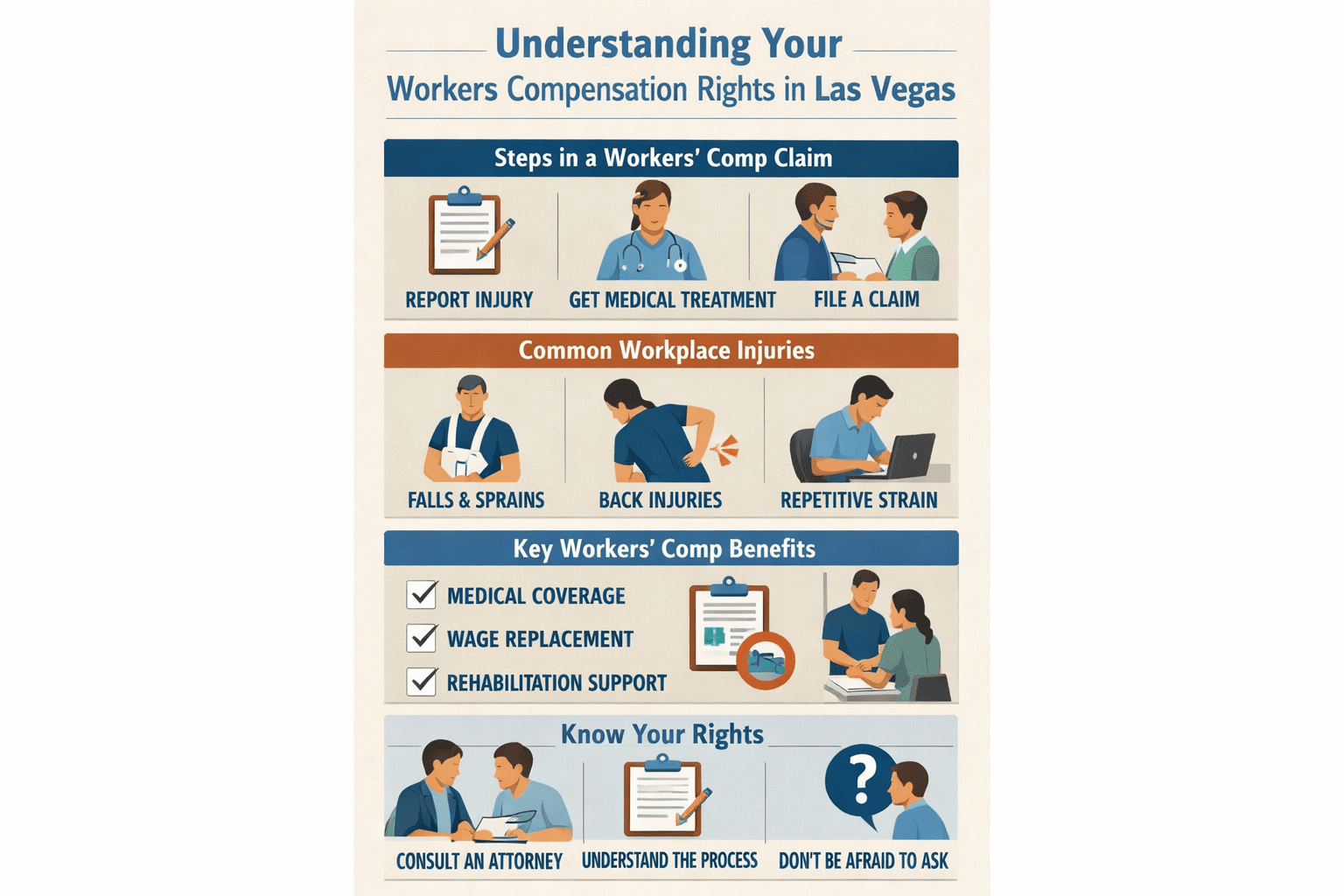
Many people want to know what the process actually looks like from start to finish. While every case is different, a workers compensation claim in Las Vegas often follows this general path.
Initial report and claim filing
The worker reports the injury and the formal claim process begins. This stage may involve employer paperwork, medical documentation, and insurer review.
Medical treatment and work status decisions
The treating provider evaluates the injury, recommends care, and determines whether the worker can return to work, needs restrictions, or must remain off work temporarily.
Insurer acceptance or denial decision
The insurer may accept the claim, accept it in part, or deny it. Even after acceptance, specific treatment requests or periods of disability may still be disputed later.
Benefit payments and ongoing care
If the claim is moving forward, medical treatment continues and disability benefits may begin if the worker cannot earn normal wages due to the injury.
Disputes, appeals, or hearings if necessary
If there are disagreements about compensability, medical necessity, work restrictions, impairment, or disability payments, the worker may need to pursue review or appeal procedures.
Maximum medical improvement and permanent impairment issues
Eventually, the worker may reach a stage where recovery has stabilized. At that point, questions often arise about permanent impairment, future limitations, and whether the worker can return to the same occupation.
Knowing these stages in advance helps workers avoid panic when something changes in the claim. Many problems are not unusual, but they do need timely response.
Common Misconceptions About Workers Compensation
Misunderstanding the system can cause workers to lose time, miss deadlines, or give up benefits they may have had a right to pursue. Here are some of the most common misconceptions about workers compensation in Las Vegas.
Misconception: “If it was partly my fault, I cannot get benefits.”
Workers compensation is generally not based on proving employer fault the way a regular injury lawsuit is. A claim may still be valid even if the worker made a mistake, as long as the injury arose out of the employment and no specific legal exclusion applies.
Misconception: “If I did not report it the same minute it happened, I have no case.”
Delay can hurt a claim, but delayed reporting does not automatically erase rights in every situation. Some injuries develop gradually, and some workers do not realize the severity immediately. The key is to act quickly once you recognize there may be a work-related injury.
Misconception: “I can only get benefits if I was injured in a dramatic accident.”
Not true. Many valid workers compensation claims involve cumulative trauma, repetitive strain, overexertion, or worsening symptoms over time. A back injury from repeated lifting can be just as real as an injury from a fall.
Misconception: “If the employer says there is no light duty, I am out of luck.”
Not necessarily. If a doctor restricts your work and the employer cannot accommodate those restrictions, wage-loss benefits may still be an issue in the claim.
Misconception: “If the claim is denied, that is final.”
A denial can often be challenged. The outcome may depend on the reason for denial, the available medical evidence, and whether deadlines for review or appeal are met.
Misconception: “Workers compensation covers pain and suffering like a personal injury lawsuit.”
Workers compensation benefits are different from a standard negligence lawsuit. They usually focus on medical care, wage-loss benefits, and disability-related compensation rather than general pain and suffering damages. However, in some situations there may also be a separate third-party personal injury claim if someone other than the employer caused the injury.
Misconception: “If I have a preexisting condition, I cannot file a claim.”
Preexisting conditions do not automatically bar a claim. Many disputes center on whether work aggravated, accelerated, or worsened a prior issue. That question often requires detailed medical evidence.
Warning Signs That You May Need Legal Help
Some workers compensation claims move relatively smoothly. Others become difficult very quickly. You may want legal guidance if any of the following happen:
- Your employer tells you not to report the injury
- You are pressured to use personal health insurance instead of workers compensation
- Your claim is denied
- Your treatment is delayed or cut off
- The insurer disputes whether the injury is work-related
- You are sent back to work before you are medically ready
- Your restrictions are ignored
- Your wage benefits seem too low
- You are told your injury was preexisting without a fair review
- You face retaliation, schedule cuts, or sudden discipline after reporting the injury
- You suffered a serious or permanent injury
- A third party may also be responsible for the accident
These situations are especially important in serious cases involving surgery, long-term disability, or inability to return to prior work.
How Injury Nation Supports Workers Compensation Claimants in Las Vegas
Injury Nation helps injured people understand their legal options after accidents and workplace injuries. When a Las Vegas worker is trying to navigate a workers compensation claim, legal support can make the process clearer and more manageable.
Clear guidance without unnecessary legal jargon
Workers compensation law can feel technical very fast. Injury Nation focuses on explaining what is happening in practical terms: what paperwork matters, what deadlines may apply, what the insurer is disputing, and what steps may help protect the claim.
Help evaluating denials and disputes
If your claim was denied, the key question is why. Was the denial based on late notice, causation, treatment disputes, alleged lack of medical support, or employment status issues? Injury Nation helps claimants identify the real issue and assess what comes next.
Support with medical and wage-loss issues
Many disputes are not about whether an injury happened at all. They are about whether treatment should continue, whether surgery should be approved, whether temporary disability payments are correct, or whether work restrictions are being taken seriously. These issues can be just as financially important as the initial claim decision.
Attention to possible third-party claims
Some workplace injuries involve more than workers compensation. For example, if a Las Vegas delivery driver is hit by another motorist while working, there may be a workers compensation claim and a separate third-party motor vehicle claim. If a construction worker is injured by defective equipment or another contractor’s negligence, there may be additional legal issues beyond the comp claim alone.
Because Injury Nation is focused on personal injury legal representation as well as workers compensation-related support, claimants can get a more complete evaluation of potential avenues for recovery.
Free consultations and 24/7 emergency legal help
Workers compensation problems do not always arise during normal office hours. Injury Nation offers free consultations and immediate legal assistance for people who need direction after a serious injury, denial, or urgent claim problem.
Examples of Real-World Claim Problems Las Vegas Workers Face
The facts differ from case to case, but these examples show how common problems develop.
Example 1: The “wait a few days” problem
A hotel worker strains her back while lifting heavy laundry bags. Her supervisor tells her to go home, rest, and see how she feels. Three days later the pain is worse, and now the insurer questions whether the injury really happened at work because there was a reporting delay and no immediate treatment.
Lesson: report promptly and seek documented medical evaluation through the proper process.
Example 2: The “light duty is available” dispute
A warehouse employee is given restrictions against lifting more than ten pounds. The employer says light duty is available, but the actual tasks still require bending, carrying, and repeated twisting. The worker tries to continue and the condition gets worse.
Lesson: restrictions should be clearly documented and realistically matched to job tasks.
Example 3: The preexisting condition defense
A casino maintenance worker with occasional prior back pain suffers a serious aggravation after moving equipment. The insurer argues it is just the old condition. But the worker had been doing full-duty work before the incident and now has substantially worse symptoms and new limitations.

Lesson: preexisting issues do not automatically defeat a claim, especially when work materially worsens the condition.
Example 4: The dual claim situation
A Las Vegas employee driving between job sites is rear-ended by another driver. The worker may have a workers compensation claim because the injury happened during work duties, and there may also be a separate claim against the negligent driver.
Lesson: some work injuries involve more than one legal path.
Decision Factors: When Is a Workers Compensation Claim Straightforward, and When Is It Complex?
Some claims are simpler than others. Factors that can increase complexity include:
- Serious injuries requiring surgery
- Neck, back, or head injuries with subjective symptoms
- Cumulative trauma claims
- Disputes about whether the worker was acting within job duties
- Independent contractor classification issues
- Conflicting medical opinions
- Permanent restrictions affecting future employment
- Employer retaliation concerns
- Possible third-party liability
If your case involves one or more of these issues, it is wise to get advice sooner rather than later.
How Las Vegas Work Environments Can Affect a Claim
Local context matters. Las Vegas workers often have schedules and work conditions that create unique claim challenges.
Shift work and overnight jobs
Many hospitality and casino employees work overnight or rotating shifts. That can affect how quickly an injury is reported, where treatment is obtained, and whether witnesses are available.
Seasonal surges and event staffing
Convention, event, and tourism-related staffing can involve temporary or layered employment relationships. That may create confusion about which company is responsible for the claim.
Physically demanding hospitality roles
Las Vegas relies heavily on workers performing repetitive physical tasks in hotels, restaurants, entertainment venues, and service operations. Injuries in these roles are not always caused by one dramatic incident; many develop over time.
Outdoor heat and construction conditions
Southern Nevada weather and construction conditions can increase fatigue, dehydration risks, and physically demanding exposure. While every case depends on its facts, environmental conditions may be important in understanding how the injury occurred.
Frequently Asked Questions About Workers Compensation Rights Las Vegas Employees Often Ask
Can I still file a claim if my injury got worse over several weeks?
Possibly. Not every valid claim comes from a single sudden event. Repetitive stress injuries and cumulative trauma can be covered, but these claims often require careful medical documentation connecting the condition to the work duties.
What if I was injured while driving for work in Las Vegas?
If you were performing work duties when the crash happened, workers compensation may apply. Depending on the facts, you may also have a claim against the at-fault driver.
What if my employer says I am an independent contractor?
Classification disputes can be complicated. Just because a company calls someone an independent contractor does not automatically settle the issue. The real working relationship matters.
Can I use my own doctor because I do not trust the employer’s process?
You should be careful here. Getting care outside the approved system without understanding Nevada requirements can create payment and coverage disputes. Before making assumptions, get guidance on how authorized treatment works in your case.
What if the insurance company approves some treatment but denies more testing or surgery?
Partial approval disputes are common. The issue may come down to medical necessity, causation, or whether the insurer believes the requested care is related to the workplace injury. These decisions can often be challenged.
What if I can work some hours, but not my normal schedule?
Reduced capacity can still raise wage-loss questions. Restricted work does not always mean the claim is over.
What if I am worried about losing my job?
That concern is common. Document communications, follow your medical restrictions, and speak with a lawyer if you believe your employer is punishing you for reporting the injury or filing a claim.
Can undocumented workers have rights after a workplace injury?
Employment and benefit issues can be sensitive and fact-specific. Workers should not assume they have no rights without getting legal advice about their specific situation.
How long will my workers compensation case take?
There is no one-size-fits-all timeline. A minor injury may resolve relatively quickly, while a serious injury involving surgery, disability disputes, or permanent impairment can take much longer.
Mistakes to Avoid After a Las Vegas Workplace Injury
- Failing to report the injury promptly
- Assuming the pain will just go away
- Leaving out body parts or symptoms when first describing the injury
- Ignoring doctor restrictions to avoid missing work
- Missing appointments
- Throwing away letters from the insurer
- Not keeping copies of forms and medical records
- Assuming a denial cannot be challenged
- Overlooking a possible third-party personal injury claim
- Waiting too long to get legal advice once problems appear
These mistakes are understandable. Injured workers are often in pain, worried about income, and trying to keep their jobs. But small errors early on can become major obstacles later.
What Makes Legal Representation Valuable in Workers Compensation Claims?
Workers compensation claims involve more than filling out forms. Legal representation can be valuable because it helps workers:
- Understand deadlines and procedural requirements
- Present medical evidence more effectively
- Respond to denials and disputes
- Identify underpaid or interrupted benefits
- Address return-to-work conflicts
- Evaluate permanent disability issues
- Spot related third-party claims
- Reduce the risk of saying or signing something that harms the case
For Las Vegas workers dealing with missed paychecks, treatment delays, and uncertainty about the future, having a knowledgeable advocate can make the process more manageable and more informed.
Conclusion: Protect Your Workers Compensation Rights in Las Vegas
A workplace injury can disrupt every part of your life. One day you are working a normal shift. The next day you are trying to manage pain, report the injury, get treatment approved, and figure out how you will pay your bills if you cannot return to work right away.
Understanding your workers compensation rights Las Vegas employees rely on is the first step. Nevada law may provide medical benefits, wage-loss support, and disability-related compensation, but the system often requires careful documentation and fast action. Delays, denials, treatment disputes, and return-to-work conflicts are common, especially in physically demanding industries across Las Vegas.
If you have questions about a work injury, a denied claim, restricted duty, missing benefits, or whether another legal claim may also exist, Injury Nation is here to help. We provide free legal consultations and 24/7 emergency legal help for injured workers who need practical answers and immediate support.
Contact Injury Nation today for a free consultation and get help understanding your options after a workplace injury in Las Vegas.