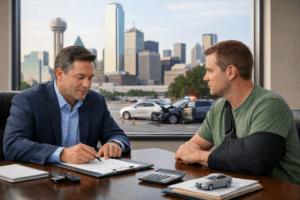

Personal Injury Legal Representation in Irvine: Uber and Lyft Accident Claims
A collision with an Uber or Lyft vehicle raises questions that an ordinary insurance exchange may not answer. Was the driver waiting for a request, heading to a pickup, carrying a passenger, or using the car personally? Those details can change which insurance applies—but they do not automatically establish who caused the crash.
If you are looking for a rideshare accident lawyer in Irvine, start by separating three issues: responsibility for the collision, available insurance, and the losses your injuries caused. This guide explains what to preserve, how to approach insurer communications, and when car accident legal representation may help.
After an Irvine Rideshare Crash: Protect Your Health and Your Claim
Whether the collision happens on the I-405, near the I-5 interchange, or along an Irvine street such as Jamboree Road or Culver Drive, immediate safety comes first. Seek emergency assistance for serious injuries, move out of traffic if you can do so safely, and do not stand in an active lane to take photographs.
Once immediate dangers are addressed:
- Exchange identifying information. Collect the drivers’ names, contact details, license information, license plates, and insurance information. A personal insurance card may not identify the insurer handling a rideshare claim.
- Ask about rideshare activity. Ask whether the driver was logged in to Uber or Lyft, had accepted a request, or was transporting someone. Record the answer without arguing.
- Identify the reporting agency. Depending on the location, Irvine Police or the California Highway Patrol may respond. Save the incident or report number and the agency’s name.
- Arrange medical evaluation. Describe your symptoms, how the impact occurred, and whether you struck anything inside the vehicle. Follow treatment recommendations and report new symptoms.
- Open a claim file. Keep photographs, medical paperwork, towing receipts, insurer messages, and work-absence records together.
Visible vehicle damage does not, by itself, establish how seriously someone was injured. If pain, headaches, dizziness, or limited movement develop later, obtain appropriate medical attention rather than waiting for an adjuster’s approval. Our guidance on when symptoms worsen after an Irvine crash explains why follow-up care and accurate documentation matter.
For rideshare passengers: Save the receipt, driver profile, route, pickup and destination information, and any messages within the app. Report the collision through the platform, but remember that an app report does not replace medical care, required government reporting, or appropriate insurance notice.
Why the Driver’s App Status Matters for Insurance Coverage
California rideshare insurance coverage depends heavily on the driver’s activity at the moment of the collision. The applicable policy, endorsements, statutory requirements, and crash date must be reviewed together. A rideshare sticker on a windshield is not proof that platform-related coverage applies.
| Driver’s status | Insurance question | Evidence that may help |
|---|---|---|
| App off; personal driving | The driver’s personal auto policy is generally the starting point, subject to its terms and other applicable coverage. | Login/logout history, driver statements, personal policy, and purpose of the trip. |
| App on; available for requests, but no accepted ride | California requires specified primary liability coverage during this waiting period. Coverage may be provided through the driver, the platform, or a combination. | Availability logs, request history, policy documents, and precise collision time. |
| Ride accepted; traveling to pick up the passenger | The accepted-trip liability requirements apply even though the passenger has not entered the vehicle. | Acceptance timestamp, pickup route, dispatch records, and cancellation history. |
| Passenger being transported | Trip-period liability coverage is relevant. Uninsured or underinsured motorist coverage requires a separate analysis. | Trip receipt, passenger account, route data, and trip completion records. |
Understand what a coverage limit does—and does not—mean
Under California Public Utilities Code section 5433, the waiting-for-a-request period requires primary liability coverage of at least $50,000 for death or personal injury per person, $100,000 per incident, and $30,000 for property damage. The statute also provides for at least $200,000 in additional excess liability coverage for the platform and driver during that period, subject to the statutory conditions. An attorney should examine how those layers apply rather than simply adding them together as an available settlement amount.
From acceptance of a ride request through completion of the ride, section 5433 requires primary liability coverage of at least $1 million. That requirement is not a promise of payment or a valuation of your claim. Liability, covered losses, policy terms, and competing claims can affect recovery. The linked statute should be checked against the version governing the collision date.
Liability coverage addresses covered harm an insured causes to others. Uninsured/underinsured motorist coverage addresses a different situation: injury caused by a driver who lacks sufficient applicable liability insurance. Do not assume the liability limit is also the UM/UIM limit. California’s rideshare UM/UIM requirements have changed, making the crash date and actual policy language especially important. Review the applicable statutory requirements alongside the policy before relying on a particular limit.
Hypothetical example: A driver accepts a pickup near Irvine Spectrum Center and collides with another car before reaching the passenger. An empty back seat does not establish that the driver was merely waiting for work. The acceptance timestamp may change the insurance analysis, while signal timing, lane movements, and other evidence determine fault.

Who May Be Responsible—and How Shared Fault Affects a Claim
Insurance availability is not the same as legal responsibility. A driver can be actively transporting a rideshare passenger without causing the collision. Conversely, a driver using the vehicle personally may be responsible even though platform coverage is unavailable.
Depending on the evidence, potentially responsible parties may include:
- The Uber or Lyft driver, for conduct such as an unsafe turn, distraction, or failure to yield.
- Another motorist, including a truck or delivery vehicle driver.
- A vehicle owner or employer, when a legally supported basis for liability exists.
- A maintenance provider or manufacturer, if a defect or negligent repair contributed to the collision.
- A public entity, in a qualifying dangerous-road-condition claim.
- The rideshare company, if the facts and applicable law support a claim against it—not simply because its app was involved.
California generally follows pure comparative negligence. An injured person’s damages may be reduced by their percentage of responsibility rather than automatically barred because they share fault. The Judicial Council’s civil jury instructions, including CACI No. 405, address comparative fault. An insurer’s initial allocation is a negotiating position, not a binding court determination.
For a rideshare passenger, the central dispute is often which driver caused the collision rather than whether the passenger drove negligently. A passenger may need to pursue more than one potentially responsible party while insurers investigate. Available UM/UIM coverage may also matter if the at-fault motorist lacks sufficient insurance.
If the rideshare vehicle was rented, that introduces another set of policy and contract questions. See our discussion of rental car accident claims in Irvine. Rental ownership alone does not establish the rental company’s liability.
Evidence to Preserve Before Trip Records and Video Disappear
Evidence should document both how the collision happened and what the rideshare driver was doing. You do not need to prove the entire claim at the roadside, and you should never access someone else’s phone or account without permission.
Preserve scene evidence safely
- Photograph vehicle positions, damage, plates, debris, traffic controls, lane markings, and blocked sightlines.
- Record the exact location, direction of travel, approximate time, and relevant intersection or freeway exit.
- Collect witness contact details and note whether a witness was a passenger, pedestrian, or nearby driver.
- Save original dashcam footage immediately; loop recording may overwrite it.
- Identify nearby businesses, parking facilities, or residences that may have recorded the event. Do not assume traffic cameras recorded or retained usable footage.
Preserve rideshare-specific information
If available, save the trip identification number, driver profile, vehicle listing, booking receipt, pickup and drop-off times, cancellation notices, and platform support messages. If the driver voluntarily shows an app screen, note what it displays and when. A screenshot taken after the crash may not establish the driver’s status at impact.
Write down statements promptly and distinguish direct quotations from your own impressions. Preserve complete messages and original files instead of relying only on cropped screenshots. Avoid deleting relevant posts, messages, or account history.
A lawyer can send preservation requests identifying relevant app logs, GPS data, dispatch records, communications, and video. Obtaining those records may require cooperation, authorization, or formal legal process. A preservation request is not a guarantee that every record exists or will be produced.
Tell prospective counsel about footage or app-status disputes early. These issues may require immediate work even when your medical prognosis remains uncertain. Ask whether specialized evidence retrieval or expert analysis could create separate case costs.
Insurance Communications, Damages, and California Deadlines
Keep insurer communications factual
Notify your own insurer promptly as required by your policy. Provide accurate information, preserve claim numbers, and maintain a log of calls and written communications. You may have contractual cooperation duties to your own insurer that differ from your obligations to another driver’s insurer.

Before giving a recorded statement, ask which insurer the adjuster represents, which policy is being investigated, and whether the request arises under your own coverage. Avoid guessing about speed, app status, or injury prognosis. If a question calls for information you do not know, say so.
Read medical authorizations and settlement releases carefully. Ask why an insurer needs particular records and whether an authorization can be limited appropriately. Do not assume a payment labeled “quick assistance” is separate from a release of injury claims; review the actual terms.
Document losses, not just medical bills
Recoverable damages depend on proof of fault, causation, and legally compensable loss. They may include reasonable medical expenses, supported future care needs, lost earnings, reduced earning capacity, property-related losses, and pain or limitations caused by the injuries. The California civil jury instructions, including the CACI 3900 series, explain categories of damages and relevant limitations.
Useful documentation includes treatment records, itemized bills, pay records, employer confirmations, transportation receipts, and a factual record of activities you can no longer perform comfortably. Tell treating professionals about relevant prior conditions; an aggravation may matter, but concealing medical history can undermine credibility.
A settlement’s gross amount is not necessarily the amount you receive. Attorney fees, case expenses, medical liens, and health-plan reimbursement claims may affect the net recovery. Ask how those obligations will be identified and addressed before agreeing to a settlement.
Calendar legal and reporting deadlines separately
California generally allows two years to file a personal injury lawsuit and three years for a property-damage lawsuit. Exceptions can change the calculation. Claims involving government entities commonly require an administrative claim within six months for personal injury or personal-property damage, followed by separate lawsuit deadlines. Consult the California Courts guide to statutes of limitations and obtain advice about the facts of your case.
Insurance negotiations ordinarily do not pause the lawsuit deadline. Policy notice requirements and UM/UIM procedures can create additional deadlines, so do not treat the general two-year period as permission to wait.
A separate California DMV SR-1 report is required within 10 days when a collision causes injury, death, or property damage exceeding $1,000. A police report or insurance claim does not replace it. See the California DMV’s collision reporting guidance for requirements and submission options.
How an Irvine Rideshare Accident Lawyer Can Help
Car accident legal representation in Irvine should address the specific coverage and evidence problems in your collision—not just forward medical bills to an adjuster. Depending on the case, counsel may:
- Investigate responsibility: Review reports, witness accounts, vehicle damage, video, and roadway conditions.
- Establish the relevant app period: Seek records showing availability, acceptance, cancellation, pickup, and trip completion.
- Map potentially applicable insurance: Examine personal, rideshare, commercial, rental-related, and UM/UIM coverage where relevant.
- Document damages: Connect medical evidence and financial records to the collision and assess supported future losses.
- Manage claims and deadlines: Communicate with adjusters, evaluate coverage positions, and preserve litigation options.
- Explain settlement choices: Discuss the evidence, disputed issues, costs, liens, and likely practical consequences of accepting or rejecting an offer.
When evaluating an Uber accident lawyer in Irvine or a Lyft accident attorney in Irvine, ask who will handle the file, who will answer routine questions, and how significant decisions will be explained. Request a clear discussion of app-status disputes, evidence preservation, and multiple-insurer claims. A credible evaluation should acknowledge uncertainty rather than promise a particular insurer will pay.
Injury Nation’s page on personal injury legal representation in Irvine provides a local service starting point. Our guide to choosing an Irvine lawyer during recovery also addresses communication and practical access while you manage treatment.

Frequently Asked Questions About Irvine Rideshare Claims
Can I pursue a rideshare insurance claim if the Uber or Lyft driver was waiting for a ride request?
Potentially, yes. California requires liability coverage during the logged-in, available-for-requests period, even before a ride is accepted. You still need to establish responsibility and covered damages. Determine whether the driver was actually available through the app, identify the applicable policies, and avoid assuming accepted-trip coverage applies to a waiting-period collision.
What if the driver says the app was off, but I believe they were working?
Preserve the reason for your belief: a passenger’s statement, a visible pickup route, an app notification, or a contemporaneous message. None necessarily resolves the issue alone. An attorney may seek platform logs, trip history, timestamps, and other records to test the account. Do not confront the driver or try to obtain private account information yourself.
Should I accept an insurance settlement before I understand my injuries?
Be cautious about signing a final injury release while diagnosis, treatment needs, or work restrictions remain unclear. A release usually ends the claims it covers, even if later treatment costs more than expected. You do not necessarily need to finish every treatment before evaluating settlement, but you should understand the medical uncertainty, supported future expenses, and rights you would give up.
How much does an Irvine rideshare accident lawyer charge, and are case costs separate?
Many personal injury lawyers use contingency-fee arrangements, in which the legal fee depends on a recovery. The percentage and conditions vary; do not assume a particular arrangement applies without reviewing the written agreement. Case costs—such as filing fees, medical records, depositions, or experts—may be separate.
Ask whether costs are deducted before or after the attorney’s percentage, whether the fee changes if litigation is necessary, and what you owe if there is no recovery. Also ask whether an initial consultation has a charge. Medical liens and reimbursement obligations are separate considerations that may reduce your net recovery.
How soon should I speak with an attorney, and how long could my claim take?
Consider an early discussion when injuries require ongoing care, fault is disputed, app status is unclear, several insurers are involved, or a release is being requested. Prompt advice can help preserve evidence without requiring you to decide immediately whether to hire counsel.
There is no reliable universal completion date. Treatment progress, access to platform records, coverage disputes, the number of injured people, and litigation can affect timing. Ask for the next concrete milestone and the factors that could delay it, rather than a guaranteed settlement date.
Discuss Your Irvine Crash and Legal Options
You do not need to know which insurance company is ultimately responsible before asking for legal help. The useful first step is to organize what you have and identify what remains uncertain.
Request car accident legal representation help in Irvine from Injury Nation for a collision involving an Uber or Lyft vehicle. Bring the crash date and location, insurance correspondence, report number, photographs, and any available trip information. An initial discussion can identify coverage questions, urgent deadlines, and whether representation is appropriate for your situation.
This article provides general information, not legal advice for a particular claim. Submitting an inquiry does not create an attorney-client relationship or guarantee case acceptance. Any representation must be separately confirmed with the attorney or firm.