

Why Federal Employees Struggle with OWCP Claims
Finding the best OWCP attorney can mean the difference between securing the benefits you deserve and facing years of denials and appeals. Here’s what to look for:
Top Qualities in an OWCP Attorney:
- Specialized federal employment law experience – Not just general workers’ comp
- Insider knowledge – Former OWCP claims examiners or federal agency attorneys
- Proven track record – Schedule awards ranging from $100,000 to $500,000+
- 99% success rates – Demonstrated ability to win claims and appeals
- Contingency fees – Typically 15-25% of settlement, no upfront costs
- National representation – Can handle claims anywhere in the country
The Office of Workers’ Compensation Programs (OWCP) administers the Federal Employees’ Compensation Act (FECA), which provides benefits to federal employees injured on the job. These benefits include medical coverage, wage loss payments, vocational rehabilitation, and schedule awards for permanent impairment.
But here’s the reality: the OWCP system has become adversarial over the years. What was designed to help federal employees has turned into a complex maze of forms, deadlines, and denials. Claims examiners may deny benefits due to insufficient medical evidence, and your agency isn’t necessarily on your side—even though they claim to be.
Federal workers face unique challenges that state workers’ compensation doesn’t address. You’re dealing with federal regulations, Department of Labor procedures, and a burden of proof that falls entirely on you. Missing a 30-day deadline or filing the wrong form (CA-1 versus CA-2) can derail your entire claim.
Having an attorney with insider experience—someone who worked at the FLRA, FAA, or as an OWCP claims examiner—gives you a critical advantage. They know how the system really works, what evidence convinces claims examiners, and how to steer the three levels of appeals when denials happen.
What Qualities Define the Best OWCP Attorney?
When you’re facing the complexities of an OWCP claim, you need more than just any lawyer. You need someone who truly understands the federal system and can fight effectively on your behalf. So what should you look for when searching for the best OWCP attorney?
Specialization in federal law is absolutely critical. Federal workers’ compensation operates under completely different rules than state workers’ comp. It’s governed by the Federal Employees’ Compensation Act (FECA) and administered by the U.S. Department of Labor’s OWCP. The forms are different, the deadlines are stricter, and the appeals process follows its own unique path. An attorney who handles state workers’ comp cases—even successfully—may struggle with federal claims because it’s truly a different beast. You need someone who lives and breathes FECA law.
Insider experience can give you a tremendous advantage. Some of the most effective OWCP attorneys are those who previously worked within the federal system itself. An attorney who has worked for agencies like the Federal Labor Relations Authority (FLRA) or the Federal Aviation Administration (FAA) brings invaluable perspective. Some firms even have retired OWCP Claims Examiners and former Legal Assistants to Federal Administrative Law Judges on their teams. These professionals know exactly what claims examiners look for in documentation, how decisions are made behind the scenes, and which arguments carry weight. It’s like having someone who knows the other team’s playbook.
A proven track record speaks louder than promises. While no attorney can guarantee specific results, their history of success tells you what they’re capable of achieving. Look for firms that report high success rates and have helped thousands of satisfied clients. It’s also important to find attorneys who have secured substantial schedule awards for their clients. We’re talking about real outcomes, with awards reaching $119,207, $171,814, $314,233, and even an impressive $520,620. These aren’t just statistics—they represent life-changing compensation that helped federal employees secure their financial futures after injury.
Client satisfaction reveals how an attorney really operates. Success rates matter, but so does the experience of working with an attorney throughout your claim. Strong testimonials tell you whether an attorney communicates clearly, responds promptly to questions, and genuinely cares about your outcome. Look for reviews that mention not just winning cases, but feeling supported and informed throughout the process. The best attorneys treat clients like people, not case numbers.
Peer recognition and professional honors can also signal exceptional expertise. Organizations like the Workers’ Injury Law & Advocacy Group (WILG) recognize top injured workers’ attorneys, and “Best Lawyers in America” highlights exceptional legal professionals based on peer review. Having an attorney who has earned recognition in this specialized field is a strong indicator of their expertise. While awards alone don’t tell the complete story, they do indicate that an attorney has earned respect within the legal community for their knowledge and skill.
The bottom line? The best OWCP attorney for your case combines specialized federal knowledge, a history of winning claims and appeals, genuine care for clients, and the communication skills to guide you through every step. When you’re dealing with the federal government and your financial future is on the line, settling for anything less just doesn’t make sense.
The Attorney’s Role: Navigating the Claims Process from Start to Finish
Navigating an OWCP claim without expert guidance is like trying to find your way through a maze in the dark. That’s where the best OWCP attorney becomes your most valuable ally, lighting the path from your initial injury all the way to securing the benefits you’ve earned.

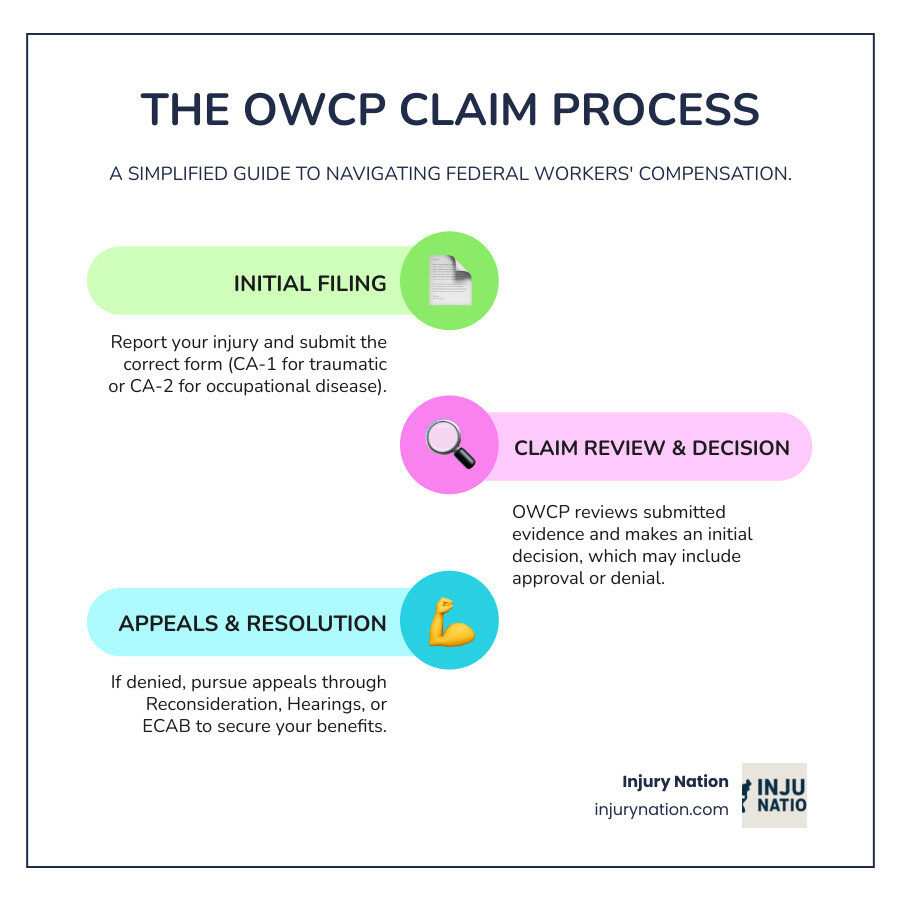
The journey starts with your initial application, and this is where precision matters most. Filing correctly the first time isn’t just important—it’s critical. You carry the burden of proof in these cases, and even small mistakes can trigger delays or outright denials that set you back months or even years. A skilled attorney ensures you complete the right forms from the start, whether that’s a CA-1 for a traumatic injury or a CA-2 for an occupational disease. They’ll double-check every detail, making sure nothing is overlooked.
Timing is everything in the OWCP world. Missing that crucial 30-day deadline for reporting your injury can derail your entire claim before it even gets off the ground. Your attorney keeps you on track, ensuring every form lands on the right desk at the right time.
Gathering evidence and medical documentation is where many federal employees struggle without legal help. Your attorney knows exactly what OWCP claims examiners need to see. They’ll work directly with your treating physicians to obtain clear, detailed medical reports that establish a direct connection between your injury or illness and your federal employment. This isn’t just about getting any medical report—it’s about getting the right medical report, written in language that satisfies OWCP’s specific requirements.
Form CA-20, which provides essential medical evidence linking your condition to workplace activity, is a perfect example. Your doctor might not know what OWCP needs to see in this form, but your attorney does. They bridge the gap between medical expertise and legal requirements, translating complex medical information into evidence that wins claims.
Understanding Different OWCP Claim Types
Not all injuries are created equal in the eyes of OWCP, and understanding which category your claim falls into shapes your entire strategy. Your attorney will guide you down the correct path, ensuring you file the right paperwork with the right evidence.
| Claim Type | Definition | Filing Requirements | Key Considerations |
|---|---|---|---|
| Traumatic Injury (Form CA-1) | A sudden, specific incident or event that occurs at a definite time and place during a single work shift, causing immediate injury. | Must be reported within 30 days; requires supervisor verification; needs specific incident details including exact date, time, and location. | Examples include slips, falls, lifting injuries, or vehicle accidents. The incident must be clearly identifiable and documented. Witness statements strengthen these claims. |
| Occupational Disease (Form CA-2) | An illness or condition that develops gradually over time due to workplace exposure or repetitive job duties. | No strict reporting deadline, but earlier is better; requires detailed work history; needs medical evidence linking condition to employment factors. | Common examples: carpal tunnel syndrome, hearing loss, respiratory conditions, stress-related illnesses. Proving causation is more complex and requires thorough medical documentation. |
| Recurrence of Injury (Form CA-2a) | When a previously accepted work-related injury or condition worsens or returns after a period of recovery. | Must show connection to original accepted claim; requires medical evidence of recurrence; often needs explanation of why condition returned. | Timing matters—long gaps between original injury and recurrence require stronger medical evidence. Your attorney can help demonstrate the causal link even years later. |
Why You Need the Best OWCP Attorney for a Schedule Award
Schedule awards represent some of the most significant benefits available under FECA, yet they’re also among the most misunderstood. These awards compensate federal employees for permanent impairment to specific body parts listed in the FECA schedule, including arms, legs, hands, feet, eyes, ears, and certain organs.
The key to maximizing a schedule award lies in understanding Maximum Medical Improvement (MMI)—the point when your condition has stabilized and is unlikely to improve further. Your attorney knows that timing your impairment rating request strategically can mean the difference between a modest payout and a life-changing sum.
With proper legal representation, real federal employees have received transformative schedule awards. For example, successful claims have resulted in awards of $119,207, $171,814, $314,233, and even an incredible $520,620. These aren’t just numbers—they represent justice for federal workers whose permanent impairments affect their quality of life forever.
Maximizing your impairment rating requires medical expertise and legal strategy working in concert. Your attorney will ensure your treating physician understands how to properly assess and document your permanent impairment. They’ll also know when to seek additional medical opinions if the initial rating doesn’t reflect the full extent of your limitations. Sometimes, waiting a few extra months for your condition to fully stabilize results in a higher rating and a substantially larger award.
Your attorney also understands the nuances of how different impairments are calculated. For example, hearing loss in both ears is evaluated differently than a single-ear loss. Multiple impairments to the same limb may be combined in specific ways. These technical details can dramatically impact your final award amount.
Handling Claim Denials and the Appeals Process
Claim denials happen, even to federal employees with legitimate injuries. OWCP has become increasingly adversarial over the years, and claims examiners often deny benefits for reasons that can be overcome with the right approach. This is where having the best OWCP attorney becomes absolutely essential.
Common denial reasons include insufficient medical evidence, failure to establish a causal relationship between your condition and your employment, missed deadlines, or incomplete forms. Sometimes, OWCP simply doesn’t believe your injury occurred as you described it. Each denial reason requires a different response strategy, and your attorney knows exactly how to address each one.
When you receive a denial, you have three main appeal options, each with strict deadlines. A Request for Reconsideration asks the same OWCP office to review their decision based on new evidence or arguments. This option works best when you have new medical evidence or can demonstrate that OWCP misunderstood or overlooked existing evidence.
A Request for Hearing brings your case before an OWCP hearing representative who conducts an independent review. This option gives you the chance to present your case in person, submit new evidence, and make oral arguments. Many federal employees find success at this level, especially with an attorney who knows how to present evidence persuasively.
If both of those options fail, you can appeal to the Employees’ Compensation Appeals Board (ECAB), which reviews whether OWCP followed proper procedures and correctly applied the law. ECAB appeals are highly technical and require precise legal arguments—this isn’t the place to go it alone.
Submitting new evidence is often the key to winning appeals. Your attorney knows what type of evidence will be most persuasive at each level. Maybe you need a more detailed medical report. Perhaps a vocational expert’s opinion would help. Or maybe witness statements would clarify what actually happened. Your attorney orchestrates all these pieces into a compelling case for benefits.
Navigating strict deadlines is non-negotiable in the appeals process. You typically have just 30 days to request reconsideration and 30 days for a hearing request. Miss these deadlines, and your appeal rights may be lost forever. Your attorney ensures every deadline is met and every required document is filed correctly and on time, so your case moves forward without procedural stumbles that could cost you everything.