Understanding the Impact of a Brain Injury and Your Legal Rights
A brain injury attorney is a legal professional who specializes in representing victims of traumatic brain injuries (TBIs). Their primary goal is to secure the maximum compensation possible to cover devastating losses, including medical expenses, lost wages, pain and suffering, and the costs of long-term care. Navigating the aftermath of a TBI is incredibly complex, and an experienced attorney is an essential advocate in this fight.
What a Brain Injury Attorney Does:
An expert TBI lawyer does far more than just file paperwork. They build a comprehensive case designed to prove the full extent of your damages.
- Investigates the Accident: They immediately move to preserve evidence, interview witnesses, obtain police and incident reports, and identify all potentially responsible parties. In complex cases, they may hire accident reconstruction experts to prove how the incident occurred and who was at fault.
- Gathers Comprehensive Medical Evidence: Your attorney will work closely with your medical team and retain leading independent experts, such as neurologists, neuropsychologists, and physical therapists. They gather all medical records, test results, and expert reports to create a clear picture of the injury’s severity and its impact on your life.
- Calculates the Full Cost of Your Injury: This is one of the most critical roles. They don’t just add up past medical bills. They work with life care planners and economists to project the full lifetime cost of your injury. This includes future surgeries, ongoing rehabilitation, in-home attendant care, home modifications, assistive technology, and lost earning capacity.
- Negotiates with Insurance Companies: Insurance adjusters are trained to minimize payouts. A brain injury attorney understands their tactics and counters them with robust evidence and legal arguments. They handle all communications, protecting you from pressure to accept a lowball settlement offer.
- Takes Your Case to Trial: While most cases settle out of court, the willingness and ability to win at trial are an attorney’s greatest leverage. If the insurance company refuses to offer a fair settlement, your lawyer will be prepared to present your case to a judge and jury to fight for the justice you deserve.
When You Need One:
You should consult a brain injury attorney as soon as possible in any situation where a head injury was caused by someone else’s negligence, including:
- After a car, truck, or motorcycle accident: The violent forces in a collision can easily cause the brain to slam against the inside of the skull.
- Following a slip and fall or workplace incident: A fall from a height or a slip on a hazardous surface can lead to a direct, forceful impact to the head.
- When medical malpractice caused oxygen deprivation: A lack of oxygen to the brain during surgery or birth can cause widespread and permanent brain damage.
- After a sports injury or violent attack: These incidents can involve direct blows to the head, resulting in serious TBIs.
Even what doctors call a “mild” traumatic brain injury can have devastating, lifelong consequences. As one legal expert noted, “a ten percent drop in function can result in the complete loss of a career.” The challenges you’re facing are real, and you deserve justice.
Brain injuries are a major public health issue. According to the CDC, there were over 64,000 TBI-related deaths in the United States in 2020. In 2019, there were approximately 223,000 TBI-related hospitalizations. Falls are a leading cause, followed by motor vehicle accidents and assaults.
Unlike a broken bone that heals predictably, a brain injury can fundamentally alter your emotions, personality, memory, and ability to work. The person you were before the accident may feel like a stranger now. This isn’t just a medical crisis—it’s a life-changing event that requires both exceptional medical care and experienced legal representation to steer the profound impact on you and your family.
The road ahead is challenging, but you don’t have to walk it alone. Understanding your legal rights is the first step toward securing the resources you need to rebuild your life.
Understanding the Scope of a Traumatic Brain Injury
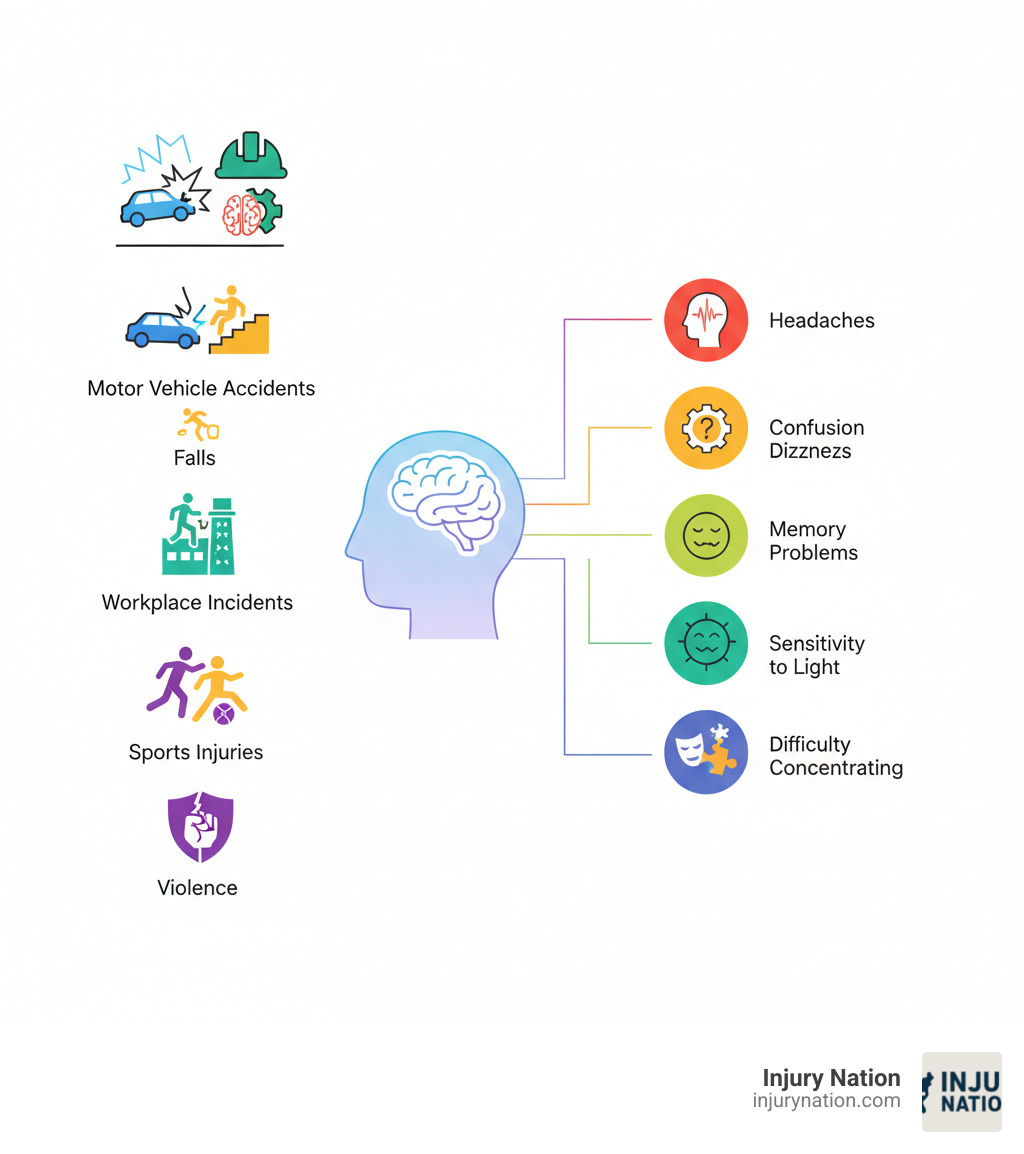
When someone suffers a traumatic brain injury (TBI), they’re dealing with damage to the brain caused by an external force—a sudden blow, bump, or jolt to the head, or an object that penetrates the skull. This can happen in a car crash where the head whips back and forth (a coup-contrecoup injury) or from a fall. In some cases, the damage is widespread, involving the tearing of nerve fibers throughout the brain (a diffuse axonal injury), which is often invisible on standard scans. These injuries range from what doctors call “mild” (a brief change in consciousness or mental state) to severe (extended unconsciousness or memory loss). But here’s what you need to know: even injuries classified as “mild” can lead to serious, permanent problems. As medical experts often point out, even a small drop in brain function can completely derail someone’s career and livelihood. Learn more about what a TBI is and its causes and symptoms.
The effects of a brain injury ripple through every aspect of a person’s life. You might notice physical changes like persistent, debilitating headaches or migraines that make it impossible to focus. Dizziness and problems with balance can make walking a challenge and increase the risk of further injury from falls. Other common symptoms include constant fatigue that sleep doesn’t fix, blurred vision, or an overwhelming sensitivity to light and sound that makes being in a normal environment painful. Some people develop slurred speech, weakness in their limbs or face, or in severe cases, seizures or even coma. Longer-term physical challenges can include difficulty walking, loss of bladder or bowel control, and chronic pain that never seems to go away.
Then there’s the cognitive impact—the invisible struggles that others can’t see but that make everyday life feel impossible. Many TBI survivors find themselves unable to concentrate for more than a few minutes at a time. Their short-term memory fails them, causing them to forget conversations they just had or important appointments. They have trouble with executive functions like making decisions, solving problems, or planning ahead, which can make managing personal finances or a daily schedule overwhelming. These aren’t just minor inconveniences—they can make it impossible to return to a demanding job, succeed in school, or manage daily responsibilities.
Perhaps most heartbreaking are the emotional and behavioral changes that can transform someone’s personality. Sudden mood swings, intense irritability over small things, and crippling anxiety or depression are common. Some people lose their social filter, reacting inappropriately in social situations, while others experience dramatic personality shifts. Family members often say it feels like they’re living with a different person, which strains relationships with spouses, children, and friends, leading to painful isolation at a time when support is needed most.
Doctors use tools like the Glasgow Coma Scale to assess the initial severity of a brain injury by evaluating eye-opening, verbal responses, and motor skills. The Rancho Los Amigos Scale helps track cognitive and behavioral recovery progress. But here’s something crucial to understand: brain injuries don’t always show up on standard MRI or CT scans. These scans are good at detecting structural problems like bleeding or a skull fracture, but they often miss microscopic damage to nerve cells. This makes a thorough clinical diagnosis, detailed patient history, and specialized evaluations like neuropsychological testing absolutely vital. Just because a scan looks normal doesn’t mean the injury isn’t real or serious.
The journey after a brain injury is often long, expensive, and overwhelming. Many people need extended hospital stays, inpatient rehabilitation, and years of ongoing care, including physical, occupational, and speech therapy. The lifetime costs can easily run into the millions of dollars. That’s where a brain injury attorney becomes essential—someone who understands both the medical complexity and the immense long-term costs of these life-changing injuries and can fight to secure the resources needed for a lifetime of care.
| Feature | Mild TBI (Concussion) | Severe TBI |
|---|---|---|
| Loss of Consciousness | Brief (seconds to minutes) or none | Extended (hours to days or longer) |
| Memory Problems | Temporary confusion or short-term memory gaps | Significant, long-lasting memory impairment |
| Physical Symptoms | Headaches, dizziness, nausea, fatigue, sensitivity to light/sound | Persistent headaches, seizures, paralysis, chronic pain, loss of motor control |
| Cognitive Impact | Difficulty concentrating, mild confusion, slower thinking | Severe problems with attention, reasoning, learning, and executive function |
| Emotional Changes | Irritability, anxiety, mild mood swings | Major personality changes, depression, inappropriate behavior, emotional instability |
| Recovery Timeline | Days to months (but symptoms can persist) | Months to years (many effects are permanent) |
| Impact on Daily Life | May miss work/school temporarily, need accommodations | Often unable to return to previous work, may need lifelong assistance and care |
| Medical Costs | Moderate (emergency care, follow-up visits, therapy) | Extensive (long-term hospitalization, rehabilitation, home care, assistive devices) |
| Need for Legal Help | Important to document and secure compensation for lost wages and treatment | Critical to ensure lifetime care needs and lost earning capacity are covered |