

Why Chronic Pain Claims Matter to Your Recovery
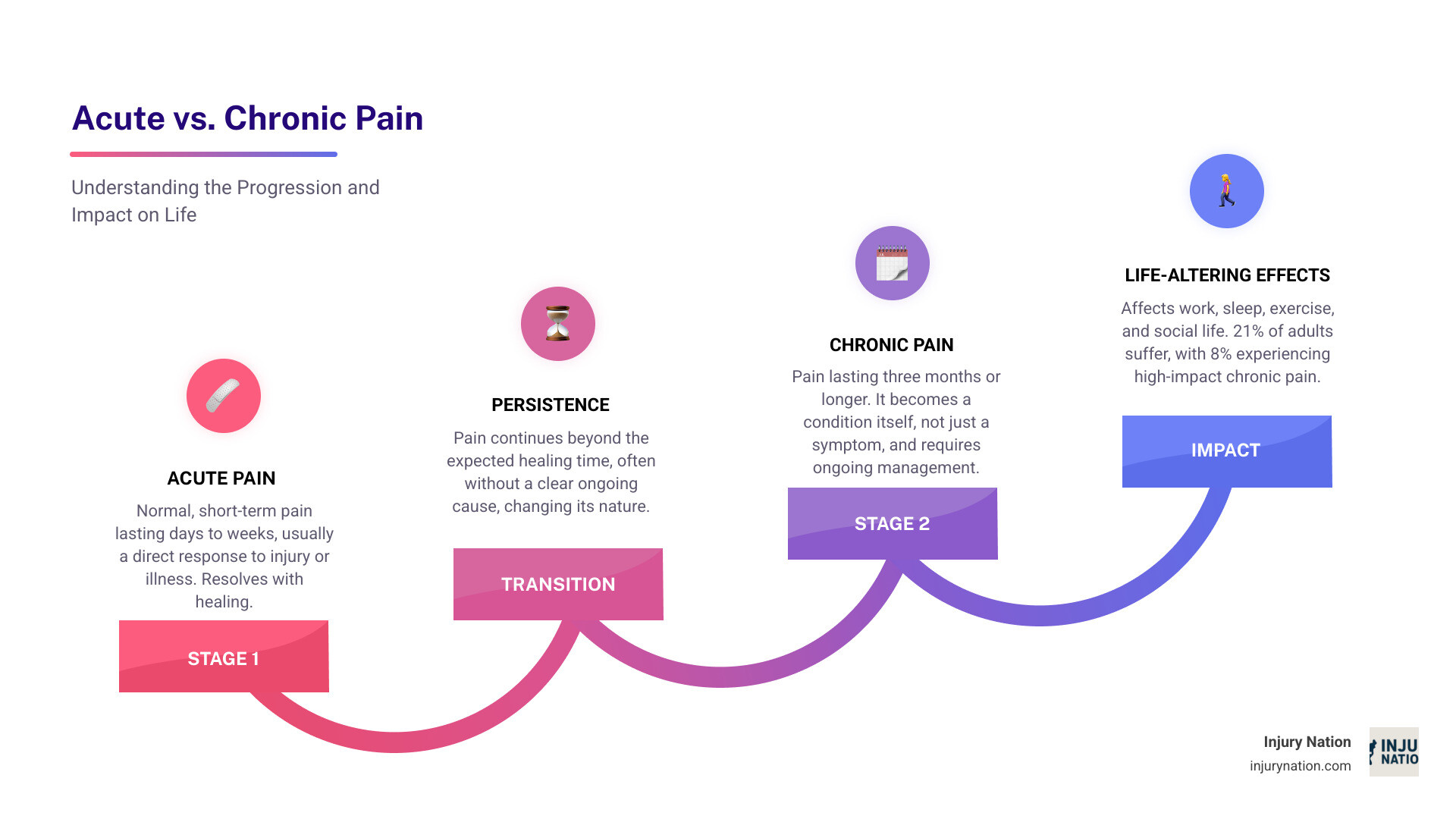
A chronic pain claim can provide the financial support you need when persistent pain disrupts your life. Defined as pain lasting three months or longer, it affects your ability to work, care for yourself, and maintain your quality of life.
Quick Overview: Types of Chronic Pain Claims
- Personal Injury Claims – Compensation from accidents caused by negligence
- Workers’ Compensation – Benefits for work-related injuries causing ongoing pain
- Social Security Disability – Monthly payments when pain prevents you from working
- VA Disability Benefits – Compensation for veterans with service-connected pain conditions
The statistics are sobering: around 21% of adults suffer from chronic pain, and 8% live with high-impact chronic pain that severely limits their daily activities. Millions struggle with these invisible disabilities, which are often misunderstood by insurance companies and employers.
Chronic pain isn’t just an inconvenience; it can touch every aspect of your life, standing between you and the activities that bring you joy.
The challenge with chronic pain claims is proving something that can’t be seen on an X-ray. Insurance companies often view pain as subjective, making it harder to secure compensation. However, with proper documentation, medical evidence, and legal strategy, a successful claim is possible.
Whether your pain stems from an accident, workplace injury, or military service, understanding how to build your case can mean the difference between financial security and ongoing hardship.
What is Chronic Pain and How is it Defined for a Claim?
Chronic pain is a debilitating condition, not just a symptom. For a chronic pain claim, it’s defined as pain that persists for at least three months and isn’t relieved by treatment. This definition establishes the long-term nature of your suffering.
Because pain is subjective, you must link it to a “medically determinable impairment.” A successful claim shows that your pain stems from an underlying medical condition or causes functional limitations that prevent you from working. The three-month rule is a key threshold; pain lasting less time is typically considered acute and falls under different compensation guidelines.
Common Causes and Conditions Leading to Claims
Chronic pain can arise from traumatic injuries, surgeries, or medical conditions. Common causes include:
- Arthritis: Osteoarthritis or rheumatoid arthritis causing persistent joint pain.
- Fibromyalgia: Widespread musculoskeletal pain accompanied by fatigue, sleep, and memory issues. The Mayo Clinic provides more details on fibromyalgia.
- Back Injuries: Degenerative disc disease, herniated discs, or nerve impingement.
- Nerve Damage: Neuropathy causing burning, tingling, or shooting pains.
- Migraines: Severe, recurring, and debilitating headaches.
- Complex Regional Pain Syndrome (CRPS): Chronic pain affecting a limb, usually after an injury or stroke.
- Post-surgery Pain: Pain that continues long after a surgical procedure’s normal healing time.
- Other Conditions: Chronic kidney disease or inflammatory bowel disease can also be sources of chronic pain.
Chronic pain is more than just physical pain; it can impede simple daily tasks and impact personal hygiene. The accompanying exhaustion, sleep issues, and lack of stamina are common symptoms.
Types of Chronic Pain Claims and How to Qualify
When chronic pain creates a financial burden, several compensation systems can help. Understanding which path fits your situation—whether it’s disability benefits, personal injury settlements, workers’ compensation, or VA disability—is the first step to getting the support you deserve.
Each system has its own rules for qualifying and proving that your pain has caused significant harm. Some focus on proving fault, while others are concerned only with your ability to work. Let’s break down each option.
Personal Injury Claims
If your chronic pain began because of someone else’s negligence—like a car accident or a slip and fall—you may have a personal injury claim. Even a seemingly minor incident can lead to long-lasting pain that changes your life.
These claims allow you to recover economic damages (medical bills, lost wages) and non-economic damages (pain and suffering). The second category is crucial for chronic pain, as it covers the loss of enjoyment of life, sleepless nights, and strain on relationships.
The challenge is that insurance companies often undervalue chronic pain claims because the pain is invisible. They may try to minimize your suffering or suggest it’s exaggerated. This is why proving how your life has changed is so critical.
Settlement negotiations become a battle over the value of this invisible suffering. An adjuster’s formulas don’t account for your pain, so solid documentation of your daily struggles and expert testimony are essential.

Workers’ Compensation Claims
If your chronic pain stems from your job, whether from a single accident or repetitive stress injuries, workers’ compensation should provide benefits. The key is proving your injury is work-related.
This system covers your medical treatment and provides lost income benefits. Eventually, doctors will determine you’ve reached Maximum Medical Improvement (MMI). This doesn’t mean you’re pain-free, only that further treatment isn’t expected to improve your condition significantly.
Many people with chronic pain reach MMI but still suffer daily. The good news is that ongoing pain after MMI can still qualify for benefits, especially if it prevents you from returning to work. The biggest hurdle is that employers may blame your pain on psychological factors or accuse you of faking it. Consistent medical records and adherence to your treatment plan are your best defense.
Disability Claims (Social Security & VA)
When chronic pain makes work impossible, disability benefits are a lifeline. The two main systems, Social Security Disability (SSDI) and VA disability benefits, operate differently.
Social Security Disability does not list chronic pain as a standalone disability. You must show your pain stems from a condition in their Blue Book of impairments or prove your limitations make any work impossible. They evaluate your Residual Functional Capacity (RFC)—what you can still do despite your pain.
Unfortunately, most initial SSDI claims are denied. Being over 55 or having multiple medical conditions can improve your chances, but many applicants must appeal, often with legal help, to get approved.
For veterans, the VA system offers more direct paths. You can get disability benefits for chronic pain if it’s service-connected. The VA rates the underlying condition causing your pain or secondary conditions like depression. To prove a service connection, you need a current diagnosis, evidence of an in-service event, and a medical opinion linking the two (a nexus letter). VA claims for chronic pain can lead to a 100% disability rating, either through a high rating for the underlying condition or by qualifying for Total Disability Individual Unemployability (TDIU).
Building a Bulletproof Chronic Pain Claim

Winning a chronic pain claim requires proving an invisible condition. While you know the pain is real, convincing others demands a strategic approach and rock-solid evidence.
The challenge is the subjective nature of pain. Unlike a broken bone on an X-ray, chronic pain is difficult to document objectively. Your credibility is paramount, and building an airtight case can be the difference between approval and denial.
The Critical Role of Medical Evidence
Medical evidence is the foundation of your claim. Your records must tell a clear, consistent story about your condition and its impact on your life.
- Consistent medical treatment is vital. Regular doctor visits and following prescribed therapies show you are actively managing your condition. Gaps in treatment can weaken your claim.
- Clear diagnosis documentation from treating physicians is the backbone of your case. For VA claims, a Medical Nexus Letter or Independent Medical Opinion (IMO) connecting your pain to your service is often decisive. Telemedical LLC offers services for Medical Nexus Letters that can strengthen your case.
- Physician statements and specialist opinions carry significant weight. A detailed letter from a pain management specialist explaining your condition, prognosis, and limitations provides professional validation.
- Diagnostic tests like MRIs, X-rays, and nerve conduction studies offer objective evidence of the underlying damage causing your pain. For conditions like fibromyalgia, specific tests like tender point testing should be documented.
How to Document and Prove Your Functional Limitations
This is where you build a bridge between your internal feeling of pain and what an evaluator can verify.
- Pain journals and daily activity logs are game-changers. Consistently recording pain levels, triggers, and the impact on daily tasks creates an objective timeline of your struggle.
- Witness testimony and lay statements from family, friends, or coworkers provide powerful third-party validation. For VA claims, lay statements are especially effective in showing how your condition affects your daily life.
- Video evidence can be persuasive. Recording your struggles with mobility or daily activities provides visual proof of your limitations.
- Describing pain levels effectively during medical appointments or a C&P exam is key. Be prepared to articulate your pain’s intensity, duration, and frequency with specific examples.
- Before and after comparisons paint a vivid picture. Describing your active lifestyle before the injury versus your current limitations helps evaluators understand the scope of your loss.
Strategies for Strengthening Your Chronic Pain Claim
Success often comes down to strategy and consistency. Position yourself for the best outcome by:
- Following treatment plans diligently to build credibility and show the medical necessity of your care.
- Avoiding exaggeration, as it can destroy your credibility. Evaluators are trained to spot inconsistencies.
- Highlighting medication side effects like drowsiness or concentration problems, which can be as disabling as the pain itself.
- Demonstrating consistency across all records. Your medical records, personal statements, and witness accounts must align.
- Obtaining nexus letters for VA claims to provide the critical link between your military service and your current condition.
Navigating the Evaluation and Denial Process
The evaluation process for a chronic pain claim is often an uphill battle. Insurance companies, the VA, and Social Security administrators are naturally skeptical of conditions they can’t see on an X-ray or measure with a test. Understanding how these systems work can help you prepare for what’s coming and give you the best shot at approval.
How Your Chronic Pain Claim is Evaluated
The evaluation of your chronic pain claim depends on the system you’re dealing with.
Insurance companies handling personal injury or disability claims will comb through your medical records for inconsistencies or gaps in treatment. They may even use investigators to observe your daily activities to find evidence that contradicts your claim. Their goal is to minimize payouts, so your documentation must be flawless.
VA evaluations focus on service connection. During a C&P exam, the examiner reviews your military and current medical records, conducts a physical exam, and asks detailed questions about how pain affects your life. Be honest about your worst days, not just how you feel during the exam. Downplaying symptoms can hurt your claim.
Social Security’s approach centers on whether your pain prevents you from working. The Disability Determination Services uses a Residual Functional Capacity assessment to determine what you can still do. They may use vocational experts to identify jobs you could theoretically perform. Your ability to sit, stand, walk, lift, and concentrate are all considered.
Functional capacity evaluations are increasingly used across all systems to objectively measure your physical abilities, bridging the gap between subjective pain and objective proof. Throughout all evaluations, credibility assessment is key. Evaluators look for consistency between your reports, your doctor’s notes, and their observations.
Common Reasons for Denial and How to Appeal
An initial denial is frustrating but common. Understanding why claims are denied can help you build a stronger appeal.
Common denial reasons include:
- Insufficient medical evidence: Not enough documentation, unclear diagnoses, or gaps in your treatment records.
- Lack of objective findings: Your MRI may look normal, but you’re in constant pain. This is a challenge for conditions like fibromyalgia.
- Inconsistent reporting: If you tell your doctor your pain is a 9/10 but are seen carrying groceries without issue, it creates doubt.
- Failure to follow treatment: Skipping physical therapy or not taking prescribed medication can be interpreted as your pain not being severe.
- Perceived lack of functional limitation: Your records may document pain but fail to explain how it prevents you from working or performing daily tasks.
If your chronic pain claim is denied, don’t give up. The appeals process exists for a reason.
- For VA claims, you can file a Supplemental Claim with new evidence, request a Higher-Level Review, or appeal to the Board of Veterans’ Appeals.
- For Social Security claims, the process includes Reconsideration, a hearing before an Administrative Law Judge (where odds improve), and further appeals to the Appeals Council or federal court.
- For workers’ comp or personal injury, you may face internal appeals, mediation, or litigation.
The key to a successful appeal is to understand the reason for denial and address it with new evidence. Legal representation can make a significant difference, as experienced attorneys know how to present your case effectively. Persistence often pays off in chronic pain cases.
Frequently Asked Questions about Chronic Pain Claims
What makes a chronic pain claim so difficult to prove?
The primary challenge is the subjective nature of pain. Unlike a broken bone visible on an X-ray, pain cannot be objectively measured. This leads to skepticism from insurers and disability administrators who require concrete proof of a condition’s severity and its impact on your ability to function. The key is to build a strong paper trail with consistent medical treatment, detailed doctor’s notes, and personal logs that document how pain affects your daily life. Your credibility is everything.
Can you receive a 100% disability rating for chronic pain?
Yes, a chronic pain claim can lead to a 100% disability rating, typically in one of three ways. First, the underlying condition causing the pain may be severe enough on its own for a 100% rating. Second, you might reach 100% through a “combined rating,” where your primary condition is combined with secondary issues like depression or nerve damage. Third, you may qualify for Total Disability based on Individual Unemployability (TDIU), which pays at the 100% rate if your pain prevents you from maintaining steady employment, even if your ratings don’t total 100%.
How is “pain and suffering” calculated in a personal injury case?
There is no single formula for calculating pain and suffering. Lawyers and insurers often use one of two methods. The “multiplier method” takes your total medical bills and multiplies them by a number (usually 1.5 to 5) based on the injury’s severity and long-term impact. The “per diem method” assigns a daily dollar amount for your pain. The final amount depends on the evidence showing how your pain affects your relationships, work, and overall quality of life. In states like Nevada, juries are instructed to award a “fair” amount, making strong legal representation crucial to demonstrating the true value of your suffering.
Conclusion

Living with chronic pain is a battle, and fighting for the compensation you deserve adds another layer of stress. Chronic pain claims are uniquely challenging because the pain is invisible, but thousands of people successfully steer this process every year.
The secret is turning your invisible pain into visible evidence. Every doctor’s visit, pain journal entry, and witness statement builds your case. By consistently seeking treatment and documenting your limitations, you create a paper trail that speaks volumes to evaluators.
Insurance companies and government agencies need proof that your pain significantly impacts your life. When you provide that proof through detailed medical records, physician support, and honest documentation of your daily struggles, you are speaking their language.
Don’t let an initial denial discourage you. Many successful claims are rejected at first. The appeals process exists for a reason, and with the right evidence and persistence, many denials are overturned.
The most important thing is that you don’t have to face this alone. Chronic pain can be isolating, but the legal process doesn’t have to be.
At Injury Nation, we’ve seen how the right legal representation can transform a claim. A skilled attorney knows what evidence to gather, how to present your case, and which experts to consult. They understand that behind every claim is a real person whose life has been changed.
Your pain is real, and so is your right to fair compensation. Take the first step toward getting the help you need and deserve.