

Understanding How Lawyer Ratings Work
How can you get a rating on a lawyer? Lawyers get ratings in two main ways: from peer review systems, where other legal professionals assess their skills, and from client review platforms, where people share their experiences. Established legal directories use structured methods to rate attorneys, while clients post reviews on widely used public review sites.
Quick Answer: Ways to Find and Understand Lawyer Ratings
- Peer Review Ratings – Check long-standing peer-review directories that award tiered recognitions (for example, “Preeminent,” “Distinguished,” “Notable”), selective honors lists that recognize a small percentage of attorneys, and publications that rely purely on peer nominations
- Client Review Scores – Look at reputable client review platforms and public review sites (often 1–10 scores or star averages); some also award client-service badges (such as Platinum/Gold/Silver) based on review quality and volume
- State Bar Verification – Visit your state bar website to check license status and disciplinary history
- Legal Directories – Search multiple sources for comprehensive information
When you’re hurt and searching for legal help, understanding these ratings can feel overwhelming. You might see an attorney with a top-tier peer badge or a perfect 10.0-style score and wonder what it all means. Are these ratings trustworthy? Can lawyers buy good ratings? What should you actually look for?
The truth is that lawyer ratings come from different sources and measure different things. Some focus on what other lawyers think about an attorney’s legal skills, while others reflect real clients’ experiences. For more than a century, respected organizations have evaluated attorneys through peer review, while newer platforms use transparent criteria and algorithms to score lawyers based on their backgrounds.
This guide will walk you through the entire rating landscape. You’ll learn how ratings are determined, what the different scales mean, and how to use this information to find the right attorney for your personal injury case.
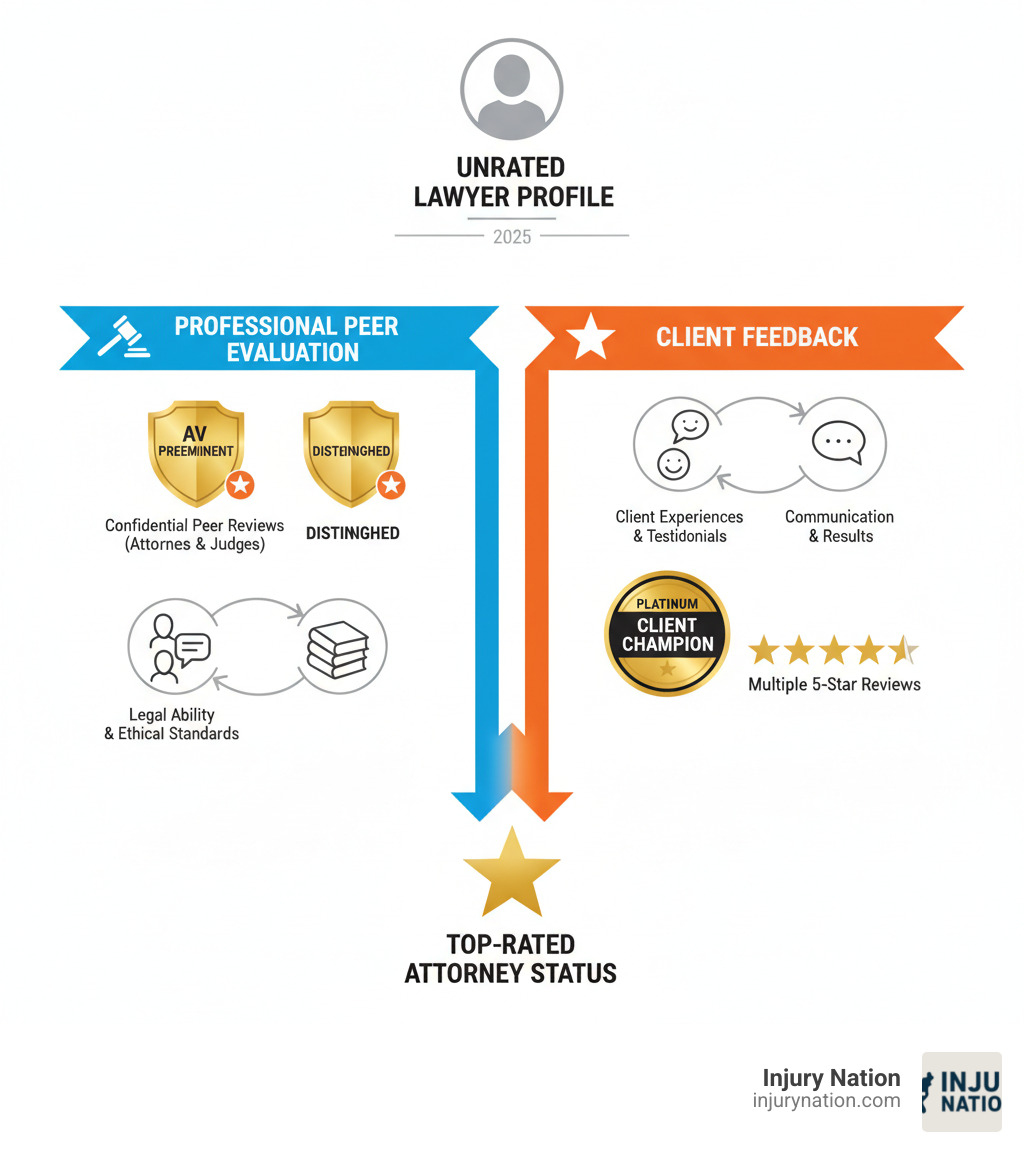
The Two Pillars of Lawyer Ratings: Peer vs. Client Reviews
Think of lawyer ratings as a two-sided coin. On one side, you have peer reviews from other legal professionals. On the other, you have reviews from actual clients. Both sides matter for seeing the complete picture of an attorney.
How can you get a rating on a lawyer? By looking at both pillars together. Peer reviews show an attorney’s professional excellence, while client reviews reveal their communication skills and how they treat the people they represent.
The Significance of Peer Review Ratings
When attorneys and judges rate each other, they evaluate things most of us can’t see, like courtroom performance and negotiation tactics. This makes peer recognition incredibly valuable—it’s a reference from someone who truly knows the job.
-
Long-standing peer-review directories survey an attorney’s colleagues to assess legal knowledge, communication skills, and ethical standards. These systems are designed to be credible and based on professional evaluations.
-
Some publications use a purely peer-review approach, relying on surveys of lawyers in the same geographic and practice areas. This recognition means an attorney is held in high esteem by other top lawyers.
-
Selective honors lists identify a small percentage of attorneys annually through a rigorous, multiphase selection process that is both peer-influenced and research-driven. These recognitions signal lawyers who have achieved a high degree of peer recognition and professional achievement.
-
Attorney-to-attorney review networks use verified lawyers familiar with the reviewed attorney’s work to rate legal knowledge, analysis, communication, and ethics on numerical scales.
These peer-based systems give you confidence that an attorney has earned the respect of people who understand what good legal work looks like.
The Power of Client Reviews and Testimonials
Here’s where the rubber meets the road. Peer reviews tell you if a lawyer is respected professionally. Client reviews tell you what it’s like to work with them.
Over 80% of people check reviews first when seeking an attorney. When you’re hurt, you want to know if a lawyer returned calls, explained things clearly, and treated past clients with respect.
-
Many lawyer profile platforms assign a numerical score using proprietary or transparent criteria that evaluate background, achievements, and any disciplinary history. Beyond the number, client reviews often reveal an attorney’s responsiveness and professionalism.
-
Some directories complement peer reviews with client-service awards. Tiered levels (for example, Platinum, Gold, and Silver) are based on the number and quality of client reviews, highlighting an attorney’s client care.
These client testimonials highlight an attorney’s communication style and how well they keep clients informed. Both pillars matter: peer reviews show professional excellence, and client reviews show client service. Together, they give you the complete picture. For more info about finding a lawyer, check out our resources to help you make the best choice.
How Can You Get a Rating on a Lawyer? The Mechanics Explained
When you’re trying to understand how can you get a rating on a lawyer, it helps to see how these systems work. There’s a real structure behind every badge, star, and score.

How Lawyer Ratings Are Determined
Each rating platform has its own method, but they all aim to help you make a good decision. Some focus on peer opinion, others analyze a lawyer’s background, and many include client feedback.
-
Peer-review directories use survey-based systems. An attorney’s nominated peers rate them on key areas: legal knowledge, analytical capabilities, judgment, communication ability, and legal experience, along with ethical standards.
-
Profile platforms use algorithms that analyze an attorney’s professional background—years in practice, achievements, publications, and disciplinary history—to generate a numerical score. Reputable systems base these scores on verifiable facts and do not sell ratings.
-
Selective honors lists start with peer nominations and apply rigorous evaluations across multiple indicators of achievement. A panel review may follow, with only a small percentage making the final list.
-
Pure peer-review publications rely exclusively on colleague evaluations within the same practice area and region, recognizing outstanding lawyers based on collective professional judgment.
-
Attorney-to-attorney review networks translate verified peer feedback into 1–10 style scores across criteria such as legal knowledge, analysis, communication, and ethics.
For a deeper dive into how these different systems compare, check out our ratings explained page.
The Role of State Bar Associations in Vetting Lawyers
While rating platforms tell you who’s good, state bar associations tell you who’s licensed to practice and if they have a disciplinary history. This is a fundamental check.
Every attorney must be licensed by their state bar. In Nevada, the State Bar of Nevada handles all licensing, regulation, and discipline of attorneys. Their website is a source of essential information.
When you look up a lawyer through the State Bar, you can verify their license status and check their disciplinary history. This public record shows if a lawyer has been sanctioned for ethical violations. Think of it as a critical background check that can save you from hiring someone with serious problems.
While state bars don’t give out star ratings, they provide the official record of whether a lawyer is in good standing—your first line of defense in vetting any attorney.
How to Find Reliable Information About a Lawyer’s Rating and Reviews
Now that you know how ratings are created, let’s talk about finding this information. The key is to be thorough without getting overwhelmed.
Start by checking multiple sources rather than trusting just one platform. A lawyer might have great reviews on one site but be absent from another. Cross-referencing gives you a fuller picture.
Look for consistency across platforms. When you see an attorney with strong peer recognition and high client reviews on public review sites, that’s a pattern worth noting. Consistent excellence across different systems is a meaningful signal.
Don’t just count stars—read the actual reviews. Detailed reviews that explain how the attorney communicated and what the experience was like are more informative than dozens of one-word comments. Look for comments that address what matters most to you.
Visit the attorney’s website to see which awards and testimonials they highlight. This gives you a sense of how the lawyer presents themselves and their practice.
Finally, use legal directories as your starting points. When you’re looking for a personal injury lawyer in Las Vegas, these directories can help you narrow down your options and see relevant ratings in one place.
To make this process easier, we’ve built tools that let you compare lawyers side by side. When you’re ready, you can find a lawyer who’s right for your situation.
Decoding the Score: How to Interpret Lawyer Ratings
Once you’ve found various ratings, the next step is understanding what they mean. Each platform has its own way of expressing excellence, and the terminology can be confusing. But once you know what to look for, these ratings become useful tools for understanding what makes a lawyer stand out.

Understanding Common Rating Scales
Each platform has its own system for measuring excellence. Understanding these differences helps you make smarter choices.
-
Tiered peer-review systems are built on evaluations by other lawyers and judges. The top tier often signifies the highest level of professional excellence, with tiers below that still reflecting strong peer recognition for achievement and ethics.
-
Numerical scales (often 1–10) use background analysis and/or attorney-to-attorney reviews to assign a score based on a lawyer’s experience, achievements, and disciplinary history.
-
Some recognitions are about selection into an exclusive group. Selective honors lists identify a small percentage of attorneys through rigorous, research-driven, peer-influenced processes.
-
The client perspective is captured by client-service awards. These commonly come in tiered levels (for example, Platinum, Gold, and Silver), based on the quantity and average score of client reviews.
Comparing the Highest Ratings Across Different Platforms
To make sense of different systems, it helps to see them side by side in general terms. Here’s what the top tier looks like across major categories:
| Category | Highest Peer Recognition | Highest Client Rating/Score |
|---|---|---|
| Tiered peer-review directories | Top-tier professional excellence (highest tier) | Tiered client-service badge (e.g., Platinum) |
| Algorithmic score platforms | N/A (primarily background-based scoring) | 10/10 or 5-star average |
| Selective honors lists | Selection to top small percentage of attorneys | N/A (primarily peer and research-based) |
| Pure peer-review publications | Recognition by colleagues in practice/region | N/A (peer-based; client scores not part of system) |
| Attorney-to-attorney networks | 10/10 style score from verified peer reviews | N/A (score is peer-based, not client reviews) |
This comparison shows that different platforms measure different things. Some focus on professional reputation, while others incorporate client feedback or background analysis. Seeing high marks across multiple categories—especially in both peer and client dimensions—gives you the most complete picture of an attorney’s capabilities.
Beyond the Numbers: What Ratings Don’t Tell You
Ratings are incredibly helpful, but they don’t tell you everything. Think of them as a starting point, not the finish line. A lawyer with top ratings isn’t automatically the right fit for your personal injury case.

Key Qualities to Look for in a Personal Injury Lawyer
When you’re hurt, you need to dig deeper than badges and stars. Certain qualities directly impact your case and your experience.
-
Specialization matters. You need a lawyer who specializes in personal injury law and understands how Nevada courts work. For example, an attorney focused on catastrophic injury, wrongful death, and car accidents will bring targeted experience that can make a real difference.
-
Trial experience and settlement success are a powerful combination. Most cases settle, but an attorney’s willingness to go to trial provides crucial leverage against insurance companies.
-
Communication skills can make or break your experience. Your attorney should explain complex legal concepts clearly, return your calls promptly, and make you feel heard. Open communication is the foundation of the attorney-client relationship.
-
Fee transparency protects you from surprises. A good lawyer will provide a clearly stated fee agreement and explain exactly how they charge.
-
Local knowledge is a significant advantage, especially for a claim in Las Vegas. A local attorney understands the court systems, judges, and procedures, which often translates into better outcomes. For free injury legal advice and to start exploring your options, we’re here to help.
The Importance of the Initial Consultation
This meeting is where everything comes together. It’s your chance to evaluate the lawyer, not just the other way around. This is where you see if their personality, communication style, and approach feel right.
Trust your gut about the personal fit. Do you feel comfortable talking with them? Do they listen when you speak? If the personal chemistry is off, that’s a valid reason to look elsewhere.
Asking questions is essential. Dig into their experience with cases like yours. Ask about their communication process, their team, and potential challenges. A confident lawyer will welcome your questions.
Discussing case strategy gives you insight into how they think. A skilled attorney can outline a potential path forward and discuss possible outcomes honestly, helping you set realistic expectations.
Building trust happens in these face-to-face moments. The attorney-client relationship depends on it. Ratings might get a lawyer on your shortlist, but this initial meeting is where you decide if they are the right advocate for you.
Frequently Asked Questions about Lawyer Ratings
We hear these questions all the time, and they’re smart questions to ask. When you’re injured, understanding what ratings really mean can make all the difference.
What is the highest rating a lawyer can achieve?
There isn’t just one “highest” rating because different platforms use different systems. Here’s a quick breakdown:
-
In tiered peer-review systems, the top recognition is the highest professional excellence tier. Many also offer client-service badges at the top level (often called Platinum or similar).
-
Numerical ratings typically use a 1–10 scale, making 10 the highest score, reflecting an assessment of a lawyer’s background and achievements.
-
With selective honors lists, the highest achievement is being chosen among a small percentage of attorneys in a state or region.
-
Pure peer-review publications sometimes name a “Lawyer of the Year” in specific practice areas and locations as their highest individual honor.
-
Attorney-to-attorney networks that use 1–10 scales consider 10 their top rating.
Can a lawyer pay for a good rating?
For reputable rating systems, the answer is no. This is a crucial feature of their design.
Respected platforms state that their ratings cannot be bought or manipulated, as their scoring methods evaluate verifiable aspects of a lawyer’s background. Similarly, peer-to-peer rating systems are based purely on verified attorney reviews, not on advertising payments.
While attorneys can pay for advertising or improved profile visibility on some sites, they cannot pay to influence the rating outcome itself. The selection processes are designed to be merit-based.
It’s important to distinguish between paying for a rating (a red flag) and paying to advertise a rating that has already been earned through merit.
What’s more important: peer ratings or client reviews?
Honestly? You need both. They tell you different but equally essential things.
Peer ratings reveal a lawyer’s professional standing, legal skill, and ethical reputation within the legal community. When other lawyers and judges rate an attorney highly, it’s a powerful signal that they are a true expert.
Client reviews, on the other hand, tell you what it’s actually like to work with that attorney. They reveal communication style, responsiveness, and whether clients felt respected and supported during a stressful time.
Think of it like choosing a doctor: you’d want to know if other doctors respect their medical knowledge (peer review) and if their patients feel well-cared for (client review). One without the other gives an incomplete picture.
The best approach is to look at the whole picture—peer recognition, client feedback, and the gut feeling you get during your initial consultation. That’s how you find an attorney who is not only highly skilled but also the right personal fit for you.
Conclusion
When you’re injured, understanding how can you get a rating on a lawyer transforms an overwhelming question into a manageable process. You now know that lawyer ratings come from two key sources: the professional judgment of legal peers and the real-world experiences of past clients.
The ratings landscape is rich with information. Long-standing peer-review systems reflect a tradition of professional evaluation, numerical score platforms offer transparent, criteria-based assessments, and selective honors lists recognize a small percentage of standout attorneys. Each system helps you understand who excels in the legal profession.
But remember: these ratings are your starting point, not your finish line. A high score confirms a lawyer has earned recognition, but the best-rated lawyer isn’t always the best fit for your specific case.
That’s why you must look beyond the numbers. Specialization in personal injury law matters. Local knowledge of Las Vegas courts matters. Communication style matters. Most of all, the way a lawyer makes you feel during a vulnerable time matters tremendously.
Check multiple sources, read the actual client reviews, and verify an attorney’s standing with the State Bar of Nevada. Then, use the initial consultation as your personal interview. Ask questions and trust your instincts.
At Injury Nation, we’ve built our directory to help you with this exact process. We connect injury victims with top-rated personal injury lawyers who have demonstrated both professional excellence and genuine client care. Our goal is to help you find an attorney who will fight for your rights and maximize your settlement.
Your injury deserves serious attention, and you deserve a lawyer who not only has impressive credentials but also treats you with respect and genuinely cares about your recovery.
Find a top-rated personal injury lawyer near you and take that important first step toward justice and healing.