Why Injured Federal Workers Face a Unique Legal Challenge
An injured federal worker attorney specializes in navigating the complex federal workers’ compensation system (OWCP/FECA), helping federal employees secure medical benefits, wage loss compensation, schedule awards, and appeal denied claims. This process differs significantly from state workers’ compensation and requires specialized legal knowledge that few attorneys possess.
Quick Navigation Guide:
- If you need immediate help: Federal workers’ compensation attorneys typically charge upfront retainers (not contingency fees) and specialize in OWCP claims.
- If your claim was denied: You have strict deadlines to appeal through the Department of Labor’s system.
- If you’re just starting: You must file within 3 years of your injury using specific forms (CA-1 for traumatic injury, CA-2 for occupational disease).
- If you’re comparing options: Federal workers’ comp covers medical expenses, wage loss, and permanent impairment awards but excludes pain and suffering.
Many of the 2.1 million federal civilian employees who get injured on the job struggle to find legal representation. Why? Because federal workers’ compensation operates under entirely different rules than state systems. The federal system, governed by the Federal Employees’ Compensation Act (FECA) and administered by the Office of Workers’ Compensation Programs (OWCP), prohibits contingency fees. This means attorneys cannot take a percentage of your recovery and must instead charge upfront retainers, which most injured workers cannot afford. As a result, only one in ten injured federal employees who seek legal help actually retain an attorney.
If you work for a high-risk federal agency like the USPS, VA, TSA, or DHS, understanding your rights under FECA is essential. This guide explains the benefits you’re entitled to, how the claims process works, critical deadlines, and why an experienced injured federal worker attorney can make all the difference.
Understanding the Federal Workers’ Comp System (FECA & OWCP)
If you’re a federal employee injured at work, your claim doesn’t fall under state law. Instead, it’s handled by a unique federal program with its own rules, procedures, and challenges.
The Federal Employees’ Compensation Act (FECA) is the law that provides workers’ compensation benefits to federal employees. It operates as a no-fault system, meaning you are entitled to benefits if your injury is work-related, regardless of who was at fault.
These benefits are managed by the Office of Workers’ Compensation Programs (OWCP), a part of the U.S. Department of Labor (DOL). Unlike the patchwork of 50 different state systems, the OWCP operates as a single federal system with uniform rules for all federal workers nationwide, from a postal worker in Phoenix to a VA nurse in Virginia.

Who is a Federal Employee?
Under FECA, a “federal employee” is a civilian employee of a U.S. federal government agency, department, or instrumentality. While this covers a vast range of jobs, some agencies have particularly high rates of workplace injuries, including:
- United States Postal Service (USPS): Workers face injuries from lifting, driving, and repetitive tasks.
- Veterans Health Administration (VA): Staff are at risk for patient handling injuries and exposure to illnesses.
- Transportation Security Administration (TSA): Officers often suffer from repetitive motion injuries.
- Department of Homeland Security (DHS): Employees like Border Patrol agents work in physically demanding and hazardous conditions.
While other countries have their own systems, such as Canada’s for defining federally regulated employment, U.S. federal workers must steer FECA and the OWCP.
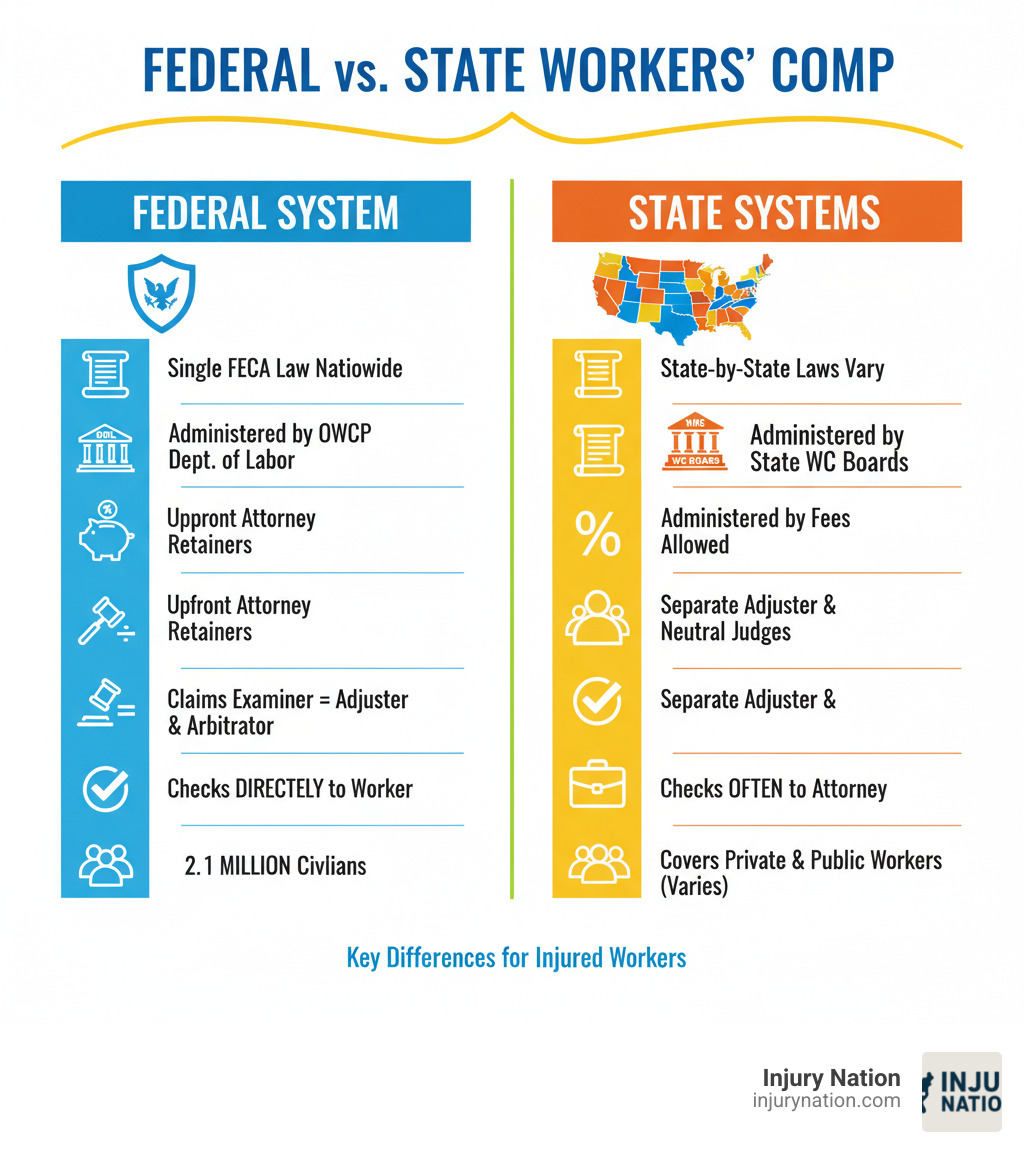
Key Differences: Federal vs. State Workers’ Compensation
Federal and state workers’ comp systems may both be no-fault, but the similarities end there. Understanding these differences is critical for your case and explains why finding a specialized injured federal worker attorney is so difficult.
- Governing Law: State systems vary by state, while all federal claims follow a single law (FECA).
- Administration: State claims go to state boards; federal claims go exclusively to the U.S. Department of Labor’s OWCP.
- Attorney Fees: State systems often allow contingency fees (a percentage of your award). FECA prohibits contingency fees, requiring attorneys to charge hourly rates and seek upfront retainers.
- Adjudication: In the federal system, OWCP claims examiners act as both adjuster and decision-maker, unlike state systems that have separate neutral judges.
- Payments: OWCP sends benefit checks directly to you, not your attorney, which creates administrative challenges for law firms.
| Feature | Federal (FECA) Workers’ Compensation | Typical State Workers’ Compensation |
|---|---|---|
| Governing Law | Federal Employees’ Compensation Act (FECA) | State-specific statutes and regulations |
| Administration | Office of Workers’ Compensation Programs (OWCP), U.S. Department of Labor (DOL) | State Workers’ Compensation Board/Commission |
| Fee Structure | Hourly rates, requires DOL approval; Contingency fees prohibited; Upfront retainers common | Contingency fees often allowed (percentage of award); Hourly rates also possible |
| Adjudication | OWCP Claims Examiners (act as adjusters & arbitrators) | Separate claims adjusters and neutral administrative law judges/hearing officers |
| Payment Recipient | Checks sent directly to injured worker | Checks may be sent to attorney for disbursement |
| Appeal Body | Employees’ Compensation Appeals Board (ECAB) | State-specific appeals boards/courts |
| Geographic Scope | Nationwide (uniform rules) | State-specific (rules vary by state) |
These fundamental differences are why a general personal injury attorney may not be equipped to handle your federal claim.
Your Rights and Benefits as an Injured Federal Worker
As an injured federal worker, FECA provides powerful protections and guarantees specific benefits to support your recovery and protect your financial future. Key rights include the right to medical treatment for your work-related condition at no cost to you and the right to choose your own qualified physician for initial treatment. You also have return to work rights, which may require your agency to offer suitable work within your medical restrictions, and access to vocational rehabilitation if you cannot return to your old job.

Covered Injuries and Illnesses Under FECA
To qualify for benefits, your injury or illness must have occurred “in the performance of duty.” This includes:
- Traumatic Injuries: Caused by a specific event in a single work shift (e.g., a fall or vehicle accident). Filed using Form CA-1.
- Occupational Diseases: Conditions that develop over time from work activities (e.g., carpal tunnel syndrome from repetitive tasks or hearing loss from noise exposure). Filed using Form CA-2.
- Repetitive Stress Injuries: A common type of occupational disease affecting muscles, tendons, and nerves from repeated motions.
- Mental Conditions: While covered, the standard is high. You must link the condition (like PTSD) to a specific traumatic event or sustained workplace harassment, not general work stress.
A Breakdown of Available OWCP Benefits
If your claim is accepted, you may be entitled to several types of benefits:
- Medical Expense Coverage: Pays for all reasonable and necessary medical care related to your accepted claim, including doctor visits, surgery, and prescriptions.
- Wage Loss Compensation: If you are totally disabled, you can receive 2/3 of your regular pay (or 3/4 with dependents) for as long as you are medically unable to work.
- Continuation of Pay (COP): For traumatic injuries, your agency may pay your full salary for up to 45 calendar days. You must file a CA-1 within 30 days to be eligible.
- Schedule Awards: Compensation for permanent impairment to specific body parts, discussed below.
- Vocational Rehabilitation: Job counseling, training, and placement assistance if you cannot return to your former job.
Federal employees may also have access to other different types of leave to help manage their recovery.
Understanding the Schedule Award for Permanent Impairment
A Schedule Award is a unique federal benefit that compensates you for the permanent loss of function of certain body parts, even if you have returned to work. You become eligible after reaching Maximum Medical Improvement (MMI), the point at which your condition has stabilized.
An impairment rating is assigned by a physician based on the AMA Guides to the Evaluation of Permanent Impairment, 6th Edition. This percentage is used to calculate your award. For example, a 10% impairment to your arm would result in an award equal to 10% of the total weeks of compensation scheduled for an arm.
Covered body parts include arms, legs, hands, feet, fingers, toes, vision, and hearing. However, FECA does not provide Schedule Awards for impairments to the back, head, or brain, or for mental conditions. This is a critical limitation that surprises many injured workers.
Coordinating with Other Federal Benefits
Your OWCP benefits can interact with other federal programs, and making the wrong choice can be costly. You may be eligible for both Federal Disability Retirement (OPM) and Social Security Disability Insurance (SSDI), but you generally cannot receive full payments from multiple programs simultaneously due to complex benefit offsets.
Deciding whether to elect OWCP benefits or OPM disability retirement requires careful analysis. An experienced injured federal worker attorney can help you understand these complex interactions and make the best strategic decision for your financial future. For general guidance on workers’ comp claims, you can find a local workers’ comp lawyer in Los Angeles or other areas through legal directories.
The Federal Claim Filing and Appeals Process
The federal claim process is laden with paperwork, regulations, and strict deadlines. Simple mistakes like incomplete forms or weak medical evidence can lead to delays or denials. Understanding the steps is crucial to protecting your rights.

Step-by-Step: How to File Your OWCP Claim
To file your claim correctly and avoid common pitfalls, follow these steps:
- Notify Your Supervisor: Report your injury immediately or as soon as you realize your condition is work-related.
- Complete the Correct Form: Use Form CA-1 for a traumatic injury (a specific event) or Form CA-2 for an occupational disease (a condition developed over time).
- Submit Strong Medical Evidence: Your claim’s success depends on a detailed report from your physician that clearly links your condition to your job duties. Vague reports are a primary cause of denials.
- Submit Your Claim: Your employing agency is responsible for providing you with the forms and forwarding your completed claim to OWCP.
Critical Deadlines You Cannot Miss
Missing a deadline can result in a permanent loss of benefits. Be aware of these key time limits:
- 30 Days for Continuation of Pay (COP): You must file Form CA-1 within 30 days of a traumatic injury to be eligible for up to 45 days of your full salary.
- 3 Years to File a Claim: The statute of limitations for filing a claim is generally three years from the date of injury or three years from when you became aware that your occupational disease was work-related.
Strict deadlines also apply to all stages of the appeals process.
What to Do If Your Claim is Denied
A denial from OWCP is not the end of the road. You have the right to appeal a decision, but you must act quickly. Your options include:
- Reconsideration: You can ask OWCP to reconsider its decision by submitting new evidence and arguments to address the reason for the denial.
- Hearing: You can request a hearing with an OWCP representative to present your case in person or over the phone.
- ECAB Appeal: If other options fail, you can appeal to the Employees’ Compensation Appeals Board (ECAB), which will review the written record for legal or factual errors.
Each appeal route has its own procedures and deadlines. An injured federal worker attorney can be invaluable in navigating this technical process and building the strongest possible appeal.
Why You Need an Experienced Injured Federal Worker Attorney
The federal workers’ compensation system is a bureaucratic maze with its own language and traps. While you can file a claim alone, an experienced injured federal worker attorney brings specialized knowledge that is invaluable for navigating the process, maximizing your benefits, and fighting for your rights.

The Unique Challenges of Federal Workers’ Comp Cases
Most personal injury attorneys avoid federal workers’ comp cases due to structural barriers that make them financially challenging for law firms. The biggest obstacle is that federal law prohibits contingency fees. Unlike state systems where lawyers take a percentage of the settlement, federal attorneys must charge hourly rates.
This requires them to ask for upfront retainers, a significant financial burden for injured workers. This is a primary reason why only one in ten injured federal employees who seek legal help actually retain an attorney.
Other challenges include a complex attorney fee approval process with the Department of Labor and the fact that benefit checks are sent directly to clients, complicating fee collection. These factors lead to a scarcity of specialized lawyers in this field. The firms that do take these cases are deeply committed to serving federal employees.
How an Injured Federal Worker Attorney Builds Your Case
A specialized attorney acts as a strategic partner to build the strongest case possible. They will:
- Evaluate Your Case: Conduct a thorough review of your injury, medical history, and job duties to identify strengths and weaknesses.
- Develop Legal Arguments: Frame your case using the specific criteria and language that OWCP requires, citing relevant case law and regulations.
- Gather Medical Evidence: Work with your doctors to ensure their reports meet OWCP’s strict requirements for causation and impairment, especially for Schedule Awards under the AMA Guides 6th Edition.
- Communicate with Claims Examiners: Act as your advocate in all communications with OWCP, responding to requests and pushing back when necessary.
- Represent You in Appeals: If your claim is denied, your attorney will manage the entire appeals process, from filing for reconsideration to representing you at hearings and drafting appeals to the ECAB.
Specialized legal help can make all the difference. You can see how experienced attorneys assist injured workers by browsing directories like the Injured Workers Law Firm.
Finding the Right Injured Federal Worker Attorney for You
Look for an attorney with genuine expertise in the federal system. Key qualifications include:
- Specialized Experience with OWCP/FECA: Don’t settle for a generalist. You need a lawyer who lives and breathes federal workers’ comp.
- Nationwide Practice: Since federal law is uniform, attorneys with a nationwide practice have broader experience with different agencies and scenarios.
- Positive Client Testimonials: Look for reviews from other federal employees (postal workers, VA nurses, etc.) that speak to the attorney’s communication and effectiveness.
- Free Consultations: Use this opportunity to ask direct questions about their experience with FECA cases, Schedule Awards, and ECAB appeals.
- Transparent Fee Structure: A reputable attorney will be upfront about their hourly rates, retainer requirements, and the DOL fee approval process.
Finding the right advocate is a crucial investment in your case and your peace of mind.
Frequently Asked Questions about Federal Injury Claims
Navigating the federal injury claim system raises many questions. Here are clear, direct answers to some of the most common concerns.
How much does it cost to hire a federal workers’ compensation attorney?
Unlike state workers’ comp or personal injury cases, federal law prohibits contingency fees. This means an injured federal worker attorney cannot take a percentage of your settlement.
Instead, they must charge an hourly rate. To begin work, most firms require an upfront retainer, which is a deposit that your attorney’s fees are drawn from. The retainer amount varies based on the case’s complexity. All attorney fees must be reviewed and approved by the Department of Labor to ensure they are reasonable. Most reputable firms offer a free initial consultation to explain their fee structure before you make any commitment.
Can I choose my own doctor for a federal work injury?
Yes. You have the right to choose your initial treating physician. This is a critical right, as a trusted doctor who understands your condition is vital for your recovery and your claim. However, OWCP or your agency may require you to attend an independent medical examination (IME) with a doctor they select to get a second opinion on your condition or work status. If you disagree with the IME doctor’s findings, you have the right to seek your own second opinion, which OWCP may pay for under certain circumstances. You must request OWCP approval if you wish to change your primary treating physician.
How long does a federal workers’ compensation case take?
The timeline for a federal workers’ comp case varies widely, from a few months to several years. The duration depends on several factors:
- Claim Complexity: A simple traumatic injury with clear evidence will resolve much faster than a complex occupational disease claim.
- Quality of Evidence: Incomplete or ambiguous medical reports are a major source of delays.
- Appeals: If your claim is denied, each stage of the appeals process (reconsideration, hearing, ECAB appeal) can add many months or even years to your case.
- OWCP Workload: The caseload at the OWCP can also affect processing times.
An experienced attorney can’t control the OWCP’s timeline, but they can prevent unnecessary delays by ensuring all submissions are complete, accurate, and timely.
Conclusion: Take the Next Step to Secure Your Benefits
The federal workers’ compensation system is undeniably complex. With its unique FECA regulations, OWCP procedures, and strict deadlines, it can feel overwhelming when you are trying to recover from an injury.
The key takeaway is that you have rights as an injured federal employee. You are entitled to medical care, wage replacement, and compensation for permanent impairment. However, securing these benefits requires navigating a system where a single misstep can jeopardize your claim.
This is why expert legal guidance is so critical. An experienced injured federal worker attorney understands the rules, knows what OWCP examiners require, and can advocate for you against a challenging bureaucracy. While the retainer-based fee structure is a hurdle, the value of having a specialist in your corner can be immense, both in the benefits you receive and in your peace of mind.
At Injury Nation, we connect injured people with top-rated lawyers who fight for their clients. We understand how difficult it is to find an attorney for a specialized federal claim, and we are here to help.
If you are struggling with a denied claim or are overwhelmed by the process, don’t give up. Your recovery and your benefits are too important. Take the next step to protect your rights.
Find an experienced lawyer to handle your case and get the guidance you need to secure the benefits you’ve earned as a federal employee.