
Why Understanding Motorcycle Accident Claims Can Make or Break Your Recovery
Motorcycle accident claims are fundamentally different from car accident claims—and understanding this difference could mean thousands of dollars in compensation. As one motorcyclist put it after their crash: “I had no idea I could still get benefits even though I was partly at fault.”
Key Facts About Motorcycle Accident Claims:
- Multiple avenues for compensation: Claims against at-fault drivers and your own insurance policy
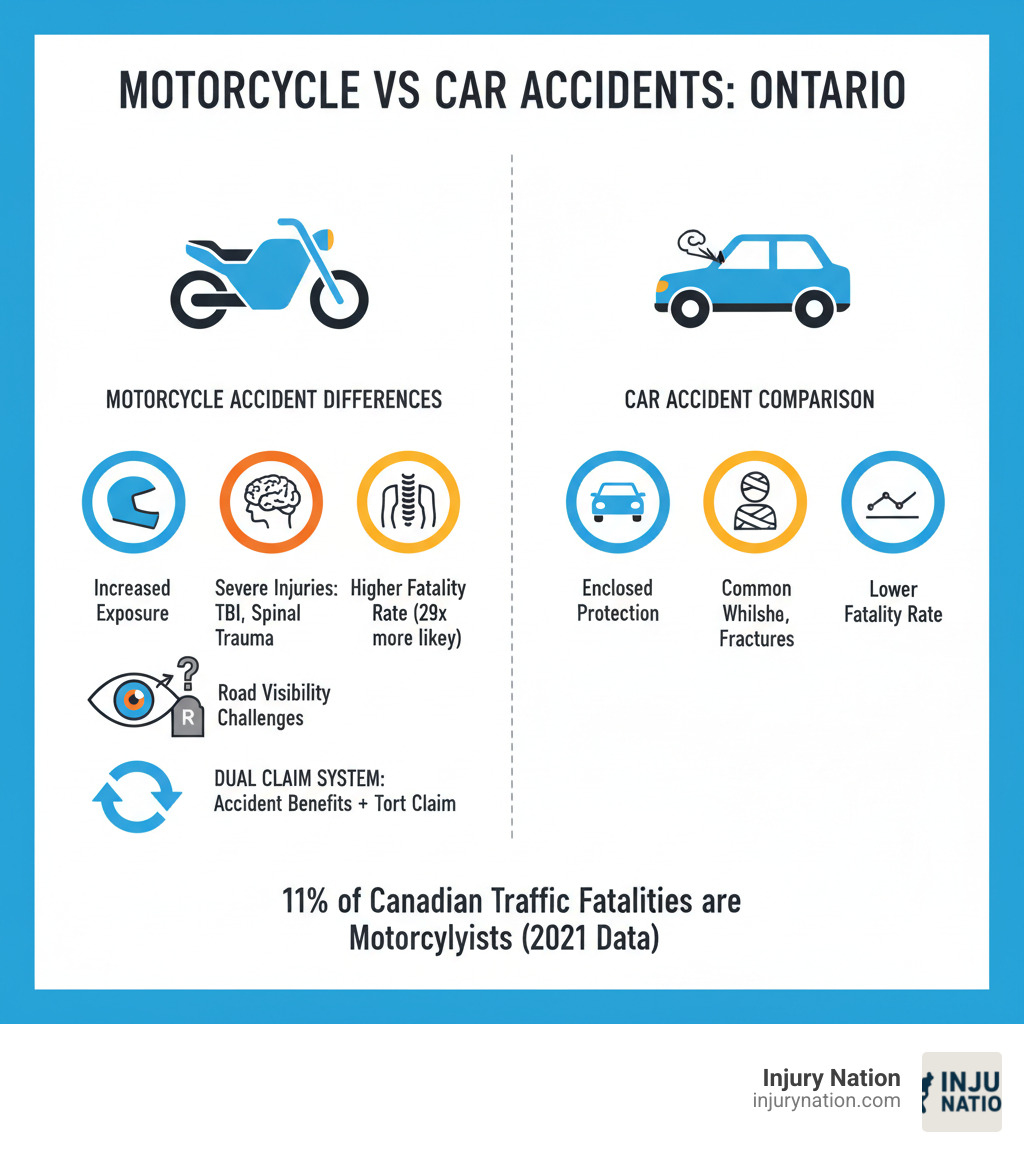
- Higher injury severity: According to the National Highway Traffic Safety Administration (NHTSA), motorcyclists are about 28 times more likely to die in a crash than car occupants.
- Equal legal rights: Despite biases, motorcyclists have the same road rights and legal protections as other drivers.
- Partial fault doesn’t eliminate claims: You can still receive compensation even if you’re partially responsible.
- Two-year deadline: Many states have a strict statute of limitations, giving you limited time to file a lawsuit.
The reality is stark. In 2021 alone, 5,932 motorcyclists were killed in the United States, accounting for 14% of all traffic fatalities.
Your vulnerability on the road doesn’t have to mean vulnerability in the claims process.
Whether you’re dealing with traumatic brain injuries, spinal cord damage, or the financial stress of being unable to work, understanding your rights is the first step toward fair compensation. The insurance companies know the system inside and out—and now you will too.
First on the Scene: Critical Steps After a Motorcycle Accident
The moments after a motorcycle crash are overwhelming. Your heart is racing, your mind is foggy, and you’re scared. What you do in these first critical minutes can make a huge difference for your health and any future motorcycle accident claims.
Safety First
If you can, move yourself and your bike out of traffic. Turn on your hazard lights. If you have warning triangles or flares, use them to alert other drivers. This helps prevent another accident and ensures first responders can reach you safely.
Call 911 and Seek Immediate Medical Attention
You must call 911, even if you feel okay. Adrenaline can mask serious injuries. Police need to document the scene, and paramedics must check you over. Injuries like traumatic brain injuries or internal bleeding may not be immediately apparent but can be life-threatening.
Getting medical attention creates a record that is crucial for your claim. Motorcycle crash injuries are often severe due to the lack of protection:
- Traumatic Brain Injuries (TBI): Even with a helmet, concussions or more severe TBIs can have long-lasting effects on your cognitive function and quality of life.
- Spinal Cord Injuries: These can range from painful sprains to paralysis, often requiring lifelong care.
- Road Rash: Severe abrasions from sliding on pavement can require skin grafts and lead to infection and permanent scarring.
- Broken Bones and Fractures: Arms, legs, ribs, and collarbones are commonly broken due to direct impact.
Attend all follow-up appointments to aid your recovery and document the ongoing impact of your injuries.
Gather Evidence, But Don’t Admit Fault
If you are physically able, start collecting evidence. Your health always comes first.
- Police Report: Obtain a copy as soon as it’s available. It’s a key piece of evidence, even if it contains initial errors.
- Witness Information: Get names and phone numbers from anyone who saw the crash. Their unbiased accounts are invaluable.
- Photos and Videos: Use your phone to document everything: vehicle damage, positions, road conditions, traffic signs, and your injuries.
Most importantly: do not admit fault. Even saying “I’m sorry” can be used against you by insurance companies. Stick to the facts when talking to the police and other drivers.
Notify your insurer as soon as possible to start the claims process.
Essential information to collect at the scene:
- Names, addresses, and phone numbers of all involved
- Insurance company names and policy numbers
- Driver’s license and license plate numbers
- Make, model, and year of all vehicles
- Witness contact information
- Attending police officer’s name and badge number
- Photos/videos of the scene, damage, and injuries
- Date, time, and location of the accident
- Notes on weather and road conditions
The shock of an accident makes it hard to think clearly. Keep this list on your phone or in your wallet.
How Motorcycle Accident Claims Work in an At-Fault System

After a motorcycle accident, understanding how to get compensation is key. In most states (including Nevada), the system is an “at-fault” one. This means the person who negligently caused the crash is responsible for the damages. This gives you two primary avenues for seeking compensation.
Think of it this way: one path holds the responsible party accountable, while the other acts as your personal safety net. Successful motorcycle accident claims often use both.
The Primary Path: Filing a Claim Against the At-Fault Driver
Your main claim will be against the at-fault driver and their liability insurance. To win this claim, your lawyer must prove the other driver’s negligence. This involves showing they had a duty of care to drive safely, they breached that duty (e.g., by texting or speeding), their actions directly caused your injuries, and you suffered actual damages as a result.
This legal pathway allows you to seek compensation for a wide range of losses:
- Economic Damages: This covers all your financial losses, including current and future medical bills, lost wages, reduced earning capacity, and the cost to repair or replace your motorcycle.
- Non-Economic Damages: This compensates you for the non-financial impact of the crash, such as pain and suffering, emotional distress, and the loss of enjoyment of life if you can no longer ride or enjoy your hobbies.
- Wrongful Death Claims: In the most tragic cases, surviving family members can file a claim to seek compensation for funeral expenses, lost financial support, and the loss of companionship.
Your Safety Net: Using Your Own Insurance Coverage
What happens if the at-fault driver is uninsured or their policy isn’t enough to cover your severe injuries? This is where your own insurance policy becomes critical.
- Uninsured/Underinsured Motorist (UM/UIM) Coverage: This optional but vital coverage steps in to pay for your damages when the at-fault driver has no insurance (uninsured) or not enough insurance (underinsured) to cover your losses.
- Medical Payments (MedPay) Coverage: Also optional, MedPay can cover your initial medical expenses up to your policy limit, regardless of who was at fault. It provides immediate help while your main claim is pending.
Navigating these claims can be complex. The at-fault driver’s insurance company will try to pay as little as possible, which is why understanding both avenues is crucial for your financial recovery.
Key Legal Problems and Considerations for Bikers

Being a motorcyclist in the legal system isn’t always a fair fight. You’re already vulnerable on the road, and that can follow you into the claims process. But understanding these challenges is the first step to overcoming them.
Statute of Limitations
Time is not on your side. In many states, including Nevada, you have exactly two years from the date of your accident to file a lawsuit. If you miss this deadline, your case is likely over, no matter how strong it is.
In some cases, the “findy rule” can extend this deadline if your injuries weren’t immediately apparent. However, you should never count on this exception. Evidence disappears and witness memories fade, so acting quickly is always best.
Shared Fault and Comparative Negligence
Accidents often involve shared responsibility, but an unfair bias against riders can complicate things. Insurance adjusters and jurors sometimes assume motorcyclists are reckless, making it harder to prove the other driver’s fault.
This is where shared fault rules come in. Most states use a “comparative negligence” system. In a state with a modified comparative negligence rule (like Nevada), you can still recover damages as long as you are not 51% or more at fault. Your compensation is simply reduced by your percentage of fault.
Helmet laws also play a role. In states with universal helmet laws, like Nevada, wearing one is mandatory. Not wearing a helmet won’t prevent you from filing a claim, but the other side may argue it contributed to your injuries, potentially reducing your compensation.
Understanding Your Rights in Motorcycle Accident Claims
Despite these challenges, know this: you have equal road rights. The “assumption of risk” argument—that you accepted the danger by riding a motorcycle—is a myth. You do not assume the risk of another driver’s negligence.
Your rights include seeking compensation from the at-fault party and using your own insurance, like Medical Payments (MedPay) and Uninsured/Underinsured Motorist (UM/UIM) coverage, to protect yourself.
Can I Still Get Compensation If I Was Partially At Fault?
Yes, absolutely. This is a critical point for motorcycle accident claims.
Under a comparative negligence system, partial fault doesn’t bar you from recovery. For example, if your damages total $100,000 but you are found 20% at fault, you can still receive $80,000. As long as you are not found to be primarily at fault (51% or more in states like Nevada), you can still get compensation.
Don’t let worry about partial fault stop you from pursuing a claim. The other driver’s negligence still caused your injuries, and you deserve to be compensated for that.
Why You Need an Expert in Your Corner
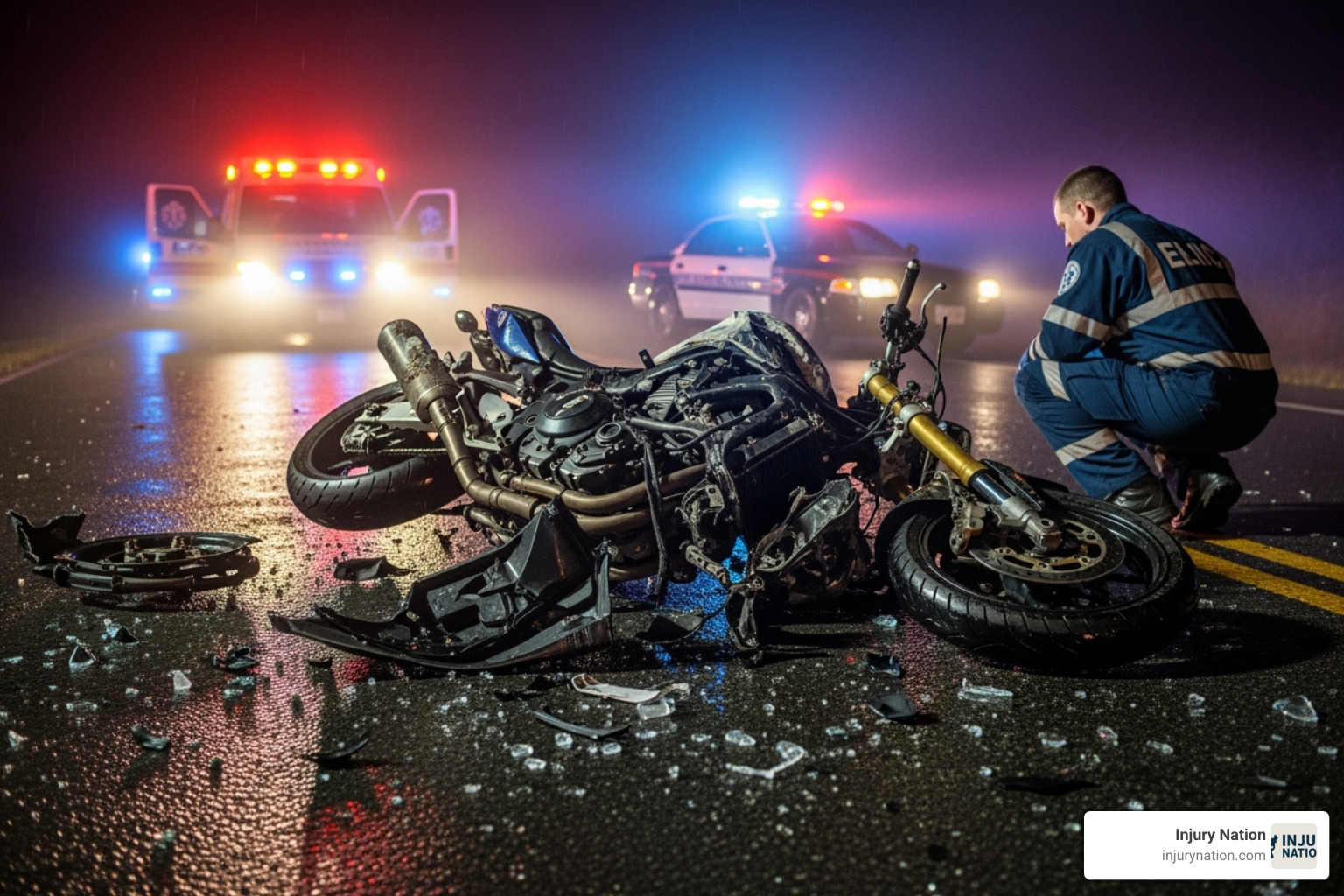
Imagine you’re recovering from a motorcycle accident, dealing with pain and lost income. An insurance adjuster calls with a “generous” offer that expires today. They sound friendly, but they are not on your side. Their job is to pay you as little as possible.
Motorcycle accident claims are complex, and you shouldn’t have to fight this battle alone while you’re trying to heal.
Insurance Company Tactics
Insurers use proven tactics to minimize claims. They make lowball settlement offers soon after the crash, betting you’ll take a fraction of what you deserve out of desperation. They also ask for recorded statements, hoping to use your words against you later to downplay your injuries. Adjusters are trained negotiators, not your friends.
How a Personal Injury Lawyer Maximizes Your Claim
A skilled lawyer levels the playing field. They handle the legal fight so you can focus on recovery.
- Strategic Evidence Gathering: Lawyers know what evidence matters. They collect police reports, medical records, and witness statements to build a strong case.
- Hiring Expert Witnesses: They work with accident reconstructionists to prove fault and consult medical and economic experts to calculate the full, long-term cost of your injuries.
- Managing Deadlines & Paperwork: They steer the complex legal procedures and deadlines, including the statute of limitations, so you don’t have to.
- Expert Negotiation: Lawyers understand the true value of your claim and won’t be intimidated by insurance company tactics. They negotiate from a position of strength.
- Litigation Experience: If the insurer refuses to offer a fair settlement, an experienced lawyer is prepared to take your case to trial.
Find experienced Motorcycle Accident Lawyers at Injury Nation to help you with your claim.
Overcoming Common Claim Problems
Motorcycle accident claims face unique problems. Lawyers are essential for overcoming them.
- Disputed Liability: To counter unfair rider bias, lawyers use accident reconstruction reports and witness testimony to clearly establish the other party’s fault.
- Downplayed Injuries: They work with your doctors to create a complete record of your injuries and their impact on your life, proving their severity to the insurer.
- Pre-existing Conditions: If an insurer tries to blame your pain on an old injury, a lawyer can demonstrate how the accident aggravated that condition, making the at-fault party responsible for the worsened outcome.
- Proving Future Losses: Lawyers use life care planners and economic experts to accurately project future medical costs and lost earning capacity, ensuring your settlement covers your needs for life.
Frequently Asked Questions about Motorcycle Accident Claims
After a motorcycle accident, you have questions. Here are clear answers to the most common concerns we hear from riders.
How much can I sue for in a motorcycle accident?
There’s no magic number, as the value of motorcycle accident claims depends entirely on how your life has been affected. The severity of your injury is the biggest factor. Insurance companies may try to classify your injuries as “minor,” but motorcycle accidents often cause severe or catastrophic injuries that require extensive medical care and prevent you from returning to work.
We calculate your claim’s value based on:
- Economic damages: Medical bills, lost wages, future care costs, and property damage.
- Non-economic damages: Pain and suffering, emotional trauma, and loss of enjoyment of life.
Every case is evaluated on its own facts. Your age, career, and recovery prognosis all play a role. Settlements can range from thousands of dollars to millions for severe, life-altering injuries or wrongful death cases.
How long does it take to settle a motorcycle accident claim?
This is difficult to predict. Simple cases may settle in months, while complex ones can take several years. Rushing to settle can cost you dearly.
Claim complexity, disputes over fault, and injury severity all affect the timeline. We must wait until you reach “maximum medical improvement” to understand the full long-term impact of your injuries. Settling too early means you might not get compensation for future medical needs that arise later.
Most cases settle through negotiation. However, if the insurance company is unreasonable, filing a lawsuit may be necessary, which extends the timeline but often leads to a fairer result.
Will my insurance rates go up if I file a claim?
This is a common worry, but the answer depends on who was at fault. If the accident was not your fault, your rates generally should not increase. The at-fault driver’s insurance is responsible for the damages.
If you are found at-fault, your premiums will likely increase, though some policies have accident forgiveness for a first offense. Check with your broker about this.
Using your own optional coverages like Medical Payments (MedPay) typically won’t impact your premiums, as they are designed to be used when needed. Don’t let fear of a rate increase stop you from getting the compensation you deserve. The value of a successful claim almost always outweighs any potential premium increase.
Conclusion
The road to recovery after a motorcycle accident doesn’t have to be traveled alone. This guide has walked you through the essential steps to protect yourself from insurance companies that count on your lack of knowledge.
Remember the key takeaways: In an at-fault system, your primary claim is against the negligent driver, but your own insurance coverages like MedPay and UM/UIM provide a crucial safety net. The two-year deadline for filing a lawsuit is strict, so don’t wait to seek legal advice. Most importantly, partial fault doesn’t eliminate your rights under a comparative negligence system.
Your energy should go toward healing, not battling complex legal systems and insurance adjusters. The unique challenges motorcyclists face—from rider bias to severe injury complications—require an expert who understands both the law and the motorcycle community.
The importance of timely legal advice cannot be overstated. A skilled personal injury lawyer handles the legal pressures while you focus on what matters most: getting your life back.
At Injury Nation, we connect you with experienced legal professionals who specialize in motorcycle accident claims and genuinely care about riders’ rights. These lawyers know how to counter insurance company tactics, properly value severe injuries, and fight for every dollar you deserve.
You’ve been through enough. Let us help you find the right legal support for your journey to recovery. Find a top-rated personal injury lawyer near you.