What Can Extend the Timeline of an Injury Claim in New Orleans After Liability Seems Clear
If the other driver ran a red light on Claiborne Avenue, rear-ended you on I-10, or admitted fault at the scene, it is natural to think your claim should wrap up quickly. Many injured people assume that once liability is obvious, the insurance company should simply calculate the losses and pay. In reality, the new orleans injury claim timeline after liability clear can still stretch out for reasons that have little to do with proving fault and everything to do with proving damages, reviewing records, and negotiating the value of the claim.
That can be frustrating, especially if you came to Injury Nation through the New Orleans resource page looking for straightforward answers. The short version is this: clear fault does not mean instant settlement. Even when responsibility seems settled, the claim still has to move through medical treatment, records collection, wage verification, insurer review, and negotiation. This article explains why that happens, what to expect, and what you can do to avoid preventable delays while you pursue personal injury legal guidance in New Orleans.
Why Clear Liability Does Not Automatically Produce a Fast Settlement
Injury claims have two major parts: fault and damages. Fault answers the question, “Who caused the accident?” Damages answer the question, “What did the accident cost the injured person physically, financially, and personally?”
When liability seems clear, only the first part may be relatively settled. The second part often remains under review. Insurance companies usually do not pay substantial injury claims based only on a police report or an admission of fault. They want documents. They want timelines. They want treatment records, billing records, proof of lost income, and enough information to argue about whether the care was necessary, whether the injuries were caused by the accident, and whether the amount demanded is reasonable.
That is why people in New Orleans often find themselves asking why their case is still open months after the insurer appeared to accept blame. The answer is usually not that nothing is happening. It is that the claim has moved into the slower, document-heavy stage where the insurer evaluates the full value of the losses.
Common misunderstanding: “If they admitted fault, they have to pay now”
They do not necessarily have to settle immediately just because fault looks obvious. They may still investigate the extent of the injuries, review treatment gaps, ask for prior medical history, challenge certain bills, or dispute future medical needs. They may also make an offer that is far below what the claim is worth, which turns a supposedly simple matter into a negotiation.
In other words, admitted fault can remove one major obstacle, but it does not eliminate the rest of the process.
The Main Reasons a New Orleans Injury Claim Can Take Longer Even After Fault Looks Clear
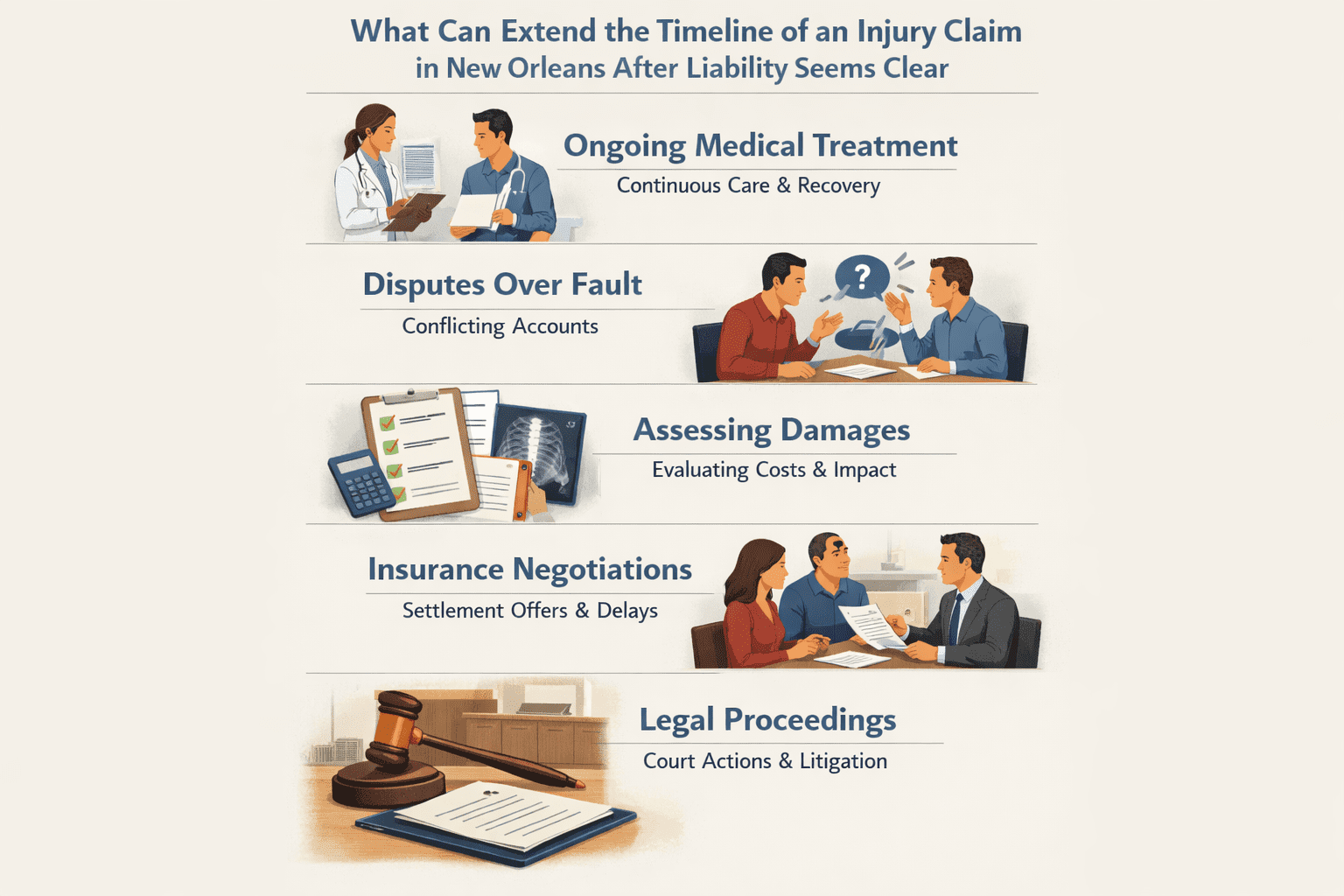
1. Medical treatment is still ongoing
One of the biggest reasons a claim remains open is that the injured person is still treating. This is often not a bad thing. In fact, settling too early can create serious problems. If you resolve a claim before doctors have a clear picture of your recovery, you may accept compensation without understanding the full cost of the injury.
For example, a crash victim in New Orleans might initially think they have only neck and back soreness. A few weeks later, imaging may show a herniated disc, a shoulder tear, or a need for injections or surgery consultation. Until treatment progresses far enough to understand the diagnosis, prognosis, and likely future care, the claim value may be unclear.
Insurance companies know this. They often want to wait until one of the following happens:
- The person completes treatment
- The doctors identify long-term limitations
- The injured person reaches a more stable recovery point
- Future medical needs can be estimated with some confidence
That does not mean every case must wait until perfect recovery. It does mean that treatment progress often controls the timing far more than people expect.
2. Medical records and bills take time to gather
Even a straightforward case can involve records from multiple providers:
- Emergency room
- Ambulance
- Primary care doctor
- Orthopedist
- Chiropractor
- Physical therapist
- Pain management specialist
- Imaging center
- Pharmacy
Each provider has its own process for releasing records and itemized bills. Some respond quickly. Others do not. Some send incomplete sets. Some require updated authorization forms. Some separate narrative records from billing records. If one piece is missing, the insurer may say it cannot complete its review.
This is a common source of delay in injury claims generally, and New Orleans cases are no exception. A claim can stall not because the facts are disputed, but because one physical therapy office has not yet sent the complete billing ledger.

3. The value of damages is still being documented
Damages are broader than medical expenses. Depending on the facts, a complete demand package may include:
- Medical bills
- Medical records
- Lost wages
- Lost earning capacity
- Out-of-pocket costs
- Property damage records if relevant to injury severity discussions
- Photographs of injuries
- Statements about pain, limitations, and recovery
- Evidence of missed events, household difficulties, or daily life disruption
If any of those are incomplete, the insurer may argue it cannot fairly evaluate the claim. For instance, if you missed work after an accident in New Orleans but your employer has not yet issued a wage verification letter, that missing document can hold up the file. If you are self-employed, documenting income loss may require invoices, tax records, appointment logs, and proof of canceled work.
4. The insurer still conducts a review even when fault appears obvious
Insurance adjusters do not simply check a box marked “insured at fault” and issue payment. They typically move the claim through an internal review process that may include:
- Reviewing the police report
- Looking at scene photos
- Reading recorded statements
- Comparing treatment dates to the accident date
- Flagging gaps in care
- Looking for prior injuries
- Assessing whether each provider’s care appears related to the incident
- Checking policy limits
- Seeking supervisor approval for larger offers
In more serious cases, the file may move beyond the first adjuster. It may be reviewed by a bodily injury unit, large-loss team, claims manager, or defense counsel. That review process adds time even when the defense is not seriously contesting who caused the accident.
5. Negotiation itself takes time
Settlement is usually not a one-step event. It is often a back-and-forth process. A demand is submitted. The insurer reviews it. The insurer responds, sometimes with requests for more information and sometimes with an offer. Then the parties negotiate.
Where people get discouraged is that this stage may feel slow and repetitive. You may hear things like:
- “We’re still evaluating the records.”
- “We need updated treatment information.”
- “We need authority to increase the offer.”
- “We are waiting on supervisor review.”
- “We need clarification on the wage loss claim.”
Sometimes those statements reflect legitimate review. Sometimes they reflect delay tactics or ordinary claims-volume backlog. Either way, negotiation rarely moves as quickly as injured people hope.
6. There may be questions about pre-existing conditions or prior accidents
One reason insurers often slow down after fault becomes clear is that they shift focus to causation and severity. They may say:
- You had similar pain before the accident
- You had prior treatment to the same body part
- The imaging findings are degenerative rather than traumatic
- The collision was too minor to cause the claimed injuries
Even when these arguments are weak, they can delay settlement because they require records comparison, physician notes, and a more detailed presentation of how the accident changed your condition. A person with a prior back issue can still have a valid claim if the accident aggravated that condition, but documenting that often takes more work than documenting a completely new injury.
7. Gaps in treatment create questions the insurer will use
If there is a long break between the accident and the start of treatment, or a long pause in care after treatment begins, the insurer may question how serious the injuries really were. In New Orleans claims, as elsewhere, gaps in treatment are one of the most common reasons claims take longer than expected.
That does not mean every gap is fatal. People miss appointments for understandable reasons: transportation problems, childcare obligations, work schedules, insurance issues, provider shortages, or storm-related disruption. But if the gap is not explained, it can become a sticking point in the review and negotiation process.
8. Lost wage claims often take longer than expected to prove
Many people think proving missed work should be simple. It can be simple if you are paid hourly, your employer is responsive, and your absence is clearly documented. It becomes more complicated when:
- You are paid partly in tips or commissions
- You are self-employed
- You had irregular hours
- You used sick leave or paid time off
- You missed opportunities rather than fixed scheduled shifts
- Your doctor’s work restrictions were not clearly written
If the wage-loss portion of the claim is not well documented, the insurer may delay while asking for pay records, tax documents, employer letters, or medical work-status notes.
9. Future damages may need closer review
Some injuries are not fully resolved by the time demand is made. A doctor may recommend future physical therapy, a follow-up with a specialist, injections, surgery, or long-term medication. Once a future-care component enters the claim, the insurer often becomes more cautious because the dollar amount may rise significantly.
That can lengthen the timeline because the adjuster may ask for:
- Updated physician opinions
- Treatment plans
- Cost estimates
- Clarification on whether a procedure is probable or only possible
Cases involving future care often require more negotiation because the parties disagree not only about what has already happened, but also about what is likely to happen next.
10. Policy limit issues can complicate the timeline
Even if fault is clear and injuries are significant, the available insurance coverage may affect the pace of resolution. If damages appear to exceed policy limits, the insurer may conduct a more careful review before tendering limits. There may also be questions about additional coverage, umbrella coverage, uninsured or underinsured motorist coverage, or multiple potentially responsible parties.
Those issues do not always arise, but when they do, they can extend the process even in cases where no one seriously disputes liability.
What the Typical Post-Liability Claim Stage Looks Like
If you are reading this after visiting the New Orleans service page and wondering what happens after “fault is clear,” it helps to think of the claim in stages. Not every case follows the same path, but many look something like this.
Stage 1: Immediate claim setup and early investigation
This usually includes notice to the insurer, initial statements, crash documentation, and basic review of liability. In a clear-fault situation, this stage may move relatively quickly.
Stage 2: Ongoing medical treatment and monitoring
This stage often takes much longer than people expect. The claim remains active while you treat, attend follow-ups, complete therapy, receive imaging, and learn whether the injury will resolve or become long term.
Stage 3: Record and damages collection
Once there is enough treatment history to value the claim, records, bills, wage documents, and supporting evidence are gathered. This can be slowed by provider response times and missing paperwork.
Stage 4: Demand package submission
A demand package is typically sent to the insurer laying out liability, injuries, treatment, losses, and the basis for settlement. In clear-fault cases, this stage focuses heavily on damages rather than blame.
Stage 5: Insurer review and evaluation
The insurer studies the materials, compares them with the claim file, and decides whether to request more documents, make an offer, deny parts of the demand, or escalate the file for additional review.
Stage 6: Negotiation
Offers and counteroffers go back and forth. This may take one conversation or many. The amount of time depends on claim value, quality of documentation, seriousness of injuries, and whether the insurer is acting reasonably.
Stage 7: Decision point
If settlement terms become acceptable, the matter can resolve. If not, the next step may involve stronger legal pressure, formal filing, or litigation, depending on the circumstances and deadlines.
Specific New Orleans Factors That Can Affect Claim Timing
Every city has practical realities that shape how injury claims unfold. New Orleans can present its own challenges, especially for people dealing with transportation issues, provider scheduling, and post-accident disruption in everyday life.
Busy medical systems and specialist scheduling
In larger metro areas, specialist appointments are not always available immediately. Orthopedic reviews, pain management, advanced imaging, and surgical consultations can all take time to schedule. If your claim depends on one key specialist opinion, that wait can affect the entire timeline.

Storm disruptions and recovery interruptions
In Southeast Louisiana, weather events can interfere with treatment, document requests, travel, and communication. A missed appointment caused by severe weather may be understandable, but it can still slow the progression of care and delay evaluation of the claim.
Traffic-related injury patterns
New Orleans-area crashes often involve congested roads, rear-end collisions, intersections, tourist traffic, and commercial vehicles. Even where fault is straightforward, the injuries may not be. Soft tissue injuries that later turn into prolonged pain complaints often require more medical follow-up than people first expect.
Local provider response times
Some offices release records quickly; others do not. Delays in obtaining certified records, itemized bills, or physician narratives can hold up a demand package no matter how strong the underlying claim is.
What Clients Can Do to Avoid Preventable Slowdowns
Not every delay can be avoided. Some are built into the process. But many slowdowns are preventable. If you want to protect your claim and reduce unnecessary lag, these steps matter.
Get medical care promptly
Prompt evaluation creates a clearer link between the accident and the injury. Waiting too long gives the insurer room to argue that something else caused the problem or that the injury was not serious enough to require care.
Follow the treatment plan consistently
Attend recommended appointments, therapy sessions, specialist visits, and follow-ups when possible. If you must miss an appointment, reschedule promptly. A consistent treatment history usually makes the claim easier to evaluate and defend.
Explain unavoidable treatment gaps
If there is a break in care because of work, cost, transportation, childcare, or weather disruption, make sure that explanation is documented where appropriate. Silence allows the insurer to make assumptions.
Keep all paperwork organized
Save discharge instructions, bills, receipts, prescriptions, mileage records for medical travel if relevant, and any communication from insurers or providers. Also keep copies of work notes and disability slips.
Track how the injury affects daily life
Write down practical examples:
- Nights you could not sleep
- Activities you had to stop
- Household chores you could not perform
- Events you missed
- Times pain interfered with parenting or work
These details can help explain the real impact of the injury beyond the billing records.
Respond quickly to document requests
If wage records, authorization forms, accident photos, or insurance information are requested, provide them as soon as you can. A claim may sit idle simply because one needed item has not yet been returned.
Be careful with insurer communications
Do not assume the adjuster is just calling to help move things along. Insurance communications can affect the value and timeline of the claim. Be cautious, stay accurate, and avoid guessing about medical recovery if you truly do not know yet.
Do not settle before the claim can be valued properly
Fast is not always better. Some delays occur because the case is being developed to reflect the true extent of the injury. A quick settlement can be a poor settlement if it closes the claim before the medical picture is complete.
Warning Signs That the Delay May Be More Than Routine
Some delays are normal. Others suggest the insurer may be undervaluing the case or intentionally dragging out the process. Watch for signs like these:

- Long periods with no substantive response
- Repeated requests for documents already provided
- Unexplained changes in adjusters
- Low offers that do not appear to account for clear treatment records
- Constant statements that the file is “under review” with no progress
- Focus on minor paperwork issues while major damages go unaddressed
- Pressure to settle before treatment is complete
When these patterns appear, a stronger legal strategy may be necessary to move the claim forward and protect against a bad outcome.
Examples of How a “Clear Liability” Claim Still Slows Down
The following examples are general illustrations, not case studies, but they show how timing issues arise in real-world claims.
Example 1: Rear-end collision with delayed imaging
A driver is rear-ended in New Orleans. The police report and property damage make fault look obvious. The person treats conservatively for several weeks, but pain continues. An MRI is then ordered and reveals a more significant injury than expected. Although liability was clear from day one, the claim timeline extends because the injury picture changed and the value of the claim increased.
Example 2: Clear fault but inconsistent therapy attendance
An injured passenger begins physical therapy but misses multiple appointments due to work and family obligations. The insurer later argues the symptoms must not have been severe, or the person would have attended more consistently. The claim takes longer because the treatment history now needs explanation.
Example 3: Clear fault but incomplete wage-loss proof
A restaurant worker misses shifts after a crash, but income is partially based on tips and varying schedules. The insurer requests more wage documentation. Liability is not the issue. The delay comes from proving how much income was actually lost.
Example 4: Clear fault but pre-existing back pain
A person with prior lower back complaints is hit in an obvious intersection crash. The insurer accepts that its driver caused the collision but disputes whether the current symptoms are new, aggravated, or unrelated. Records from before and after the accident must be reviewed, which slows settlement.
How the Strength of Your Damages Presentation Affects Timing
After liability seems clear, the claim often becomes a presentation problem. The stronger and cleaner the damages package, the easier it is to move the file toward meaningful negotiation.
A strong damages presentation usually does the following:
- Tells a clear story of what happened
- Connects the injury timeline to the accident timeline
- Accounts for all providers and treatment dates
- Explains any treatment gaps
- Shows wage loss with documents rather than estimates
- Addresses prior injuries honestly
- Provides organized records and billing support
- Explains ongoing limitations in concrete terms
A weak presentation leaves unanswered questions, and unanswered questions create delay. The insurer may not even need to deny the claim outright. It can simply keep asking for more support while holding the offer down.
What to Expect Emotionally During This Stage
This phase of a claim is often harder than people expect because it feels like nothing is happening. The accident is over. Fault seems obvious. Yet the bills keep coming, your body may still hurt, and the case is not resolved.
Common reactions include:
- Frustration that the insurer is moving slowly
- Anxiety about medical costs and missed income
- Confusion about whether treatment should continue
- Temptation to accept a low offer just to end the stress
- Worry that a delay means the claim is weak
Delay does not automatically mean the claim lacks merit. In many cases, it means the claim is still being built, documented, and valued. The challenge is to distinguish normal process delay from problematic insurer behavior.
How This Article Fits If You Came Through the New Orleans Service Page
If you found this article after visiting Injury Nation’s New Orleans personal injury resources, you are likely looking for local guidance rather than generic legal theory. This topic matters because many New Orleans accident victims reach the same confusing point: they believe fault is no longer in dispute, but their claim still has not settled.
This article is meant to answer that specific question. It does not assume every claim follows the same path. It also does not promise that insurers move quickly once liability is admitted. Instead, it focuses on the practical reasons your claim may still take time and the steps you can take to avoid making the process slower than it already is.

That is especially important for people dealing with car accident claims assistance, medical follow-up, and the search for a local personal injury lawyer resource in New Orleans. Clear guidance at this stage can help you avoid mistakes that reduce leverage later.
When It May Be Time to Speak With a New Orleans Personal Injury Lawyer
Not every delay requires immediate escalation, but some situations deserve prompt legal review. Consider seeking help if:
- Liability seems clear, but the insurer is still not engaging meaningfully
- Your injuries are more serious than you first thought
- You are still treating and do not know whether it is too early to settle
- The insurer is minimizing your medical care
- You have pre-existing conditions the insurer is using against you
- Your lost wages are difficult to document
- You suspect the available policy may not cover the full loss
- You are nearing a legal deadline and the claim remains unresolved
A local lawyer can help organize the record, present damages properly, handle negotiation, and identify whether the delay is ordinary or a sign of a bigger problem. In a city like New Orleans, local familiarity also matters when understanding provider patterns, traffic realities, and the practical pace of claims handling.
Frequently Asked Questions About the New Orleans Injury Claim Timeline After Liability Is Clear
If fault is admitted, should I expect a settlement within a few weeks?
Not necessarily. Some small, uncomplicated claims resolve relatively quickly, but many do not. If treatment is ongoing, records are incomplete, or damages are still being documented, the claim may take much longer.
Can the insurer delay because I am still going to physical therapy?
What often happens is not exactly “delay because of therapy,” but rather continued evaluation while therapy is ongoing. The insurer may want to see whether you improve, plateau, or need further care before valuing the claim.
Do I have to finish all treatment before settlement talks can start?
Not always. In some cases, discussions begin before treatment fully ends. But the claim usually becomes easier to value once the medical condition is more stable and future care is easier to estimate.
Will missing a few appointments ruin my case?
Missing appointments does not automatically ruin a claim, but it can create issues. The key is whether the gaps were significant, whether there was a real reason, and whether the overall treatment history still supports the seriousness of the injury.
Why does the insurer keep asking for more records if fault is clear?
Because the insurer is now focused on damages. It wants to assess the nature of the injury, the reasonableness of treatment, the cost of care, prior conditions, and the amount it may have to pay.
Should I accept a quick offer if the other side is clearly at fault?
Not without understanding the full value of your claim. A quick offer may come before the long-term medical picture is known. Settling too early can leave you paying for future consequences on your own.
Does a claim taking longer mean it is weak?
No. Sometimes stronger claims take longer because the injuries are more complex, treatment lasts longer, or the amount in dispute is larger.
Can a New Orleans lawyer help even if the issue is delay, not denied liability?
Yes. Many injury claim disputes are really about valuation, documentation, and negotiation rather than basic fault. Legal help can still be important when the main problem is a stalled or undervalued claim.
Practical Checklist for Avoiding Claim Delays
- Seek medical attention as soon as reasonably possible
- Follow up with recommended providers
- Keep a calendar of all appointments and missed work
- Save bills, receipts, prescriptions, and mileage or other accident-related costs
- Request employer wage verification early
- Document symptoms and daily limitations in plain language
- Be honest about prior injuries instead of hoping they will not matter
- Provide requested documents promptly
- Avoid casual statements to insurers about being “fine” if you are still hurting
- Get legal guidance if the insurer’s review seems to drag on without progress
Conclusion
The new orleans injury claim timeline after liability clear is often longer than injured people expect because fault is only one part of the case. Even when the other side’s responsibility looks obvious, your claim may still need time for treatment progress, records collection, wage-loss proof, damages documentation, insurer review, and negotiation. That does not mean you are doing something wrong, and it does not mean the claim lacks value. It means the case has moved into the stage where proving the impact of the injury matters just as much as proving who caused it.
If you are dealing with a delayed injury claim in New Orleans and want clearer direction on what comes next, Injury Nation can help you connect with local personal injury lawyer resources and practical legal guidance. Contact a local personal injury lawyer for a free consultation today if you have questions about a slow-moving claim, ongoing treatment, insurer tactics, or how to avoid preventable setbacks while your case is still pending.