

What Happens If the Other Driver Is Uninsured in St Louis?
A crash is stressful enough when insurance information is clear. It becomes even more confusing when you learn the other driver may not have coverage at all. If you are dealing with an uninsured driver accident claim St Louis situation, you may be asking practical questions right away: Who pays for your medical bills? Can your own insurance help? What if the uninsured driver caused serious damage? What should you say to insurance adjusters, and what should you avoid?
This guide explains what usually happens after a crash involving an uninsured driver in St Louis, what steps may protect your claim, what kinds of damages may still be pursued depending on the facts, and when legal guidance can help you understand your options. Every case is different, but the claims process becomes easier to manage when you know what information to collect and what decisions matter early.
Why Uninsured Driver Crashes Create More Problems Than a Typical Claim
In a standard car accident claim, the at-fault driver’s insurance policy is often the first place injured people look for compensation. When the other driver is uninsured, that usual path may not be available. That changes the case in several important ways.
- You may need to look first at your own auto policy instead of the other driver’s policy.
- Your claim may involve more documentation because coverage questions often become disputed.
- The at-fault driver may have few personal assets, making direct recovery difficult even if liability is clear.
- There may be disputes about whether the vehicle was insured, whether another household policy applies, or whether a hit-and-run can be treated similarly under certain policy terms.
- Prompt reporting becomes especially important because your insurer may require quick notice and supporting evidence.
That does not mean you have no options. It means your claim path may look different from what many accident victims expect. The sooner you understand that difference, the better prepared you are to protect your rights.
Immediate Steps After the Crash in St Louis
The first minutes and hours after a wreck matter. They affect your safety, your medical care, and your ability to support a future claim. Whether the crash happened on I-64, I-70, I-44, Highway 40, Kingshighway, Grand Boulevard, or on a local neighborhood street in St Louis, the same basic priorities apply.
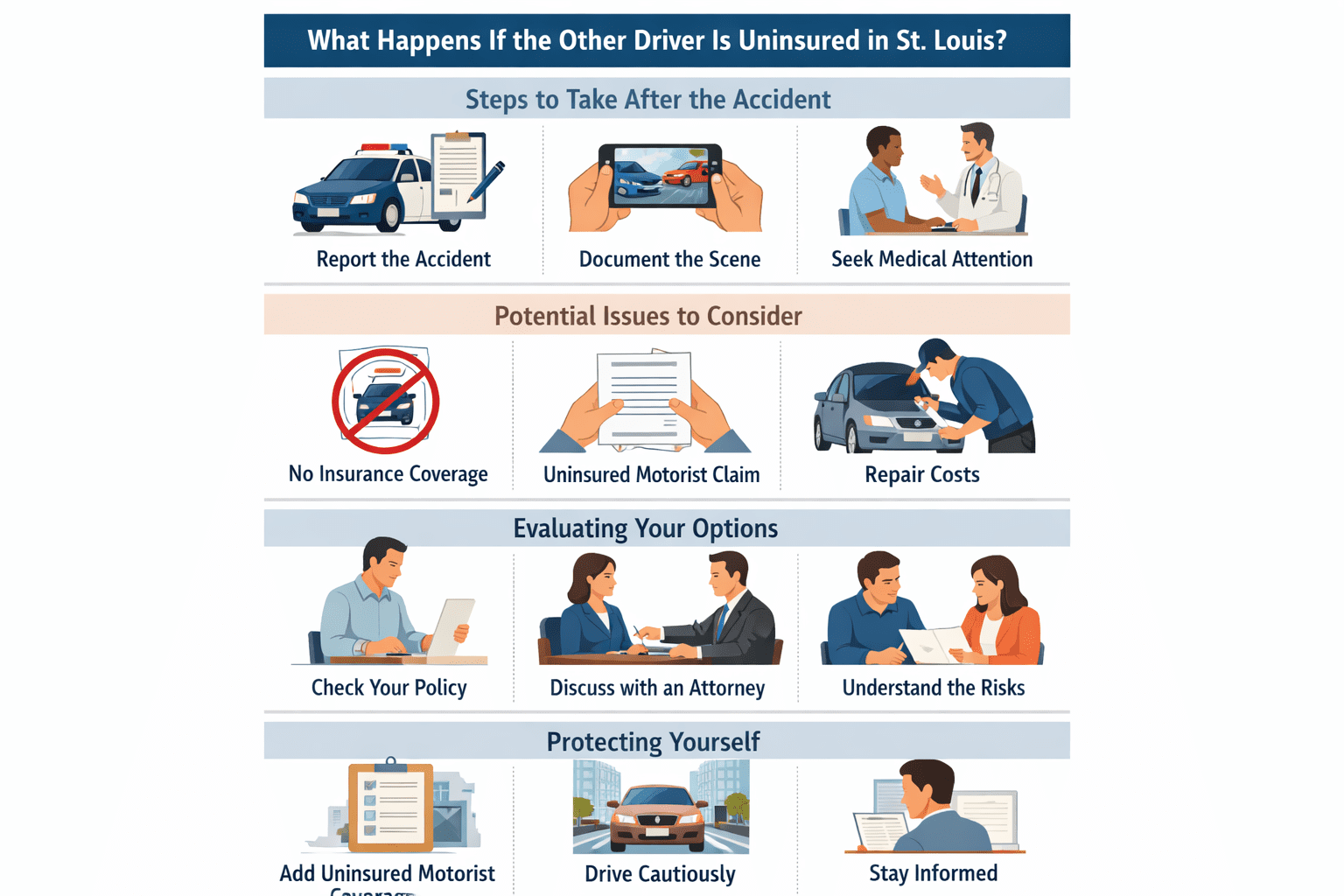
1. Call 911 and Request Police Response
If anyone is hurt, call for emergency medical help immediately. Even if injuries seem minor, requesting police response can be important. A police report may later help document:
- The date, time, and location of the crash
- The drivers involved
- Initial observations about vehicle damage
- Statements made at the scene
- Potential witness names
- Whether the other driver appeared to lack proof of insurance
If the other driver says they do not have insurance, do not argue at the scene. Stay calm and let law enforcement document what they can.
2. Get Medical Attention Quickly
Many injuries are not obvious right away. Adrenaline can mask pain after impact. Neck injuries, back injuries, concussions, soft tissue damage, internal injuries, and worsening soreness may not fully appear until hours or days later.
Prompt medical evaluation matters for two reasons. First, it protects your health. Second, it creates a timeline linking your injuries to the crash. If you wait too long to get checked, an insurance company may argue that your injuries were minor, unrelated, or caused by something else.
3. Gather Information at the Scene
If you are physically able, collect as much information as possible. In an uninsured driver case, details matter even more because coverage questions often become a central issue.
Try to collect:
- The other driver’s full name
- Phone number and address
- Driver’s license number
- License plate number
- Vehicle make, model, and color
- Vehicle identification number if visible
- Photos of all vehicles
- Photos of the road, skid marks, debris, traffic signs, and weather conditions
- Photos of any visible injuries
- Names and contact information of witnesses
- The police report number or responding agency details
If the other driver hands you an insurance card, photograph it even if you suspect it may be expired or invalid. Do not assume anything yet. Sometimes there is a policy issue, a lapsed policy, a household exclusion issue, or confusion about who was permitted to drive.
4. Do Not Admit Fault or Speculate
Keep your comments factual. Do not apologize in a way that sounds like you are accepting blame. Do not guess about speed, impact, injuries, or what happened if you are unsure. Simple statements are best: where you were driving, what you observed, and whether you need medical help.
5. Notify Your Insurer Promptly
Even if the other driver caused the crash, your own insurance company may become a primary source of potential coverage in an uninsured driver claim. Many policies require prompt notice. Waiting can create problems, especially if there is a future dispute over uninsured motorist benefits or other available coverage.
What Information to Collect If You Suspect the Other Driver Is Uninsured
When the other driver may be uninsured, your case often depends on proving not just the crash itself, but the insurance status, liability facts, and your resulting damages. Here are the most useful categories of information to preserve.
Scene Evidence
- Wide-angle photos showing the crash layout
- Close-up damage photos
- Traffic lights, stop signs, lane markings, and road conditions
- Nearby business cameras, dashcams, or home surveillance that may have captured the crash
Driver and Vehicle Information
- Driver identity details
- Registered owner information if the driver is not the owner
- Any insurance card, even if incomplete or possibly outdated
- Rideshare, delivery, or commercial use indicators if applicable
Witness Information
- Neutral witnesses can be especially valuable when fault is disputed.
- Get names, phone numbers, and short notes about what each witness saw.
Medical Documentation
- Emergency room records
- Urgent care visits
- Primary care notes
- Specialist evaluations
- Imaging results
- Physical therapy records
- Medication receipts
Financial Loss Records
- Pay stubs showing missed work
- Employer letters verifying time lost
- Vehicle repair estimates
- Towing and storage bills
- Rental car receipts
- Out-of-pocket expenses tied to the crash
Strong documentation does not guarantee payment, but weak documentation can make a difficult uninsured driver claim even harder.
How Uninsured Motorist Issues May Affect Your Claim Path
One of the biggest surprises for many crash victims is that an uninsured driver case may still involve extensive dealings with insurance companies. The difference is that the focus may shift from the at-fault driver’s insurer to your own policy, other available policies, or alternative legal paths.
Your Claim May Turn Into a First-Party Insurance Claim
If the at-fault driver has no insurance, you may need to pursue available benefits under your own auto policy, depending on the policy language and the facts. This can feel frustrating. Even though you paid premiums for protection, your insurer may still investigate:
- Whether the other driver was actually uninsured
- Who caused the collision
- The extent of your injuries
- Whether your treatment was necessary and related
- The value of vehicle damage and other losses
People sometimes assume their own insurance company will automatically treat the claim fairly because they are a customer. In reality, coverage and value disputes can still happen.
There May Be Questions About Whether Other Coverage Exists
Before concluding that the driver is truly uninsured, several questions may need to be answered:
- Was there a valid policy on the vehicle?
- Did the driver live with someone whose policy might apply?
- Was the driver working at the time, raising possible business or commercial coverage questions?
- Was the vehicle borrowed, rented, or used for delivery or rideshare purposes?
- Was there a policy that existed but was denied for a specific reason?
These details can change the claim path. In some cases, there is more than one possible source of coverage, and identifying that early can matter.
Hit-and-Run Cases May Raise Similar Issues
If the other driver fled and was never identified, the situation can resemble an uninsured motorist issue in practical terms. However, hit-and-run claims often have strict reporting and proof requirements under policy language. That is one reason immediate reporting and police involvement are so important.
Fault Still Matters
Even if the other driver has no insurance, you still generally need to show they were legally responsible for the collision before significant compensation is available. Evidence of fault remains central. Uninsured status does not replace proof.
Why Policy Review Matters More Than Most People Realize
After a crash with an uninsured driver, many people focus only on the police report and the other driver’s lack of insurance. But one of the most important documents in your case may be your own insurance policy.

A careful policy review can help answer questions like:
- What coverages were active on the date of the crash?
- What notice requirements apply?
- Are there deadlines for submitting documents or requesting benefits?
- What exclusions may be relevant?
- Are there medical payment benefits or other optional coverages that may help?
- Are there separate claim paths for vehicle damage and bodily injury?
Insurance policies are not always easy to read. Terms may seem straightforward at first but become less clear when applied to a specific accident. That is why reviewing the declarations page alone is often not enough. The full policy language may matter.
Why Prompt Reporting Matters
Prompt reporting is not just a courtesy to your insurer. It can directly affect your rights. Delays may lead to arguments such as:
- The insurer was not given a fair chance to investigate
- Vehicle damage was altered before inspection
- Medical issues cannot be tied clearly to the crash
- The uninsured status of the other driver was not adequately documented
- Witnesses became unavailable
You do not need to have every answer before reporting the crash. In many cases, it is better to report promptly and continue supplying documents as they become available.
What Damages May Still Be Pursued Depending on Coverage and Facts
When the at-fault driver is uninsured, people often fear they are automatically stuck with every expense. That is not always true. The damages that may still be pursued depend on the available coverage, the severity of the harm, and whether there are other responsible parties or policies.
Medical Expenses
You may be able to pursue compensation related to:
- Emergency room care
- Ambulance charges
- Hospital treatment
- Doctor visits
- Physical therapy
- Diagnostic imaging
- Prescription medication
- Future medical care that is reasonably related to the crash injuries
The exact path depends on available coverage and the legal facts. Keep every bill, explanation of benefits, and treatment record.
Lost Income
If your injuries caused you to miss work, lose earning opportunities, use leave time, or reduce your hours, those losses may be part of the claim. Documentation is key. A lawyer or claims professional may want:
- Recent pay stubs
- Tax records if self-employed
- A letter from your employer
- Work restriction notes from your doctor
Property Damage
Vehicle repair or total loss issues may involve separate parts of the claims process. Even if bodily injury coverage questions are complicated, property damage claims may still need immediate attention because you need transportation. Save:
- Repair estimates
- Total loss valuations
- Tow invoices
- Storage charges
- Rental car receipts
- Photos of personal items damaged in the crash
Pain and Suffering or Other Non-Economic Harm
Depending on the claim path and legal facts, damages may also involve non-economic effects such as pain, disruption of daily life, emotional distress, reduced mobility, or lingering symptoms. These are often more heavily disputed because they are harder to measure than bills or pay stubs.
Future Losses
Some injuries do not resolve quickly. If the crash caused long-term limitations, ongoing treatment needs, or future wage impairment, those issues may become part of the claim analysis. Serious cases often require careful evaluation so that future losses are not overlooked.
Can You Sue the Uninsured Driver Directly?
In some cases, yes, the at-fault driver may be sued directly. But whether that path is practical is a different question.
An uninsured driver may have limited financial resources. Even if you obtain a judgment, collecting it can be difficult. That is why many uninsured driver cases focus first on available insurance coverage or other responsible parties rather than assuming a direct lawsuit will solve the problem.
Still, a direct legal claim may be considered if:
- The driver has meaningful assets
- There are facts suggesting additional liable parties
- The vehicle owner is different from the driver
- A business, employer, or commercial entity may be involved
- There are disputed coverage issues that need deeper investigation
A lawyer can help assess whether a direct suit is realistic or whether it may cost time without improving recovery.
Other Possible Sources of Recovery People Sometimes Miss
Not every uninsured driver case begins and ends with the driver’s lack of coverage. Depending on the facts, there may be other avenues worth examining.
The Vehicle Owner
If the person who caused the crash was driving someone else’s vehicle, the owner’s insurance or legal responsibility may need to be investigated.
An Employer or Business
If the driver was working at the time of the crash, making deliveries, transporting goods, or driving for a company purpose, there may be business-related liability issues worth reviewing.
Rideshare or Delivery Context
If the driver was using an app-based service or conducting delivery work, the insurance picture can become more complex. Coverage may depend on what stage of the trip or job the driver was in at the time of the crash.
Household Policies
Sometimes another household insurance policy or related policy may need to be reviewed. That does not mean coverage will apply, only that an investigation may be appropriate.
Third-Party Negligence
In less common cases, another driver, a company vehicle, a roadway hazard, poor maintenance, or a defective vehicle component may also have contributed to the collision.
The point is not to assume hidden money exists. It is to avoid closing the file too early before the facts are fully checked.
Common Problems in an Uninsured Driver Accident Claim in St Louis
These cases often involve more friction than people expect. Here are some of the most common obstacles.
The Other Driver Gives Incomplete or False Information
A driver who lacks insurance may also provide a wrong address, an old insurance card, or inconsistent statements. That makes it even more important to photograph documents, license plates, and the scene.
The Insurance Company Questions Whether the Driver Was Actually Uninsured
This can happen when there is partial documentation, a possible lapsed policy, or uncertainty about who owned the vehicle. Coverage investigations may take time.
The Insurer Disputes Fault
Even if the other driver had no insurance, your own insurer may still challenge whether they were actually at fault. Witness statements, scene photos, dashcam footage, and police documentation can all become important.
The Insurer Downplays the Injury
It is common for adjusters to focus on treatment gaps, prior injuries, minor vehicle damage, or delayed symptoms. That does not mean your injury is not real. It means documentation matters.
People Wait Too Long to Act
Waiting can hurt the claim. Vehicles get repaired or sold, witnesses disappear, surveillance video is erased, and medical timelines become harder to connect.
Warning Signs That You Should Get Legal Guidance Soon
Not every crash requires a lawyer, but some situations deserve prompt legal review. Consider seeking help quickly if any of these apply:
- You suffered significant injuries or ongoing symptoms
- The insurer says coverage is unclear or denied
- The other driver fled or provided false information
- You are being blamed for all or part of the crash
- There are multiple vehicles involved
- You missed work or expect long-term treatment
- The crash involved a commercial vehicle, rideshare, or delivery driver
- You are receiving settlement pressure before you know the full extent of your injuries
- Your vehicle was totaled and transportation problems are creating added pressure
- You do not understand what your own policy covers
A lawyer does not create insurance coverage where none exists. What legal guidance can do is identify claim paths, preserve evidence, interpret policy issues, value losses, and prevent avoidable mistakes.
What a St Louis Car Accident Lawyer May Do in an Uninsured Driver Case
When legal guidance is helpful, it is often because uninsured driver cases involve both legal and insurance issues at the same time. A lawyer may assist by:
- Reviewing the crash facts and identifying possible claim paths
- Obtaining the police report and following up on corrections or supplemental details
- Preserving witness information and scene evidence
- Reviewing your insurance policy language
- Communicating with insurers to reduce damaging misstatements
- Calculating current and future damages
- Investigating whether other parties or policies may apply
- Advising whether a direct lawsuit is practical
- Helping you understand deadlines and documentation requirements
For many injured people, the value of legal help is clarity. It is hard to make good decisions when you do not know what options exist.
What to Expect From the Claims Process
An uninsured driver accident claim St Louis case may move through several phases. Knowing what usually happens can reduce some uncertainty.
Step 1: Reporting the Crash
You report the accident to law enforcement if appropriate and to your insurance company. Basic facts are gathered. The insurer opens a claim file.
Step 2: Initial Investigation
The insurer reviews liability, vehicle information, coverage details, and available documents. You may be asked for:
- A recorded statement
- Photos
- Repair estimates
- Medical authorizations
- Proof of lost wages
Be careful with broad authorizations or rushed statements before you understand the implications.
Step 3: Medical Treatment and Damage Assessment
If you were injured, your treatment progresses while the claim develops. At the same time, your vehicle damage claim may move separately.
Step 4: Coverage Review
The key question becomes what policy or policies may apply. This can take longer than people expect in disputed uninsured driver cases.
Step 5: Demand or Settlement Discussion
Once your damages are clearer, there may be settlement discussions. This is where incomplete medical records, missing wage proof, or unclear future treatment can weaken a claim.
Step 6: Dispute Resolution or Litigation if Needed
If the claim is denied, undervalued, or complicated by multiple legal questions, a lawyer may advise further action. The right approach depends on the policy, the facts, and your losses.
Practical Example Scenarios
Examples can help show how these cases differ. These are general illustrations, not guarantees.
Example 1: Rear-End Crash With Clear Liability
You are stopped at a red light in St Louis City and another driver rear-ends you. Police respond. The other driver has no valid insurance card and later confirms they are uninsured. You go to urgent care the same day and later start physical therapy. In this type of case, the main issues may be documenting your injuries, proving your wage loss, and identifying what first-party benefits may be available under your own policy.
Example 2: Hit-and-Run on a Highway Ramp
A vehicle sideswipes you near a highway interchange and leaves the scene. You report it immediately, take photos, and locate a witness who saw the other car flee. Here, prompt reporting and witness evidence may be crucial to supporting a claim path that treats the unknown driver similarly to an uninsured motorist situation under the relevant policy language.
Example 3: Uninsured Driver Working a Delivery Shift
You are hit by someone who says they were making deliveries. They do not have personal insurance information available. In this scenario, the investigation may need to look beyond the driver personally and examine whether any business, platform, or employer-related issues exist.
Example 4: Vehicle Owned by Someone Else
The at-fault driver is uninsured, but the car belongs to a relative or friend. That changes the investigation. The owner’s policy and permission issues may become relevant.
Mistakes to Avoid After an Uninsured Driver Crash
Some errors can make a difficult claim much harder. Try to avoid these common mistakes.

Assuming You Have No Claim
The other driver’s lack of insurance does not automatically end the matter. It changes the analysis, but it does not mean you should give up without reviewing your options.
Waiting Too Long for Medical Care
If you are hurt, delaying evaluation can harm both your health and your claim.
Failing to Report the Crash Promptly
Late notice can create avoidable coverage disputes and investigation problems.
Throwing Away Documents
Save everything: prescriptions, bills, receipts, letters, claim numbers, tow invoices, and repair paperwork.
Giving Casual Statements That Minimize Injury
People often say “I’m fine” right after a crash simply because they are overwhelmed. Later, those comments may be used against them.
Accepting a Quick Offer Before Understanding Your Losses
Some injuries take time to develop. Settling too early can leave you dealing with ongoing medical issues after the claim is closed.
Local Relevance: Why St Louis Drivers Should Act Quickly
In a metro area as busy and spread out as St Louis, evidence can disappear fast. Highway crashes may involve fast-moving traffic, multiple witnesses who leave the area, and surveillance footage from nearby businesses or traffic corridors that is not saved for long. Urban intersections, parking lot incidents, and neighborhood street collisions may also depend heavily on camera footage or independent witnesses.
St Louis-area accident victims often face practical pressure immediately after a crash: getting to work, arranging rides, managing treatment, dealing with vehicle damage, and handling calls from insurance. Those pressures can push legal and coverage questions to the bottom of the list. Unfortunately, uninsured driver claims are exactly the kind of cases where early attention to details can make a major difference.
How to Prepare for a Free Consultation
If you decide to speak with a lawyer or legal team, a little preparation can make the conversation more useful. Bring or gather:
- Date, time, and location of the crash
- Police report number if available
- Photos and videos
- Names of witnesses
- The other driver’s information
- Your insurance declarations page and policy documents if you have them
- Any letters, emails, or texts from insurance companies
- Medical records or at least provider names and treatment dates
- Proof of missed work
- Repair estimates and property damage records
You do not need every piece of paper before asking for help. But the more organized information you have, the easier it is to get clear guidance.
Frequently Asked Questions About an Uninsured Driver Accident Claim in St Louis
What if the other driver says they will pay out of pocket?
Be cautious. Drivers sometimes promise to pay privately to avoid consequences, then disappear or stop responding. You should still document the crash, protect your rights, and report it appropriately.
What if I only found out later that their insurance was invalid?
That happens. A driver may provide an insurance card that later turns out to be expired, canceled, or denied for another reason. This is one reason prompt reporting and policy review matter. Do not assume the issue is resolved just because a card was shown at the scene.
Do I need a police report for every uninsured driver claim?
A police report is often very helpful, especially in disputed cases, though the exact role depends on the facts. If police did not respond, gather as much independent evidence as possible and seek guidance quickly.
Will my own insurance company automatically pay because the other driver was uninsured?
Not automatically. Your insurer may still investigate liability, damages, and coverage. That is why documentation and policy review are so important.
Can I recover for pain and suffering?
Possibly, depending on the claim path, available coverage, and facts of the case. These damages are often more contested than straightforward economic losses.
What if I was partly at fault?
Shared-fault issues can affect recovery, and they often make legal guidance more important. Even if you think you may have contributed in some way, do not assume you have no claim.
How long should I wait before speaking to a lawyer?
In a more serious or unclear uninsured driver case, it is usually wise to seek guidance sooner rather than later. Early review can help preserve evidence and avoid missteps.
What if the uninsured driver was driving someone else’s car?
That may change the claim analysis significantly. The owner’s policy or legal responsibility may need to be investigated.
What if I feel fine now but get worse in a few days?
That is common after crashes. Seek medical attention as soon as symptoms appear and document the progression carefully.
Is a free consultation worth it if I am not sure I have a strong case?
Yes. A consultation can help you understand whether there are realistic options, what documents matter, and what steps you should take next.
Final Thoughts: You May Still Have Options After an Uninsured Driver Crash
Learning that the other driver is uninsured can make a bad day feel worse. But it does not always mean the end of your case. A careful review of the facts, your policy, your damages, and any other available claim paths may reveal options you did not realize existed.
If you are dealing with an uninsured driver accident claim St Louis issue, focus first on the basics: get medical care, report the crash promptly, preserve evidence, review your insurance coverage, and avoid making assumptions about what can or cannot be recovered. When the situation is serious, disputed, or confusing, legal guidance can help clarify the next step.
Injury Nation helps connect accident victims with local personal injury lawyer resources and claim guidance. If you were hurt in a St Louis crash involving an uninsured driver, contact a local personal injury lawyer for a free consultation today.