

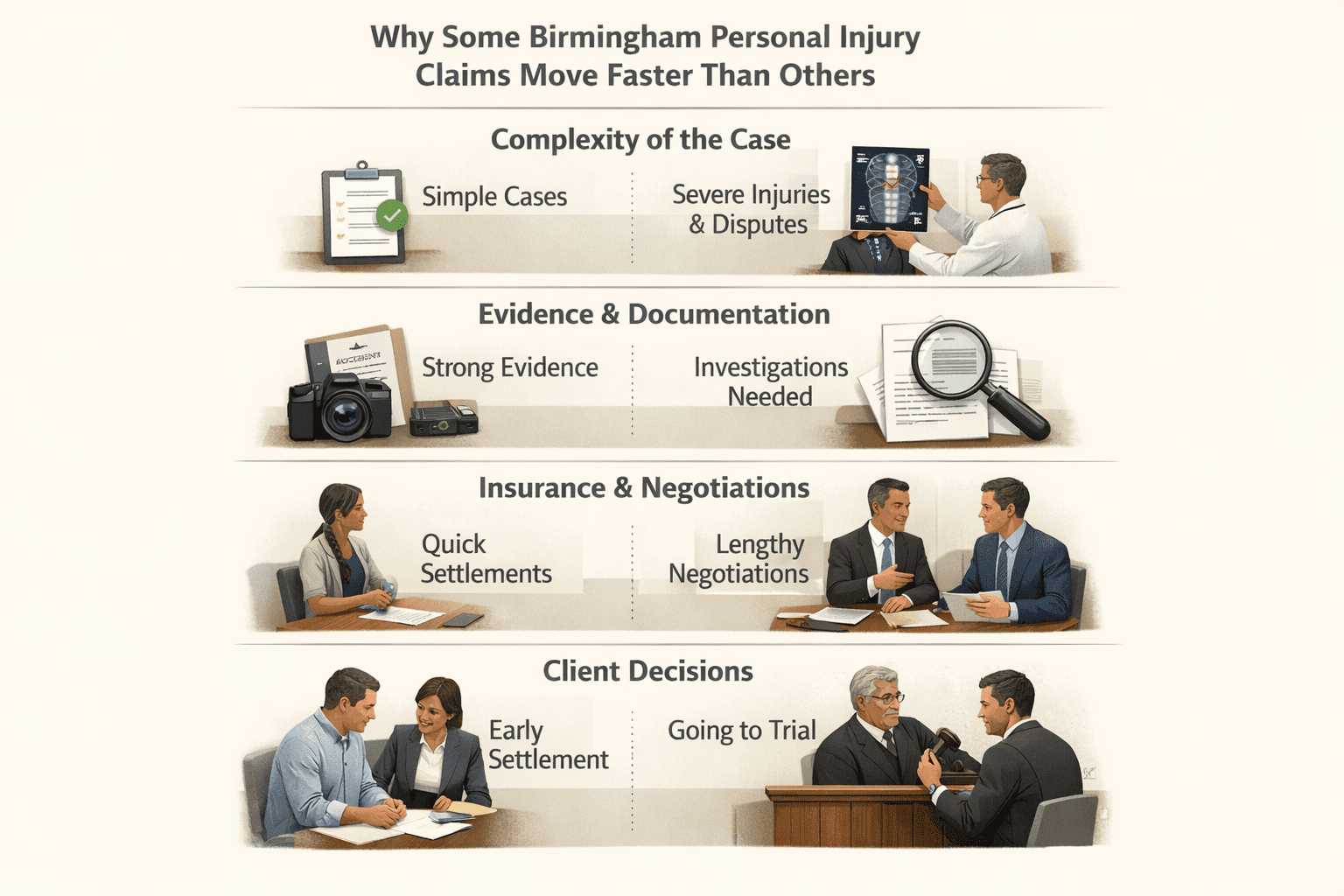
Why Some Birmingham Personal Injury Claims Move Faster Than Others
If you are trying to understand your Birmingham personal injury claim timeline, it can be frustrating to hear vague answers like “it depends.” While every case is different, there are real reasons some claims move forward quickly and others take much longer. In Birmingham, the pace of a personal injury claim often turns on practical issues such as how long medical treatment lasts, whether fault is clear, how responsive the insurance company is, and how well the case was documented from the beginning.
This guide explains what usually affects the speed of a claim, what milestones most people can expect, what causes avoidable delays, and when a slower case may still be completely normal. If you were hurt in a crash, fall, or another accident caused by someone else, understanding the process can help you make better decisions early.
FAQ: Birmingham Personal Injury Claim Timeline
Why do some Birmingham personal injury claims move faster than others?
Some claims move faster because the facts are straightforward. For example, if liability is clear, medical records are organized, treatment is relatively short, and the insurance company responds promptly, a claim may move through the early stages with fewer slowdowns. On the other hand, claims often take longer when there are disputes about who caused the accident, when the injured person is still treating, when there are multiple insurers involved, or when the value of the damages is still uncertain.
The important point is that claim speed is not just about how serious the accident was. A moderate injury with excellent documentation and clear fault can move more efficiently than a less obvious injury that raises questions about causation, pre-existing conditions, or insurance coverage.
What is the typical Birmingham personal injury claim timeline from intake to settlement discussions?
While there is no single schedule that fits every case, many personal injury claims in Birmingham move through a series of recognizable milestones:
- Initial consultation and case intake
- Accident report and evidence collection
- Medical treatment and ongoing monitoring of recovery
- Insurance claim notice and early communications
- Review of liability, damages, and available coverage
- Assembly of records, bills, wage loss information, and supporting proof
- Demand package preparation when the claim is mature enough
- Settlement discussions and insurer evaluation
- Further negotiation, dispute resolution, or litigation if necessary
Not every case follows this path in a perfectly neat way. Some claims begin with strong early negotiations. Others require additional investigation before meaningful settlement discussions can even begin. But these milestones are common enough that most Birmingham injury victims will encounter some version of them.
How does medical treatment length affect claim pacing?
Medical treatment length is one of the biggest factors in a Birmingham personal injury claim timeline. In many cases, the claim cannot be accurately valued until there is a clearer picture of the injured person’s condition. If treatment is ongoing, the total medical costs may still be changing, future care needs may still be uncertain, and it may be too early to know whether the person will fully recover or have lasting limitations.
This does not mean every claim must wait until treatment is completely over. But as a practical matter, claims often move more slowly when:
- The injured person is still attending appointments
- Doctors are ordering additional testing
- There may be a need for surgery or specialist care
- Pain levels, work restrictions, or daily limitations are still evolving
- There are gaps in treatment that need explanation
Insurance adjusters often look for a stable medical picture before they seriously evaluate settlement value. If treatment is unfinished, they may argue that the claim is premature or that the long-term impact is still unclear. That uncertainty alone can slow progress.
Does a more serious injury always mean a slower claim?
Not always, but serious injuries often involve more moving parts. A significant injury may require hospital care, follow-up appointments, physical therapy, imaging, specialist opinions, prescriptions, work restrictions, or long-term rehabilitation. More records must be gathered, more expenses must be tracked, and more questions must be answered about prognosis and future losses.
By contrast, a relatively minor injury with a short treatment period can sometimes be documented and evaluated more quickly. Still, seriousness is not the only issue. A severe crash with obvious liability and complete records may progress more efficiently than a lower-impact collision where the insurer argues the injuries were unrelated or exaggerated.
Why do liability disputes slow down Birmingham injury claims?
Liability disputes slow claims because they affect everything. Before an insurer seriously evaluates how much a case is worth, it usually wants to know whether its insured was actually at fault. If there is disagreement about how the accident happened, whether the injured person contributed to the incident, or whether some other party bears responsibility, the investigation becomes more involved.
Examples of liability issues that can cause delays include:
- Conflicting witness statements
- Incomplete or disputed police reports
- Questions about traffic signals, lane changes, speed, or right of way
- Claims that the injured person was partly responsible
- Commercial vehicle crashes involving multiple entities
- Premises liability cases where notice and property conditions are contested
In Birmingham car accident cases, fault may seem obvious to the injured person but still be questioned by the insurance company. That can mean requests for more evidence, recorded statements, scene photos, video, repair estimates, and medical records before negotiations gain real traction.
How do insurance response times affect the claim timeline?
Insurance company response times matter more than many people expect. Even when a claim is strong, progress often depends on how quickly the insurer acknowledges the claim, assigns an adjuster, reviews the file, requests records, evaluates damages, and responds to settlement communications.
Delays can happen when:
- An adjuster has a heavy caseload
- The insurer changes adjusters mid-claim
- There are multiple policy layers or coverage questions
- The insurer waits for more medical information before evaluating the case
- The defense wants additional investigation before discussing settlement
Sometimes the issue is not outright refusal. It is simply slow internal processing. That can be especially frustrating because the injured person may feel they are doing everything asked of them while the file sits waiting for review. A local Birmingham personal injury lawyer can often help push communications forward, document follow-ups, and make sure important requests do not get lost or ignored.
What can clients do early to avoid unnecessary delays?
Clients can make a major difference early in the process. Some delays are unavoidable, but many are not. Practical steps that may help keep a claim moving include:
- Getting medical care promptly after the accident
- Following treatment instructions and attending appointments consistently
- Keeping copies of discharge papers, bills, prescriptions, and referrals
- Taking photographs of injuries, vehicles, scene conditions, and visible hazards
- Preserving names and contact information for witnesses
- Reporting the accident through the appropriate channels
- Avoiding inconsistent statements about how the injury happened
- Tracking missed work, reduced duties, and other out-of-pocket losses
- Consulting a lawyer before signing broad insurance releases or accepting quick offers
The earlier the facts are organized, the less likely the claim is to stall because of missing information.
What are the biggest avoidable delays in a personal injury case?
Some of the most common avoidable delays include late medical treatment, missed appointments, failing to gather basic documents, ignoring insurer communications, posting publicly about the accident in ways that create confusion, and waiting too long to get legal guidance. A case can also slow down when clients do not tell their lawyer about prior injuries, other insurance claims, or ongoing symptoms that later show up in records. Surprises create extra work and often give insurers room to challenge the case.
Another avoidable problem is poor recordkeeping. If lost wages, medication costs, mileage to treatment, medical equipment expenses, or time away from regular responsibilities are not tracked, rebuilding that proof later can take time and may never be as strong.
When is a slow-moving case still normal?
A slow-moving claim may still be normal when the injured person is receiving ongoing medical care, when doctors are still evaluating the full extent of the injury, when multiple parties are involved, when there are substantial records to review, or when the damages are significant enough that the insurer is taking a harder look at the file. Slower does not always mean something is wrong.
For example, it can be completely normal for a claim to move gradually if:

- The person is still recovering and it is too early to know long-term limitations
- There are orthopedic, neurological, or soft tissue injuries requiring repeated follow-up
- More than one defendant or insurance policy may apply
- The insurer requested supporting records that take time to obtain
- Settlement talks are active but the sides are still far apart
What matters is whether the case is progressing for a reason and whether someone is actively moving it forward.
What are warning signs that a Birmingham injury claim may be stalling unnecessarily?
There are some red flags that may suggest unusual delay rather than normal case development. These include:
- Long periods with no meaningful update
- Repeated insurer requests for documents that were already sent
- No clear explanation for why settlement discussions have not started
- Coverage questions that remain unresolved without follow-up
- Missed deadlines for returning calls, records, or claim materials
- Uncertainty about who is handling the file
If you are not sure whether delay is normal or unnecessary, a free consultation with a local personal injury lawyer can provide useful perspective.
Understanding the Real Drivers of Claim Speed in Birmingham
People often search for a Birmingham personal injury claim timeline because they want certainty after an accident. That makes sense. Bills may already be coming in, work may be disrupted, and family responsibilities do not stop while a claim is pending. But the timeline is usually driven by facts on the ground, not by a fixed calendar.
In Birmingham, a claim’s pace can be shaped by city traffic patterns, crash scene complexity, hospital and provider record turnaround, insurer staffing, and whether the incident happened on a busy roadway, private property, or a commercial site. A rear-end collision on a crowded corridor may generate different evidence than a slip and fall at a local business or a crash involving a delivery vehicle. The more complex the source of proof, the more likely the claim will require careful assembly before serious settlement discussions begin.
That is why good legal guidance matters. A lawyer is not just there for courtroom issues. Strong representation often helps manage the timeline by identifying the missing pieces early, following up with providers and insurers, and knowing when the case is ready for a stronger demand rather than a rushed one.
Milestone by Milestone: What to Expect in a Birmingham Personal Injury Claim
1. Intake and first case review
The first stage usually begins with a consultation. This is where the lawyer or legal team learns what happened, when and where it occurred, what injuries were involved, whether insurance information is available, and whether the person has already received medical treatment.
This stage can move quickly when the basic facts are easy to gather. It can take longer when the injured person does not yet have the accident report, does not know all involved parties, or is still trying to sort out where treatment was received. A productive intake often includes:
- Crash or incident date and location
- Names of involved drivers, businesses, or property owners
- Insurance information
- Police report or incident report details
- Initial medical treatment information
- Photos, witness names, and communication from insurers
Good intake saves time later because it gives the claim a cleaner starting point.
2. Evidence collection
After intake, the focus usually shifts to evidence. In a Birmingham car accident case, that may include photos of vehicle damage, the crash report, witness statements, repair estimates, and traffic or surveillance footage if available. In a premises case, it may include photos of the hazard, incident reports, maintenance issues, and notice-related evidence.
This phase may be fast if records are readily available. It may slow down when footage is hard to obtain, the scene changed quickly after the incident, or witnesses become difficult to reach. Acting early matters. Video from businesses, intersections, or nearby properties may not be preserved for long. That is one reason prompt legal help can affect the overall claim timeline even when a lawsuit is not immediately planned.
3. Medical treatment and recovery tracking
This stage often lasts longer than clients expect, and for good reason. Treatment is not just about healing. It also creates the medical record that later supports the legal claim. Emergency room notes, imaging reports, physical therapy progress records, specialist evaluations, and discharge summaries all help tell the story of what the accident caused.
If treatment is spread across multiple providers in Birmingham or surrounding areas, collecting a complete set of records can take time. It is common for legal teams to request updates more than once if treatment continues over several months. The claim may not be ready for strong valuation until this picture is developed.
4. Insurance notice and claim setup
Once the proper insurer or insurers are identified, the claim must be set up, acknowledged, and assigned. This may sound routine, but it can become complicated if:
- The at-fault driver’s insurer is unclear
- Commercial or rideshare coverage may apply
- More than one vehicle was involved
- There are umbrella or excess policies
- There are questions about uninsured or underinsured coverage
Even before negotiations begin, time can pass while the insurer confirms policy details and opens the file for evaluation.
5. Building the damages picture
Damages are not just medical bills. A well-supported claim may include lost wages, reduced earning ability, out-of-pocket expenses, physical pain, emotional disruption, and loss of normal daily functioning. Gathering this material takes organization.
For some clients, proving lost income is simple. For others, especially self-employed workers, hourly workers with changing schedules, or people with missed overtime opportunities, documenting income loss can take more effort. The more complete the proof, the easier it is to move to meaningful settlement discussion.
6. Demand preparation
When the case is mature enough, a demand package is often prepared. This generally brings together liability evidence, medical records, bills, wage loss proof, photographs, and a presentation of how the injury affected the client’s life. The timing here depends heavily on treatment status and documentation completeness.
A rushed demand can hurt a claim if it understates the injury or omits key support. A delayed demand can create frustration if the case was ready earlier but no one acted. Good pacing means sending it when the claim can be presented with enough strength to support serious negotiation.
7. Settlement discussions
After the demand is submitted, the insurer typically reviews the materials and responds. This can involve questions, requests for more records, an initial offer, a denial of part of the claim, or arguments over fault and damages. Some cases move through this phase with only a few exchanges. Others require extended negotiation.
Settlement discussions often slow when there is a major disagreement about either liability or medical causation. For example, the insurer may argue that some treatment was unrelated, excessive, or tied to an earlier condition rather than the Birmingham accident itself.
8. Litigation if pre-suit resolution is not possible
Not all claims settle before formal legal action. If the insurer refuses to make a fair offer or will not reasonably evaluate the claim, litigation may become necessary. Once a case moves into that phase, the pace is affected by filing requirements, court scheduling, discovery, motion practice, and other formal procedures. That does not mean settlement is off the table. Many cases continue to resolve through negotiation during litigation, but the process becomes more structured.
How Medical Treatment Length Changes the Timeline in Practical Terms
The length of medical treatment is one of the clearest reasons that two Birmingham injury claims arising from similar accidents can move at very different speeds.
Consider a relatively simple example. One person goes to urgent care, follows up with a primary doctor, completes a short course of physical therapy, and is released with no major ongoing symptoms. Another person from a similar crash develops persistent neck or back pain, needs imaging, sees an orthopedic specialist, tries injections or more intensive therapy, and misses substantial work. Even if both cases began on the same day, the second case will often require more time before anyone can realistically assess value.
Longer treatment affects the timeline in several ways:
- More records must be requested and reviewed
- Medical bills continue to accumulate
- Future care may still be uncertain
- The insurer may wait to see if the condition improves
- Doctors may not yet have a final view on restrictions or permanency
There is also a strategic reason not to rush. Settling before the injury picture is clear can leave an injured person without recourse if symptoms worsen later. Once a claim is settled, the case is generally over. That is why a lawyer may advise patience even when the client understandably wants resolution as soon as possible.
Treatment gaps can complicate timing
Another issue is treatment gaps. If an injured person stops care for weeks or months and then returns, the insurer may question whether the accident truly caused the later symptoms. That can trigger additional records requests, closer medical review, or arguments that part of the claim is unsupported. In other words, inconsistent treatment does not just affect case value. It can also slow the process.
Specialists often extend but strengthen the claim record
Seeing specialists can lengthen the timeline because specialist appointments, testing, and reports take time. But specialist care can also clarify the injury and strengthen the case. A slower case is not always a weaker case. Sometimes it is a better-developed one.
Why Liability Disputes Often Matter More Than Clients Expect
When clients think about delay, they often focus on medical care. But liability disputes are just as important. If the insurer does not accept fault, there may be little momentum toward settlement even if the injuries are well documented.
In Birmingham traffic cases, liability disputes can arise from lane-change allegations, intersection conflicts, disputed following distance, weather conditions, or driver distraction claims. In property injury cases, there may be disagreement about whether the hazard existed long enough for the owner to address it, whether the condition was open and obvious, or whether the person’s own actions contributed to the incident.
These disputes slow claims because evidence must be gathered and interpreted. Police reports may not be conclusive. Witness accounts may differ. Scene evidence may be incomplete. The defense may look for comparative fault arguments or challenge how the event unfolded.
Examples of liability issues that can slow progress
- A rear-end crash where the defense claims the lead driver stopped unexpectedly
- A multi-car collision where each driver blames another
- A parking lot crash with no independent witness
- A slip and fall where the business disputes knowledge of the spill or condition
- A truck or delivery case involving both the driver and a company
The more contested fault becomes, the more important it is to preserve photos, video, witness information, and contemporaneous reports. Those details can mean the difference between an extended dispute and a more efficient resolution.
Insurance Company Delays: What Is Normal and What Is Not?
Insurance carriers do not all move at the same speed. Some respond quickly and evaluate claims in a predictable way. Others are slower, request more documentation, or take a harder line before making meaningful offers. Understanding this difference can help injured people separate normal processing time from unnecessary delay.
Normal insurer activity
Some waiting is expected. It is normal for an adjuster to need time to:
- Review the accident report
- Confirm coverage
- Request and evaluate medical records
- Examine the demand package
- Discuss authority internally before making an offer
Potentially problematic insurer behavior
By contrast, delay may be more concerning when the insurer:
- Repeatedly ignores communications
- Asks for the same records more than once without explanation
- Fails to identify what information is still needed
- Uses broad delay tactics without engaging the merits of the claim
- Changes positions without a documented basis
It helps to have clear records of what was sent, when it was sent, and what response was given. Organized follow-up can reduce the chance that a legitimate claim drifts without direction.
What Birmingham Clients Can Do Right Away to Keep a Claim on Track
After an accident, clients often assume the legal side will take care of itself. In reality, the earliest steps can shape the entire Birmingham personal injury claim timeline. Here are practical actions that help.
Get prompt medical attention
Even if symptoms seem manageable at first, early evaluation creates a record and protects your health. Waiting too long can make both treatment and proof harder.
Describe symptoms accurately and consistently
Be honest and specific with providers. If your neck hurts, say so. If headaches started after the crash, report them. If your shoulder pain worsens with work tasks, mention that. Medical records become evidence later. Clear reporting helps avoid disputes.
Keep every document you receive
Save discharge papers, referrals, bills, pharmacy receipts, work notes, and appointment summaries. These small items often become important later.
Take photographs early
Photograph vehicle damage, visible injuries, roadway conditions, property hazards, footwear if relevant, and anything else that may help explain what happened. Conditions change quickly.
Track daily impact
Many people remember medical bills but forget to document how the injury affects ordinary life. Keeping notes on pain, sleep loss, missed family activities, driving problems, lifting limits, or job restrictions can help present a fuller claim.
Be careful with insurance communications
Do not guess, speculate, or minimize your symptoms just to sound polite. Do not rush into broad recorded statements or settlement discussions before understanding the full picture.
Consult a local lawyer early
You do not have to wait until things go wrong. Early legal guidance can help avoid preventable mistakes, identify missing evidence, and clarify whether the claim is moving at a normal pace.

Common Reasons a Birmingham Claim Slows Down Even When the Client Did Nothing Wrong
It is important not to blame yourself for every delay. Many claims slow down for reasons outside the client’s control. For example:
- Medical providers may take time to release records
- Specialists may not have immediate appointment availability
- Insurance coverage may be layered or unclear
- Multiple injured parties may be making claims against the same policy
- Accident reconstruction or expert review may be needed
- The insurer may dispute causation because of prior treatment history
In these situations, a slower pace does not necessarily mean the case is weak or mishandled. It may simply reflect the complexity of building a claim that can withstand scrutiny.
When a Slow Case May Still Be the Right Case Strategy
Some clients worry that if a claim is not settling quickly, something has gone wrong. Sometimes the opposite is true. A claim may be moving slowly because rushing would leave value on the table or fail to account for the full extent of the injury.
Examples include:
- A doctor has not yet determined whether surgery will be needed
- The client is still under work restrictions
- Future care costs are being evaluated
- The insurer is challenging causation and more support is needed
- The initial offer was too low to justify a quick resolution
Patience is difficult when bills and stress are rising. But a carefully developed case often puts the client in a stronger position than a hurried settlement built on incomplete information.
Questions to Ask If You Are Worried About Delay
If your case feels slow, ask direct questions. A good legal team should be able to explain where the claim stands and what is causing the current pace. Useful questions include:
- Are we waiting on medical treatment, records, or insurance review?
- Has liability been accepted, denied, or left unresolved?
- What documents are still missing?
- Is the case ready for a demand package?
- Has the insurer requested anything specific?
- Are settlement discussions active, or are we still in the investigation stage?
- Is there any delay we can realistically avoid?
These questions do not guarantee speed, but they do provide clarity. Knowing whether your claim is paused for a normal reason or drifting without a plan can make a major difference.
Local Relevance: Why Birmingham Context Can Matter
Birmingham claims are influenced by local realities. Busy roads, commercial traffic, neighborhood business properties, hospital systems, and local insurer handling practices can all affect how evidence is gathered and reviewed. A claim arising from a downtown crash, a suburban intersection collision, or an incident at a local business may require different documentation and different follow-up efforts.
Local familiarity can help in practical ways. A lawyer with Birmingham-focused experience may be more familiar with common accident patterns, local treatment providers, and the kinds of documentation that tend to matter in this market. That does not mean every case is unique to Birmingham, but local knowledge can help move a claim more efficiently when timing and proof matter.
Frequently Asked Questions About Claim Pace and Delays
Should I accept a fast settlement if I need money right away?
Not automatically. A quick offer may be tempting, especially if you are missing work or facing bills. But speed alone is not a reason to settle. Before accepting, it is important to understand whether your treatment is still ongoing, whether future care may be needed, and whether the amount reflects the full impact of the injury. Once you settle, you usually cannot reopen the claim.
Can a claim move forward while I am still treating?
Yes, parts of the claim can still move forward. Evidence can be gathered, insurers can be put on notice, liability can be investigated, and records can begin to accumulate. However, final valuation may be limited if the course of treatment is still changing.
Will missing a few appointments really matter?
It can. Missed appointments may create gaps the insurer uses to argue that your injuries were not serious or that you recovered sooner than claimed. If you miss care for a legitimate reason, communicate with your provider and your legal team so the gap can be explained.
Does hiring a lawyer speed up a Birmingham personal injury claim?
A lawyer cannot force every part of the process to move quickly, but legal representation often helps avoid preventable delay. A lawyer can organize evidence, communicate with insurers, monitor records collection, evaluate when a demand should be sent, and push back when the insurance company is dragging its feet.
Why does the insurance company keep asking for more records?
Sometimes the insurer is legitimately trying to understand the injury and the treatment course. Other times, repeated record requests can reflect caution, skepticism, or internal delay. The key question is whether the requests are reasonable and whether they are moving the claim toward evaluation or simply postponing a decision.
What if liability seems obvious but the insurer still delays?
Even in seemingly clear cases, insurers may slow evaluation while reviewing injuries, treatment, policy information, or damage calculations. Clear liability helps, but it does not automatically guarantee fast payment.
Can a lower-damage case take longer than a higher-damage case?
Yes. If a lower-damage case has disputed fault, poor records, inconsistent treatment, or coverage confusion, it may drag on longer than a larger case with strong proof and an organized presentation.
Does social media affect claim timing?
It can. Public posts that appear inconsistent with reported injuries may lead the insurer to ask more questions or dispute the claim more aggressively. That can complicate both value and timing.
Key Takeaways for Anyone Tracking a Birmingham Personal Injury Claim Timeline
If you remember only a few things, remember these:
- There is no single Birmingham personal injury claim timeline that fits every case
- Medical treatment length is one of the biggest factors in claim pacing
- Liability disputes can delay resolution even when injuries are well documented
- Insurance response times often affect progress more than clients expect
- Early action by the client can prevent many unnecessary delays
- A slower case is not always a problem; sometimes it is a sign the claim is being properly developed
Understanding these points can make the process feel less unpredictable. You may not be able to control every part of the timeline, but you can take steps that put your claim in a stronger position.
Conclusion
Some Birmingham personal injury claims move faster because the facts are clear, treatment is shorter, and the insurance company responds without much resistance. Others take longer because the injuries are still unfolding, fault is disputed, records are still being gathered, or the insurer is slow to evaluate the case. The difference is often not random. It usually comes down to evidence, timing, medical development, and strategy.
If you were hurt in Birmingham and you are unsure whether your claim is moving normally, or you want help avoiding delays from the start, Injury Nation can help you connect with local legal guidance. Contact a local personal injury lawyer for a free consultation today and get a clearer picture of your next steps.