

Do You Pay Anything Up Front for a Personal Injury Lawyer in Dallas?
If you were hurt in a crash, slip and fall, workplace-related incident, or another accident in Dallas, one of the first questions you may have is simple: Do I have to pay a lawyer up front? For many injured people, the answer affects whether they feel comfortable getting legal help at all.
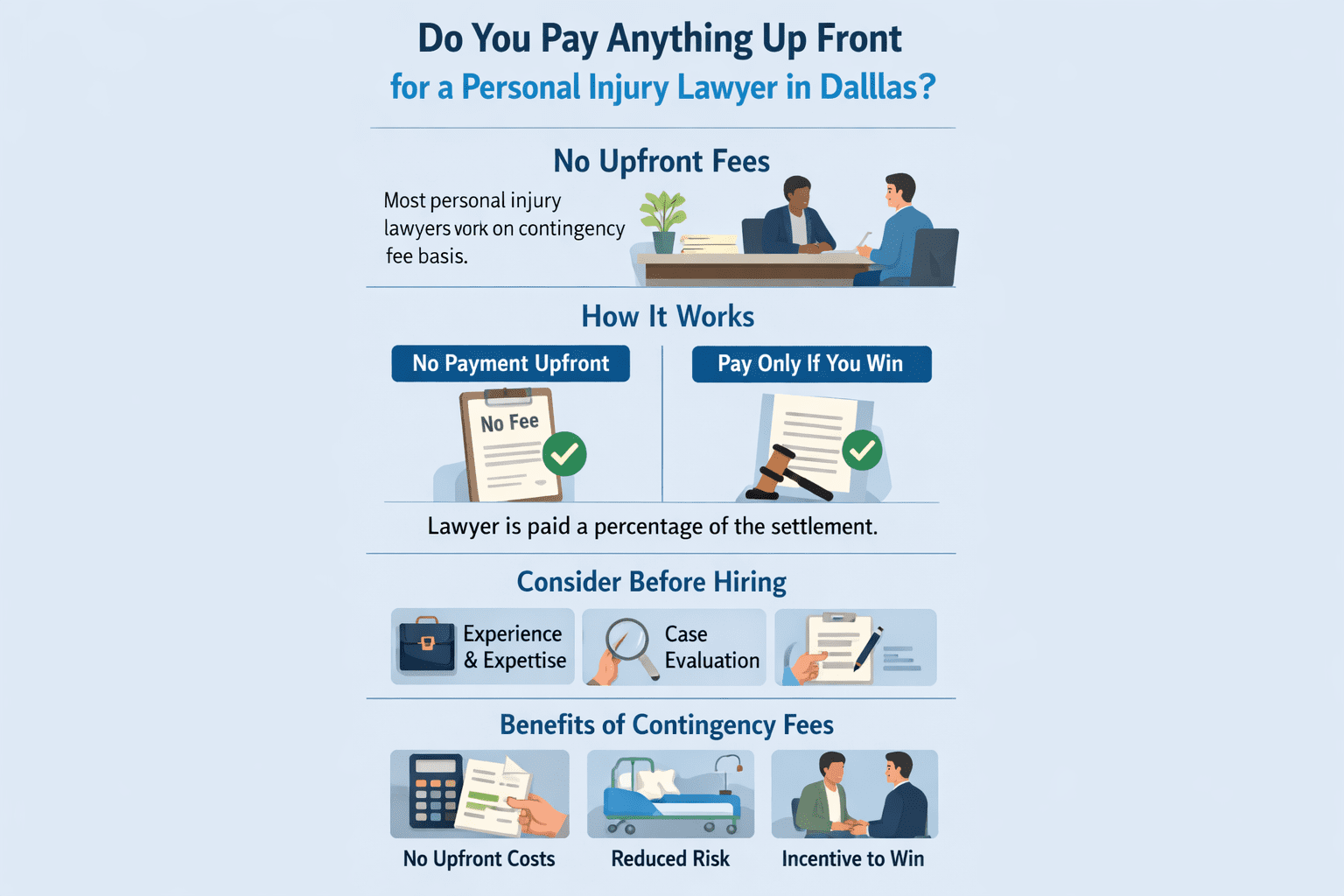
In most personal injury cases, a lawyer does not charge traditional hourly fees up front. Instead, many Dallas personal injury lawyers work on a contingency fee. That means the lawyer’s fee is usually tied to whether money is recovered in the case. But that short answer is only part of the picture.
The more complete answer is that you should understand how contingency fees work, whether the consultation is free, what case expenses are separate from attorney fees, and what happens if there is no recovery. Those details matter. They can affect how much you owe, when you owe it, and what questions you should ask before signing a fee agreement.
This FAQ guide explains the issue in plain language, with a Dallas focus, so you can better understand the dallas personal injury lawyer cost upfront question before moving forward.
The Short Answer: Usually, No Traditional Up-Front Attorney Fee
In many Dallas personal injury matters, clients do not pay a large retainer or hourly legal bill at the start of the case. That is different from some other types of legal work, such as business law, divorce, or contract disputes, where a lawyer may require a deposit before beginning work.
Personal injury cases are often handled on a contingency fee basis because injured people are frequently under financial pressure already. They may be dealing with:
- Emergency room or hospital bills
- Follow-up medical appointments
- Missed work and lost wages
- Car repair or replacement issues
- Insurance adjuster calls
- Ongoing pain and treatment needs
A contingency arrangement can make legal representation more accessible because the client typically does not pay the attorney’s fee at the beginning of the case.
However, “no up-front fee” does not always mean “no costs of any kind under any circumstances.” That is where people can get confused. A proper explanation requires separating three things:
- The consultation fee
- The attorney’s fee
- Case expenses and costs
Each one should be discussed clearly before you hire a lawyer.
What Is a Contingency Fee, in Plain Language?
A contingency fee means the lawyer’s fee is generally paid only if the lawyer recovers money for you through a settlement or court award. Instead of billing you by the hour each week or month, the lawyer takes an agreed percentage of the recovery.
In plain terms, it works like this:
- The lawyer investigates the case
- The lawyer communicates with insurance companies or defense lawyers
- The lawyer gathers records and evidence
- The lawyer negotiates a settlement or, if necessary, files a lawsuit
- If money is recovered, the fee is usually paid from that recovery according to the fee agreement
This setup can help people pursue claims even when they cannot afford to pay hourly legal rates while recovering from an injury.
Why Personal Injury Lawyers Often Use Contingency Fees
There are practical reasons this fee structure is common in personal injury cases:
- Clients are often financially strained. After an accident in Dallas, a person may be missing work and trying to manage medical care at the same time.
- The value of the case is usually uncertain at the start. No one can responsibly promise an exact result on day one.
- The lawyer takes on risk. If there is no successful recovery, the lawyer may not earn a fee for the time spent on the case, depending on the agreement.
- The model aligns incentives. The lawyer is generally motivated to build a strong claim and pursue compensation.
That said, contingency fees are not all identical. The exact percentage, timing, and treatment of expenses can vary from one firm to another. That is why reading the fee agreement matters.

Are Free Consultations Really Free in Dallas Personal Injury Cases?
In many cases, yes. Dallas personal injury lawyers commonly offer a free initial consultation. This is usually a first meeting, call, or online review where the lawyer or law firm learns about the accident, asks questions, and gives you an initial sense of whether they may be able to help.
A free consultation often includes discussion of:
- How the accident happened
- What injuries you suffered
- Whether medical treatment has started
- Whether insurance companies have contacted you
- Whether a claim or lawsuit may exist
- How the fee structure may work
But you should still confirm what “free consultation” means in that particular office. It is fair to ask direct questions.
Questions to Ask About the Consultation
- Is the initial consultation free?
- Is there any charge for reviewing my documents or accident report?
- Will I be billed if the consultation lasts longer than expected?
- If you decide not to take my case, do I owe anything?
- Will I receive a written fee agreement before I hire you?
Most reputable personal injury consultations are designed to be low-pressure and informational. You should leave understanding whether the firm charges a contingency fee, what expenses may be involved, and what the next steps would be if you move forward.
Attorney Fees vs. Case Expenses: The Difference Matters
One of the biggest sources of confusion is the difference between attorney fees and case expenses. These are not the same thing.
Attorney Fees
The attorney fee is what the lawyer earns for legal work on your case. In a contingency arrangement, that fee is typically a percentage of the amount recovered.
Case Expenses
Case expenses are out-of-pocket costs associated with building and pursuing the claim. Depending on the case, these can include:
- Charges for obtaining medical records
- Accident report fees
- Court filing fees if a lawsuit is filed
- Deposition costs
- Expert witness fees
- Investigation expenses
- Postage, copying, and document preparation costs
These expenses can be minor in some cases and substantial in others. A relatively straightforward claim with clear liability may involve fewer costs than a disputed case requiring experts, depositions, and formal litigation.
Why This Difference Is Important
When someone hears “you pay nothing up front,” they may assume that means both:
- No attorney fee up front, and
- No responsibility for case costs later
That assumption can lead to surprises if the fee agreement says something else. Some firms advance case expenses and recover them from a settlement. Some may handle certain routine costs one way and major litigation expenses another way. The only safe approach is to ask for specifics.
What Happens if There Is No Recovery?
This is one of the most important questions you can ask. In many contingency fee arrangements, if there is no recovery, the lawyer does not receive an attorney fee. But that does not automatically answer what happens to case expenses.
The answer depends on the law firm’s agreement and practices.
Possible Outcomes if the Case Does Not Recover Money
Depending on the agreement, one of several things may happen:
- The lawyer may waive the attorney fee and absorb certain costs
- The lawyer may waive the fee but expect repayment of some case expenses
- The lawyer may advance expenses during the case and then recover them only if there is a successful result
- The treatment of costs may differ depending on whether the case settles early or goes into formal litigation
This is exactly why you should never rely on assumptions or general statements from advertisements alone. Ask the law firm to explain:
- If my case does not succeed, will I owe any attorney fee?
- If my case does not succeed, will I owe any case expenses?
- Which expenses are advanced by the firm?
- Which expenses, if any, could become my responsibility?
- Does the answer change if a lawsuit is filed?
A trustworthy lawyer should be willing to walk through those points clearly.
How Dallas Personal Injury Cases Commonly Start
If you were injured in Dallas, the first days and weeks after an accident may feel chaotic. Understanding the early process can help you see where costs usually enter the picture.
Step 1: Initial Contact and Free Consultation
You call or submit information online. The office asks what happened, where the accident occurred, whether you received medical care, and whether insurance has contacted you. This first step is often free.
Step 2: Case Review
The law firm evaluates basic issues such as fault, injury severity, available insurance coverage, and deadlines. If they believe the case fits their practice, they may offer representation.
Step 3: Fee Agreement
If you decide to hire the lawyer, you sign a written agreement. This document should explain:
- The contingency fee structure
- How case expenses are handled
- Whether expenses are deducted before or after the attorney fee is calculated
- What happens if there is no recovery
- Whether the percentage changes if a lawsuit is filed or an appeal becomes necessary
Step 4: Investigation and Claim Handling
The lawyer begins collecting evidence. This may include the police crash report, photos, witness statements, medical records, billing records, employment documentation, and insurance policy information.
Step 5: Negotiation or Litigation
Many cases resolve through insurance negotiations, but some require filing suit in Dallas County or another appropriate venue depending on the facts. Litigation often increases the amount of work and may increase case expenses.
Examples of How Costs Can Work
Below are simple examples to help explain the concepts. These are not promises, standard outcomes, or universal fee models. They are just illustrations of how arrangements can differ.
Example 1: Straightforward Car Accident Claim
You are rear-ended on Central Expressway, receive treatment, and the other driver’s insurer accepts fault. The law firm handles the case on a contingency fee. The initial consultation is free. The firm obtains records and negotiates with the insurer. If the case settles, the attorney fee is paid according to the contingency agreement, and case expenses are handled the way the contract states.
In this kind of scenario, you may not have paid a retainer up front, but the final distribution still matters. You need to understand how the fee and costs come out of the recovery.
Example 2: Disputed Liability Crash in Dallas
You are involved in a multi-vehicle accident near I-35E or the Dallas North Tollway, and fault is disputed. The case may require deeper investigation, witness interviews, scene analysis, or expert review. These added steps can increase case expenses.
Again, you may not pay an attorney fee up front, but the cost structure behind the scenes can be more involved. It becomes especially important to ask how major litigation expenses are handled.
Example 3: Premises Liability Injury
You are injured in a fall at a business, and the owner denies responsibility. The lawyer may need surveillance requests, incident reports, maintenance records, and expert input. The contingency fee model may still apply, but costs can vary depending on how hard the defendant fights the claim.

Does Every Dallas Personal Injury Lawyer Charge the Same Way?
No. While contingency fees are common, terms can vary. Two law firms may both advertise “no fee unless we recover,” but still differ in important ways.
Differences You May See Between Firms
- Different contingency percentages
- Different percentages depending on whether the case settles or goes to trial
- Different approaches to advancing case expenses
- Different policies on expert costs and litigation costs
- Different explanations of client responsibility if there is no recovery
- Different communication styles and billing transparency
This does not necessarily mean one model is always better than another. It means you should compare carefully and make sure you understand what you are agreeing to.
What Should Be in the Fee Agreement?
A written fee agreement is one of the most important documents you will receive. You should never feel rushed into signing it without reading it.
Look for clear answers to these points:
- What percentage is the contingency fee?
- Does that percentage change if the case is filed in court?
- Are case expenses separate from the attorney fee?
- What kinds of expenses may be charged to the case?
- Who advances those expenses while the case is pending?
- Are expenses deducted before or after the contingency fee is calculated?
- If there is no recovery, do I owe anything?
- How and when will I receive a settlement statement?
Ask for Plain-English Explanations
Legal documents can be dense. That does not mean you should stay silent. Ask the lawyer or staff to explain the agreement in ordinary language. A helpful question is:
“Can you walk me through exactly how fees and costs would work if the case settles, if it goes to court, and if there is no recovery?”
If the explanation feels vague, keep asking. You are hiring the lawyer, not doing them a favor.
Why People Hesitate to Call a Lawyer About Cost
Many accident victims in Dallas delay getting legal help because they worry they cannot afford it. Some assume a lawyer will ask for thousands of dollars immediately. Others are embarrassed to ask about money.
Those concerns are understandable, especially after an unexpected injury. But avoiding the conversation can be costly in another way. Waiting too long may make it harder to preserve evidence, document injuries, or respond effectively to insurance tactics.
You do not need to know every legal detail before making the call. You just need to ask direct, practical questions.
Good Questions to Ask Right Away
- Do you charge any money up front to start the case?
- Is the consultation free?
- Do you work on contingency?
- How are case costs handled?
- If my case does not recover money, what would I owe?
- Can you send me the fee agreement to review before I sign?
Dallas-Specific Practical Considerations
Dallas is a large, fast-moving metro area with heavy traffic, busy commercial corridors, and frequent crashes on roads such as I-635, I-30, US-75, and the Dallas North Tollway. Personal injury cases here can involve local police reports, city or county procedures, local medical providers, and insurers handling claims tied to accidents in densely traveled areas.
That local context does not automatically change whether an attorney charges up front, but it can affect how a claim is developed and how much work a case may require. For example:
- A downtown collision may involve multiple witnesses or camera footage
- A commercial vehicle case may require quicker evidence preservation
- A severe injury claim may involve more extensive medical documentation
- A disputed fault case may require deeper investigation than a simple rear-end crash
All of those issues can influence case complexity and expenses, which is another reason to discuss cost structure early.
What You Should Expect from a Transparent Lawyer
A clear, trustworthy personal injury lawyer should be able to explain the financial side of representation without dodging your questions.

Signs of Transparency
- The office confirms whether the consultation is free
- The lawyer explains contingency fees in simple terms
- The firm distinguishes between attorney fees and case expenses
- The lawyer explains what may happen if there is no recovery
- You receive a written agreement
- Your questions are answered before you sign
- The office explains how settlement funds are distributed
Warning Signs to Watch For
- Vague answers like “don’t worry about it” with no specifics
- Pressure to sign immediately
- No clear written explanation of fees and costs
- Refusal to discuss what happens if the case loses
- Promises that sound too absolute or too good to be true
- Confusion over who is responsible for case expenses
If you do not understand the fee arrangement, pause and ask more questions. If you still feel unsure, it is reasonable to seek another consultation.
Does “No Fee Unless We Win” Mean Absolutely No Financial Risk?
Not always, and this is where careful reading matters. Advertising phrases can be helpful summaries, but they are not a substitute for a detailed fee agreement. In many cases, “no fee unless we win” refers specifically to the attorney’s fee, not necessarily every possible expense that could arise in every situation.
That does not mean the lawyer is doing anything improper. It just means the phrase is broad, while your contract is specific. The contract controls the details of the relationship.
So if you see marketing language about no up-front fees, use it as a starting point for questions, not the end of the discussion.
How Insurance Pressure Can Affect Your Decision
After an accident, insurers may contact you quickly. You may be asked for a statement, medical authorization, or a fast settlement decision. That pressure can make people focus only on immediate money and avoid calling a lawyer because they assume it will cost too much.
But the cost question should not stop you from at least getting information. A free consultation can help you understand:
- Whether the offer seems premature
- Whether your injuries are fully documented yet
- Whether you may need future treatment
- Whether the insurer is disputing fault
- Whether accepting now could close off future recovery
Even if you ultimately decide not to hire counsel, understanding the fee structure and your options can help you make a more informed decision.
When Case Expenses Can Become More Important
In smaller claims, people often focus only on the contingency percentage. But in more complex cases, expenses deserve equal attention.
Cases That May Involve Higher Expenses
- Commercial truck accidents
- Wrongful death claims
- Catastrophic injury cases
- Cases requiring accident reconstruction
- Cases with multiple defendants
- Cases involving serious disputed medical issues
- Claims that proceed deep into litigation
If your Dallas case appears complicated, ask for an honest discussion of how costs may build over time and how those costs are treated in the fee agreement.
Should You Compare More Than One Lawyer?
Yes, in many situations it makes sense. A comparison can help you understand whether the fee structure is standard, whether communication is clear, and whether you feel comfortable with the firm.
What to Compare
- Whether the consultation is free
- How clearly the lawyer explains contingency fees
- How the firm handles case expenses
- Whether the firm has experience with your type of injury claim
- How responsive the office is
- Whether you feel pressured
- Whether they explain local Dallas process issues clearly
Cost is important, but it should not be the only factor. A low percentage means little if communication is poor or the case is not handled carefully. On the other hand, a higher fee should come with a clear explanation of services, strategy, and expense handling.
Frequently Asked Questions About Dallas Personal Injury Lawyer Costs Up Front
Do I need a retainer for a personal injury lawyer in Dallas?
In many personal injury cases, clients do not pay a traditional retainer up front. Many firms use contingency fees instead. Still, you should confirm the exact arrangement before hiring the lawyer.
Is the first consultation usually free?
Often, yes. Many Dallas personal injury lawyers offer free consultations. But ask directly so you know whether any document review or follow-up could involve a charge.

What is the difference between a fee and a cost?
The fee is what the lawyer earns for legal work. Costs or expenses are separate out-of-pocket charges tied to the case, such as records, filing fees, depositions, or experts.
If the lawyer loses the case, do I pay nothing?
Maybe, but not automatically in every case. Many contingency agreements mean no attorney fee if there is no recovery. But the treatment of case expenses can vary, so read the agreement and ask questions.
Can the contingency percentage change?
Yes. Some fee agreements use one percentage for pre-suit resolution and a different percentage if the case moves into litigation or appeal. Do not assume the percentage stays the same in every stage.
Will the lawyer explain fees before I sign?
They should. A lawyer should be willing to explain the fee agreement in clear language and answer questions about costs, deductions, and no-recovery scenarios.
Can I ask for the fee agreement in writing before deciding?
Yes. You should ask for written terms and take the time you need to review them carefully.
Are medical bills the same as legal fees?
No. Your medical bills are separate from your lawyer’s fee. Both may affect the final amount you receive from any settlement, but they are different obligations.
Should I hire the cheapest lawyer?
Not necessarily. The better question is whether the fee structure is clear, fair, and fully explained, and whether the lawyer seems prepared to handle your case properly.
A Simple Checklist Before You Sign Anything
Use this checklist if you are speaking with a Dallas personal injury lawyer:
- Confirm the consultation is free
- Ask whether there is any money due up front
- Ask the lawyer to define the contingency fee in plain English
- Ask for the exact percentage and whether it can change
- Ask what counts as a case expense
- Ask who advances those expenses
- Ask whether you owe anything if there is no recovery
- Ask how settlement funds are distributed
- Review the written agreement carefully
- Do not sign until you understand every major term
Bottom Line: Do You Pay Anything Up Front?
For many injured people in Dallas, the practical answer is that you usually do not pay a traditional attorney fee up front to hire a personal injury lawyer. Many firms offer free consultations and work on a contingency fee, meaning the attorney is typically paid only if money is recovered.
But that is not the whole story. You also need to understand:
- Whether the consultation is truly free
- How the contingency fee is calculated
- What case expenses may apply
- Who advances those expenses
- What happens if there is no recovery
The safest approach is to ask direct questions before signing anything. A good lawyer should welcome that conversation and explain the fee agreement clearly, without pressure or confusing language.
Talk to a Dallas Personal Injury Lawyer About Your Options
If you were injured in Dallas and want clear answers about cost, fees, and what happens next, do not rely on assumptions. Get case-specific guidance. The details of your accident, injuries, insurance coverage, and potential claim can all affect what representation looks like.
Injury Nation helps connect injured people with local personal injury lawyer resources and practical legal guidance. If you are wondering about dallas personal injury lawyer cost upfront, the next step is simple: contact a local personal injury lawyer for a free consultation today. Ask about contingency fees, ask about expenses, and make sure you understand the agreement before you sign.