If you were hurt on the job in Houston, you may be dealing with pain, missed work, medical appointments, and a lot of uncertainty about what happens next. Many employees are not sure what their employer must do, what benefits may be available, or what to do if a workers’ compensation claim is delayed or denied. Understanding your options early can make a major difference.
This FAQ guide explains the basics of workers compensation legal rights Houston employees should know, with a focus on employee protections under Texas law, your rights to medical care and benefits, appeal rights after a denial, and how Injury Nation helps people connect with local legal guidance. While every claim is different, the questions below can help you understand what to expect and where problems often begin.
Workers Compensation Legal Rights Houston FAQ
What is workers’ compensation in Texas?
Workers’ compensation is a system that may provide benefits to employees who are injured or become ill because of their job. In Texas, workers’ compensation can help cover medical treatment and provide certain income-related benefits when a work injury keeps someone from earning their normal wages.
Texas is different from many states because not every employer is required to carry workers’ compensation insurance. Some employers participate in the Texas workers’ compensation system, and some do not. That distinction matters a great deal because your legal options can look very different depending on whether your employer is a workers’ compensation subscriber or a non-subscriber.
If your employer carries workers’ compensation coverage, your claim generally moves through that system. If your employer does not carry coverage, other legal options may need to be evaluated. Because that first question changes the path of the case, one of the most important early steps is confirming whether your employer has workers’ compensation insurance.
Why is Houston-specific guidance important in a workers’ comp claim?
Houston workers face injury risks in many industries, including construction, shipping, warehousing, petrochemical operations, healthcare, transportation, food service, and office-based work. While the legal framework is based on Texas law, local issues still matter. A Houston worker may be dealing with:
- Large employers and complex internal reporting systems
- Multi-site worksites and subcontractor relationships
- Long commute times that complicate medical follow-up
- Pressure to return to work before fully recovering
- Disputes about whether an injury happened on the job
- Questions about approved treating doctors and where treatment should happen
Workers in the Houston area often need practical, step-by-step help, not just general legal definitions. That means understanding deadlines, documentation, medical records, communications with insurance representatives, and how to respond if benefits stop or treatment is questioned.
Do all Houston employees have the same workers’ compensation rights?
No. Your rights depend partly on your employment status and partly on whether your employer participates in Texas workers’ compensation coverage. Key issues include:
- Whether you are classified as an employee or independent contractor
- Whether the injury happened in the course and scope of employment
- Whether your employer is a workers’ compensation subscriber
- Whether the injury was promptly reported
- Whether there is medical evidence connecting the injury to your work
Misclassification can be a major issue. Some people are told they are contractors when the actual work arrangement suggests they function more like employees. That does not mean every classification is wrong, but it does mean injured workers should not automatically assume the employer’s label ends the conversation.
What are my basic employee protections under Texas law after a work injury?
Texas law provides important protections for workers who report work-related injuries and pursue available benefits. The exact legal protections vary based on the facts, but commonly discussed employee protections include:
- The right to report a work injury
- The right to seek medical attention for a work-related condition
- The right to file a workers’ compensation claim if the employer has coverage
- The right to pursue available benefits under the system
- The right to dispute a denied claim or denied medical treatment
- Protection against certain improper retaliation for pursuing workers’ compensation rights
Retaliation concerns are especially important. Employees are often nervous that reporting an injury will lead to fewer shifts, termination, discipline, or a hostile work environment. While every retaliation claim must be evaluated carefully, workers should know that reporting a workplace injury and seeking available benefits is not something you need to hide or apologize for.
If your employer’s behavior changes after you report an injury, document what happened, when it changed, and who was involved. Save written communications, scheduling changes, disciplinary notices, and any statements that connect the adverse action to your injury report or claim.
What should I do immediately after a workplace injury in Houston?
The first steps after a workplace injury can affect both your health and your claim. In most situations, you should:
- Get emergency medical help if needed.
- Report the injury to your employer as soon as possible.
- Tell the medical provider the injury happened at work.
- Write down how, when, and where the injury occurred.
- Collect names of witnesses if anyone saw what happened.
- Take photos of visible injuries or dangerous conditions if possible.
- Keep copies of all medical records, work restrictions, and employer communications.
- Find out whether your employer carries Texas workers’ compensation coverage.
Do not assume someone else reported the injury for you. Even if a supervisor saw the incident happen, you should still make sure the injury is properly reported through the employer’s process. Verbal notice may not be enough if the employer later claims it never received a clear report.
How soon do I need to report a workplace injury in Texas?
Deadlines matter. In Texas workers’ compensation cases, injured employees generally need to notify their employer of the injury within a limited period. There are also separate deadlines for filing the formal claim paperwork. Missing a deadline can create major problems and may lead to a denied claim.
Because deadlines can depend on the type of injury and the facts of the case, it is smart to report the injury immediately and seek legal guidance as soon as there is any question about timing. Waiting because you hope the injury will improve on its own can backfire if the condition worsens and the employer or insurer later argues that the injury was not work-related or was reported too late.
What if I thought I was fine, but symptoms showed up later?
That happens often. Some workplace injuries are immediately obvious, but others develop over time. Back injuries, repetitive stress injuries, exposure-related illnesses, head injuries, and soft tissue damage may not fully show symptoms right away. If you start noticing pain, numbness, weakness, dizziness, or other symptoms after a work incident, report that to your employer and get medical attention promptly.
Delayed symptoms do not automatically mean you lose your rights, but delay can make causation disputes more likely. The longer you wait, the easier it may be for the insurance side to argue that something else caused the condition.
What kinds of injuries may qualify for a workers’ compensation claim?
Many different workplace injuries and occupational illnesses may be involved in a claim, including:
- Falls from ladders, scaffolds, or slippery surfaces
- Back, neck, and shoulder injuries from lifting or repetitive work
- Head injuries and concussions
- Hand injuries from machinery or tools
- Burn injuries
- Chemical exposure injuries
- Hearing loss from prolonged noise exposure
- Knee and ankle injuries
- Vehicle-related work injuries
- Occupational illnesses linked to the work environment
The key issue is not whether the injury sounds dramatic. The issue is whether it arose out of and in the course of employment, and whether medical evidence supports the connection.
Do I have a right to medical care under workers’ compensation?
Yes, if the claim is covered, medical care is one of the core benefits in a workers’ compensation case. Workers often ask one simple question: “Will treatment be paid for?” In a covered claim, workers’ compensation may provide medical benefits for treatment that is related to the work injury and considered necessary.
Medical care may include:
- Emergency room treatment
- Doctor visits
- Diagnostic testing such as X-rays or MRIs
- Surgery when medically indicated
- Physical therapy
- Prescription medication
- Specialist referrals
- Follow-up care and monitoring
However, getting medical care approved is not always simple. Some workers run into problems involving provider networks, authorization rules, disputes over whether treatment is reasonable, or arguments that ongoing symptoms are not related to the work injury.

Can I choose my own doctor in a Houston workers’ compensation claim?
Sometimes, but not always in the way workers expect. Texas workers’ compensation rules may affect which doctor you can use, especially if your employer participates in a workers’ compensation healthcare network. If a network applies, there may be rules about choosing a treating doctor from within that network except in emergencies or certain special situations.
This issue causes a lot of confusion. Some injured workers go to their regular doctor and later find out there are coverage questions. Others are sent to a doctor chosen by the employer and are not sure whether that doctor is really acting as their treating physician. Because treatment rules matter early, it is important to confirm what network rules apply to your claim.
If you are unsure whether you are seeing the correct doctor for workers’ compensation purposes, ask that question right away rather than assuming it will sort itself out later.
What if the insurance company says I no longer need treatment?
This is a common dispute. The insurance carrier may argue that treatment is no longer medically necessary, that you have reached maximum medical improvement, or that your current condition is no longer related to the workplace injury. When that happens, the worker may suddenly face gaps in care, unpaid bills, or pressure to return to work.
If treatment is denied, do not ignore the notice. Review the reason given, gather your medical records, and consider speaking with a workers’ compensation lawyer or legal resource promptly. You may have the right to dispute the denial and present evidence from your treating provider or other medical sources.
What income benefits might be available if I cannot work?
Workers’ compensation may provide income-related benefits when a work injury affects your ability to earn wages. The exact type of benefit depends on the nature of your injury, how long you are out of work, your medical status, and other case-specific details.
Workers generally want to know:
- Will I get paid while I am off work?
- How much will I receive?
- When do payments begin?
- What happens if I can only return on light duty?
- Can benefits stop if the insurance company disputes my condition?
The available benefits in Texas can be technical, and disputes often arise over average weekly wage calculations, disability status, work restrictions, and whether a worker is capable of returning to some type of job. If checks are late, reduced, or stopped, legal guidance can help you determine whether the carrier’s position should be challenged.
Do I get paid my full wages through workers’ comp?
Not necessarily. Workers’ compensation income benefits are usually not the same as receiving your full regular paycheck. Many injured workers are surprised by this. They assume that if they are hurt at work, all lost wages will be replaced automatically. In reality, benefit calculations often follow formulas that may not equal your normal take-home pay.
That makes it even more important to track:
- Your pre-injury wage information
- Any overtime history relevant to your earnings
- The date you stopped working
- Any partial return-to-work periods
- All benefit payment records
If the numbers seem wrong, do not assume the insurer’s calculation is final.
What if my employer offers light duty work?
Light duty can be helpful in some cases, but it needs to match your medical restrictions. If your doctor says you cannot lift over a certain amount, cannot stand for long periods, or need other limits, the job being offered should reflect those restrictions. Returning to work too early or in the wrong role can aggravate an injury.
Before accepting or rejecting a light duty position, consider:
- Whether the duties match your written restrictions
- Whether the schedule is realistic given treatment needs
- Whether transportation or physical demands create problems
- Whether the employer is informally expecting tasks outside the official job description
If the offered position appears inconsistent with your restrictions, document the concern and seek advice before making assumptions. A worker should not be pressured into duties their doctor has not cleared.
Can I be fired for filing a workers’ compensation claim in Texas?
Texas law includes protections related to workers’ compensation claims, and employers generally should not retaliate against employees for pursuing their rights. That said, retaliation cases can be fact-specific and are not always straightforward. Employers may claim there was another reason for the termination or discipline.
Warning signs that may suggest retaliation concerns include:
- Sudden discipline after you report an injury
- Schedule cuts or job removal right after a claim is filed
- Threats about reporting the injury
- Pressure to say the injury did not happen at work
- Termination shortly after seeking benefits
- Different treatment compared with similarly situated employees
If any of this happens, preserve evidence. Save text messages, emails, attendance records, pay records, and witness names. The more contemporaneous documentation you have, the easier it may be to evaluate your rights.
What if my employer says the injury was my fault?
In a workers’ compensation claim, fault is not usually the main issue in the way people often expect. Workers’ compensation systems generally focus more on whether the injury was work-related than on whether the employer or employee was negligent. That does not mean every injury is covered, but an employer cannot simply defeat a valid claim by saying you made a mistake.
For example, if a worker strains their back while lifting materials during normal job duties, the claim does not disappear just because the employer says the worker “should have lifted differently.” The important questions are usually whether the injury happened in the course and scope of employment and whether the medical evidence supports the claim.
What if there were no witnesses to my accident?
You can still have a valid claim even if nobody saw the injury happen. Many workplace injuries occur when an employee is working alone, lifting alone, driving for work, or developing symptoms gradually over time. A lack of witnesses may create more scrutiny, but it does not automatically defeat your case.
In no-witness cases, strong documentation becomes even more important. Helpful evidence may include:
- Prompt injury reporting
- Consistent statements about what happened
- Medical records tying the injury to work
- Photos of the work area or equipment
- Time records showing you were working when the injury occurred
- Prior communications reporting hazards or pain
Why are workers’ compensation claims denied?
Claims may be denied for many reasons, including:
- The injury was reported late
- The insurer disputes whether the injury happened at work
- The worker had a preexisting condition and the insurer blames that instead
- The medical records are incomplete or inconsistent
- The employer disputes the facts of the incident
- The insurer claims the worker was not acting within the scope of employment
- There is a dispute over intoxication, horseplay, or other exclusions
- The worker saw a provider outside required network rules
A denial is serious, but it is not always the end of the process. Many denials involve factual disputes, medical disputes, or paperwork issues that need to be challenged through the proper channels.
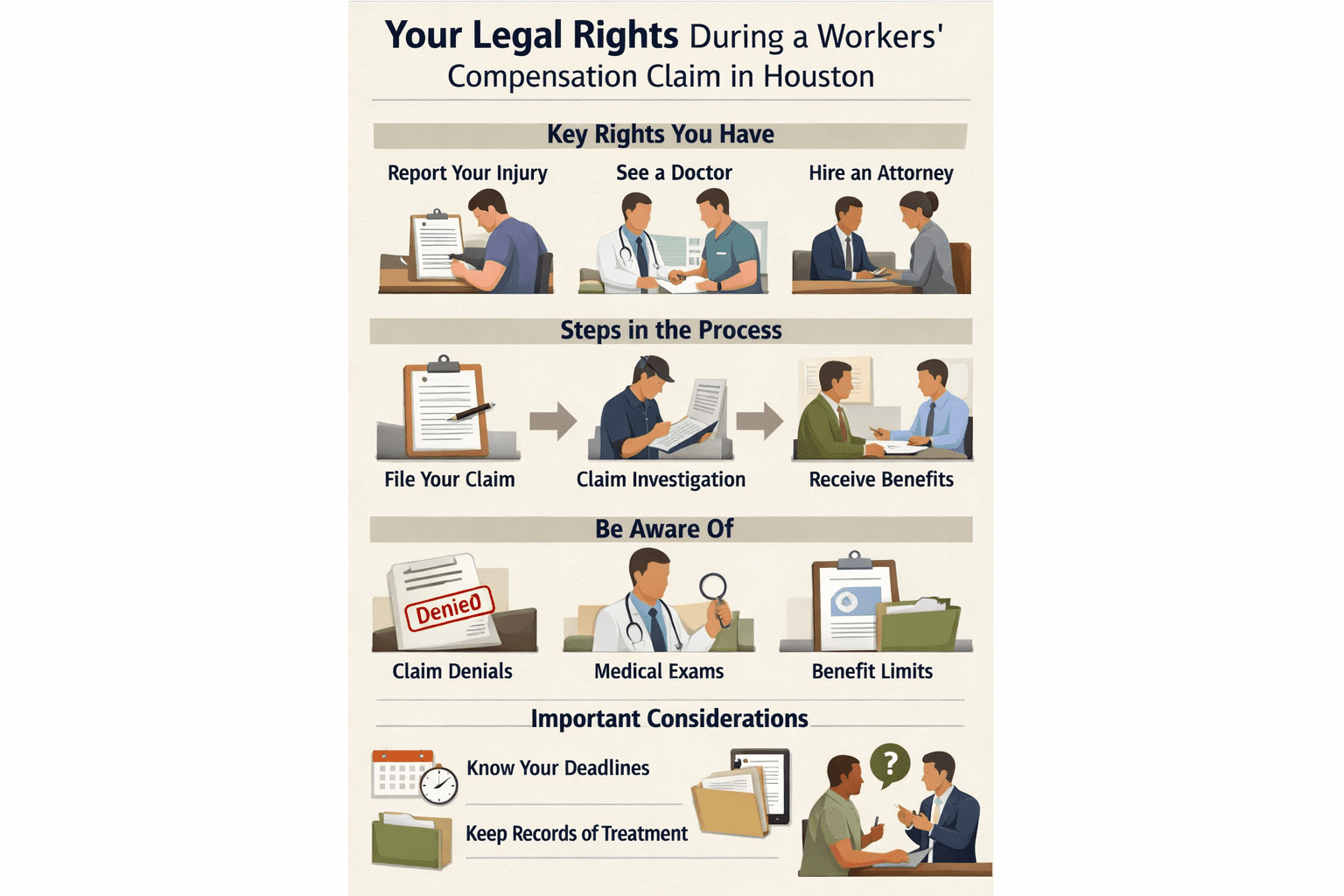
What should I do if my workers’ compensation claim is denied in Houston?
First, do not assume the denial is correct just because it came from the insurance company. Read the denial carefully and identify exactly what is being disputed. Is the insurer denying the entire claim, denying a specific body part, denying a certain treatment, or disputing disability status?
Then take practical steps:
- Keep the denial letter and note the date you received it.
- Gather all medical records and work restrictions.
- Collect accident reports, witness information, and photos if available.
- Write a timeline of events while details are fresh.
- Consult a Houston workers’ compensation lawyer or legal resource quickly.
Timing matters after a denial. The longer you wait, the harder it may be to organize evidence, protect deadlines, and respond effectively.
Do I have appeal rights if my claim is denied?
Yes. Workers in Texas may have the right to dispute denied claims or denied benefits through the workers’ compensation dispute process. The exact path can depend on the nature of the denial and where the case stands procedurally, but the important point is that a denial is not always final.
Appeal rights may apply when there is a dispute about:
- Whether the injury is compensable
- Whether certain medical treatment should be covered
- Whether the worker has disability status
- Whether benefits were calculated correctly
- Whether the worker has reached maximum medical improvement
- What impairment rating applies
Because workers’ compensation procedure can become highly technical, legal help is often most valuable at the moment a dispute begins, not after multiple deadlines have already passed.
How does the appeal or dispute process usually feel from the worker’s perspective?
For many injured workers, the appeal process feels overwhelming because they are expected to keep up with treatment, manage bills, communicate with their employer, and understand legal notices all at once. The insurance company may rely on forms, deadlines, and medical terminology that are unfamiliar to the average person.
What to expect often includes:
- Requests for records and supporting documentation
- Additional medical reviews or evaluations
- Formal dispute resolution steps
- Pressure to explain prior injuries or medical history
- Questions about work status and restrictions
This is one reason many workers seek legal guidance early. A lawyer can help frame the issues, identify weak spots in the file, and make sure the worker is not trying to navigate a procedural dispute alone while injured.
What documents should I keep during a workers’ comp claim?
Keep everything. Even records that seem minor may matter later. A good claim file may include:
- Written injury report to the employer
- Any internal incident report
- Medical records from every provider
- Prescription receipts
- Mileage or transportation records if relevant
- Work status slips and restrictions
- Pay stubs and wage records
- Benefit payment notices
- Emails, texts, and letters from the employer or insurer
- Names and contact information for witnesses
- Photos of injuries or dangerous conditions
- A personal journal of symptoms and recovery issues
Organizing documents by date can make a major difference if the claim becomes disputed.
What mistakes can hurt a Houston workers’ compensation claim?
Several common mistakes can create avoidable problems:
- Waiting too long to report the injury
- Not telling the doctor the injury is work-related
- Giving inconsistent descriptions of how the injury happened
- Ignoring medical advice or missing appointments
- Posting about the injury carelessly on social media
- Returning to work outside medical restrictions
- Failing to keep copies of records
- Assuming a denial cannot be challenged
Another mistake is minimizing the injury in the first few days. Many workers say they are “fine” because they do not want to cause trouble, only to need significant treatment later. Early downplaying can be used against you if the case becomes disputed.
Should I talk to the insurance adjuster on my own?
You may be contacted by an adjuster early in the process. Be careful, be accurate, and do not guess. If you do not know an answer, say so. If you are still receiving treatment and do not yet understand the full extent of the injury, avoid making broad statements like “I’m completely okay now” or “It’s probably nothing.”
Many workers are polite and trying to cooperate, but an informal conversation can still shape how the insurer views the claim. If the case becomes complicated, denied, or delayed, speaking with a lawyer before giving detailed recorded information can be wise.
How do preexisting conditions affect a workers’ compensation claim?
A preexisting condition does not automatically bar a workers’ compensation claim. Many people have prior back pain, old injuries, arthritis, or earlier surgeries. The legal question often becomes whether the workplace incident caused a new injury, aggravated an existing condition, or otherwise contributed to the need for treatment and disability.
Insurance carriers frequently examine prior medical history closely. That means honesty matters. Trying to hide an old injury can damage credibility. At the same time, the existence of prior symptoms does not mean the carrier gets to deny every new work-related problem. Medical evidence is critical in these situations.
What if I was injured while driving for work in Houston?
Work-related driving injuries can raise special issues. If you were making deliveries, traveling between job sites, driving as part of assigned duties, or otherwise working when a crash happened, the injury may implicate workers’ compensation rights. There may also be questions involving another driver’s fault, commercial vehicle issues, or employer policies.
The key is to avoid assuming that a “car accident” is separate from a work injury. If the crash happened in the course and scope of your job, workers’ compensation may still be part of the legal picture. These claims can become fact-intensive quickly, especially if the employer argues you were on a personal errand or off the clock.
What if my employer does not have workers’ compensation insurance?
Texas allows some employers to opt out of the workers’ compensation system. These employers are often called non-subscribers. If your employer is a non-subscriber, the claim may not proceed through the same workers’ compensation benefit system. Instead, other legal avenues may need to be considered depending on how the injury happened and what caused it.
This is a major reason not to self-diagnose your legal rights based only on internet summaries. The first practical question is whether the employer is a subscriber or non-subscriber. That answer can change the legal strategy entirely.
How can Injury Nation help with a Houston workers’ compensation issue?
Injury Nation helps injured people connect with legal guidance and local personal injury lawyer resources when they are facing complicated injury-related situations, including workers’ compensation concerns. For someone dealing with a workplace injury in Houston, that means support focused on clarity and next steps.
In practical terms, Injury Nation advocates for clients by helping them:

- Understand the basic structure of a workers’ compensation claim
- Identify whether the employer likely carries workers’ comp coverage
- Recognize warning signs in delayed, disputed, or denied claims
- Prepare for a free legal consultation with relevant documents and questions
- Connect with local legal help when the claim becomes contested or confusing
- Find guidance quickly when urgent questions arise after a work injury
Injury Nation does not replace case-specific legal advice from a licensed attorney. What it does is help injured workers avoid being left in the dark. Many people do not know where to start, what to ask, or whether their situation is serious enough to call a lawyer. Injury Nation helps bridge that gap and directs people toward informed local help.
When should I contact a Houston workers’ compensation lawyer?
You do not always need to wait for a full denial to speak with a lawyer. It is often smart to contact a local attorney if:
- Your injury is serious
- You are missing work and unsure about benefits
- Your employer disputes that the injury happened on the job
- You are being pressured to return too soon
- Medical treatment is delayed or denied
- Your checks stopped or seem incorrect
- You suspect retaliation
- Your employer may be a non-subscriber
- You are confused about deadlines or paperwork
Early guidance often prevents small claim issues from becoming major legal problems.
What should I ask during a free legal consultation?
A free consultation is more useful when you go in prepared. Good questions include:
- Does my employer appear to have workers’ compensation coverage?
- What deadlines apply in my case?
- What benefits may be available based on my injury?
- Am I treating with the correct doctor or network?
- Why might the insurer be disputing my claim?
- What evidence would strengthen my case?
- What happens if my treatment or wage benefits are denied?
- Are there signs of retaliation or a non-subscriber issue?
Bring your injury report, medical paperwork, denial letters, wage records, and any communications from the employer or insurer. The more information you bring, the more specific the guidance can be.
What does a strong workers’ compensation claim usually look like?
No claim is perfect, but stronger claims often share certain features:
- The injury was reported promptly
- The worker’s story stayed consistent
- Medical records clearly connect the condition to work
- Work restrictions are documented
- Deadlines were met
- Communication records are organized
- The worker followed treatment recommendations
Even if your claim does not check every box, do not assume it is hopeless. Many legitimate claims begin with messy facts, delayed diagnosis, disputed body parts, or employer pushback. The important thing is to identify the weak points and address them strategically.
What does a red-flag claim situation look like?
Some signs suggest the claim may need legal attention quickly:
- The employer refuses to make an incident report
- You are told to use your own health insurance without explanation
- Your supervisor asks you not to mention that the injury happened at work
- The insurer delays decisions without giving clear reasons
- Your doctor’s restrictions are being ignored
- You are sent back to full duty despite ongoing symptoms
- You receive conflicting information about coverage
- Your claim is denied based on a technicality you do not understand
These issues do not always mean someone acted unlawfully, but they do mean you should slow down, document everything, and get guidance before the record develops further without your side being fully presented.
Can a workers’ compensation claim cover long-term effects of a work injury?
Potentially, yes. Some injuries heal quickly, while others lead to long-term limitations, future treatment needs, chronic pain, or permanent impairment questions. Cases involving serious back injuries, head injuries, severe fractures, occupational disease, or surgical recovery may involve complex benefit issues over time.
Long-term claims often involve additional disputes about work ability, impairment, ongoing treatment, and whether symptoms are still tied to the original workplace injury. The longer a claim continues, the more important detailed records become.
How should I handle social media during a workers’ comp claim?
Very carefully. Social media posts can be misunderstood and used out of context. A photo of you at a family gathering does not necessarily prove you are healthy enough for heavy labor, but insurance carriers may still try to use selective posts to question the severity of your injury.
Practical guidance includes:
- Do not post about your injury, treatment, or claim details
- Do not exaggerate improvement or “tough it out” online
- Ask friends and family not to tag you in physically active events
- Review privacy settings, but do not rely on them completely
What if I need help in the middle of the night or outside business hours?
Work injuries do not happen on a convenient schedule. That is one reason many injured people look for 24/7 emergency legal help resources when they are suddenly facing a severe accident, hospitalization, employer pressure, or a confusing insurance response. If you are in Houston and do not know what to do next, reaching out promptly can help you preserve documents, avoid harmful mistakes, and get pointed in the right direction.
Why do people often wait too long to ask for help?
There are a few common reasons:
- They hope the injury will improve in a few days
- They do not want to upset their employer
- They assume workers’ compensation is automatic
- They do not realize a denial can be appealed
- They are overwhelmed by pain, work loss, and family demands
Unfortunately, delay can make almost every legal issue harder. Evidence gets stale, deadlines approach, and the insurer’s version of events may become the default record. Getting information early does not mean starting a fight. It often means protecting yourself before a small problem turns into a major one.
What is the most important thing to remember about workers compensation legal rights Houston employees have?
The most important thing to remember is that you do have rights, but those rights are strongest when you act early, document carefully, and seek guidance when something seems off. Texas workers’ compensation rules can be confusing, and Houston workers often face real pressure from employers, insurance carriers, and financial stress after an injury. You do not need to navigate that uncertainty blindly.
Your claim may involve rights to medical care, income benefits, dispute resolution, and protection against improper retaliation. If the claim is denied, delayed, or mishandled, there may still be options. The key is not to assume that silence, confusion, or an initial denial means the case is over.
What to Expect if You Reach Out for Help
If you contact Injury Nation about a Houston workers’ compensation concern, the goal is simple: help you understand the issue and move toward the right legal resource. You may be asked basic questions such as:
- When and how the injury happened
- Whether the employer was notified
- Whether you have seen a doctor
- Whether any benefits have been paid
- Whether the claim has been denied or treatment disputed
- Whether you believe the employer carries workers’ compensation coverage
That initial review can help clarify whether you need immediate legal attention, what documents you should gather, and which questions are most urgent for a local attorney to address.
Conclusion
A workplace injury in Houston can leave you dealing with pain, lost income, and a system that may feel far more complicated than it should. Understanding your workers compensation legal rights Houston workers may have is an important first step. You may have rights to report the injury, seek medical care, pursue benefits, challenge denials, and protect yourself when an employer or insurer does not handle the claim fairly.
If you are unsure whether your employer has coverage, your treatment is being delayed, your claim has been denied, or you simply do not know what to do next, do not wait for the situation to get worse. Contact a local personal injury lawyer for a free consultation today. Injury Nation can help you connect with Houston-area legal guidance so you can better understand your options and take the next step with confidence.