Facing a Disability Claim Denial
A disability insurance claim denial lawyer helps people whose disability benefits have been wrongfully denied by insurance companies. These specialized attorneys steer the complex appeals process, gather necessary evidence, and fight to get clients the benefits they deserve.
What a Disability Insurance Claim Denial Lawyer Does:
- Reviews your denial letter to understand why your claim was rejected
- Gathers medical evidence from your doctors and healthcare providers
- Files appeals within strict deadlines (often 180 days)
- Negotiates with insurance companies to overturn denials
- Represents you in court if administrative appeals fail
- Works on contingency – you only pay if they win your case
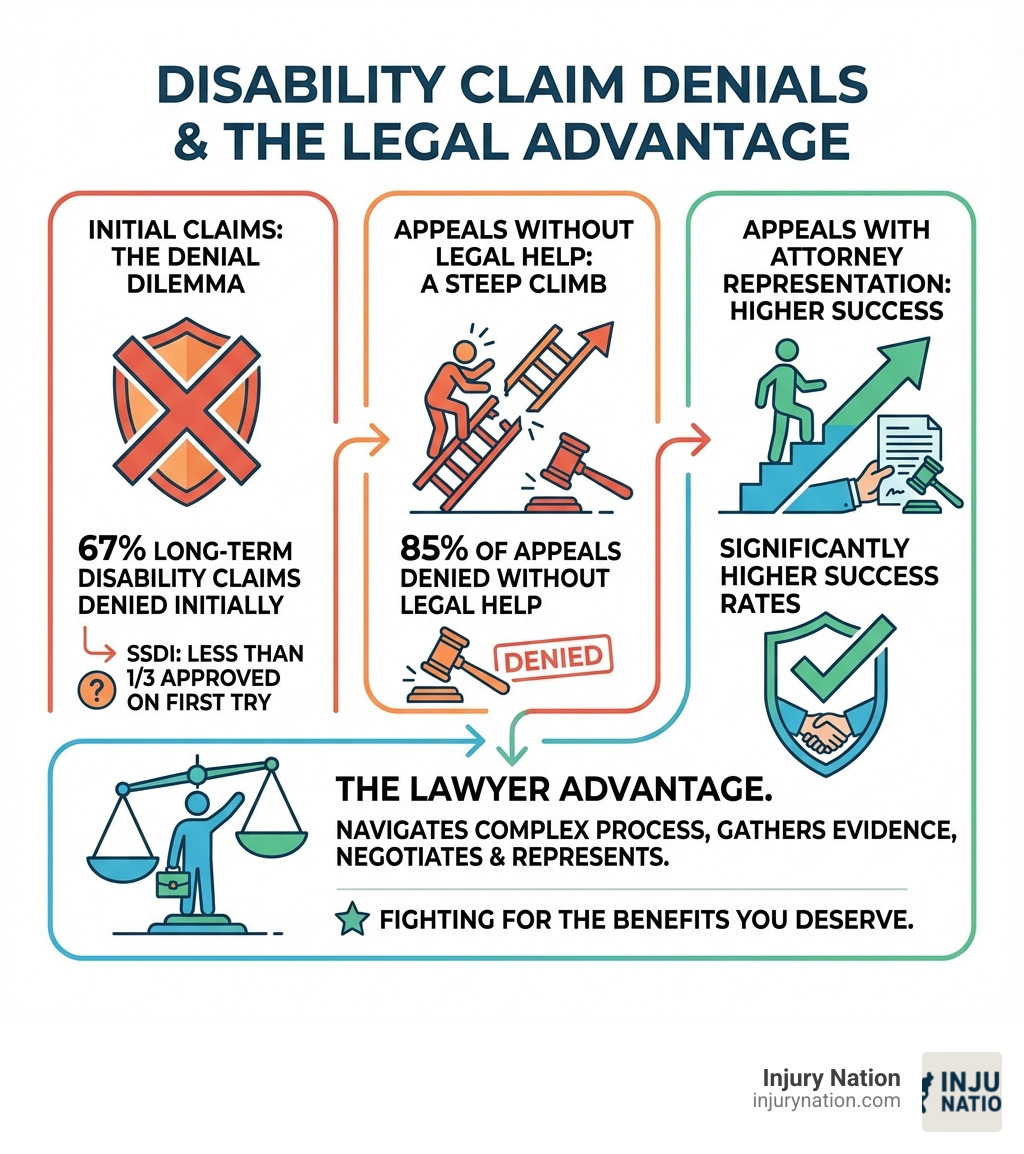
When you can’t work because of a serious illness or injury, disability insurance should be your financial lifeline. But here’s the harsh reality: insurance companies deny more than half of all long-term disability claims. In fact, the U.S. Social Security Administration reports that an average of 67% of long-term disability claims are denied.
That denial letter isn’t just paperwork. It’s a threat to your ability to pay for medical care, keep your home, and support your family during the hardest time of your life.
“Many face career-ending injuries or disabilities that force them to turn to their disability insurance in order to maintain their financial independence and physical health,” notes a leading disability law firm. “Regrettably, insurance companies repeatedly delay, challenge or deny legitimate disability claims.”
The good news? A denial is not the final word. You have the right to appeal, and with the right legal help, many denied claims are eventually approved. The key is acting quickly and building a strong case with evidence that insurance companies can’t ignore.
Similar topics to disability insurance claim denial lawyer:
Understanding Your Denial: Why Insurance Companies Say “No”

Receiving a disability insurance claim denial can feel like a punch to the gut, especially when you’re already struggling with a disabling condition. It’s easy to feel defeated, but understanding why your claim was denied is the first crucial step toward appealing it successfully. Insurance companies are businesses, and like any business, they aim to protect their bottom line. This often means employing various tactics to deny, delay, or devalue legitimate claims.
Common Reasons for Claim Denials
Insurance companies have a playbook of reasons they cite for denying disability benefits. Some of the most frequent include:
- Insufficient Medical Evidence: This is a big one. Insurers often claim that your medical records don’t adequately prove your disability or its severity. They might argue that there isn’t enough “objective” evidence (like MRI results or blood tests) to support your subjective complaints of pain or fatigue. They may also state that your medical treatment isn’t consistent or robust enough for your condition.
- Missed Deadlines: Disability policies, especially those governed by ERISA (more on that below), come with strict deadlines for filing claims and appeals. Missing a deadline, even by a day, can result in an automatic denial.
- “Not Disabled” Per Policy Definition: Your policy contains a specific definition of “disability.” This can be “own occupation” (unable to perform the duties of your specific job) or “any occupation” (unable to perform the duties of any job for which you are reasonably qualified). Insurers often deny claims by asserting that you don’t meet their definition, even if you clearly can’t do your old job.
- Application Errors or Omissions: Even minor mistakes or missing information on your application can be grounds for denial. Insurers might also claim you failed to disclose a pre-existing condition, even if it wasn’t relevant to your current disability.
- Failure to Receive Regular Medical Care: If the insurance company believes you haven’t consistently sought or followed recommended medical treatment, they might deny your claim, arguing you’re not doing everything possible to recover.
- Surveillance Tactics: Believe it or not, insurance companies sometimes hire private investigators to conduct surveillance or scour your social media. If they find images or activities they believe contradict your claimed limitations, they will use it to deny your claim.
These reasons often serve as tactics to “deny, delay, or devalue claims,” forcing claimants to “battle the complexity of information and requirements at a time when they lack the know-how to do so.”
What is ERISA and How Does It Affect Your Claim?
A significant factor in many disability claims, particularly those acquired through an employer, is the Employee Retirement Income Security Act (ERISA). This federal law, enacted in 1974, sets minimum standards for most voluntarily established retirement and health plans in private industry to provide protection for individuals in these plans.
If your disability insurance policy was obtained through your employer, it’s highly likely to be governed by ERISA. This has profound implications for your claim:
- Conflict of Interest: A key aspect of ERISA is that it “allows the plan’s administrator to evaluate claims it must pay, creating a conflict of interest that can lead to valid claims getting denied.” Essentially, the entity deciding whether to pay your claim is often the same entity that has to pay it, creating an inherent bias.
- “Abuse of Discretion” Standard: For many ERISA cases, if a lawsuit is filed, the court will apply an “abuse of discretion standard.” This standard provides insurance companies with the “benefit of the doubt” in making their coverage decisions. It means a court might uphold a denial if the insurer’s decision-making process was “reasonable,” even if the court might have come to a different conclusion.
- Federal Court: Lawsuits involving ERISA-governed policies must be filed in federal court, not state court. This adds a layer of complexity that differs significantly from other types of insurance litigation.
Understanding ERISA is crucial because it dictates the entire appeals process, the evidence you can submit, and how a court will review your case. For more information, you can visit the U.S. Department of Labor’s page on What is ERISA?.
ERISA vs. Private Disability Policies
The type of disability policy you have – whether it’s an employer-sponsored ERISA plan or a private policy you purchased yourself – dramatically impacts the appeals process and your legal options.
Here’s a quick comparison:
| Feature | ERISA-Governed (Employer-Sponsored) | Private (Individual) Disability Policy |
|---|---|---|
| Governing Law | Federal law (ERISA) | State insurance laws |
| Court Jurisdiction | Federal court | State court |
| Standard of Review | Often “abuse of discretion,” favoring the insurer | More flexible, can argue bad faith, breach of contract |
| Evidence Submission | Strictly limited to what was submitted during administrative appeal (“stacking the record” is vital) | Can often introduce new evidence in court |
| Damages | Limited to unpaid benefits, attorney fees, and sometimes interest | Can potentially include emotional distress, punitive damages for bad faith, in addition to unpaid benefits |
| Appeals Process | Mandatory internal administrative appeal(s) before lawsuit | May allow for direct lawsuit if internal appeal is not required by policy or state law |
| Complexity | Highly complex, requires specialized knowledge of ERISA regulations | Can still be complex, but lawyers can argue “bad-faith insurance practices more flexibly” |
The distinctions between these policy types highlight why having a disability insurance claim denial lawyer with specific expertise in ERISA or state insurance law is so important. What works for one type of policy might not apply to the other.
Your Step-by-Step Guide to Appealing a Denied Claim
A denial letter is certainly disheartening, but it’s rarely the end of the road. Your right to appeal is a critical part of the process, and understanding how to steer it can significantly increase your chances of success.
The first and most important step after receiving a denial is to “read the denial letter carefully to understand exactly why the claim was denied and what information needs to be submitted.” This letter will outline the insurer’s specific reasons for denial and, crucially, the deadline for your appeal. These deadlines are often strict, with many policies allowing “180 days to file an appeal under ERISA,” though this “time could be shorter or longer depending on the policy.” For Social Security Disability Insurance (SSDI) claims, you typically have a “60-day window to file an appeal.” Missing these hard deadlines can permanently bar your claim.
For ERISA-governed policies, the appeal typically involves an “administrative appeal” process where you submit additional evidence and arguments directly to the insurance company. This stage is paramount because of the concept of “stacking the record.” As one source emphasizes, “ERISA strictly bars claimants from submitting additional evidence in court if it was not included in the administrative appeal.” This means every piece of evidence, every doctor’s note, every expert opinion must be part of that initial administrative appeal.
The appeals process for SSDI claims is quite different, involving multiple levels: Reconsideration, a Hearing before an Administrative Law Judge (ALJ), Appeals Council Review, and finally, Federal Court Review. You can find more details on the SSA’s appeal process here: The SSA appeals process.
Step 1: Gather Crucial Evidence
Building a strong appeal hinges on presenting overwhelming evidence that counters the insurer’s reasons for denial. This isn’t just about sending more documents; it’s about sending the right documents.
Here’s what you’ll need to gather:
- Comprehensive Medical Records: This includes all doctor’s notes, hospital records, test results (MRIs, CT scans, X-rays, blood work), therapy notes, and medication lists. Ensure these records are complete and accurately reflect your condition and treatment. “It’s crucial to ensure records are complete and accurate, as errors or omissions, even minor ones, can lead to claim denial.”
- Physician Opinions/Statements: Crucially, get detailed written statements from your treating physicians. These statements should explain your diagnosis, prognosis, specific functional limitations, how your condition prevents you from performing your job duties, and how long they anticipate your disability will last. Insurers often provide short forms, but “insurance companies are notorious for providing short forms for physician statements, which can be misleading regarding the required level of detail.” A detailed narrative from your doctor is far more impactful.
- Vocational Expert Reports: If your denial states you can perform “any occupation,” a vocational expert can be invaluable. They can assess your education, work history, and transferable skills against your medical limitations to demonstrate that you cannot perform any suitable gainful employment.
- Witness Statements: Letters from friends, family, or former colleagues describing how your disability impacts your daily life and ability to work can provide powerful non-medical evidence. These personal accounts can paint a clearer picture of your struggles.
- Financial Documents: Depending on the nature of your claim, documentation of your income and financial need can sometimes be helpful, particularly for SSDI claims.
- Detailed Job Description: Provide a comprehensive description of your specific job duties, highlighting the physical and mental demands. This helps compare your limitations to your work requirements.
“Application requires all pertinent medical records, opinions of medical providers, subjective and objective testing, medication details, occupational demands, and financial and vocational information.”
Step 2: Steer the Appeals Process
With your evidence in hand, it’s time to carefully prepare and submit your appeal.
- Request Your Claim File: For ERISA policies, you have the right to “request copies of documents, records, and expert advice used in making the denial decision.” Get your entire claim file in writing from the insurance company. This allows you to see exactly what information the insurer relied upon (or ignored) when denying your claim.
- Craft a Detailed Appeal Letter: Your appeal letter should directly address each reason for denial stated in the insurer’s letter. Systematically refute their arguments with your new or clarified evidence. Clearly explain why their denial was incorrect and why you meet the policy’s definition of disability.
- Submit All New Evidence: Ensure every supporting document you’ve gathered is included with your appeal. Organize it logically and reference it clearly in your appeal letter. For ERISA, if it’s not in this administrative record, it generally can’t be used later in court.
- Follow Up Diligently: Insurance companies “might request specific records multiple times or fail to inform you that key information is missing from your disability file.” Don’t let them give you the “runaround.” Keep meticulous records of all communications and submissions. Confirm receipt of your appeal package.
- Exhaust Administrative Remedies: For ERISA claims, you must complete all internal appeals offered by the insurance company before you can file a lawsuit. This is a mandatory step.
Step 3: Potential Outcomes of an Appeal
After submitting your appeal, the insurance company will review your case again. The outcome can vary:
- Claim Reinstated: This is the best-case scenario. The insurer overturns their denial and begins paying your disability benefits. This could involve regular monthly payments or, in some cases, a lump-sum settlement. Our research shows that for some firms, “lump sum recoveries have been in the seven figures.”
- Lump-Sum Settlement: Sometimes, instead of reinstating monthly payments, the insurance company might offer a one-time lump-sum settlement to resolve the claim. This can be appealing for some claimants but requires careful consideration of future needs and tax implications.
- Denial Upheld: The insurance company might uphold its original denial. If this happens and you’ve exhausted all administrative appeals (especially for ERISA claims), your next step is typically to file a lawsuit.
- Filing a Lawsuit: If your appeal is denied and you believe your claim is valid, you can pursue legal action. For ERISA policies, this means federal court; for private policies, it’s usually state court. This is where a disability insurance claim denial lawyer becomes absolutely essential.
The Role of a Disability Insurance Claim Denial Lawyer

Navigating the labyrinth of disability insurance claims, especially after a denial, can be incredibly overwhelming. You’re already dealing with a debilitating condition; adding complex legal and medical paperwork to your plate is a recipe for stress and potential mistakes. This is precisely where a disability insurance claim denial lawyer steps in.
“Seek the help of a long-term disability appeal attorney to level the playing field with the insurance company,” advises one expert. Insurance companies have vast resources, legal teams, and experience denying claims. Trying to fight them alone is often like bringing a knife to a gunfight. A specialized lawyer brings the expertise, resources, and determination needed to challenge these powerful entities. Injury Nation is dedicated to helping victims find the right legal help, including those who need Disability Insurance Claims Attorneys.
These lawyers understand the nuances of disability policies, the intricacies of ERISA law, and the tactics insurers use to avoid paying. They can analyze your policy, interpret complex medical evidence, and build a compelling case that maximizes your chances of success. They also remove the burden of constant communication with the insurer, allowing you to focus on your health.
When to Hire a Disability Insurance Claim Denial Lawyer
While it’s never too late to consult an attorney, there are specific moments when hiring a disability insurance claim denial lawyer is particularly crucial:
- Immediately After Denial: The moment you receive that denial letter is the best time to involve legal counsel. “Involve legal counsel as soon as possible in the process of appealing a denied claim.” The clock starts ticking on strict appeal deadlines, and an attorney can help you respond effectively from day one.
- Complex ERISA Case: If your policy is employer-sponsored, you’re dealing with ERISA. “ERISA claims are complicated legal matters that very few attorneys handle.” The rules for evidence, appeals, and litigation under ERISA are highly specialized, making legal representation almost a necessity.
- Insurer Acting in Bad Faith: If the insurance company is using delay tactics, repeatedly requesting the same information, or making unreasonable demands, they might be acting in bad faith. “Insurance companies use many tactics to deny, delay, or devalue claims.” A lawyer can identify these tactics and hold the insurer accountable.
- Appeal is Denied: If your initial administrative appeal is denied, your next step is often a lawsuit. This is definitely not something you want to tackle without experienced legal representation.
- Before Filing a Lawsuit: Even if you plan to appeal yourself, consulting a lawyer early can help you “stack the record” correctly. As we’ve discussed, for ERISA claims, evidence not submitted during the administrative appeal cannot be introduced later in court. An attorney can ensure your appeal is litigation-ready.
How a Disability Insurance Claim Denial Lawyer Builds Your Case
A skilled disability insurance claim denial lawyer doesn’t just fill out forms. They strategically build a robust case designed to overcome the insurer’s objections.
- Analyzing the Denial Letter and Policy: They carefully review your denial letter to pinpoint the exact reasons for rejection. Then, they scrutinize your entire disability insurance policy to understand its terms, definitions, exclusions, and appeal procedures. “Review the denial letter carefully to understand the insurer’s reasoning.”
- Gathering Comprehensive Evidence: This is where their expertise shines. They know precisely what medical documentation, vocational assessments, and other evidence are needed to prove your disability. They help “gather medical records, work with healthcare professionals, show the injury meets the insurer’s definition, prove the injury prevents work duties, and submit a comprehensive appeal.”
- Communicating with Doctors: Lawyers work with your treating physicians to obtain detailed statements and reports that clearly articulate your functional limitations. They ensure your physician provides “a detailed statement about your condition and its work limitations,” countering the brief forms often provided by insurers.
- Hiring Vocational Experts: If the insurer argues you can perform “any occupation,” your lawyer can enlist a vocational expert to provide a professional opinion on why your limitations prevent you from performing other work.
- Meeting All Deadlines: With their deep understanding of policy requirements and ERISA regulations, lawyers ensure all appeals and legal documents are filed accurately and on time, preventing costly procedural errors.
- Filing a Lawsuit: If administrative appeals fail, your lawyer will guide you through the litigation process, representing you in federal or state court to fight for the benefits you deserve. They are “experienced litigators” who can “prevail against all the big players.”
Frequently Asked Questions about Disability Claim Denials
We understand you likely have many questions when facing a disability claim denial. Here are answers to some of the most common ones:
How much does a disability denial lawyer cost?
One of the biggest concerns for individuals unable to work is the cost of legal representation. The good news is that many disability insurance claim denial lawyer firms, including those we recommend at Injury Nation, work on a contingency fee basis. This means:
- No Upfront Fees: You typically won’t pay any money out-of-pocket to hire the lawyer.
- Paid from Settlement: The lawyer’s fees are a percentage of the benefits or settlement they recover for you. “They only get paid if they successfully recover compensation for you.”
- Free Case Evaluation: Most reputable firms offer a free initial consultation to review your case and determine your legal options.
This arrangement allows you to pursue justice without added financial strain during an already difficult time.
How long do I have to file an appeal?
The timeframe for filing an appeal is critically important and varies depending on your policy type:
- ERISA-Governed Policies (Employer-Sponsored): Most policies will state the deadline in your denial letter, but typically, you have “180 days to file an appeal under ERISA.” This is a hard deadline, and missing it can be fatal to your claim.
- Private Disability Policies: These deadlines can vary more widely. You must “check denial letter” and your specific policy documents carefully.
- SSDI Claims: For Social Security Disability Insurance, you generally have a “60-day window to file an appeal” after receiving a denial notice.
It is crucial to emphasize that these are “strict time limits.” Always verify the exact deadline with your insurer or, better yet, with a disability insurance claim denial lawyer.
What are my chances of winning an appeal?
While a denial is not the end, the statistics can seem daunting.
- Low Initial Approval Rates: “An average of 67% of long-term disability claims are denied,” and “less than one-third of SSDI claims are initially approved.” For SSDI, the “overall approval rate for reconsideration is around 15%.”
- Higher Success with Legal Help: The good news is that legal representation significantly improves your odds. “Working with a disability attorney may increase your chances of a successful outcome.” While it’s possible to appeal without a lawyer, “chances of success are ‘much higher’ with one.”
- Depends on Evidence: Your chances ultimately depend on the strength of your medical evidence, how well it supports your claim, and how effectively it’s presented. A skilled disability insurance claim denial lawyer knows how to gather and present this evidence to maximize your chances.
Conclusion: Find the Right Legal Advocate for Your Fight
Facing a disability insurance claim denial can feel like an impossible challenge, leaving you vulnerable and financially insecure. But as we’ve explored, a denial is not the final chapter of your story. With the right strategy, meticulous evidence gathering, and expert legal guidance, you can fight back and secure the benefits you rightfully deserve.
The complexities of disability law, the strict deadlines, and the often-aggressive tactics of insurance companies make the journey challenging to steer alone. This is particularly true for ERISA-governed policies, where the rules are stacked against claimants. A seasoned disability insurance claim denial lawyer can be your most powerful ally, leveling the playing field and advocating tirelessly on your behalf.
Don’t let a denial define your future. Take the proactive step of seeking legal advice. If you’re in Las Vegas, Nevada, or anywhere else, our Injury Nation lawyer directory can help you connect with qualified legal professionals who specialize in disability insurance claim denials. They can assess your case, explain your options, and fight to get you the justice and financial stability you need.
Take action today. Your health and financial well-being depend on it.
Ready to find a legal advocate who can help you challenge your disability claim denial? Visit our directory: Find a personal injury lawyer to handle your disability claim denial.