What You Need to Know About Expert Report Affidavits
An Expert report affidavit is a sworn legal document where an expert witness states their professional opinions and the basis for them under oath. It combines an expert report’s detail with an affidavit’s legal formality, making it a powerful tool in personal injury litigation.
Key Facts About Expert Report Affidavits:
- What it is: A notarized, sworn statement from an expert witness that verifies their professional opinions and findings
- When it’s required: Pre-trial motions (like summary judgment), admissibility hearings, and mandatory filing in medical malpractice cases in states like Texas, Georgia, and Missouri
- Who provides it: A qualified expert with specialized knowledge, experience, training, or education relevant to your case
- Why it matters: It can prevent case dismissal, strengthen settlement negotiations, and establish your claim’s credibility
- Legal standard: Must meet Federal Rule of Evidence 702 or state equivalents, demonstrating reliable methods and sufficient factual basis
If your injury case involves complex evidence, you’ll likely need an expert report affidavit. This document provides sworn testimony that can make or break your case before it reaches trial.
In some states, like Missouri and Delaware, you cannot even file a medical malpractice lawsuit without an expert affidavit, often called an “affidavit of merit.” Failure to file it correctly and on time can lead to your case being dismissed.
The stakes are high. A well-crafted affidavit can help you survive summary judgment motions and strengthen your position in settlement talks. Conversely, an inadequate affidavit can result in case dismissal with prejudice, meaning you can’t refile. Understanding this document is crucial for protecting your rights and maximizing your compensation.
Expert Affidavit vs. Expert Report: What’s the Difference?
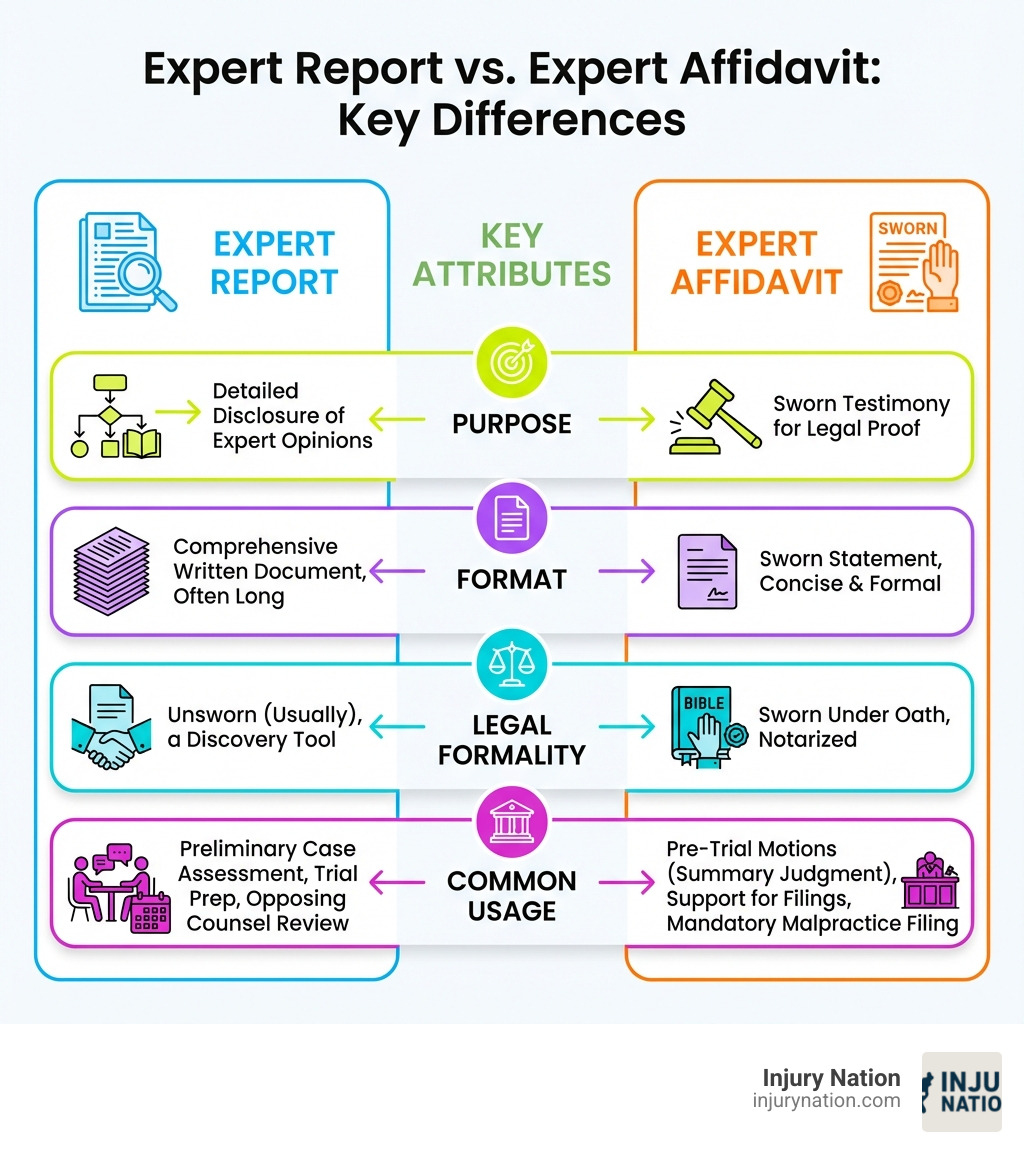
While both are crucial for presenting specialized knowledge, an expert report and an expert affidavit serve distinct purposes. Think of them as two sides of the same coin.
An expert report is a comprehensive document detailing an expert’s findings, opinions, and the basis for them. It’s a detailed roadmap of the expert’s expected testimony, disclosed to the opposing side.
An expert affidavit, on the other hand, is a sworn, notarized statement. It takes the core information from the report and presents it under oath, changing it from a disclosure into direct evidence suitable for pre-trial motions. While a report lays out the expert’s thoughts, an affidavit formally attests to their truth.
Here’s a quick comparison to highlight their key differences:
The Comprehensive Expert Report
In federal courts, Federal Rule of Civil Procedure 26(a)(2)(b) requires a comprehensive expert report that includes:
- A complete statement of all opinions and the basis and reasons for them.
- The facts or data the expert considered.
- Any exhibits that will be used to support the opinions.
- The expert’s qualifications, including publications from the last 10 years.
- A list of other cases where the expert has testified in the last four years.
- A statement of the expert’s compensation for the case.
This level of detail is meant to prevent surprises and allow for thorough preparation. As courts have noted, a vague or conclusory report can lead to the expert’s testimony being excluded—an outcome to avoid in your personal injury case.
The Sworn Expert Affidavit
The expert report affidavit adds the power of sworn testimony to the expert’s analysis. It’s a concise summary of the expert’s findings and opinions, affirmed under penalty of perjury.
In Nevada, affidavits are generally limited to facts, not opinions. However, an expert’s opinion is treated differently. According to Nevada Rules of Court Rule 13, when properly supported by reliable methods and data, an expert’s professional opinion is considered a ‘fact’ within their specialized field, making it admissible in an affidavit. Nevada law, under NRS 53.045, provides options for preparing an affidavit to ensure the affiant swears to the truth of their statement.
The primary role of a sworn expert affidavit is during pre-trial motions, especially for summary judgment. Under Nevada Rules of Civil Procedure 56(e), a party responding to a summary judgment motion must present evidence supporting their position. A well-crafted expert affidavit is a game-changer here, demonstrating a genuine issue of material fact that requires a trial.
When Is an Expert Report Affidavit Required?
The requirement for an expert report affidavit varies by jurisdiction and legal context. While not always needed to start a case, it becomes indispensable at critical junctures in personal injury litigation in Las Vegas.
Mandatory Filing in Specific Cases
Some states mandate an expert affidavit, often called an “affidavit of merit,” at the beginning of certain lawsuits to screen out frivolous claims. This is especially common in medical malpractice cases.
For example, states like Texas, Georgia, Illinois, Missouri, and Delaware require an affidavit from a qualified expert confirming the case has merit. Under laws like Missouri’s affidavit of merit law, this must be filed within a strict deadline after the lawsuit is initiated. Failure to comply often leads to case dismissal.
What about Nevada?
While Nevada does not mandate a pre-lawsuit “affidavit of merit” for all personal injury cases, expert affidavits are still vital during litigation. Nevada Revised Statute 50.275 governs expert qualifications, and the state Supreme Court requires expert testimony to be “helpful” to the jury, meaning it must be well-grounded. You will almost certainly need an expert affidavit to support your case during key pre-trial stages.
Supporting Pre-Trial Motions
This is where the expert report affidavit is most powerful in Nevada and federal courts.
-
Summary Judgment Motions: To defeat a motion for summary judgment, which asks a judge to dismiss your case pre-trial, you must show a genuine dispute of material fact. An expert affidavit provides the sworn testimony needed to establish this dispute and prove a trial is necessary. Nevada Rules of Civil Procedure 56(e) explicitly allows for affidavits in these situations.
-
Admissibility Challenges (Daubert/Frye): In federal court, expert testimony must meet the reliability standards of Federal Rule of Evidence 702. An expert affidavit helps prove the expert’s methods are reliable and relevant. While Nevada state courts use a slightly different standard, the principle is the same: the expert’s opinion must be well-founded. A strong affidavit can preemptively address these admissibility challenges.
-
Expert Disclosures: The detailed expert report required by Federal Rule of Civil Procedure 26(a)(2)(b) is a crucial disclosure. While not sworn at this stage, it contains all the information that will later form the basis of a sworn affidavit or trial testimony.
Crafting a Bulletproof Expert Report Affidavit
Creating a persuasive and legally sound expert report affidavit is critical. A well-crafted affidavit can be the linchpin of your personal injury case, helping to prove negligence, causation, and damages. This requires meticulous attention to detail and close collaboration between your legal team and the expert.
Essential Components of a Strong Affidavit
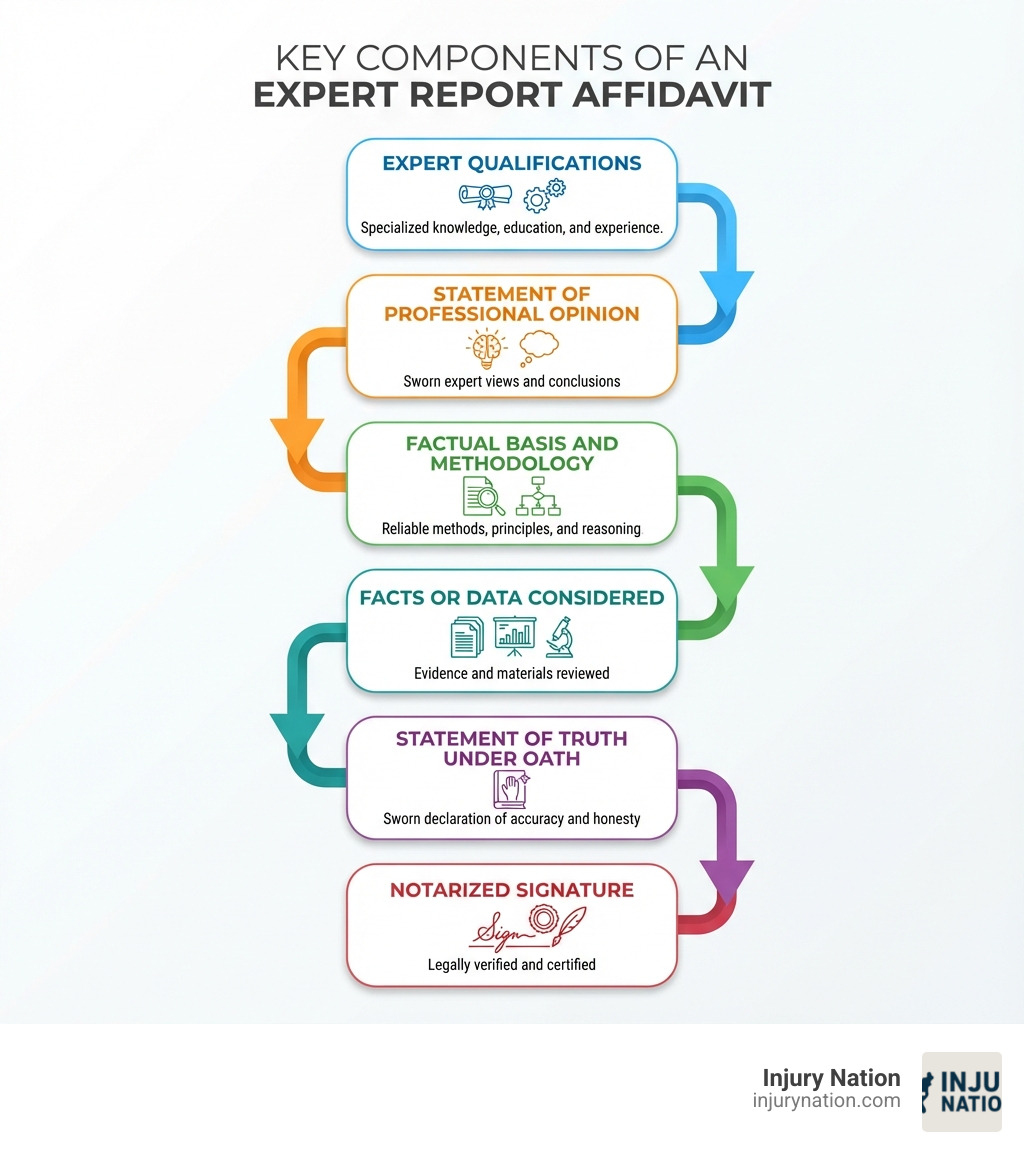
An effective expert affidavit must be clear, comprehensive, and compliant with court rules. Key components include:
- Expert’s Qualifications: The affidavit must detail the expert’s credentials (education, training, experience, certifications) to establish their authority on the subject.
- Statement of Opinions: The expert must clearly state their professional opinions on the key issues of the case, such as breach of standard of care or causation of injury.
- Factual Basis and Methodology: The affidavit must list the specific facts, data, and evidence reviewed (e.g., medical records, accident reports) and explain the reliable methodology used to form the opinions.
- Statement of Truth/Oath: The expert must affirm that the affidavit’s contents are true and accurate under penalty of perjury. This is what gives the document its legal power.
- Signature and Notarization: The affidavit must be signed, dated, and notarized to verify the expert’s identity and oath.
- Compliance with Court Rules: The document should state that the expert understands their duty is to the court, ensuring their opinion is independent and impartial.
Common Pitfalls to Avoid
Even a qualified expert can draft a weak affidavit. We work to avoid these common pitfalls:
- Conclusory Statements: An affidavit that states conclusions without providing the underlying reasoning or factual support is insufficient. As courts have noted in cases like Moore v. International Paint L.L.C., reports that are “too vague, or if they are written with conclusionary statements without a supporting basis for their conclusions” can lead to the expert being barred from testifying.
- Inadequate Foundation: The affidavit must clearly connect the expert’s opinions to the case facts and explain the methodology used. A failure to show how an opinion was reached weakens it.
- Untimely Filing: Court deadlines are strict. Failing to file an affidavit on time can lead to severe consequences, including case dismissal.
- Excessive Jargon: While the subject matter is complex, the affidavit should be understandable to a judge. Overly technical language can obscure the message.
- Failure to Address All Legal Elements: The expert’s opinion must address the relevant legal elements of the case, such as duty, breach, causation, and damages.
- Inconsistent Statements: The affidavit must be consistent with the expert’s other reports and testimony. Inconsistencies can destroy an expert’s credibility.
The Strategic Impact on Your Personal Injury Case
In personal injury litigation, an expert report affidavit is a critical strategic tool that can profoundly influence the outcome of your case. Leveraging its impact is paramount to securing the best possible result.
How a Strong Affidavit Benefits Your Case
A well-drafted affidavit provides numerous strategic advantages:
- Surviving Summary Judgment: A strong affidavit creates a “genuine issue of material fact,” which is essential to defeat a motion to dismiss your case before it ever reaches a jury.
- Strengthening Negotiating Position: A solid expert affidavit signals to the opposing side that you have a strong, defensible case. This increases your leverage and often leads to more favorable settlement offers.
- Shaping the Case Narrative: An affidavit allows you to frame the key issues early on, anchoring your legal arguments with sworn testimony from a qualified expert.
- Locking in Expert Testimony: By signing an affidavit, an expert is formally bound to their stated opinions. This ensures consistency and prevents surprises later in the litigation process.
- Demonstrating Case Merit: Even where not required, a well-prepared affidavit shows the court and opposing counsel that your claim is serious, well-researched, and supported by professional expertise.
Consequences of an Inadequate Expert Report Affidavit
Conversely, a weak or improper affidavit can have devastating consequences:
- Case Dismissal: If an affidavit is required and is filed incorrectly or late, your case can be dismissed. If the dismissal is “with prejudice,” you are permanently barred from refiling the lawsuit.
- Exclusion of Expert Testimony: A court can exclude an expert’s testimony if their affidavit is conclusory, lacks foundation, or fails to meet legal standards. Without an expert, many complex personal injury cases are impossible to prove.
- Sanctions: Courts can impose sanctions, such as monetary fines, for submitting inadequate documents.
- Damaged Credibility: A sloppy or inconsistent affidavit can damage the expert’s professional credibility, undermining their effectiveness.
- Weakened Settlement Leverage: A flawed affidavit signals weakness to the opposing side, reducing your negotiating power and likely leading to lower settlement offers.
Frequently Asked Questions about Expert Affidavits
We understand that the legal landscape can be confusing, especially when dealing with specialized documents like expert affidavits. Here are some common questions we hear, along with our answers, focusing on how they apply to your personal injury case in Las Vegas, Nevada.
What is the main purpose of an expert affidavit in a summary judgment motion?
Its main purpose is to demonstrate that a genuine dispute of material fact exists, which is necessary to defeat a summary judgment motion. By presenting sworn expert opinions that contradict the other side’s claims, it demonstrates that a trial is necessary to resolve the case, thus preventing a premature dismissal.
Do rules for expert affidavits differ between civil and criminal cases?
Yes, the rules differ significantly. Civil cases, like personal injury lawsuits, are governed by Rules of Civil Procedure that focus on disclosure. Criminal cases are governed by Rules of Criminal Procedure and are constrained by constitutional rights, like the Sixth Amendment right to confrontation, which affects how expert testimony can be presented.
Can an expert’s report be used at trial without an affidavit?
Generally, yes. The expert report is a required pre-trial disclosure. At trial, the expert provides live testimony under oath, which is the primary form of evidence presented to a jury. An expert report affidavit is more commonly used for pre-trial motions, such as summary judgment, rather than as a substitute for live testimony.
Conclusion
Navigating the legal system after a personal injury can be daunting, but understanding key legal instruments like the expert report affidavit can empower you. This sworn document, uniting an expert’s detailed analysis with the gravity of an oath, is a pivotal element in many personal injury claims, particularly in Las Vegas, Nevada.
We’ve explored how a robust expert affidavit can be the difference between a case moving forward or being dismissed, how it strengthens your position in negotiations, and how it helps us strategically guide your case toward a successful outcome. We’ve also highlighted the severe consequences of an inadequate or improperly filed affidavit, underscoring the necessity of meticulous preparation and strict adherence to legal standards.
At Injury Nation, we believe in arming you with knowledge and connecting you with top-rated personal injury lawyers who understand these intricate legal requirements. Our goal is to help you find a lawyer who can adeptly leverage every tool, including a bulletproof expert report affidavit, to ensure you receive the maximum compensation you deserve. Don’t let procedural missteps jeopardize your claim.
If you’re facing a personal injury case, especially one involving complex medical or technical evidence, securing an experienced legal team is your first and most crucial step. They will guide you through the process, ensuring all expert evidence is carefully prepared and strategically deployed.
Find an experienced lawyer for your medical malpractice case in Las Vegas.