

Why Left Turn Accidents Are More Dangerous Than You Think
A left turn accident occurs when a driver turning left collides with oncoming traffic, another vehicle, or a pedestrian. These crashes are alarmingly common and often result in severe injuries due to high-impact, side-angle collisions.
Quick Answer: Who’s at Fault in a Left Turn Accident?
- Generally: The driver making the left turn is presumed at fault because they must yield to oncoming traffic.
- Exceptions: Fault can shift if the oncoming driver was speeding, ran a red light, was distracted, or violated traffic laws.
- California Law: Uses “pure comparative negligence,” meaning fault can be shared and your compensation reduced by your percentage of fault.
- Key Evidence: Police reports, witness statements, photos, dashcam footage, and medical records are critical to proving your case.
If you’ve been injured in a left turn collision, you’re not alone—and the question of who’s responsible isn’t always straightforward.
Left turns are one of the most dangerous maneuvers a driver can make. Unlike right turns, they require crossing one or more lanes of oncoming traffic, leaving little room for error. The statistics are sobering: approximately 22% of all car accidents involve a left-turning vehicle, and 53% of cross-path accidents result from left turns.
These crashes are also particularly severe. Because they often result in T-bone or near head-on collisions at high speeds, victims frequently suffer serious injuries—broken bones, traumatic brain injuries, spinal damage, and worse.
But here’s what many accident victims don’t realize: determining fault in a left turn accident is more complex than it seems. While the turning driver is often presumed to be at fault, this isn’t always the case. If the oncoming driver was speeding, distracted, or ran a red light, liability can shift—sometimes entirely.
Understanding these nuances is critical to protecting your rights and securing fair compensation for your medical bills, lost wages, and pain and suffering.
Left turn accident helpful reading:
The Rules of the Road: Establishing Right-of-Way in a Left Turn
When it comes to making a left turn, the golden rule of the road is almost universally consistent: the driver making the left turn must yield the right-of-way to oncoming traffic. This means that unless specific signals or circumstances dictate otherwise, oncoming vehicles, pedestrians, and cyclists typically have the right to proceed through an intersection before a left-turning vehicle.
In Nevada, for instance, a driver turning left must yield to oncoming cars close enough to pose an immediate danger. Only after oncoming vehicles clear the intersection can the driver turning left proceed, and other drivers must then yield. This rule is designed to prevent collisions by placing the responsibility of a safe turn squarely on the shoulders of the turning driver.
Who has the right-of-way when a left turn is made in California?
For our readers in California, the laws governing left turns are clearly outlined in the California Vehicle Code. Specifically, California Vehicle Code § 21801 states that a driver intending to turn left must yield the right-of-way to all vehicles approaching from the opposite direction that are close enough to constitute a hazard. This means the left-turning driver must wait until it is safe to complete the turn without interfering with oncoming traffic. California Vehicle Code § 22100(b) further guides the proper way to make a left turn safely, emphasizing the need to approach the turn from the extreme left-hand lane available for your direction of travel.
Common Scenarios Leading to Collisions
Even with clear right-of-way rules, left turn accidents are common. They often arise from a series of misjudgments or lapses in attention:
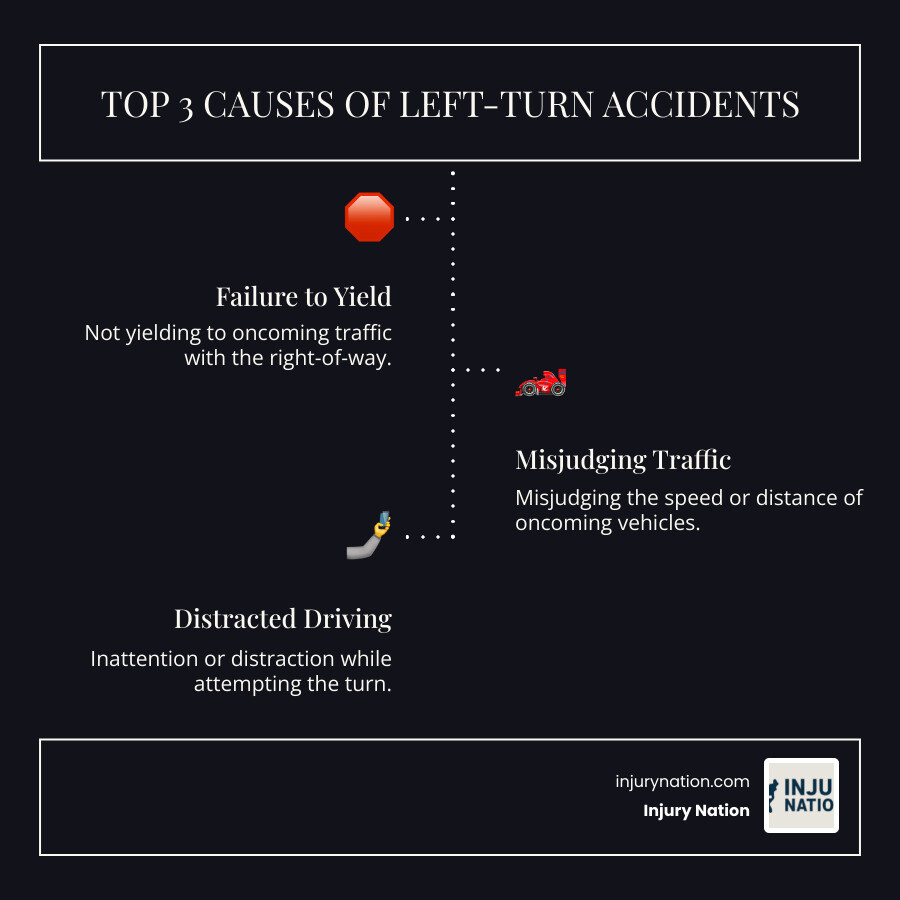
- Misjudging Speed of Oncoming Cars: Drivers attempting a left turn frequently miscalculate the speed of oncoming vehicles. What appears to be a safe gap can quickly close, leading to a collision.
- Failure to See Smaller Vehicles Like Motorcycles: Motorcycles, due to their smaller size, can be difficult to perceive and their speed hard to judge. This often leads to drivers turning left directly into the path of an oncoming motorcycle, which accounts for nearly 42% of fatal motorcycle accidents.
- Following Another Car Blindly Through a Turn: Sometimes, a driver will follow the car in front of them through a left turn, assuming the path is clear without independently verifying. This “herd mentality” can be extremely dangerous.
- Accidents Involving Rideshare Vehicles: With the rise of rideshare services, drivers are often navigating unfamiliar routes or feeling pressured, which can increase the risk of an unsafe left turn. If you’ve been in an accident involving a rideshare vehicle, specific legal considerations might apply. You can learn more about these cases with our Rideshare Accident Attorneys.
- Turning in Front of a Vehicle That Is Passing: If another vehicle is attempting to pass on the left as you initiate a left turn, you could be held liable if you failed to check your blind spots or signal properly.
When Liability Shifts: Exceptions to the Left-Turn Rule
While the driver making a left turn is generally presumed to be at fault, this presumption is not absolute. There are specific circumstances where liability for a left turn accident can shift, sometimes entirely, to the oncoming driver. This is particularly relevant in Las Vegas and throughout Nevada, where busy intersections and high speeds can complicate fault determination.
Here are factors that can shift liability from the left-turning driver to the oncoming driver:
- Speeding: If the oncoming vehicle was traveling above the posted speed limit, their excessive speed could have made it impossible for the turning driver to accurately judge the time needed to complete the turn. This is a common defense for a left-turning driver.
- Running a Red Light or Stop Sign: An oncoming driver who disregards a traffic signal or stop sign forfeits their right-of-way. If they collide with a vehicle making a legal left turn (e.g., on a green arrow), the oncoming driver would likely be held at fault.
- Distracted Driving: If the oncoming driver was distracted by a phone, passengers, or other internal/external factors, leading to their failure to react appropriately or observe the turning vehicle, liability could shift. Up to 8.2% of fatal accidents occur due to driver distraction.
- Driving Under the Influence (DUI): An impaired oncoming driver is a significant factor. Their reduced reaction time and judgment would likely make them primarily, if not solely, responsible for the collision.
- Vehicle Malfunction: In rare cases, a sudden and unforeseen mechanical failure in the oncoming vehicle (e.g., brake failure) could contribute to the accident, potentially shifting some liability.
- Road Hazards: If an unforeseen road hazard (like a sudden pothole or debris) caused the oncoming driver to lose control and collide with the turning vehicle, it could be a factor in determining fault.
How Traffic Signals and Road Conditions Affect Fault
Traffic signals and environmental factors play a crucial role in determining fault in a left turn accident.
| Traffic Signal Type | Meaning for Left Turn | Impact on Liability The Right-of-Way: The most common cause of a left turn accident is a driver failing to yield to oncoming traffic. In Las Vegas, a driver turning left must yield to oncoming cars close enough to pose an immediate danger.
- Misjudging Speed and Distance: Drivers often misjudge the speed of approaching vehicles, leading to unsafe turns. This is especially true for smaller vehicles like motorcycles, which are frequently involved in left turn accidents.
- Distracted Driving: Texting, talking on the phone, or engaging in other distracting behaviors can cause a driver to miss critical cues, such as oncoming traffic or traffic signals.
- Aggressive Driving: Rushing to make a turn before a light changes or before an oncoming vehicle arrives can lead to dangerous situations.
- Improper U-Turns: Unsafe U-turns, which are essentially left turns with an additional degree of turn, can also lead to accidents.
- Running Red and Yellow Lights: Drivers who try to “beat” a red light or misinterpret a yellow light can cause collisions with vehicles making legal left turns.
- Malfunctioning Traffic Signals: While rare, a malfunctioning traffic signal can confuse drivers and contribute to an accident. In such cases, the municipality responsible for signal maintenance could potentially share liability.
- Poor Road Conditions: Bad weather, obstructed views, or road defects can make it difficult for drivers to safely execute a left turn or for oncoming drivers to react in time. The “Speed-Size Illusion,” where larger vehicles appear to move slower than they are, can also contribute to misjudgments, especially with commercial trucks. Scientific research on the speed-size illusion highlights how our perception can trick us, making it even more crucial to be cautious around large commercial vehicles. For more information on collisions involving these heavyweights, see our Truck Accident Attorney Ultimate Guide.
Understanding California’s Comparative Negligence in a Left Turn Accident
When a left turn accident occurs in California, the state’s “pure comparative negligence” rule comes into play. This legal principle is crucial because it means that fault for an accident can be shared among multiple parties, and each party’s degree of fault will directly impact the amount of compensation they can recover.
Under California’s pure comparative negligence system, you can still recover damages even if you are found to be partially at fault for the accident. However, your compensation will be reduced by your percentage of fault. For example, if a court determines that you were 20% responsible for the accident, and your total damages are assessed at $100,000, you would only be able to recover $80,000 (a reduction of $20,000). This system ensures that even if you made a mistake, you’re not entirely barred from compensation, but it also means that proving the precise percentages of fault becomes critically important in your case.
It’s worth noting that while California employs “pure” comparative negligence, Nevada, where our company has locations, uses a “modified” comparative negligence rule. In Nevada, you can recover damages if you are less than 51% at fault, but if you are found to be 51% or more at fault, you cannot recover any compensation. This distinction highlights why understanding the specific laws of your state is so vital.
Building Your Case: Evidence and Damages to Recover
After a left turn accident, gathering comprehensive evidence is paramount to establishing fault and ensuring you receive fair compensation. Without solid proof, even the clearest right-of-way can be challenged by insurance companies.
Crucial Evidence for Your Claim
To build a strong case, we recommend collecting the following:
- Police Reports: These official documents often contain diagrams of the accident scene, statements from drivers and witnesses, and the investigating officer’s preliminary opinion on fault.
- Witness Statements: Independent accounts from bystanders can provide invaluable, unbiased perspectives on how the accident occurred. Be sure to get their contact information at the scene.
- Photos and Videos of the Scene: Use your phone to capture everything – vehicle damage from multiple angles, road conditions, traffic signals, skid marks, debris, and any relevant signs or obstructions.
- Dashcam Footage: If either vehicle involved had a dashcam, this footage can offer irrefutable evidence of the accident’s dynamics.
- Medical Records: Document all injuries, treatments, and associated costs. These records link your injuries directly to the accident.
- Traffic Citations: If the other driver was cited for a traffic violation (like speeding or running a red light), this can serve as strong evidence of their negligence.
- Expert Analysis: In complex cases, accident reconstruction experts can recreate the scene and provide testimony on how the collision happened.
Types of Damages You Can Claim
A left turn accident can result in significant financial burdens and personal suffering. Our goal is to help you recover compensation for both economic and non-economic damages:
- Economic Damages: These are quantifiable financial losses resulting from the accident:
- Medical Bills: Covers emergency care, hospital stays, doctor visits, surgeries, medications, physical therapy, and future medical needs.
- Lost Wages: Compensation for income lost due to time off work for recovery or appointments.
- Loss of Earning Capacity: If your injuries prevent you from returning to your previous job or earning potential.
- Property Damage: Costs to repair or replace your vehicle and any other damaged property.
- Non-Economic Damages: These are subjective, non-monetary losses that impact your quality of life:
- Pain and Suffering: Compensation for physical pain and emotional distress caused by your injuries.
- Emotional Distress: Covers anxiety, depression, PTSD, or other psychological impacts.
- Loss of Enjoyment of Life: If your injuries prevent you from participating in hobbies or activities you once enjoyed.
For a deeper dive into the types of compensation you might be eligible for, explore our Vehicle Injury Lawyer Ultimate Guide.
Frequently Asked Questions about Left Turn Collisions
Is the driver making the left turn always at fault for the accident?
No, not always. While the driver attempting a left turn is often presumed to be at fault, this is not an absolute rule. The legal principle behind this presumption is that the turning driver must yield to oncoming traffic. However, liability for a left turn accident is determined by examining all the circumstances and actions of every party involved.
The left-turning driver can be held liable if they:
- Failed to yield to oncoming traffic when they did not have a protected turn signal.
- Made an unsafe turn without properly checking for other vehicles, pedestrians, or cyclists.
- Turned from an improper lane.
- Failed to signal their turn.
However, fault can be shared or even shifted entirely if the oncoming driver was negligent. For instance, if the oncoming driver was speeding, ran a red light or stop sign, was distracted, or was driving under the influence, they may be held partially or entirely responsible for the collision. Every case is unique and depends heavily on the specific evidence.
What should I do immediately after a left turn accident?
Your safety and well-being are the top priority after any accident. Here are the steps we recommend:
- Prioritize Safety and Call 911: Check for injuries to yourself and others. If anyone is hurt, or if there’s significant property damage, call emergency services immediately.
- Seek Medical Attention: Even if you feel fine, adrenaline can mask pain. It’s crucial to get checked out by a medical professional as soon as possible. Some injuries, like whiplash or concussions, might not show symptoms right away.
- Exchange Information: With the other driver, exchange contact information, insurance details, and vehicle registration. Do not admit fault or make statements about the accident.
- Document the Scene: Take photos and videos of everything – vehicle damage, positions of vehicles, road conditions, traffic signals, skid marks, debris, and any relevant signs. This evidence can be invaluable.
- Get Witness Information: If anyone saw the accident, ask for their name and contact information. Their impartial testimony can be crucial.
- Report to Law Enforcement: Cooperate with police and ensure an official accident report is filed. Obtain a copy of this report later.
- Contact an Attorney: After taking these initial steps, we strongly advise contacting experienced car accident lawyers in Las Vegas. We can guide you through the process, protect your rights, and handle communication with insurance companies.
How is fault determined in a left turn accident involving a motorcycle?
The process for determining fault in a left turn accident involving a motorcycle is fundamentally the same as with other vehicles: we examine right-of-way rules, traffic signals, driver actions, and contributing factors like speeding or distraction. However, these cases often highlight unique dangers and challenges:
- Visibility and Perception: Motorcycles are smaller and can be harder for drivers to see, especially when making a left turn. Drivers often misjudge a motorcycle’s speed and distance, a phenomenon sometimes linked to the “Speed-Size Illusion.”
- High Fatality Rates: Tragically, statistics underscore this danger: in 2019, 41% of motorcycle fatalities involved another vehicle turning left into the oncoming motorcycle. This stark number emphasizes the vulnerability of motorcyclists in these situations.
- Severity of Injuries: Due to the lack of protection, motorcyclists often suffer catastrophic injuries in collisions, making the determination of fault and recovery of damages even more critical.
Given these factors, witness testimony, traffic camera footage, accident reconstruction, and expert analysis become even more critical in proving fault in motorcycle left-turn accidents.
Conclusion: Navigating Your Next Steps After a Collision
We’ve explored the complexities of left turn accidents, from the general rules of right-of-way to the nuanced factors that can shift liability. What’s clear is that determining fault is rarely straightforward, and the presumption that the turning driver is always to blame is often challenged by specific circumstances.
Evidence is critical to proving your case, and understanding the comparative negligence laws in your state (such as California’s pure comparative negligence or Nevada’s modified comparative negligence) is vital to understanding how your potential compensation might be affected. Vulnerable road users like pedestrians and cyclists are at extreme risk in these crashes, making vigilance and adherence to traffic laws paramount.
If you or a loved one has been involved in a left turn accident in Las Vegas, or anywhere in Nevada, seeking legal assistance is a crucial next step. Dealing with insurance companies, gathering evidence, and navigating the legal system can be overwhelming, especially while recovering from injuries. Our experienced attorneys can investigate your claim, establish liability, and fight for the compensation you deserve. Injury Nation connects accident victims with experienced legal professionals who understand these complexities.
Find an experienced bicycle accident lawyer to protect your rights as a vulnerable road user. We are here to help you turn a wrong turn into the right path toward justice.