

Understanding What You Can Recover After Medical Harm
Medical malpractice damages are the financial compensation you can receive when a healthcare provider’s negligence causes you harm. If you’ve been injured by a medical error, understanding what you’re entitled to recover is crucial for your future.
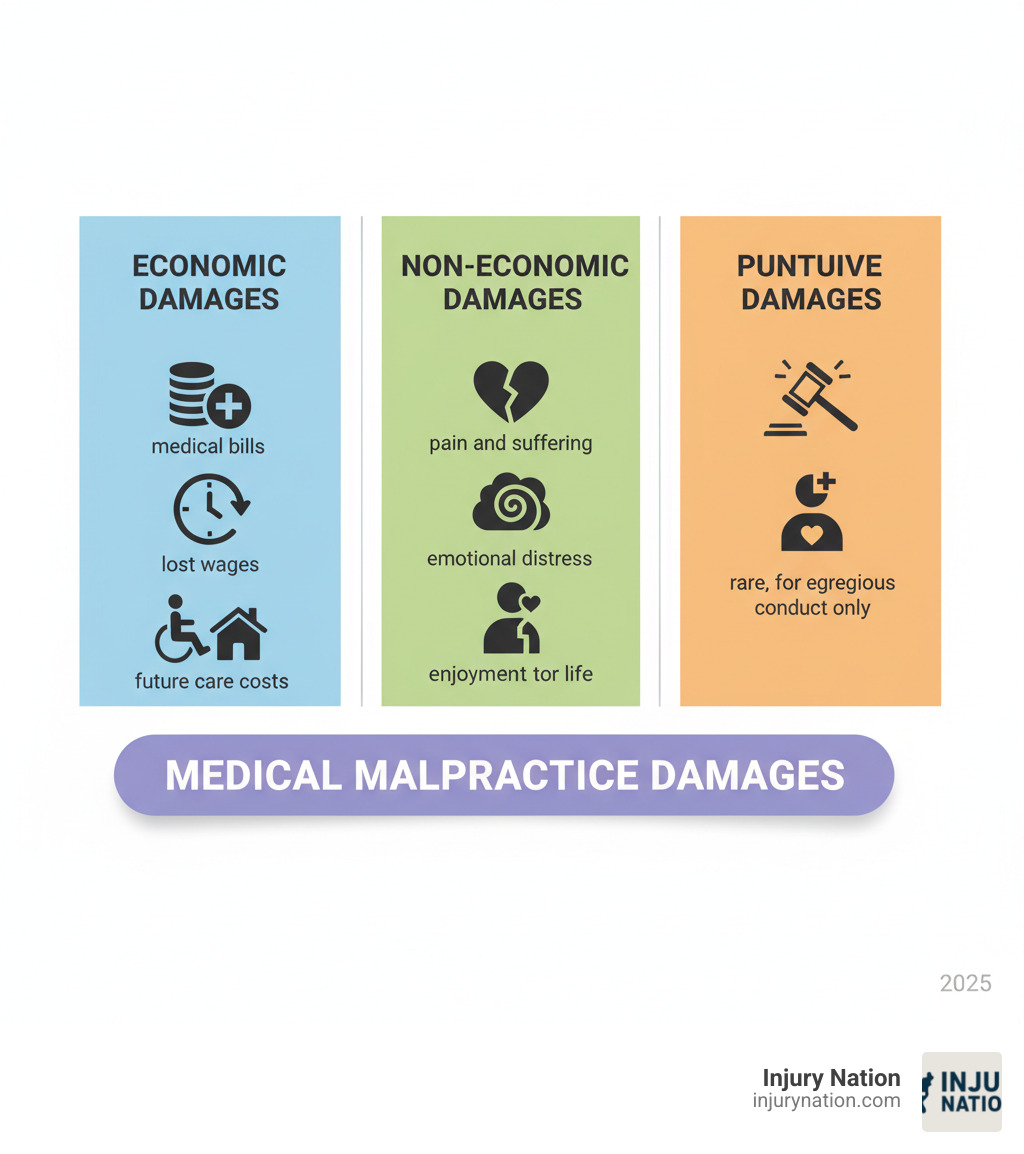
Quick Answer: The Three Main Types of Medical Malpractice Damages
- Economic Damages – Covers measurable financial losses like medical bills, lost wages, and future care costs
- Non-Economic Damages – Compensates for pain, suffering, emotional distress, and loss of enjoyment of life
- Punitive Damages – Rarely awarded, these punish especially reckless or intentional misconduct
When the trust you place in a medical professional is broken by negligence, the consequences can be devastating. A surgical mistake, misdiagnosis, or medication error can cause not only physical harm but also mounting medical bills, lost income, chronic pain, and profound emotional suffering.
The law provides a path to compensation through medical malpractice claims, but what you can recover is complex. As one legal expert notes, “every medical malpractice case is unique, so there’s no accurate way to predict what a particular claim might be worth without taking a deep dive into its specific characteristics.”
This guide breaks down the different types of damages available, explains how they’re calculated, and clarifies the factors that influence your final award. Whether you’re dealing with economic losses or non-economic suffering, you deserve to understand your full legal rights.
The Core Components of Compensation: Economic vs. Non-Economic Damages
When you’ve been hurt by a medical error, the legal system aims to make you “whole” again through compensatory damages. These are designed to cover everything you’ve lost due to negligence and are divided into two buckets: the measurable costs and the intangible suffering.

Economic Damages: The Tangible Costs of Negligence
Economic damages, or “special damages,” are the provable financial losses you’ve incurred. If you have a receipt or pay stub, it likely falls into this category.
- Medical Expenses (Past and Future): This includes every bill for treatment you’ve already received and the projected cost of all future care. For severe injuries requiring lifelong treatment, specialized equipment, or in-home nursing, these future costs can run into the millions.
- Lost Wages and Earning Capacity: You can recover income you’ve already missed while unable to work. More significantly, if the injury prevents you from returning to your career or limits your future earnings, you can claim for this loss of future earning capacity. This calculation considers your age, occupation, and projected lifetime income, including lost benefits and retirement contributions. Financial economists often provide expert testimony to calculate the present value of these future losses.
- Rehabilitation Expenses: This covers costs like physical and occupational therapy, psychological counseling, and vocational retraining if you need to switch careers.
Proving these damages requires meticulous documentation for past expenses and expert testimony from medical and economic professionals to project future costs.
Non-Economic Damages: Compensating for Intangible Suffering
Non-economic damages, or “general damages,” compensate for the profound, subjective harms that don’t come with a price tag but severely impact your quality of life.
- Pain and Suffering: This covers the physical pain and discomfort you’ve endured and will continue to experience. Chronic pain is a significant component, recognized in healthcare as the “fifth vital sign”.
- Emotional Distress and Mental Anguish: This addresses the psychological toll, such as anxiety, depression, PTSD, or a fear of medical settings that many victims experience.
- Loss of Enjoyment of Life: This compensates you for the inability to participate in hobbies, activities, and life experiences that once brought you joy.
- Disfigurement and Permanent Impairment: You can be compensated for permanent changes to your appearance (scarring, amputation) and for lasting physical or mental limitations that reduce your overall quality of life.
Valuing these damages is subjective. Attorneys and juries consider the severity and permanence of your injuries to determine a fair amount. However, many states impose caps on non-economic damages, which can limit how much you can recover for your suffering, regardless of its extent.
For more information about pursuing a medical malpractice claim, you can explore our guide on medical malpractice claims.
Beyond the Victim: Damages for Family Members
Medical negligence harms more than just the patient; it creates waves of harm that affect entire families. The law recognizes this, allowing certain family members to seek their own compensation for what they’ve lost.

Wrongful Death Claims
When medical malpractice causes a death, a wrongful death claim can be brought by the deceased’s family or estate to compensate survivors for their losses. These damages can include:
- Lost Financial Support: The income and benefits the deceased would have provided.
- Lost Inheritance: Assets the deceased would have accumulated and passed on.
- Funeral and Burial Expenses: The immediate costs associated with the death.
- Loss of Services: The value of services the deceased provided, such as childcare or home maintenance.
Some states also permit a “survival action,” which recovers damages for the pain and suffering the victim experienced between the time of the malpractice and their death.
Loss of Consortium Claims
When your spouse is severely injured by medical malpractice, it can damage the marital relationship itself. A loss of consortium claim is a separate claim brought by the uninjured spouse to compensate for the loss of:
- Companionship and Society: The everyday connection and presence of your partner.
- Affection and Intimacy: The loss of the physical and emotional closeness you shared.
These claims acknowledge that a severe injury to one spouse harms the other. To learn more, visit our guide on What is loss of consortium?.
This recognition of family harm is widespread. For example, in Ontario, Canada, the Family Law Act also allows family members to claim for loss of guidance, care, and companionship, showing a broad legal understanding that a patient’s injury is a family’s loss.
Calculating the Final Award: Factors That Influence Medical Malpractice Damages
There is no simple formula for calculating the value of a medical malpractice case. Instead, courts and insurance companies weigh several key factors to determine a fair award.
The most significant factor is the severity and permanency of your injury. A temporary injury will result in a much smaller award than a catastrophic condition like a traumatic brain injury or paralysis that permanently alters your life. How your quality of life has been impacted—your ability to work, enjoy hobbies, and interact with family—is also a critical consideration.
Your age and health before the malpractice are also crucial. A young, healthy person with decades of lost earning potential will have higher economic damages than an older person near retirement. Similarly, your occupation and salary directly impact calculations for lost wages and future earning capacity. This isn’t about valuing one person over another; it’s about compensating for actual financial losses.
State-Imposed Damage Caps
Frustratingly for many victims, your recovery may be limited by state law. Many states have imposed caps on non-economic damages, limiting the amount you can receive for pain and suffering, regardless of the severity of your injury.
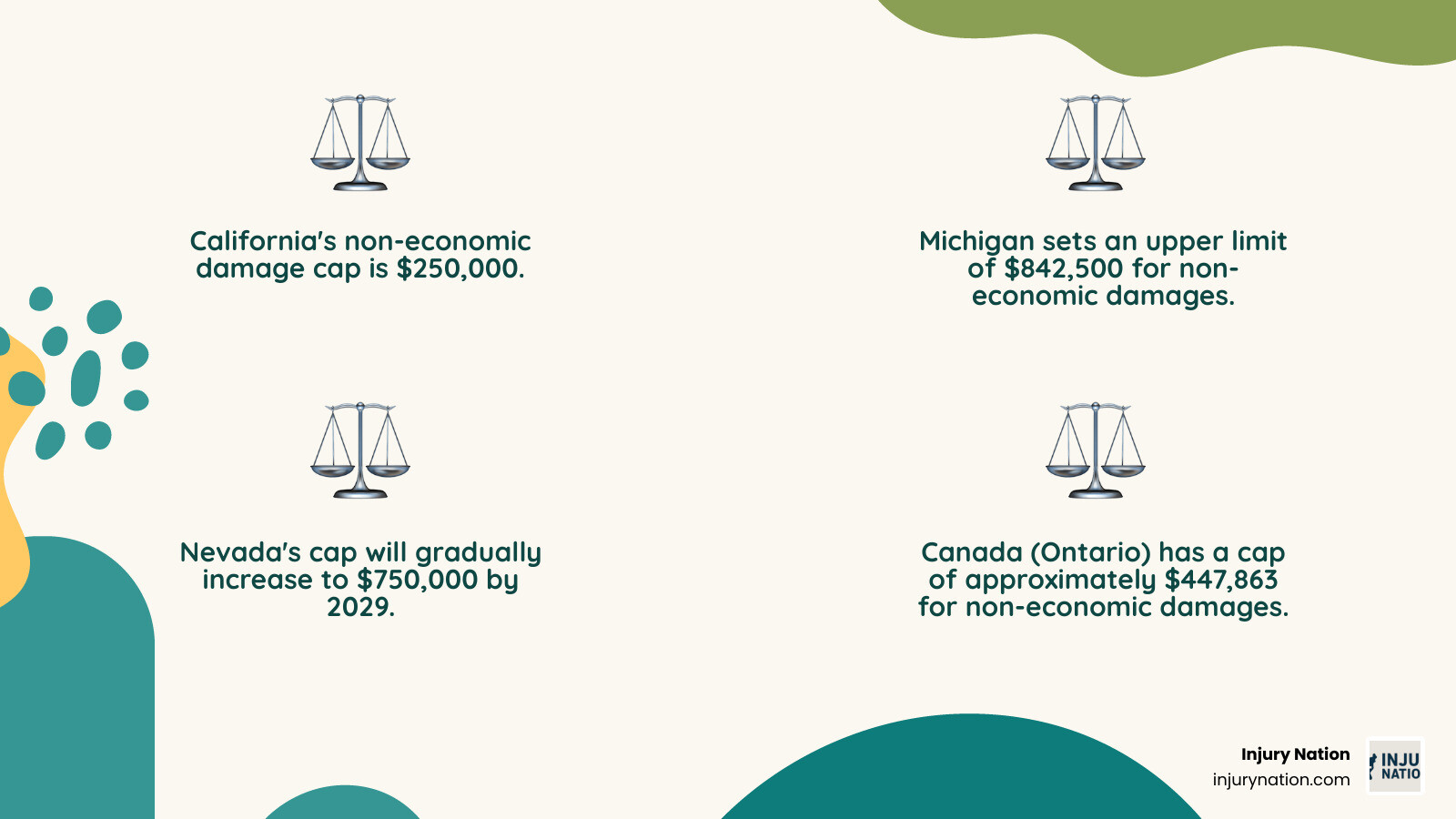
These caps vary dramatically. California has a strict limit of $250,000, while some states have no caps. In Nevada, new legislation passed in 2023 is gradually increasing the cap from its previous $350,000. Starting January 1, 2024, the cap rises by $80,000 annually until it reaches $750,000 in 2029, after which it will be adjusted for inflation. This change provides more meaningful compensation for severe injuries.
| Jurisdiction | Non-Economic Damage Cap (approximate) | Notes |
|---|---|---|
| California | $250,000 | |
| Michigan | $842,500 | |
| Nevada | Increasing to $750,000 by 2029 | Starting at $350k, rising $80k/year |
| Ontario, CA | $447,863 (as of 2023) | Rarely awarded, only in most severe cases |
These caps typically apply only to non-economic damages; your economic damages for financial losses are usually not limited.
The Impact of Contributory Negligence
If a patient’s own actions contributed to their injury, it’s called contributory or comparative negligence, and it can reduce the final award. Common examples include failing to follow a doctor’s instructions, delaying follow-up care, or providing an incomplete medical history.
If a court finds you were partially at fault, your award will be reduced by your percentage of responsibility. For example, if your damages are $1 million but you are found to be 20% at fault, your award would be reduced to $800,000. An experienced attorney can argue that the negligence lies solely with the provider, which can be critical to securing your full compensation.
Special and Rare Awards: Punitive and Aggravated Damages
While most medical malpractice damages are compensatory, two special types of awards serve a different purpose: punishing outrageous conduct. These are rarely awarded and reserved for the most serious cases.

Understanding Punitive Damages in Medical Malpractice
Punitive damages are not meant to compensate the victim but to punish the healthcare provider and deter similar behavior in the future. They are awarded only for egregious conduct that goes far beyond simple negligence.
This includes actions involving malicious intent, reckless behavior (like a surgeon operating while intoxicated), or gross negligence that shows a conscious disregard for patient safety. Think of a doctor performing unnecessary surgeries for profit or falsifying records to hide a mistake. The conduct must be so offensive that it “offend[s] the court’s sense of decency.”
The bar for proving punitive damages is extremely high, requiring clear and convincing evidence of intentional or reckless wrongdoing. As a result, they are very rare in medical malpractice cases.
For more detailed information about this topic, you can read our guide on What are punitive damages?.
What Are Aggravated Damages?
Aggravated damages are a hybrid. They are compensatory, but they specifically address the additional emotional harm caused by the manner in which the defendant acted. They are awarded when a provider’s callous, cruel, or insulting behavior during or after the negligence causes extra humiliation, distress, or mental anguish.
For example, if a doctor not only made an error but then mocked your concerns or treated you with contempt, that additional psychological harm might warrant aggravated damages. Like punitive damages, they are rarely awarded. The key difference is that aggravated damages compensate you for increased suffering, while punitive damages punish the defendant for their outrageous conduct.
The Legal Framework: Proving Your Claim and Meeting Deadlines
Winning medical malpractice damages requires building a solid legal case. You must prove that a provider-patient relationship existed (duty of care), the provider was negligent (breach of duty), that negligence directly caused your injury (causation), and that you suffered real harm (damages). Medical malpractice cases are among the most complex in personal injury law, and the burden of proof is high.
The Crucial Role of Expert Testimony
Expert witnesses are essential in medical malpractice cases. Since judges and juries lack medical training, qualified medical professionals are needed to explain the complex details of your case. These experts perform several critical functions:
- Establish the standard of care: Explaining what a competent provider would have done.
- Prove the breach: Identifying how the defendant’s actions fell short of that standard.
- Establish causation: Directly linking the negligent act to your injury.
In addition, financial experts and economists are often needed to quantify your future damages, such as lost income and the cost of lifelong medical care. As legal professionals in Nevada know, “medical malpractice trials are scientifically complex and challenging to prove causation.” Expert testimony translates that complexity into clear, understandable evidence.
The Statute of Limitations: A Critical Deadline
If there’s one thing that can destroy a strong medical malpractice case, it’s waiting too long to file. The statute of limitations is a strict legal deadline for bringing a lawsuit. If you miss it, your right to seek compensation is lost forever, regardless of the severity of your injury.
These deadlines vary by state. In Nevada, you generally have three years from the date of the injury or one year from the date you finded (or reasonably should have finded) the harm was caused by medical negligence. This “findy rule” accounts for injuries that are not immediately apparent.
For wrongful death cases in Nevada, the statute of limitations is typically two years from the date of death.
These deadlines are ironclad. It is critical to consult with an experienced medical malpractice lawyer as soon as possible. They can ensure all deadlines are met and begin building your case while evidence is still fresh.
Don’t let time run out on your right to justice.
Conclusion
As you’ve seen, medical malpractice damages are a complex calculation. They combine economic damages for your financial losses with non-economic damages for your pain, suffering, and changed quality of life. For families, wrongful death and loss of consortium claims acknowledge their unique losses as well.
Every case is different, with the final award influenced by the severity of the injury, your age, your occupation, and state laws like damage caps. In rare cases of outrageous conduct, punitive damages may be awarded.
Navigating this process alone is nearly impossible. These cases are scientifically complex and legally demanding, requiring expert testimony and adherence to strict deadlines. The longer you wait, the harder it becomes to build a strong case.
If medical negligence has turned your world upside down, you deserve an advocate who will fight for the compensation you’re owed. The right attorney can manage the legal complexities, challenge unfair limitations, and hold negligent providers accountable.
You’ve been through enough. Let an expert carry the legal burden while you focus on healing.