

Should You Call for 24/7 Legal Help From the Hospital After a Crash in Houston?
After a serious crash in Houston, the first priority is medical care. If you are in an emergency room, admitted for observation, waiting on scans, or recovering in a hospital bed, legal questions may still start quickly. You may wonder whether the other driver’s insurer will call, whether someone needs to get your car moved, whether evidence will disappear, or whether your family should talk to anyone on your behalf.
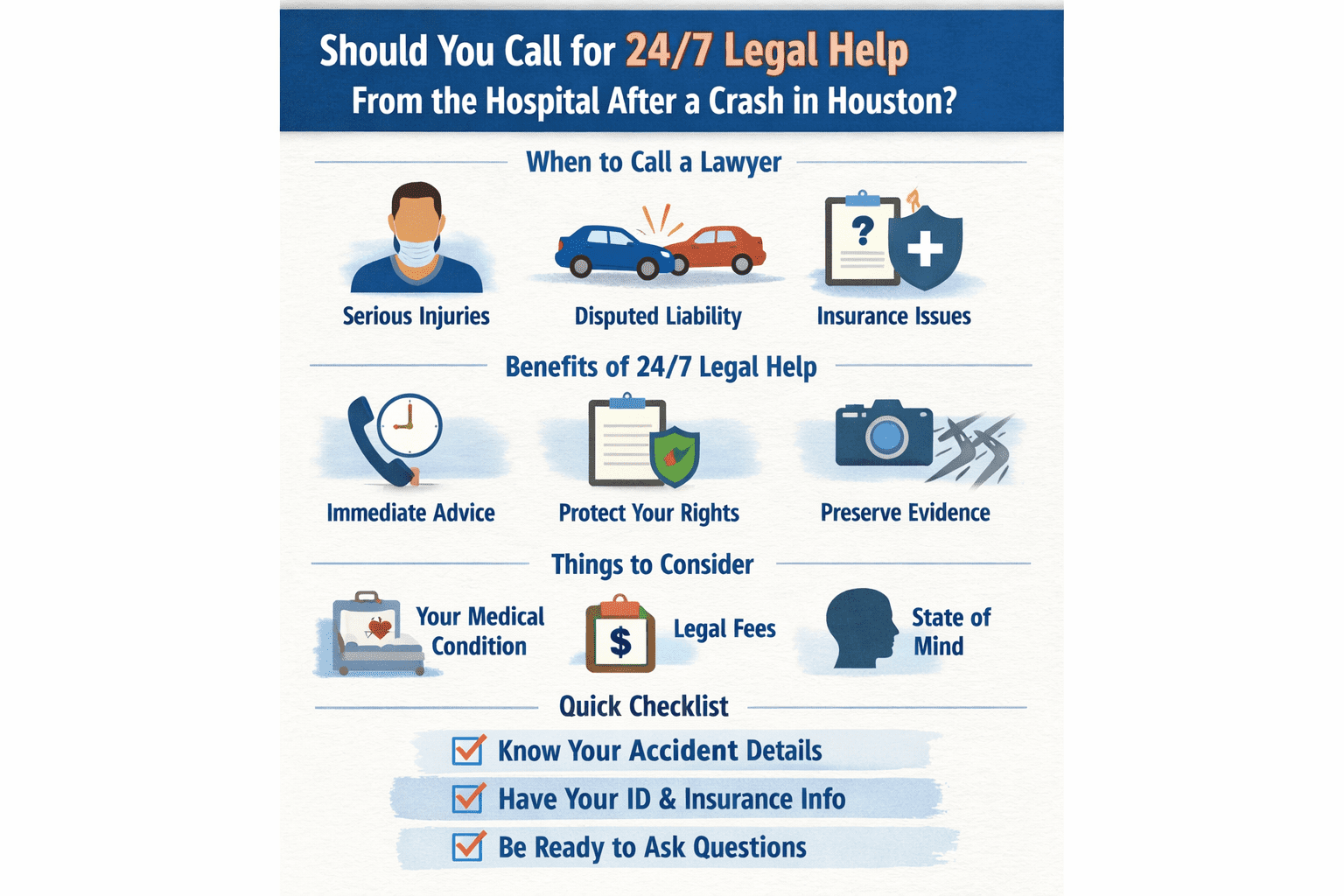
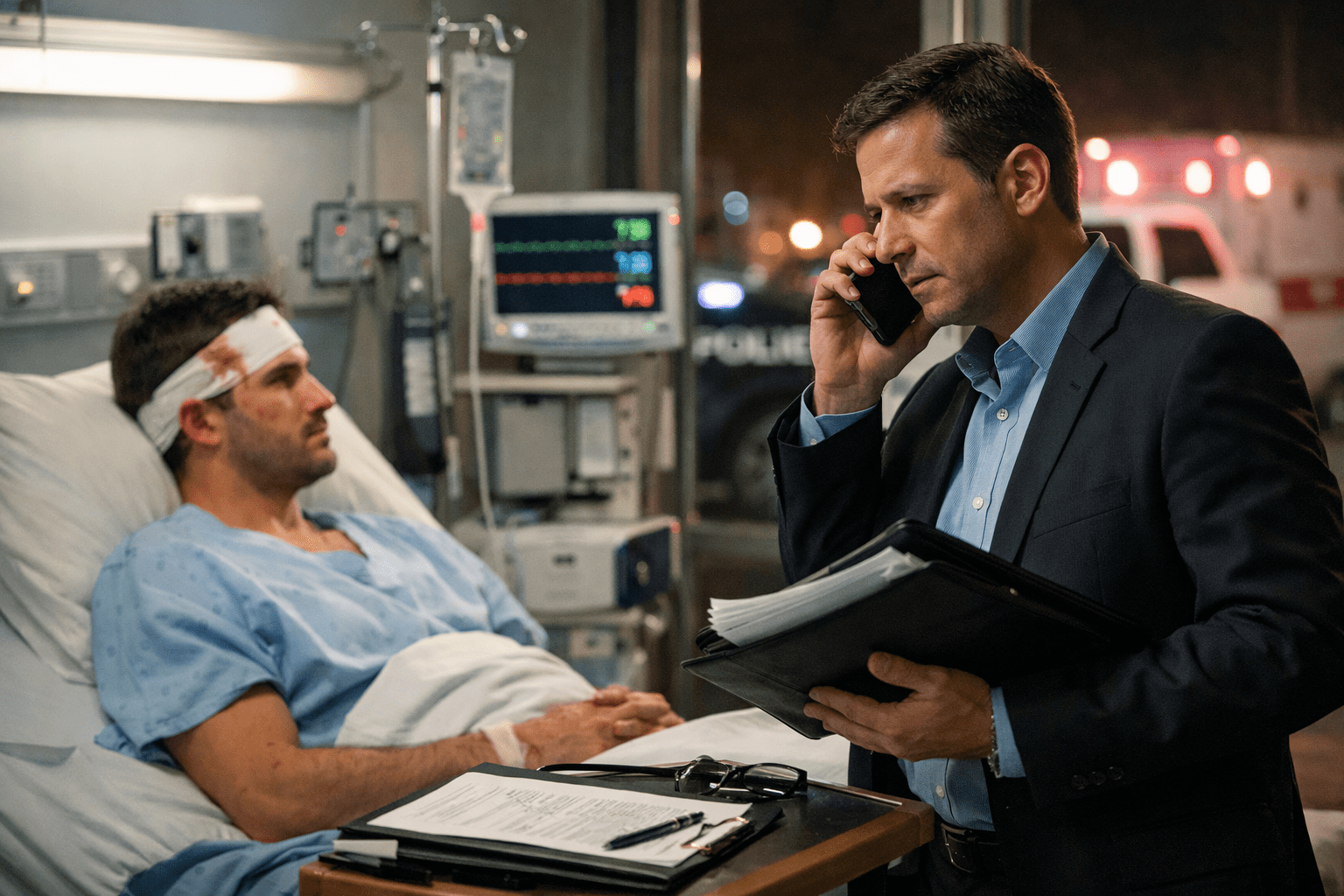
That is where a houston 24 7 accident lawyer hospital call can make sense in the right situation. An immediate legal call is not about rushing you into a lawsuit. It is about getting practical guidance while facts are still fresh, while records are easier to preserve, and while you or your family may need help handling the next few hours and days.
This FAQ explains when calling from the hospital may be useful, what a family member can share, what not to do, and what you can expect from emergency legal help in Houston after a crash.
FAQ: Is it okay to call a lawyer from the hospital after a Houston car accident?
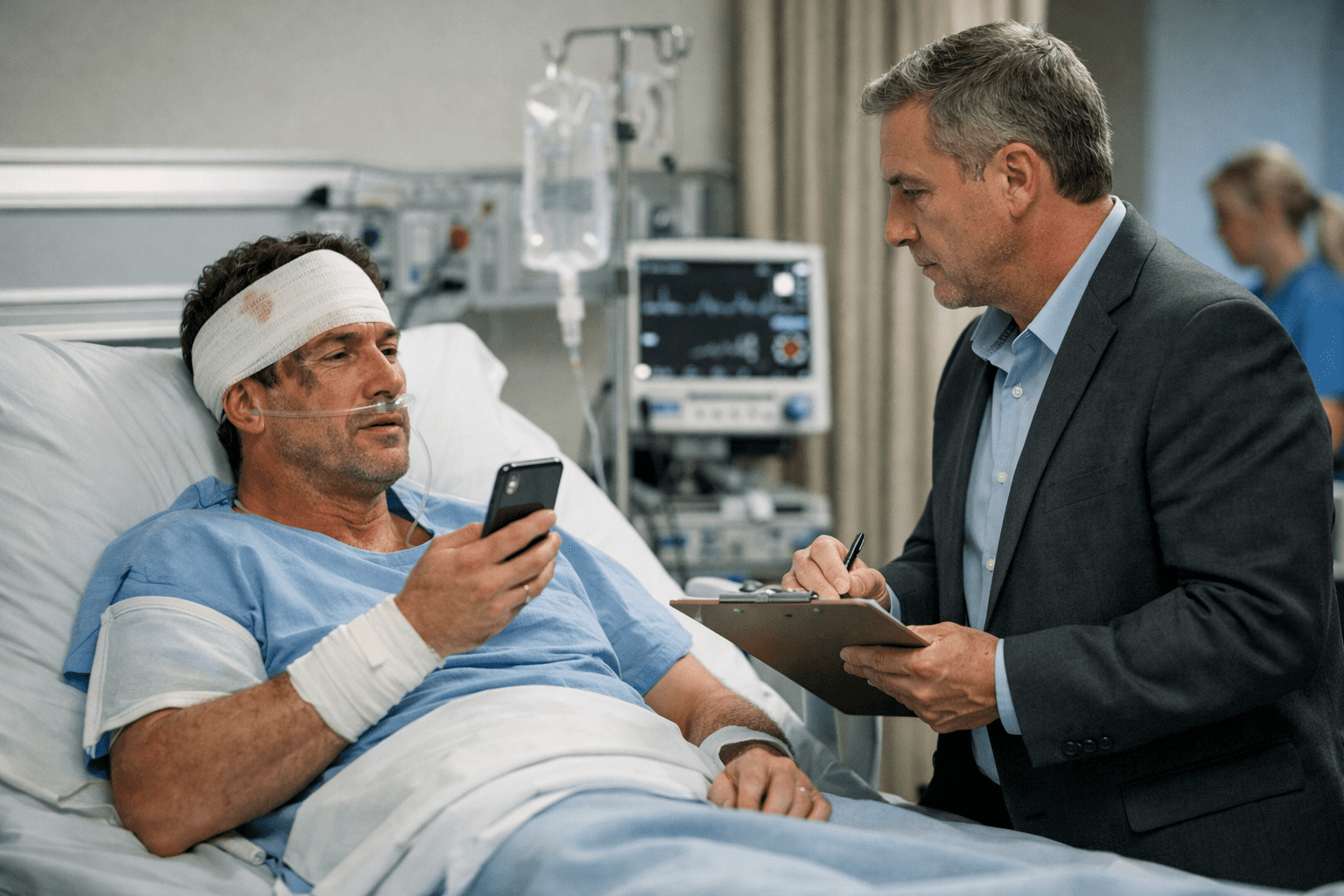
Yes. If you are medically stable and able to speak, or if a close family member is helping, calling for legal guidance from the hospital can be appropriate after a Houston crash. The key is keeping priorities in the right order: medical care comes first, and legal help supports the recovery process rather than interfering with treatment.
A hospital call can be useful when:
- The crash caused serious injuries and you expect significant medical treatment.
- The other driver’s insurer is already trying to contact you.
- You are unsure what to say to police, adjusters, or a towing company after the initial report.
- Your vehicle, phone, dash cam, or personal property may contain evidence that needs to be preserved.
- A family member needs to handle immediate practical issues while you are receiving care.
- Fault is disputed, or multiple vehicles were involved.
- The crash involved a rideshare vehicle, commercial truck, company car, or uninsured driver.
- You cannot safely manage calls, paperwork, or insurer questions because of pain, medication, or hospitalization.
In other words, a hospital call is often less about “starting a case” and more about preventing avoidable mistakes while you focus on your health.
FAQ: Does calling 24/7 legal help mean I am filing a lawsuit right away?
No. This is one of the most common misunderstandings.
Urgent legal guidance is different from filing a lawsuit immediately. A 24/7 call often involves basic next-step advice, such as:
- How to avoid giving a recorded statement too soon.
- What information to collect before it disappears.
- How to identify all possible insurance policies involved.
- How your family can document injuries, vehicle damage, and personal property loss.
- How to avoid signing forms you do not understand while hospitalized.
- How to preserve a timeline of events for later use.
Filing a lawsuit is a separate step that may or may not happen later, depending on your injuries, liability, insurance issues, settlement discussions, and the facts of the case. Early legal help is usually about stabilization, documentation, and communication, not immediate litigation.
FAQ: When is an immediate call especially useful after a crash in Houston?
Not every collision requires a middle-of-the-night legal call. But some situations do justify reaching out sooner rather than later.
Serious injury or hospital admission
If you were taken to a Houston hospital after a crash, that alone can signal a more significant claim. Fractures, head injuries, internal injuries, spinal pain, surgery, ICU monitoring, or overnight observation can all change how a claim should be handled from day one.
In these cases, early legal guidance can help ensure that:

- Basic details are documented while memories are fresh.
- Your family knows what calls to avoid or postpone.
- The insurer does not take advantage of confusion during a vulnerable moment.
- Important evidence tied to the vehicles, roadway, or witnesses is not lost.
Fault is unclear or disputed
Houston crashes often happen in heavy traffic, complicated intersections, freeway ramps, construction zones, and multi-lane conditions where stories can conflict. If there is any sign that the other driver may deny fault, early guidance matters more.
This may be especially true if the crash occurred on or near major routes such as I-10, I-45, I-69, Loop 610, the Sam Houston Tollway, or busy local corridors where witness turnover and camera footage can make a difference.
Multiple vehicles or commercial involvement
If your collision involved:
- A delivery vehicle
- A company truck or van
- An 18-wheeler
- A rideshare driver
- A city or government vehicle
- A chain-reaction crash
then there may be multiple insurance carriers, layered liability issues, and additional evidence sources. Early legal help can assist with identifying who should be notified and what documentation should be preserved.
You are being contacted while still receiving treatment
If insurance representatives start calling while you are in the emergency room, admitted, sedated, exhausted, or under pain medication, that is a strong sign to slow things down. You do not need to make detailed statements before you are ready.
A lawyer or intake team can often help explain how to protect yourself from saying too much before your medical picture is clear.
A loved one needs immediate direction
Sometimes the injured person cannot talk, should not talk, or is simply overwhelmed. In those cases, a spouse, parent, adult child, or other trusted family member may need immediate practical guidance on next steps.
FAQ: What can a family member share during a hospital call?
A family member can often provide very useful information, even if they were not at the scene. The goal is not to guess or exaggerate. It is to communicate the known facts and identify what still needs to be confirmed.
Helpful information a family member can share
- The injured person’s full name and best callback number.
- The hospital name and current condition if known.
- The date, time, and Houston-area location of the crash.
- Whether police responded and whether a report number is available.
- The type of crash involved, such as rear-end, T-bone, rollover, pedestrian, motorcycle, or multi-car collision.
- Names of other involved drivers if known.
- Insurance information available from the vehicle, glove box, phone, or app.
- Whether photos, dash cam footage, or witness contact information exist.
- Whether the injured person has already been contacted by an insurer.
- Whether the vehicle was towed and, if so, where it may have been taken.
What a family member should not do
- Do not speculate about fault if you do not know the facts.
- Do not minimize injuries just because a full diagnosis is not available yet.
- Do not accept a fast settlement or approve a recorded statement on the injured person’s behalf.
- Do not sign releases unless you fully understand what they cover.
- Do not post detailed crash opinions on social media.
A calm, factual family member can be extremely helpful during the first hours after a crash, especially when the injured person is focused on medical testing, pain management, or surgery.
FAQ: What if I am too injured, medicated, or overwhelmed to talk clearly?
Then it may be better not to give detailed statements at all until you are in a clearer condition. This is one of the strongest reasons people seek emergency legal help from the hospital.
After a serious crash, you may be dealing with:
- Pain medication
- Shock
- Concussion symptoms
- Confusion about what happened
- Lack of sleep
- Stress from imaging, procedures, or surgery discussions
These are not ideal conditions for discussing fault, symptoms, prior injuries, speed, lane positions, or insurance details with an adjuster. A brief legal call can help establish that you need time, that communication should be handled carefully, and that your family may assist with logistics until you are stable.
FAQ: What evidence can be preserved early after a Houston crash?
Preserving evidence early is one of the most practical reasons to contact legal help quickly. Some evidence fades, gets deleted, gets repaired, or becomes harder to access with every passing day.
Evidence that may be important right away
- Photos of vehicle damage before repairs or total-loss disposal.
- Photos of your injuries in the first hours and days.
- Names and numbers of witnesses.
- Police report information.
- Dash cam or surveillance footage.
- Tow yard and storage location information.
- Vehicle black-box or electronic data in some cases.
- Rideshare trip details if Uber or Lyft was involved.
- Truck company records if a commercial vehicle caused the crash.
- Damaged personal property such as phones, helmets, child seats, glasses, or work equipment.
Why early preservation matters
Cars get repaired, totaled, or sold for salvage. Witnesses forget details. Security footage may be overwritten. Skid marks fade. Debris gets cleared. A family member who understands this can start gathering basic information even while the injured person is still in the hospital.
That does not mean anyone should interfere with police or medical staff. It simply means acting promptly and responsibly to keep useful information from disappearing.
FAQ: What should I do first in the hospital before thinking about a legal call?
The first steps should stay focused on health and safety.
- Get evaluated and follow medical instructions.
- Be honest about symptoms, even if they seem minor at first.
- Tell providers about headache, dizziness, numbness, neck pain, chest pain, abdominal pain, or worsening symptoms.
- Ask questions if you do not understand discharge instructions or follow-up needs.
- Make sure a trusted family member knows where you are and how to reach your care team if appropriate.
Once urgent treatment needs are addressed, a short legal call may fit into the process. The right timing depends on your condition. If you are undergoing testing or preparing for surgery, that obviously comes first. If you are stable and waiting, it may be a practical time to get guidance.
FAQ: What should I expect during a 24/7 hospital call with a Houston accident lawyer?
A useful hospital call should feel calm, organized, and practical. It should not feel like pressure.
Topics often covered on the first call
- Basic facts of the crash.
- Your current medical status.
- Whether police responded.
- Whether any insurer has contacted you.
- Whether photos, witnesses, or video evidence may exist.
- Whether a family member needs to help communicate for now.
- Immediate next steps to protect your claim while you focus on treatment.
Questions you may be asked
- Where did the crash happen in Houston?
- When did it occur?
- What kind of vehicles were involved?
- Were you the driver, passenger, pedestrian, cyclist, or motorcyclist?
- What injuries are known so far?
- Have you spoken with any adjuster already?
- Do you know whether the other driver had insurance?
- Was your car towed, and do you know where it is?
What a good first conversation usually does not require
- A perfect memory of every event.
- A complete medical diagnosis on day one.
- A decision to sue immediately.
- A detailed damages calculation before treatment has developed.
The purpose is to orient the situation, reduce confusion, and give you a plan for the next steps.
FAQ: Should I talk to the insurance company from the hospital?
That depends on the situation, but many people should be cautious about discussing details from a hospital bed.
It is common for adjusters to request statements early. Some calls may sound routine and harmless. But when you are injured, medicated, or unsure of the facts, even simple questions can create problems later.
Risks of speaking too soon
- You may underestimate the seriousness of your injuries before full testing is complete.
- You may guess about speed, distance, lane position, or timing.
- You may forget important details because of shock or head injury symptoms.
- You may say you are “fine” out of habit even when that is not accurate.
- You may not yet know whether there are additional liable parties.
If you do speak with an insurer before legal guidance, keep it very limited and factual. Do not agree to a recorded statement or sign broad releases unless you understand the consequences. If you are unsure, a short legal consultation can help you decide how to proceed.
FAQ: Can a lawyer help even if the police already made a report?
Yes. A police report is important, but it is only one part of the larger picture. Police officers often have limited time on scene and may not capture every medical consequence, witness angle, or insurance issue that matters later.
Additional documentation may still be needed, including:
- Photographs from the scene or vehicles.
- Witness follow-up.
- Hospital and emergency treatment records.
- Employment or wage-loss documentation.
- Proof of property damage and out-of-pocket costs.
- Preservation of electronic or commercial records.
If the report is incomplete or if liability becomes contested, the existence of a report does not eliminate the need for legal guidance.
FAQ: What if the crash happened late at night or on a weekend in Houston?
That is exactly when 24/7 legal help can be most useful. Serious crashes do not happen on a business-hours schedule. A collision on a Saturday night, during early morning freeway traffic, or on a holiday can still create immediate questions.
For example, your family may need guidance about:
- Whether to allow a damaged vehicle to be moved or inspected.
- How to handle insurer calls before Monday.
- What to save from the car.
- How to document visible injuries.
- How to preserve a child car seat, helmet, or damaged phone as evidence.
That does not mean every after-hours crash requires emergency legal action. It means access to guidance can be helpful when practical issues arise immediately.
FAQ: What if a family member was not at the crash scene but now has to manage everything?
That is very common. In many hospital situations, a spouse, parent, adult sibling, or close friend becomes the person coordinating the first round of practical decisions.
A helpful checklist for family members
- Write down the date, time, and location of the crash.
- Collect names of hospitals, treating providers, and room numbers if applicable.
- Locate the injured person’s insurance card and vehicle information.
- Take custody of the injured person’s personal belongings if the hospital allows it.
- Save damaged property rather than throwing it away.
- Ask where the vehicle was towed.
- Request that all calls from adjusters be logged with dates and phone numbers.
- Preserve any texts, voicemails, and photos related to the crash.
- Avoid online arguments or public posts about who caused the collision.
- Help the injured person keep medical paperwork organized.
A family member does not need to be a legal expert to be useful. The main job is to stay organized, avoid speculation, and protect information that may matter later.
FAQ: How does early legal guidance help preserve a car accident claim?
Early legal guidance can help preserve a claim by reducing preventable problems. It is often easier to protect a claim from the beginning than to fix mistakes after the fact.
Common early issues that can affect a claim
- Missing witness contact information.
- Lost photos of the vehicles or scene.
- Discarded damaged items.
- Recorded statements given before the injured person is medically stable.
- Confusing or inconsistent descriptions of symptoms.
- Failure to identify all possible insurance policies.
- Delay in documenting how the injuries affected work or daily life.
A lawyer cannot erase the crash, but timely advice can help prevent a chaotic first few days from creating unnecessary claim problems.
FAQ: What signs suggest I should not wait long to get legal advice?
Here are several practical warning signs that an early call may be worthwhile:
- You were admitted to the hospital or kept for observation.
- You may need surgery or specialist follow-up.
- The other driver or insurer is denying responsibility.
- The crash involved multiple vehicles.
- A commercial vehicle, rideshare, or work vehicle was involved.
- You have head injury symptoms or memory gaps.
- You are missing work and do not know how long recovery will take.
- Your family is being contacted by insurers while you are unable to respond.
- You suspect video footage may exist nearby.
- Your car contains important evidence and is sitting in a tow yard.
These are not reasons to panic. They are simply signs that a prompt conversation may be useful.
FAQ: What if I feel embarrassed calling a lawyer so soon after a crash?
Many people feel this way. They worry it seems too aggressive, too early, or too “legal.” But getting information is not the same as being combative. It is a reasonable step when you are hurt and uncertain about the process.
Think of it this way: if you are in a Houston hospital after a crash, you are already dealing with a serious event. Asking questions early can actually reduce stress because you and your family stop guessing about what to do next.

The best early legal help is not dramatic. It is measured, practical, and focused on helping you avoid mistakes while you recover.
FAQ: What should I have ready before making a hospital call?
If you can, gather a few basics. If you cannot, that is okay too.
Helpful items to have nearby
- Your full name and date of birth.
- The crash date and approximate time.
- The Houston location of the collision.
- Your vehicle information.
- Any insurance cards or policy details.
- The other driver’s information if available.
- The police report number, if known.
- Photos, texts, or notes related to the crash.
- The tow yard name if your vehicle was removed.
- The name of a family member who can help with follow-up.
You do not need a complete file before reaching out. Even a partial picture can be enough to get useful direction.
FAQ: Could calling from the hospital interfere with my treatment?
It should not, if handled properly. A short call should work around medical care, not compete with it.
Good timing might include:
- While waiting between tests.
- After you have been stabilized.
- When a family member is present to help.
- After discharge instructions are given and immediate medical issues are under control.
Bad timing would include trying to handle legal calls during a medical emergency, while a doctor is evaluating you, while you are going into a procedure, or when you are too impaired to understand the conversation.
The point is simple: legal help should fit around care, never replace it.
FAQ: What if I was a passenger, not the driver?
Passengers often benefit from early guidance too. If you were injured as a passenger in a Houston crash, there may be questions about which insurance policies apply, whether multiple drivers share fault, and how your injuries should be documented from the start.
Passengers sometimes assume they should “stay out of it” while the drivers sort things out. But if you were injured, your own rights and recovery matter. A hospital call can help clarify what steps make sense without forcing you into immediate legal action.
FAQ: What if the crash involved an uninsured or hit-and-run driver?
These situations can create even more confusion in the first 24 to 48 hours. If the at-fault driver fled the scene, cannot be identified, or has little or no insurance, your own policy may become more important. That is another reason early guidance can matter.
A hospital call may help you and your family understand:
- What documentation to gather right away.
- What to report to your own insurer.
- How uninsured or underinsured motorist issues may arise.
- Why preserving vehicle and scene evidence can still matter a great deal.
Again, this is not about rushing into court. It is about understanding the claim landscape early enough to make informed choices.
FAQ: What mistakes should Houston crash victims avoid while in the hospital?
Some of the most common problems happen in the first day or two, often because people are exhausted and trying to be cooperative.
Common mistakes to avoid
- Downplaying pain before doctors finish evaluating you.
- Giving a detailed recorded statement while medicated or in shock.
- Signing broad medical or settlement documents without understanding them.
- Letting damaged evidence disappear without documentation.
- Assuming the police report alone will be enough.
- Ignoring follow-up care instructions after discharge.
- Posting opinions about fault or injuries on social media.
- Relying on memory instead of writing down what happened.
None of these mistakes automatically destroys a claim, but avoiding them can make the process smoother and more accurate.
FAQ: How local is the decision in Houston compared with other cities?
Houston’s size, traffic density, freeway system, industrial activity, and volume of commercial vehicles can make crash cases feel more complex very quickly. A serious crash in Houston may involve:
- High-speed freeway impacts.
- Dense commuter traffic.
- Construction zones.
- Large trucks or service vehicles.
- Out-of-town drivers.
- Multiple responding agencies or towing issues.
Because of that, locally informed guidance matters. Even in a basic passenger vehicle crash, practical questions about scene location, tow yards, witness access, and insurer communication can look different in Houston than they would elsewhere.
FAQ: What happens after the first hospital call?
Usually, the next steps are simple and organized rather than dramatic.
What may happen next
- A more detailed follow-up call is scheduled when you are feeling better.
- Your family is asked to gather available documents and photos.
- You receive guidance about insurer communication.
- Important evidence sources are identified early.
- Your medical treatment timeline begins to take shape.
- You decide, when ready, whether you want continued legal help.
At this stage, you are not expected to know the full value of your claim or the complete course of your recovery. The focus is on protecting your options.
FAQ: So, should you call for 24/7 legal help from the hospital after a crash in Houston?
Sometimes yes, and often for practical reasons rather than dramatic ones.
A houston 24 7 accident lawyer hospital call can be useful when injuries are serious, facts are unclear, insurers are calling early, or your family needs direction while you focus on treatment. The purpose is not to push you into a lawsuit before you have even left the hospital. The purpose is to help you protect important information, avoid preventable mistakes, and make informed decisions at a stressful time.
If your injuries are minor and everything is straightforward, an immediate call may be less urgent. But if you are hospitalized, dealing with significant pain, facing uncertainty about fault, or worried about what your family should say and do, early guidance can be a reasonable and responsible step.
Conclusion: Get calm, practical help while you focus on recovery
After a Houston crash, your health comes first. But once emergency care is underway, having access to clear legal guidance can help you and your family feel more grounded. Early help can support evidence preservation, safer communication with insurers, and better organization during the first critical days after a collision.
If you or a loved one is in the hospital after a crash and you need straightforward next-step guidance, contact a local personal injury lawyer for a free consultation today. Injury Nation helps connect accident victims with local personal injury lawyer resources, car accident claims assistance, and 24/7 emergency legal help when timely answers matter most.