

What Is My Injury Claim Worth?
How much compensation you can expect from a personal injury or workers’ compensation claim depends on many factors, but here’s what the data shows:
Quick Answer: Typical Compensation Ranges
- Personal Injury Claims: Most settle between $5,000 and $75,000, with half of jury awards at $30,000 or less
- Workers’ Compensation: Average settlement is $21,800, with 55% receiving between $2,000 and $20,000
- Severe Injuries: Catastrophic cases (amputations, paralysis, brain injuries) can reach $100,000 to $500,000+
- Minor Injuries: Soft tissue injuries typically settle for $2,000 to $20,000
According to the U.S. Bureau of Labor Statistics (BLS), almost three out of every hundred workers in the United States were injured on the job in 2019. If you’re one of them—or if you’ve been hurt in a car accident, slip and fall, or other incident—you’re probably wondering: What is my case actually worth?
The truth is, there is no single “average” settlement. Every injury claim is unique. A minor fender-bender with whiplash will settle for far less than a catastrophic truck accident causing permanent disability. The amount you receive depends on the type and severity of your injuries, your medical bills, lost wages, and how the injury affects your daily life.
Your compensation is broken into different categories called “damages.” Understanding these categories—and what factors insurance companies and courts consider—is the first step to knowing what you deserve.
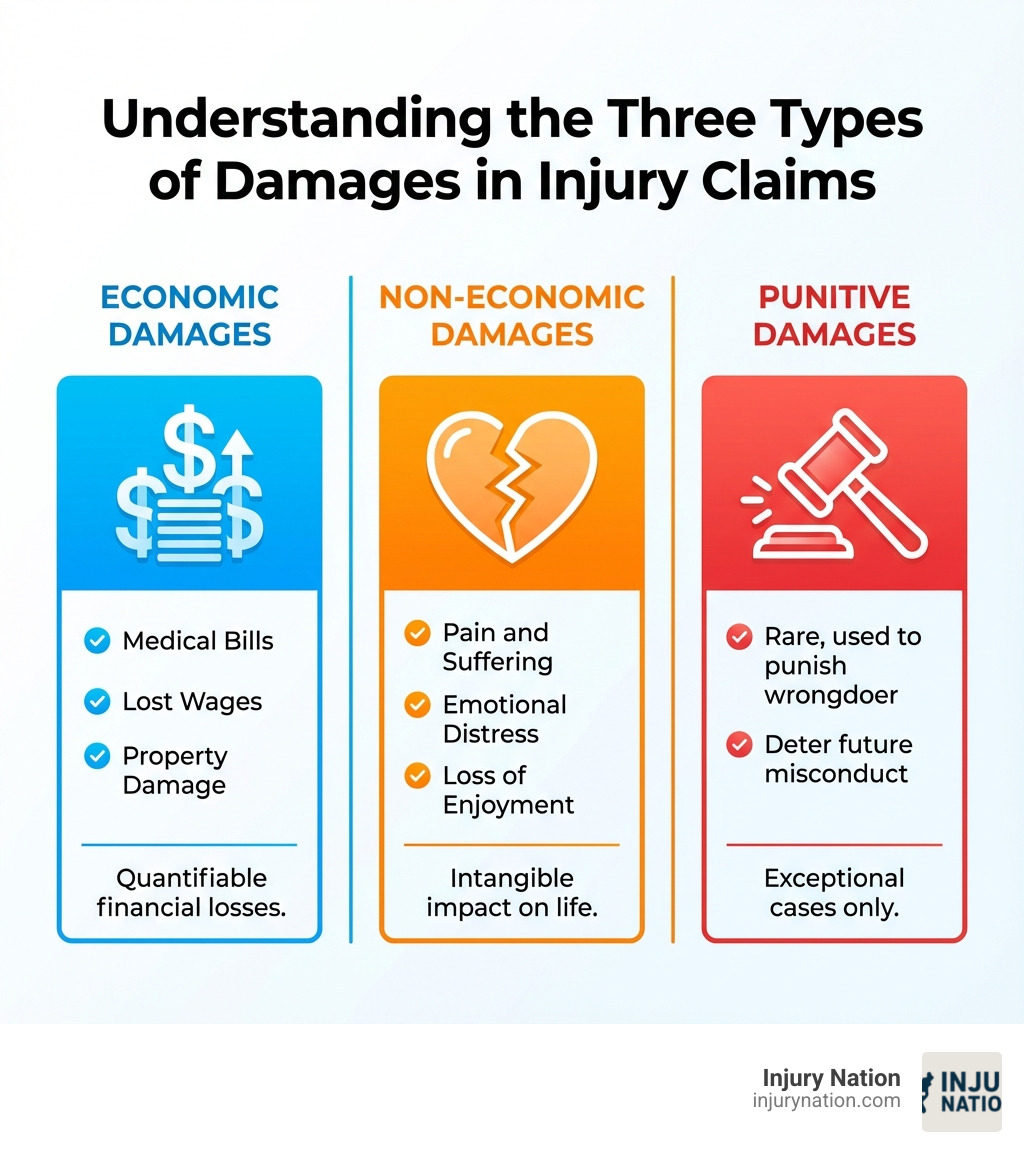
The Two Main Types of Damages: Economic vs. Non-Economic
When we talk about how much compensation you can receive for an injury, we’re really talking about “damages.” In legal terms, “damages” are the monetary award paid to an injured person (the plaintiff) by the party found legally responsible for their injury. These damages are almost always “compensatory,” meaning they are designed to compensate you for the full spectrum of your losses, aiming to put you back in the financial position you would have been in had the accident not occurred.
Compensatory damages are typically divided into two main categories: special damages (also known as economic damages) and general damages (also known as non-economic damages). Understanding this distinction is crucial for accurate claim valuation. Special damages cover your quantifiable, tangible losses, while general damages address your non-quantifiable, intangible losses.
Understanding Economic (Special) Damages: Your Tangible Losses
Economic damages are the measurable financial losses you incur due to your injury. These are often easier to calculate because they come with bills, receipts, and clear financial records. Think of them as the “hard costs” of your injury.
These can include:
- Medical Bills: This covers everything from emergency room visits, ambulance rides, and doctor’s appointments to surgeries, prescription medications, physical therapy, and ongoing rehabilitation. It’s important to include the full value of these expenses, even if your health insurance covered some of it.
- Lost Wages: If your injury prevented you from working, you can claim compensation for the income you lost. This includes hourly wages, salary, commissions, bonuses, and even benefits.
- Future Lost Income/Earning Capacity: If your injury is severe enough to affect your ability to work in the future, either by reducing your hours, forcing a career change, or preventing you from working altogether, you can claim for this long-term financial impact.
- Property Damage: In accidents like car crashes, the cost to repair or replace your vehicle, or any other damaged personal property (like a cell phone, glasses, or clothing), falls under economic damages.
- Rehabilitation Costs: Beyond basic medical treatment, this can include vocational rehabilitation if you need to learn new skills to return to the workforce, or adaptive devices (like wheelchairs or prosthetics).
- Out-of-Pocket Expenses: Don’t forget smaller costs like transportation to medical appointments (mileage, parking, taxi fares), over-the-counter medications, crutches, or even the cost of hiring help for household tasks you can no longer perform.
To prove your economic damages, you’ll need a solid paper trail. A comprehensive list of documents to prove economic damages includes:
- Medical bills and invoices
- Receipts for prescriptions and medical devices
- Pay stubs, W-2s, and tax returns to prove lost wages
- Statements from your employer detailing missed work
- Vehicle repair estimates or bills of sale for replacement
- Receipts for any out-of-pocket expenses related to your injury
- Expert testimony (e.g., from an economist) for future lost earning capacity
Calculating Non-Economic (General) Damages: Pain and Suffering
Non-economic damages are the more subjective, intangible losses that don’t come with a bill. They compensate you for the emotional and physical distress caused by your injury. While harder to quantify, these damages are a very real and often significant part of your settlement.
These can include:
- Pain and Suffering: This refers to the physical pain, discomfort, and agony you endure due to your injuries. It can range from soreness and stiffness to chronic pain and debilitating conditions.
- Emotional Distress: Injuries don’t just affect the body; they can deeply impact your mind. This includes mental anguish, anxiety, depression, fear, frustration, anger, and even post-traumatic stress disorder (PTSD).
- Loss of Enjoyment of Life: Has your injury prevented you from participating in hobbies, sports, social activities, or even simple daily pleasures you once enjoyed? This loss significantly impacts your quality of life and is a compensable damage.
- Loss of Consortium: This refers to the negative impact your injuries have on your relationships with loved ones. It can include the loss of companionship, affection, sexual relations, or the ability to provide care and support to your spouse or family members.

Insurance companies and legal professionals often use a couple of methods to estimate these non-economic damages:
- The Multiplier Method: This is a common approach where your total economic damages are multiplied by a factor, usually between 1.5 and 5, depending on the severity of your pain and suffering. For very severe or permanent injuries, this multiplier could be even higher. For example, if your economic damages are $10,000 and the multiplier is 3, your pain and suffering could be valued at $30,000.
- The Per Diem Method: Less common but still used, this method assigns a daily dollar amount (e.g., $100-$200) for each day you experience pain and suffering, starting from the date of injury until you reach maximum medical improvement. So, if you suffered for 100 days at $150/day, that would be $15,000.
It’s worth noting that insurance companies often use their own proprietary formulas to calculate the value of these subjective damages, and these calculations are frequently much lower than what an injured person truly deserves.
How Much Compensation for a Personal Injury Claim?

When it comes to personal injury claims, the question of how much compensation you’ll receive is highly individualized. These claims arise when someone’s negligence causes you harm, making them legally liable for your damages. While the average auto insurance bodily injury claim settles for around $15,500, this figure doesn’t tell the whole story. Many claims settle between $5,000 and $75,000, but catastrophic injuries can lead to much higher payouts.
Several key elements come into play when determining your compensation, including the specifics of your injury, the length of your recovery, and the limits of the at-fault party’s insurance policy.
Key Factors That Determine Your Compensation Amount
Every personal injury case is a unique puzzle, but some pieces consistently have a bigger impact on the final settlement amount:
- Injury Severity: This is perhaps the most significant factor. A minor soft tissue injury will naturally lead to less compensation than a traumatic brain injury (TBI) or a spinal cord injury resulting in paralysis. The more severe the injury, the greater the medical costs, lost income, and pain and suffering. Even “mild” TBIs can result in large settlements if their effects are significant and long-lasting, as they don’t always have a short, linear path to recovery.
- Medical Treatment Costs: The total cost of your medical care, both past and projected future expenses, directly impacts your economic damages. This includes everything from emergency care to long-term physical therapy and assistive devices.
- Length of Recovery: Injuries that heal quickly may result in smaller settlements. However, if your recovery is prolonged, requires extensive rehabilitation, or leads to permanent impairment, your compensation will increase to reflect that ongoing impact.
- Permanent Disability: If your injury results in a permanent disability, disfigurement, or chronic pain, the value of your claim will be significantly higher. This accounts for the lifelong impact on your earning capacity, daily activities, and overall quality of life.
- Disputed Liability: If there’s a question about who was at fault for the accident, it can complicate and potentially reduce your settlement. In Nevada, we operate under a comparative negligence standard, meaning if you are found partially at fault, your compensation may be reduced by your percentage of fault (we’ll cover this more later!).
- Strength of Evidence: A strong claim is built on solid evidence. This includes detailed medical records, expert witness testimony, accident reports, photos, and witness statements. The more thoroughly your case is documented and supported, the better your chances of maximizing your settlement.
- Plaintiff Credibility: Your honesty and consistency throughout the claims process, from your initial statements to your medical appointments, can influence how an insurance company or jury perceives your claim.
How to Prove Pain, Suffering, and Other Non-Economic Losses
Since non-economic damages are subjective, proving them effectively is crucial to maximizing your compensation. We can’t just put a dollar figure on your feelings, but we can demonstrate their impact on your life with compelling evidence:
- Medical Records and Doctor’s Notes: These are paramount. They document your physical pain, diagnoses, treatments, and prognosis, providing an objective basis for your suffering. Psychological records, if you’ve sought therapy for emotional distress, are also vital.
- Testimony from Friends, Family, and Coworkers: Loved ones can provide powerful accounts of how your injury has changed you, detailing your inability to enjoy hobbies, your emotional struggles, or changes in your personality or mood.
- Personal Journal: Keeping a daily journal where you chronicle your physical pain levels, emotional struggles, limitations, and how your injury affects your daily life can be incredibly persuasive. Be honest and detailed.
- Photos and Videos of Injuries: Visual evidence of your injuries, especially during different stages of recovery, can vividly illustrate your suffering. This includes visible scars, bruising, or limitations in movement.
- Psychological Evaluations: If you’re experiencing significant emotional distress, anxiety, or PTSD, a professional evaluation from a psychologist or psychiatrist can provide expert documentation of your non-economic damages.
How Much Compensation for a Workers’ Compensation Claim?
The workers’ compensation system in the United States is designed to provide benefits to employees who suffer work-related injuries or illnesses, regardless of fault. This “no-fault” system means you don’t have to prove your employer was negligent to receive benefits. It covers workplace injuries (like a slip and fall at work) and occupational illnesses (conditions developed due to your work, like carpal tunnel syndrome).
While each state has its own specific laws and benefit schedules, we can look at general US averages to understand how much compensation is typical. The average workers’ compensation settlement in the United States is $21,800. Most workers receive between $2,000 and $40,000 for their claim, with 55% receiving between $2,000 and $20,000. However, settlement amounts can vary wildly based on the type and severity of the injury.
Here’s a look at average workers’ comp settlements by injury type across the U.S.:
| Injury Type | Average Workers’ Compensation Settlement |
|---|---|
| Amputation | $118,837 |
| Head/CNS Injury | $93,942 |
| Motor Vehicle Accident | $90,914 |
| Multiple Body Parts | $62,859 |
| Hip/Thigh/Pelvis | $59,758 |
| Leg Injury | $59,748 |
| Neck Injury | $59,391 |
| Burn Injury | $54,173 |
| Arm/Shoulder Injury | $49,116 |
| Slip/Fall | $48,575 |
| Caught in Machinery | $44,588 |
| Struck by Object | $39,977 |
| Lower Back Injury | $37,966 |
| Upper Back Injury | $36,754 |
| Strain (Repetitive) | $35,291 |
| Cumulative Injuries | $32,745 |
| Knee Injury | $24,932 |
| Face Injury | $33,081 |
| Cuts, Punctures, Scrapes | $24,375 |
Average Settlement Amounts for Common Injuries
The figures above give us a clearer picture of potential compensation. As you can see, the nature of your injury significantly impacts the average settlement:
- Amputation stats: Amputations have the highest average settlement at $118,837, reflecting the severe and permanent nature of such injuries.
- Head/CNS injury stats: Injuries to the head and central nervous system also command high settlements, averaging $93,942, due to their potential for long-term cognitive and physical impairment.
- Motor vehicle crash stats: When workplace injuries are caused by motor vehicle crashes, they lead to the most expensive workers’ compensation claims, averaging $90,914 per claim.
- Back injury stats: Lower back injuries average $37,966, while upper back injuries average $36,754. These are common and can be debilitating.
- Slip/fall stats: Slip/fall incidents average $48,575, often leading to fractures, sprains, or head injuries.
- Strain injury stats: Injuries from repetitive motion or strains average $35,291, highlighting the impact of cumulative trauma.
These are averages. Your specific settlement will depend on the unique details of your case, including the extent of your medical treatment, duration of lost wages, and any permanent impairment.
Navigating the Workers’ Compensation System
The workers’ compensation system, while designed to help, can be complex. Here’s what you need to know about navigating it, especially in Nevada:
- Claim Denial and Appeals: What happens if your workers’ compensation claim is denied? Don’t panic! You have appeal options. In Nevada, if your claim is denied, you can file an appeal with the Nevada Department of Administration, Hearings Division. It’s a crucial step to challenge the denial. An attorney can guide you through this process.
- Pre-existing Conditions: How do pre-existing conditions affect workers’ compensation claims? Generally, if a work injury aggravates or accelerates a pre-existing condition, it can still be covered. The key is proving that the work incident made the condition worse.
- Death Benefits: What are death benefits in workers’ compensation cases, and who is eligible? If an employee tragically passes away due to a work-related injury or illness, their dependents (spouse, children, or other financially dependent individuals) may be eligible for death benefits, which typically cover burial expenses and ongoing financial support.
- Receiving Benefits While Working: Can you receive workers’ compensation benefits while still working? Yes, it’s possible. If your injury allows you to return to work but in a limited capacity (e.g., light duty) and at reduced pay, you may be eligible for temporary partial disability benefits to make up some of the difference.
- Temporary vs. Permanent Disability: Workers’ compensation typically covers temporary disability (while you’re recovering and unable to work or work at full capacity) and permanent disability (if your injury results in a lasting impairment).
- Lump-Sum Settlements: In Nevada, you may be able to receive a lump-sum settlement for your workers’ compensation claim, often through a Compromise and Release (C&R) agreement. This means you receive a one-time payment in exchange for closing your case and potentially forfeiting future medical care related to the claim. This can be a good option for some, but understand the implications before agreeing.
How to Maximize Your Settlement Offer
When you’re asking how much compensation you can get, you’re really asking how to get the most compensation. Taking proactive steps and having the right legal guidance can significantly impact your final settlement. Punitive damages, while rare in personal injury cases (and generally not available in workers’ compensation), are awarded in Nevada only when the at-fault party’s conduct was reckless or intentional, serving to punish the wrongdoer rather than compensate the victim. Our focus, however, is on maximizing your compensatory damages.
Actionable Steps to Strengthen Your Claim
Your actions immediately after an injury and throughout your recovery are critical. Here are steps you can take:
- Seek Immediate Medical Attention: This is crucial not just for your health but for your claim. Delays in treatment can be used by insurance companies to argue your injuries weren’t severe or weren’t caused by the incident.
- Document Everything: Keep meticulous records. This includes medical bills, appointment dates, prescription receipts, a personal injury journal detailing your pain and limitations, photos and videos of your injuries and the accident scene, and witness contact information.
- Report the Incident Promptly: For workers’ compensation, report your injury to your employer immediately. For personal injury, report the accident to the police or property owner. Timeliness is key.
- Follow Doctor’s Orders: Adhere strictly to your medical treatment plan. Missing appointments or not following recommendations can be seen as a failure to mitigate your damages, potentially reducing your compensation.
- Avoid Social Media Posts: What you post online can and will be used against you. Avoid discussing your accident, injuries, or recovery on social media.
- Do Not Rush a Settlement: Early settlement offers from insurance companies are often low. Do not feel pressured to accept an offer before you fully understand the extent of your injuries and their long-term impact.
The Role of a Lawyer in Getting Fair Compensation
Studies consistently show that injury victims represented by experienced attorneys recover more compensation than those who handle their claims alone. Here’s why a personal injury lawyer, especially one familiar with Nevada law, is invaluable:
- Case Valuation: A skilled lawyer can accurately assess the true value of your claim, considering all economic and non-economic damages, including future costs and long-term impacts. They understand how these values are typically calculated in Las Vegas and throughout Nevada.
- Evidence Gathering: We know how to gather comprehensive evidence, including expert testimony, accident reconstruction reports, and detailed medical records, to build a strong case.
- Negotiating with Insurers: Insurance companies have adjusters and attorneys whose job it is to minimize payouts. We negotiate aggressively on your behalf, understanding their tactics and countering their lowball offers.
- Handling Legal Procedures: The legal system is complex. We manage all paperwork, deadlines, and court filings, ensuring no procedural missteps jeopardize your claim.
- Maximizing Recovery: Our primary goal is to maximize your recovery. We prepare every case as if it’s going to trial, which often puts pressure on insurance companies to offer fair settlements.
- Contingency Fees: Most personal injury lawyers work on a contingency fee basis. This means you don’t pay any upfront legal fees. We only get paid if we win your case, typically taking a percentage of your settlement or award.
- Litigating if Necessary: While most cases settle out of court, if a fair settlement can’t be reached, we are prepared to take your case to trial to fight for the compensation you deserve.
Frequently Asked Questions about Compensation Amounts
Navigating the aftermath of an injury can leave you with many questions about your financial future. Let’s tackle some common ones.
Are there official charts or calculators for personal injury settlements?
While there isn’t one official, universally accepted chart or calculator in the United States that definitively tells you how much compensation you’ll receive for a personal injury, various tools and guidelines exist. For example, some online calculators can give you a rough estimate, but these are often oversimplified and don’t account for the nuances of your specific case. Insurance companies use their own internal software and formulas, which are proprietary and often aim to minimize payouts.
Every case is unique. The “Judicial College Guidelines” you might see referenced are specific to the UK legal system and are not applicable in Nevada or the rest of the US. Therefore, relying solely on general estimates or online tools can be misleading. A qualified personal injury attorney in Las Vegas can provide a much more accurate valuation based on their experience with similar cases and the specifics of Nevada law.
What is the difference between a settlement and a court award?
The vast majority of personal injury cases in Nevada, and across the US, are resolved through a settlement rather than going to trial. A settlement is an out-of-court agreement reached through negotiation between you (or your attorney) and the at-fault party’s insurance company. If you accept a settlement, you typically sign a release of liability, meaning you agree not to pursue further legal action for that incident. Settlements offer certainty and a quicker resolution.
A court award, on the other hand, is the result of a trial. If negotiations fail, your case may proceed to court, where a judge or jury will hear the evidence and issue a verdict. If the verdict is in your favor, the court will award a specific amount of damages. While a court award can sometimes be higher than a settlement offer, going to trial involves significant time, stress, and the inherent risk of losing or receiving a lower award. It’s a strategic decision that weighs risk versus certainty.
Can my own actions reduce my compensation amount?
Yes, absolutely. Your actions can significantly impact how much compensation you ultimately receive. In Nevada, we follow a modified comparative negligence rule. This means that if you are found to be partially at fault for the accident, your compensation will be reduced by your percentage of fault. For example, if your total damages are $100,000, but you are found 20% at fault, you would only receive $80,000. However, if you are found to be 51% or more at fault, you may not be able to recover any damages at all.
Another factor is the “failure to mitigate damages.” This means you have a legal responsibility to take reasonable steps to minimize your losses after an injury. For instance, if you don’t follow your doctor’s treatment plan or delay seeking medical care, the at-fault party’s insurance company might argue that your injuries worsened due to your own inaction, and your compensation could be reduced. Being proactive and responsible after an injury is crucial for protecting your claim.
Conclusion: Securing the Compensation You Deserve
Understanding how much compensation you can expect after an injury is a complex but vital process. We’ve explored the two main types of damages—economic and non-economic—and how they are calculated, whether through detailed receipts or methods like the multiplier for pain and suffering. We’ve also seen the different factors that influence personal injury and workers’ compensation claims, from injury severity and recovery time to the critical role of evidence and liability.
Whether you’re dealing with a car accident, a slip and fall, or a workplace injury in Las Vegas, Nevada, the path to fair compensation is rarely straightforward. Insurance companies are skilled at minimizing payouts, and the legal landscape can be daunting. That’s why having an experienced legal team on your side is not just helpful—it can be essential to securing the compensation you truly deserve.
Don’t steer this journey alone. Let us help you understand your rights, build a strong case, and fight for every dollar you’re owed. Find an experienced lawyer with our Personal Injury Attorney Guide and take the first step towards your recovery today.