Why Soft Tissue Injuries Require Specialized Legal Expertise
A soft tissue injury lawyer specializes in cases involving damage to muscles, ligaments, and tendons. These injuries are often invisible on X-rays but can cause chronic pain and disability, making them uniquely challenging to prove.
A specialist lawyer helps by:
- Proving invisible injuries with medical evidence and expert testimony.
- Challenging insurance company skepticism about subjective pain.
- Calculating all damages, including future medical costs and pain and suffering.
- Navigating the complexities of delayed symptom onset.
As one legal expert notes: “Soft tissue injuries are often extremely painful, can be very slow to heal, and can lead to chronic pain and a decreased range of motion that can be physically limiting.”
Because soft tissue damage relies on the victim’s reported pain and medical documentation, insurance companies often view these claims with skepticism. An attorney who understands how to build a compelling case is crucial for proving the lasting effects on your ability to work and enjoy life.
Quick soft tissue injury lawyer terms:
Understanding Soft Tissue Injuries and Their Impact

What Exactly Constitutes a Soft Tissue Injury?
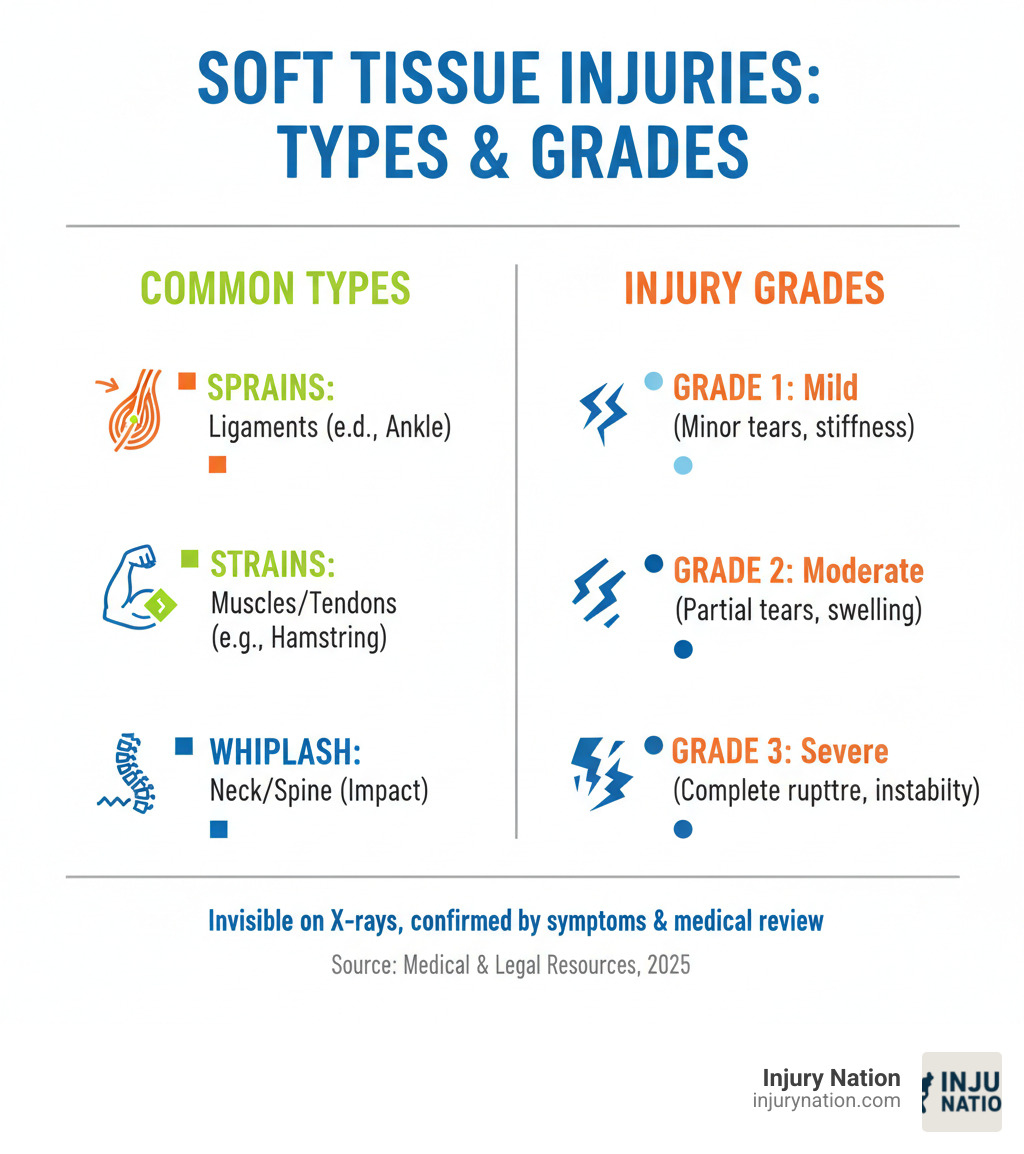
Soft tissue injuries affect the muscles, ligaments, and tendons that allow your body to move. While bones provide structure, these tissues do the heavy lifting. Muscles contract to create movement, tendons connect muscles to bones, and ligaments hold bones together at the joints. When any of these are damaged, you have a soft tissue injury. You can learn more about tendons here.
Common Types of Soft Tissue Injuries
- Sprains: Stretched or torn ligaments, common in twisted ankles.
- Strains: Injuries to muscles or tendons, like a pulled hamstring.
- Whiplash: A well-known injury from car accidents where the neck snaps back and forth, damaging delicate neck tissues.
- Contusions: Bruises that occur when blood vessels break from impact. Deep contusions can be very painful and take weeks to heal.
Common Causes of Soft Tissue Injuries
Car accidents are a leading cause, as the sudden forces can damage tissues throughout the body. Even minor fender-benders can cause significant damage that appears days later. Slip and fall accidents are another major culprit, causing sprains and strains. Workplace incidents, from repetitive motion injuries to accidents involving heavy lifting, also contribute to these injuries.
Typical Symptoms of Soft Tissue Injuries
The most challenging aspect of soft tissue injuries is that symptoms often have a delayed onset. You might feel fine initially, only to wake up the next day in significant pain. Common symptoms include:
- Pain: Ranging from a dull ache to sharp, stabbing sensations.
- Swelling around the injured area.
- Limited mobility or stiffness, making simple tasks difficult.
- Tenderness to touch and weakness in the affected area.
Unlike a broken bone, these injuries are invisible, which is why having a soft tissue injury lawyer is so important. Torn ligaments or damaged tendons can cause chronic pain and limited range of motion for months or years, seriously impacting your ability to work and enjoy life.
Why These Claims Are Difficult to Prove
Soft tissue injury claims are challenging because your real pain meets skeptical insurance adjusters who cannot see your injury. The core problem is that pain is subjective and often invisible to standard diagnostic tools.
The Challenge of Proving an Invisible Injury
Unlike a broken bone on an X-ray, torn ligaments and strained muscles often don’t appear on standard imaging. Insurance companies know this and use the subjective nature of your pain to their advantage. They may question the severity of your reported pain or argue that you are exaggerating your symptoms. This creates an uphill battle where you must constantly prove an injury that is obvious to you but invisible to others.
Another complication is the delayed onset of symptoms. It’s normal to feel fine immediately after an accident and wake up in severe pain days later, especially with whiplash. However, insurance companies often use this delay as “evidence” that your injuries are not serious or are unrelated to the accident.
Insurance companies are businesses focused on their bottom line. They routinely downplay injuries, question their connection to the accident, and offer low settlements that fail to cover ongoing pain and lost wages.
The Importance of Diagnosis and Treatment
Successfully proving your claim starts with prompt and proper medical care, which builds the foundation for your legal case.
While X-rays may not show soft tissue damage, other tools can. MRIs can reveal tears in ligaments and damage to spinal discs, while CT scans can show severe swelling. These tests provide the objective evidence needed to counter insurance company skepticism. However, you must get these tests done promptly and follow up consistently.
Your treatment plan is also critical evidence. Physical therapy and chiropractic care create detailed records of your limitations and progress. Following your doctor’s orders—whether it’s medication, braces, or therapy—is crucial. Any gaps in treatment can be used by insurance companies to argue that you weren’t seriously hurt. Every appointment adds to the paper trail that proves your injury is real, ongoing, and connected to the accident. A soft tissue injury lawyer knows how to use this documentation to build a case that insurers can’t easily dismiss.
Building a Strong Case and Proving Negligence
To get compensation, you must prove that someone else’s carelessness caused your injury. This can feel daunting, but with the right evidence and legal strategy, you can build a compelling case.

Crucial Evidence for Your Claim
A soft tissue injury lawyer helps gather the building blocks for your case. Essential evidence includes:
- Medical Records: The complete history of your injury, including MRIs, CT scans, doctor’s notes, treatment plans, and bills. A clear timeline from the accident to ongoing treatment is vital.
- Photos and Videos: Pictures of the accident scene, vehicle damage, and your injuries (even bruising or swelling) can be powerful.
- Witness Statements: Independent accounts of the accident can confirm your version of events and help establish fault.
- Accident Reports: Official police or workplace incident reports contain crucial details.
- Personal Pain Journal: A daily log of your pain levels and how the injury affects your sleep, work, and family life humanizes your suffering.
- Lost Wage Documentation: Pay stubs and employer letters prove the financial impact.
Proving Negligence
To win your case, your lawyer must prove four elements of negligence:
- Duty of Care: The other party had a responsibility to act with reasonable care (e.g., a driver’s duty to drive safely).
- Breach of Duty: They failed in that duty through a careless or reckless act, like texting while driving.
- Causation: There is a direct link between their breach of duty and your soft tissue injuries.
- Damages: You suffered actual losses, such as medical bills, lost income, and pain and suffering.
Connecting someone’s negligence to your invisible injuries requires skill, which is why working with an experienced soft tissue injury lawyer is so important.
Understanding Deadlines and Pre-Existing Conditions
Time is critical. Every state has a statute of limitations, a strict deadline for filing a personal injury lawsuit. In many states, including Georgia and Nevada, you have two years from the date of injury. If you miss this deadline, you lose your right to compensation forever. Don’t wait, as building a strong case takes time.
Having a pre-existing condition does not prevent you from receiving compensation. The law includes the “eggshell plaintiff” rule, which holds the negligent party responsible for aggravating a prior injury. If an accident worsened your manageable back pain into a debilitating condition, that difference is legally compensable. Your lawyer will use medical evidence to distinguish your new injuries from old ones and show exactly how the accident worsened your condition.
The Role of a Soft Tissue Injury Lawyer in Your Claim
When you’re in pain, battling an insurance company is the last thing you need. A dedicated soft tissue injury lawyer is an invaluable ally who manages the legal complexities so you can focus on healing.

Your Advocate and Strategist
Your lawyer acts as your shield against insurance company tactics like lowball offers, delays, and denials. They handle all communication and paperwork, fighting fire with fire.
A lawyer also serves as a detective for your case, gathering crucial evidence like medical records, witness statements, and accident reports. They may hire accident reconstructionists or medical experts to provide unbiased evaluations and testimony, strengthening your claim.
One of the most critical roles is calculating your total damages. This goes beyond current medical bills to include future medical needs, lost wages, and diminished earning capacity. They also quantify your non-economic damages, such as pain and suffering, translating the human cost of your injury into a figure that insurance companies understand.
Negotiation and Litigation
Most cases are resolved through negotiation. Your lawyer uses the evidence they’ve gathered to negotiate for a fair settlement, advising you when to accept an offer and when to keep fighting. If a fair agreement can’t be reached, a soft tissue injury lawyer is prepared to take your case to trial, presenting a compelling narrative to a judge and jury. The willingness to go to court often motivates insurers to offer a better settlement.
How a Lawyer Establishes Injury Severity
To make your invisible injury visible, your lawyer will use pain journals and testimony from family to document the daily impact on your life. They work with medical experts to explain how the accident caused your specific injuries, weaving all evidence into a powerful story that helps insurers and juries understand the true extent of your suffering.
When to Consult a Soft Tissue Injury Lawyer
Timing is crucial. You should consult a lawyer:
- Immediately after an accident to protect your rights.
- If your symptoms are significant or persist for more than a few weeks.
- Before accepting any insurance offer.
- If the other party disputes liability or blames you.
- Before signing any settlement agreement, as it is final.
Calculating Your Claim: Compensation and Settlement Factors
There is no “average” settlement for a soft tissue injury, as each case is unique. Your compensation depends on many factors, from the severity of your injury to the skill of your soft tissue injury lawyer.
Types of Compensation for Soft Tissue Injuries
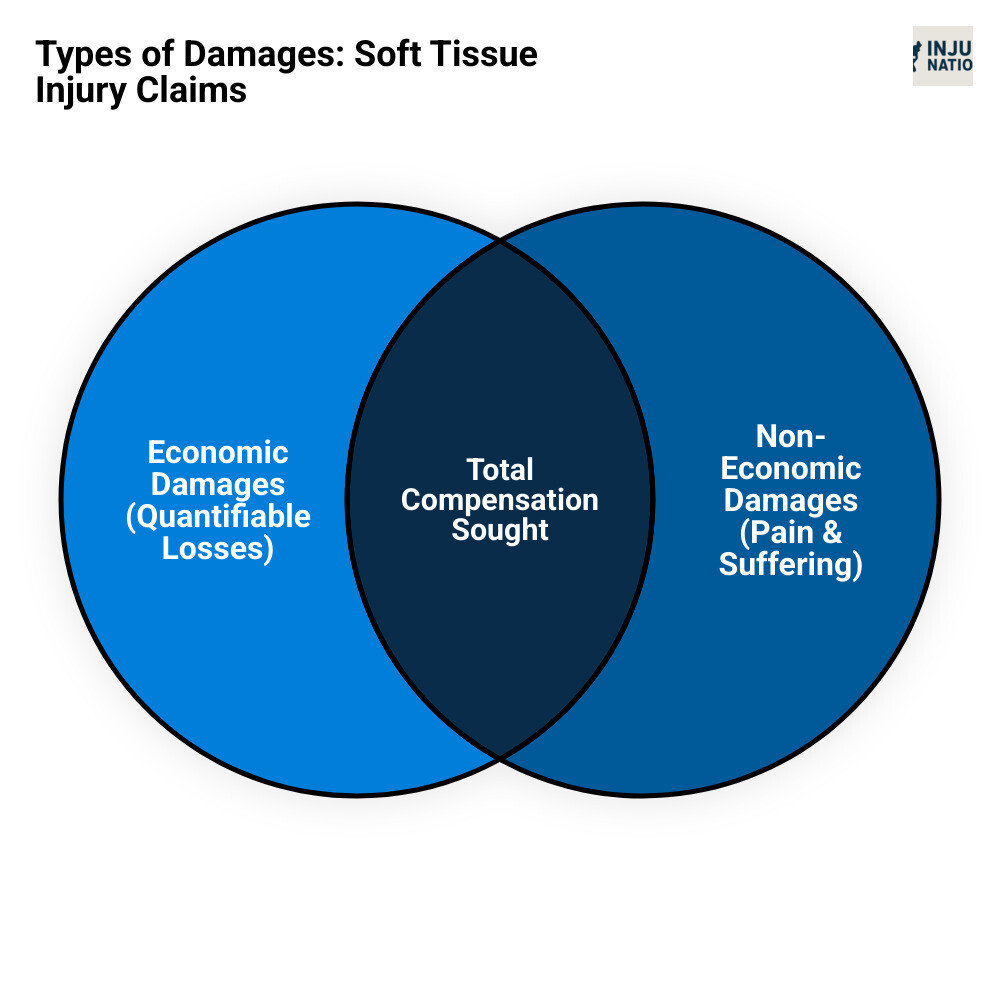
Compensation, or “damages,” falls into two main categories:
-
Economic Damages: These are tangible, calculable losses. They include all past and future medical expenses (ER visits, MRIs, physical therapy), lost wages from missed work, loss of earning capacity if your ability to work is permanently affected, and property damage to your vehicle.
-
Non-Economic Damages: These compensate for intangible losses and often make up the largest part of a settlement. They include pain and suffering for your physical discomfort, emotional distress like anxiety or depression resulting from the accident, and loss of enjoyment of life if you can no longer participate in hobbies or activities you once loved. In Nevada, unlike some other case types, there is no cap on non-economic damages for most personal injury claims.
Factors Influencing Your Settlement Amount
Several key elements determine the value of your claim:
- Injury Severity: A Grade 3 ligament tear requiring surgery will result in a much higher settlement than a Grade 1 sprain.
- Total Medical Costs: High medical bills serve as evidence of a serious injury.
- Lost Income: Significant time off work or a change in career due to the injury will increase the claim’s value.
- Strength of Evidence: Clear medical records, consistent treatment, and strong witness testimony improve your negotiating position.
- Liability: A clear-cut case where the other party is 100% at fault is stronger. In Nevada, you can still recover damages if you are partially at fault (less than 50%), but your award is reduced by your percentage of fault.
- Insurance Policy Limits: The available insurance coverage can unfortunately cap your recovery, no matter how severe your damages are.
- Legal Representation: An experienced soft tissue injury lawyer can significantly impact the final settlement amount.
Settlements can range from a few thousand dollars to hundreds of thousands, depending on these factors.
Frequently Asked Questions about Soft Tissue Injury Claims
Navigating a soft tissue injury claim can be confusing. Here are answers to some of the most common questions.
How much is a typical soft tissue injury claim worth?
There is no “average” or “typical” settlement amount. The value of a claim is highly specific to the individual case. A minor strain that heals in a few weeks is worth far less than a chronic whiplash injury requiring months of therapy. Your claim’s value depends on the severity of your injury, the total of your medical bills, the amount of income you’ve lost, and the overall impact on your daily life. A soft tissue injury lawyer can evaluate these specific factors to provide a realistic estimate of your case’s potential value.
Can I still get compensation if the accident made a pre-existing condition worse?
Yes. This is a common situation, and the law allows for it under the “eggshell plaintiff” rule. This rule states that a negligent party is responsible for all the harm they cause, even if the victim was unusually vulnerable to injury. If the accident aggravated your old back injury, causing new pain or greater limitations, you can seek compensation for that worsening. The key is to provide clear medical evidence that distinguishes your condition before and after the accident. Your soft tissue injury lawyer can help gather the necessary records and expert opinions to prove this.
How long do I have to file a soft tissue injury lawsuit?
Every state has a strict deadline called the statute of limitations. In Nevada, you generally have two years from the date of the injury to file a lawsuit. If you miss this deadline, you lose your right to sue permanently. Two years may seem like a long time, but building a strong case requires gathering extensive evidence, which can be a lengthy process. It is crucial to contact a soft tissue injury lawyer as soon as possible to protect your legal rights and give them adequate time to build the strongest case on your behalf.
Find the Right Legal Help for Your Injury Claim
The invisible nature of soft tissue injuries makes them difficult to prove, and insurance companies often exploit this to offer less than you deserve. These injuries can have a lasting impact, causing chronic pain and affecting your ability to work and enjoy life. You shouldn’t have to steer this complex legal battle while trying to heal.
Building a compelling case requires specialized knowledge to counter skeptical insurance adjusters and prove the long-term consequences of your injury. That’s why Injury Nation exists. Our mission is to connect accident victims with experienced attorneys who specialize in soft tissue injury cases.
The lawyers in our network know how to gather the right medical evidence, work with experts, and build cases that insurance companies take seriously. They understand what you’re going through and will fight for the compensation you need to cover your medical bills, lost wages, and the real impact on your quality of life.
Don’t let the system work against you. The right soft tissue injury lawyer can make all the difference.