

What Happens When Your Uber Driver Gets in an Accident
An uber driver accident is confusing and can leave you injured. The steps you take immediately after impact your ability to get compensation for injuries and damages.
Here’s what you need to know right away:
- Call 911 immediately – Get medical help and create an official police report.
- Report the crash to Uber – Use the app’s reporting feature or safety line.
- Document everything – Take photos, get witness info, and exchange insurance details.
- Seek medical attention – Some injuries appear later, so see a doctor even if you feel fine.
- Contact a personal injury attorney – Rideshare insurance claims are complex.
Rideshare accidents are increasing, with Uber and Lyft vehicles involved in nearly 1,000 crashes daily. Between 2017 and 2018, Uber vehicles were part of 97 fatal accidents causing 107 deaths.
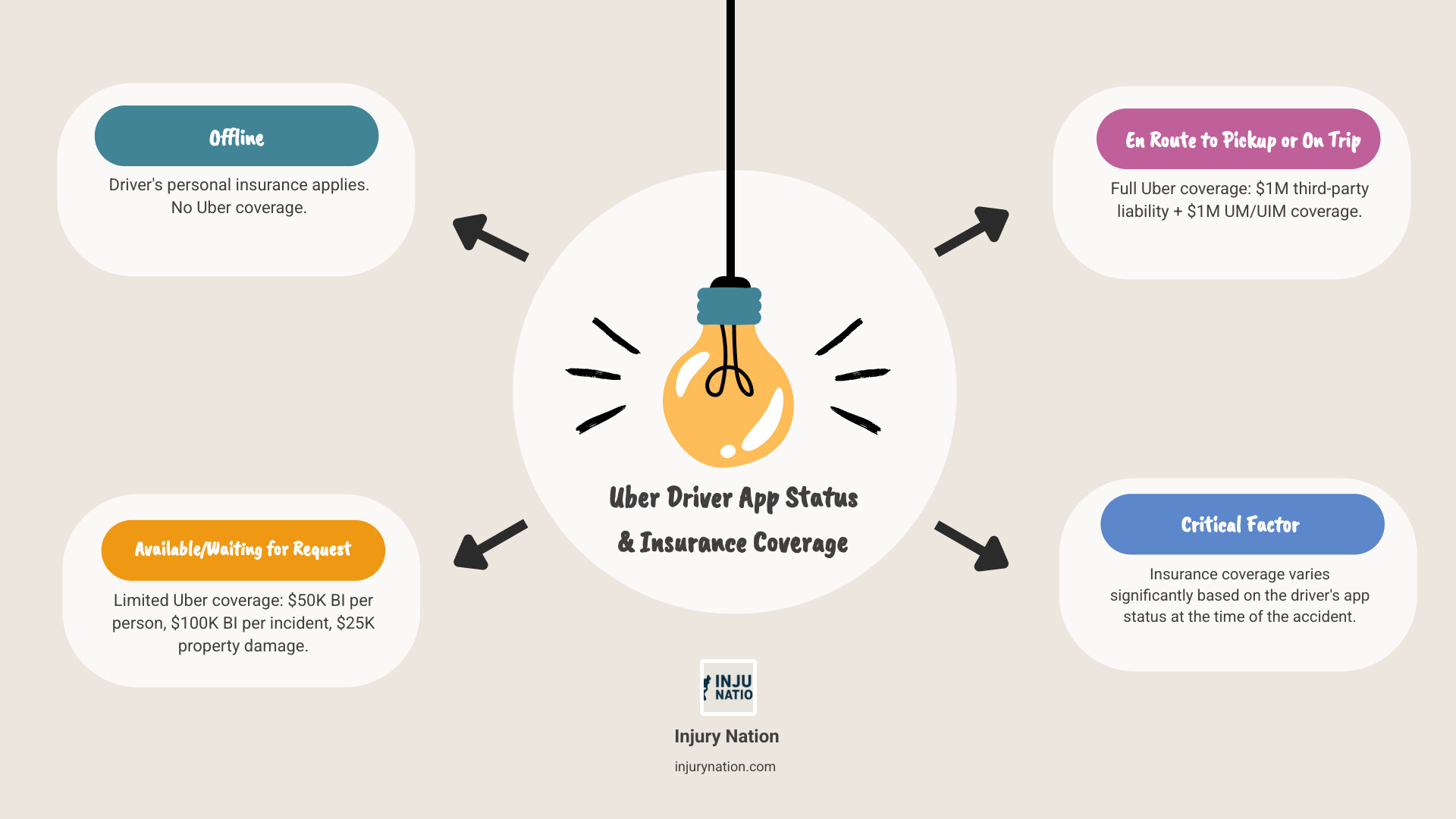
The main challenge is Uber’s complex insurance. Coverage depends on the driver’s app status during the crash. If the app was off, only the driver’s personal insurance applies. If they were waiting for a request, coverage is limited. Uber’s full $1 million policy only applies when they are actively on a trip.
This guide explains what to do after an uber driver accident, who is responsible for your damages, and why these claims are so complex.
First Steps: What to Do Immediately After an Uber Wreck
The moments after an uber driver accident are overwhelming, but your actions in these first minutes are critical for your physical and financial recovery.
Your first priority is safety. Check for injuries on yourself and others. If possible, move your vehicle out of traffic. Seek medical attention immediately, even if you feel fine. Adrenaline can mask serious injuries like whiplash or internal bleeding, and a doctor’s visit creates essential medical documentation for your claim.
Call 911 right away. A police report is a crucial piece of evidence. Get the report number from the officers before they leave.
Crucially, do not admit fault. Accidents are complex. Stick to the facts when speaking with police and other drivers.
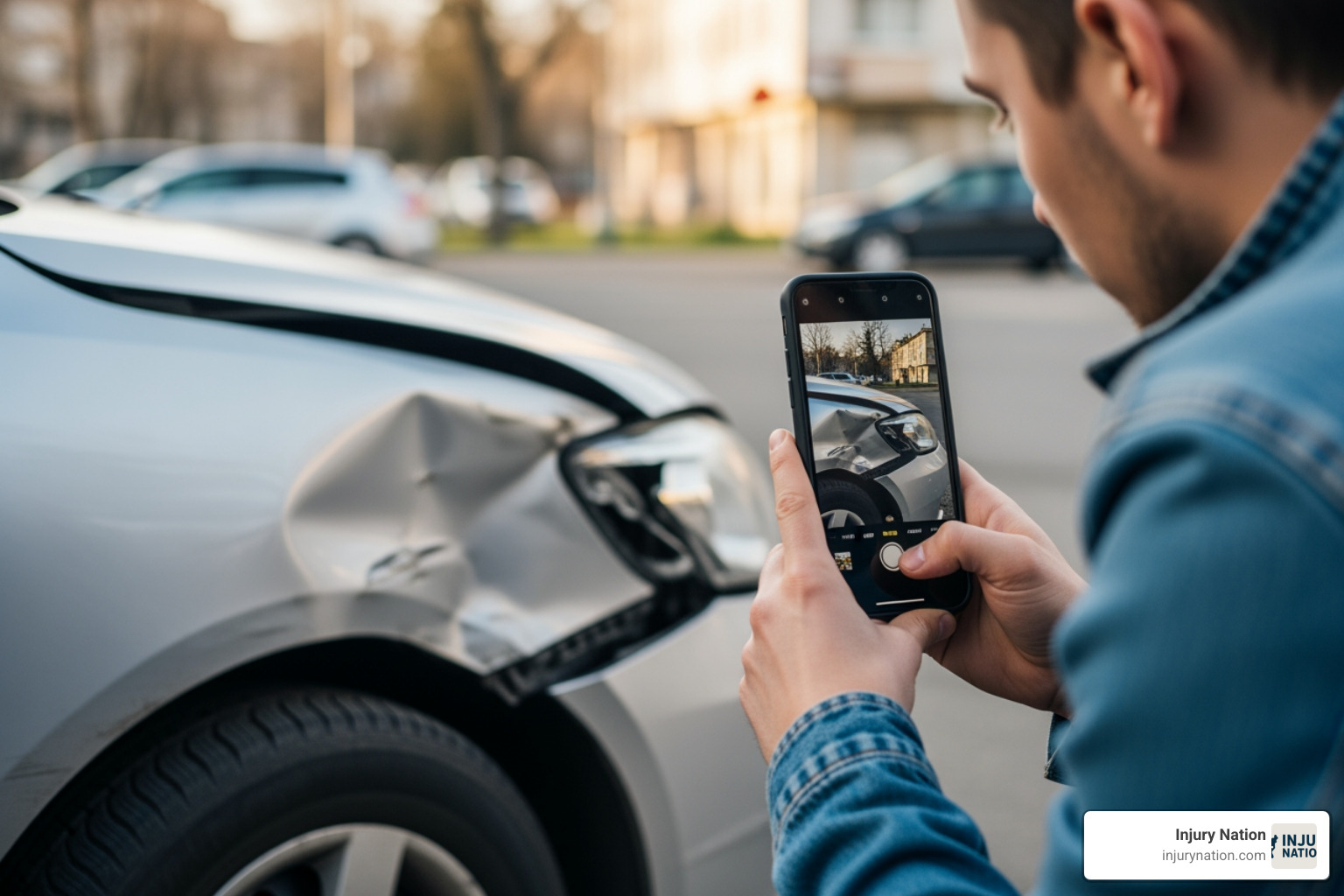
Finally, document everything. Use your smartphone to take photos, gather information, and get witness contact details. This evidence will strengthen your claim.
For Passengers
As a passenger in an uber driver accident, you weren’t in control but still face the consequences. Check for injuries and seek medical attention, even for minor pain. Shock can hide serious issues, and the medical record is vital for your claim.
Report the crash in the Uber app immediately. This creates an official record and starts the claims process. You can find instructions on how to report an accident as a rider in Uber’s help center.
Collect information from all drivers involved: names, phone numbers, personal insurance details, license plate numbers, and vehicle make/model. Also, get names and phone numbers from any witnesses, as their statements are invaluable in case of a dispute.
For Uber Drivers
If you’re an Uber driver in an accident, you have several responsibilities. First, prioritize your passengers’ safety. Check on them and provide aid if needed.
Report the crash via the Driver app’s Safety Toolkit or call the Safety Incident Reporting Line as soon as it is safe to do so. Exchange information with other drivers: names, phone numbers, insurance details, and vehicle information for your claim and Uber’s records.
Take comprehensive photos of all vehicles, damage, the scene, road conditions, and injuries. This is crucial evidence. Our Car Accident Lawyer Guide offers more legal guidance. Commercially licensed drivers must also contact their commercial auto insurer.
For Other Drivers or Pedestrians
If you were another driver or a pedestrian in an uber driver accident, the process is similar to a standard accident, with one key difference. Follow standard procedures: call 911, check for injuries, move to safety, and avoid admitting fault.
The key difference is collecting both the driver’s personal insurance and their Uber information. Ask if they were on the app, as this determines which policy applies.
Report the crash to Uber as a third party using their Third Party Incident Notice form. This creates an official record from your perspective. Notifying both the driver’s personal insurer and Uber is essential to protect your ability to recover compensation.
Who is Liable? Unpacking Uber’s Complex Insurance Policies
Figuring out who pays for your damages after an uber driver accident is tricky. Uber protects itself from direct liability by classifying drivers as “independent contractors,” not employees. This legal defense, upheld in cases like Kim v. Uber Technologies, Inc., shields the company.
This means Uber often argues it isn’t responsible for its drivers’ actions. The company’s insurance only applies during specific times, depending on the driver’s app status at the time of the crash. The challenge lies in the gap between personal auto insurance, which often excludes commercial use, and Uber’s conditional commercial coverage. This creates confusing grey areas.
Here’s a breakdown of when Uber’s insurance applies.

Period 1: Driver is Online and Waiting for a Request
Period 1 is when a driver has the app on but is waiting for a ride request. During this period, Uber provides limited contingent liability coverage: $50,000 per person for bodily injury, $100,000 total per accident, and $25,000 for property damage.
The driver’s personal auto insurance is primary, with Uber’s as a backup. However, most personal policies have rideshare exclusions and will deny claims if the app was on. This creates a dangerous coverage gap, potentially leaving you with inadequate compensation.
Periods 2 & 3: En Route to Pick Up or On a Trip
Once a driver accepts a ride request, they enter Period 2 (en route to pickup) or Period 3 (on a trip). During these periods, Uber’s full commercial insurance policy applies. This policy includes $1 million in third-party liability coverage, which pays for injuries and property damage to others if the Uber driver is at fault.
For passengers, Uber also provides $1 million in uninsured/underinsured motorist (UM/UIM) coverage. This covers your expenses if an at-fault driver has little or no insurance.
Uber also offers contingent collision and comprehensive coverage for the driver’s vehicle, but only if they have it on their personal policy. It comes with a high $2,500 deductible, meaning the driver pays that amount first for repairs.
Driver is Offline
If the Uber app is off, Uber provides zero coverage. The uber driver accident is treated like any other car crash, and you must file a claim with the driver’s personal auto insurance. However, some personal insurers may still try to deny or reduce coverage if they find the driver works for Uber, even if the app was off during the crash.
Filing Your Claim After an Uber Driver Accident
After an uber driver accident, you must act quickly to file your claim. States have a statute of limitations, usually one to three years, for filing personal injury lawsuits. Missing this deadline means you lose your right to compensation, so check your state’s specific timeline immediately.
To build a strong claim, gather all evidence. This includes the police report for an official account of the accident and all medical records, from the initial ER visit to ongoing therapy and prescriptions. Witness statements are invaluable if liability is disputed. The photos and videos you took at the scene capture crucial details like vehicle positions, weather conditions, injuries, and property damage.

What Damages Can You Recover?
After an uber driver accident, you can seek compensation for both economic and non-economic damages.
Economic damages are tangible costs with receipts. They include:
- Medical expenses: Ambulance, surgery, prescriptions, physical therapy, and future care.
- Lost wages: Income missed due to being out of work.
- Loss of earning capacity: If you cannot return to your previous job.
- Property damage: Repair or replacement costs for your vehicle or other property.
Non-economic damages are intangible losses. They include:
- Pain and suffering: Physical discomfort and emotional trauma.
- Emotional distress: Anxiety, depression, or PTSD resulting from the crash.
- Loss of enjoyment of life: Inability to participate in hobbies or activities you once loved.
An experienced attorney is crucial for properly valuing these damages.
How to Handle an Uber Driver Accident Claim
Handling an uber driver accident claim starts with reporting to Uber. This is a crucial first step for any passenger, driver, or third party to create an official record.
Next, you must file with the correct insurance company. The driver’s app status determines whether you deal with their personal insurer, Uber’s limited policy, or Uber’s $1 million commercial policy. You may need to file with multiple insurers, each with its own process and goal of minimizing payouts.
Document all communication with insurance companies. Keep a log of calls, emails, and letters. A paper trail is critical in case of disputes. While our guide on How to Negotiate a Car Accident Settlement Without a Lawyer is helpful, Uber accidents are more complex, often involving multiple insurers. Professional legal help is highly recommended.
How Comparative Negligence Affects Your Claim
Even if you weren’t entirely at fault for the uber driver accident, your compensation can be reduced if you are found to share some of the blame. This is called comparative negligence. Most states use this system, where fault is assigned by percentage to each party.
California’s pure comparative negligence rule allows you to recover damages even if you are 99% at fault. If you are 30% at fault for a $100,000 award, you would receive $70,000. Other states use a modified comparative negligence system. If you are found to be more than 50% or 51% at fault, you cannot recover any damages.
State-specific laws vary, and insurance adjusters use these rules to reduce or deny payouts by inflating your percentage of fault. Solid evidence and witness statements are crucial to prove you had minimal or no fault. An attorney can fight for an accurate assessment of liability.
Common Challenges and Why an Attorney is Crucial
Dealing with an uber driver accident claim is frustrating, especially while you’re recovering from injuries and missing work. Insurance companies prioritize their bottom line, not your best interests. Their legal teams work to pay out as little as possible.
Insurers often make lowball settlement offers soon after the accident, hoping you’ll accept before understanding the full value of your claim. They may also deny liability, arguing their driver wasn’t at fault or shifting blame to you. They will scrutinize every detail to reduce or deny your claim.
Proving the full extent of your damages, especially non-economic ones like chronic pain, is difficult. Insurers use formulas designed to minimize, not maximize, your compensation.
An experienced personal injury attorney is your greatest asset. They know insurance company tactics and how to counter them with evidence and expert testimony. They can calculate the full value of your claim, including future costs and non-economic damages. Our Uber Driver Accident Lawyer Guide explains how an attorney can level the playing field.
Common Problems in an Uber Claim
Victims of an uber driver accident often face these roadblocks:
- Determining which insurance policy applies. The driver’s app status (offline, waiting, or on a trip) dictates whether the claim is against their personal insurance, Uber’s limited coverage, or Uber’s $1 million policy. Insurers will dispute this to avoid payment.
- Fighting Uber’s “independent contractor” defense. Uber avoids direct liability by classifying drivers as contractors. Suing Uber directly for negligent hiring is possible but difficult, requiring proof that Uber knew the driver was a risk.
- Valuing non-economic damages. It’s hard to put a price on pain and suffering or emotional distress. Insurers will try to minimize these claims. An attorney uses expert testimony and legal precedent to ensure they are properly valued.
- Navigating state laws and deadlines. Each state has its own statute of limitations and personal injury laws. For example, Nevada has a two-year deadline to file a lawsuit. An attorney ensures all legal requirements and deadlines are met.
These claims involve multiple policies and complex liability issues. Facing them alone puts you at a significant disadvantage against insurance company legal teams.
Frequently Asked Questions about Uber Accidents
What if the at-fault driver was the other vehicle, not the Uber?
If another driver causes your uber driver accident, you first file a claim against their insurance policy for your damages. But what if the at-fault driver is uninsured or their policy limits are too low to cover your injuries? This is where Uber’s uninsured/underinsured motorist (UM/UIM) coverage is crucial.
As a passenger during Periods 2 and 3 (en route or on a trip), Uber provides $1 million in UM/UIM coverage. This policy can cover the gap if the at-fault driver’s insurance is insufficient to pay for your medical bills. Other drivers involved in the crash would pursue the at-fault party’s insurance first, then their own UM/UIM coverage if needed.
Does Uber’s insurance cover the Uber driver’s own car repairs?
Yes, Uber’s insurance can cover a driver’s car repairs, but there are significant catches. Uber’s collision and comprehensive coverage only applies during Period 2 (en route to pickup) or Period 3 (on a trip). There is no coverage for vehicle damage if the driver is waiting for a request (Period 1) or is offline.
This coverage is also “contingent,” meaning the driver must have personal comprehensive and collision coverage first. Since many personal policies exclude ridesharing, this can create a coverage gap. Finally, Uber’s policy has a high $2,500 deductible, which the driver must pay out-of-pocket before insurance covers any repair costs.
For full details, review more on Uber’s insurance on their website.
Can I sue Uber directly for an accident caused by its driver?
Suing Uber directly for an uber driver accident is very difficult, but not impossible. Uber classifies its drivers as independent contractors, which shields the company from direct liability. Typically, claims are made against the driver’s or Uber’s insurance policies, not Uber itself.
However, you may be able to sue Uber for negligent in hiring or retaining a dangerous driver. This would require proving Uber knew or should have known a driver was dangerous (e.g., had a history of DUIs or reckless driving complaints) but failed to act. These are complex cases that require proving a failure in Uber’s screening or retention process directly caused your injuries.
An experienced attorney is crucial here. They can investigate the driver’s history and Uber’s procedures to build a case for direct liability. A lawyer, such as a Personal Injury Lawyer Los Angeles for California cases, can determine the best legal strategy. Every case is unique, so a professional evaluation of your circumstances is essential.
Get the Help You Deserve After a Crash
As this guide shows, an uber driver accident is far more complex than a typical car crash. You face multiple insurance policies, difficult legal arguments, and insurers focused on minimizing payouts, all while trying to recover.
You shouldn’t steer this alone. Insurance companies have legal teams protecting their interests; you need an advocate committed to protecting yours.
Injury Nation is a directory of top-rated personal injury lawyers who specialize in rideshare accident cases. They understand the nuances of these claims, know how to fight Uber’s defenses, and can accurately value your case.
Whether you were a passenger, driver, or third party, you deserve fair compensation for your medical bills, lost wages, and pain and suffering. Most of these attorneys work on a contingency basis, so you pay nothing unless they win. A free consultation comes with no risk.
Find experienced rideshare accident attorneys in your area and take the first step toward the compensation you deserve. Your recovery matters, and having the right legal advocate can make all the difference.