

Why Welding Accident Victims Need Specialized Legal Help
A welding accident lawyer helps injured welders get compensation for accidents caused by employer negligence, defective equipment, or unsafe work sites.
Quick Guide to Finding a Welding Accident Lawyer:
- Look for attorneys with experience in workplace injuries and welding accidents.
- Choose lawyers who work on contingency (no upfront costs).
- Seek free consultations to evaluate your case.
- Find attorneys who know OSHA regulations and employer safety duties.
- Select lawyers with proven success in workers’ compensation and personal injury claims.
Welding is a highly dangerous job. Statistics show that more than 560,000 construction workers are injured annually in welding accidents. These incidents account for 25 percent of all fatal workplace accidents and one-third of all work-related amputations.
Daily exposure to extreme heat, toxic fumes, and electrical currents can cause devastating injuries like severe burns, eye damage, and lung disease. The consequences often include massive medical bills, lost wages, and permanent disabilities that create severe financial hardship.
If you’ve been injured, you’re facing pain, medical bills, and financial stress. You may question if safety protocols were followed or if you have legal options beyond workers’ compensation. A specialized lawyer can investigate your case, identify liable parties, and fight for full compensation while you focus on recovery.
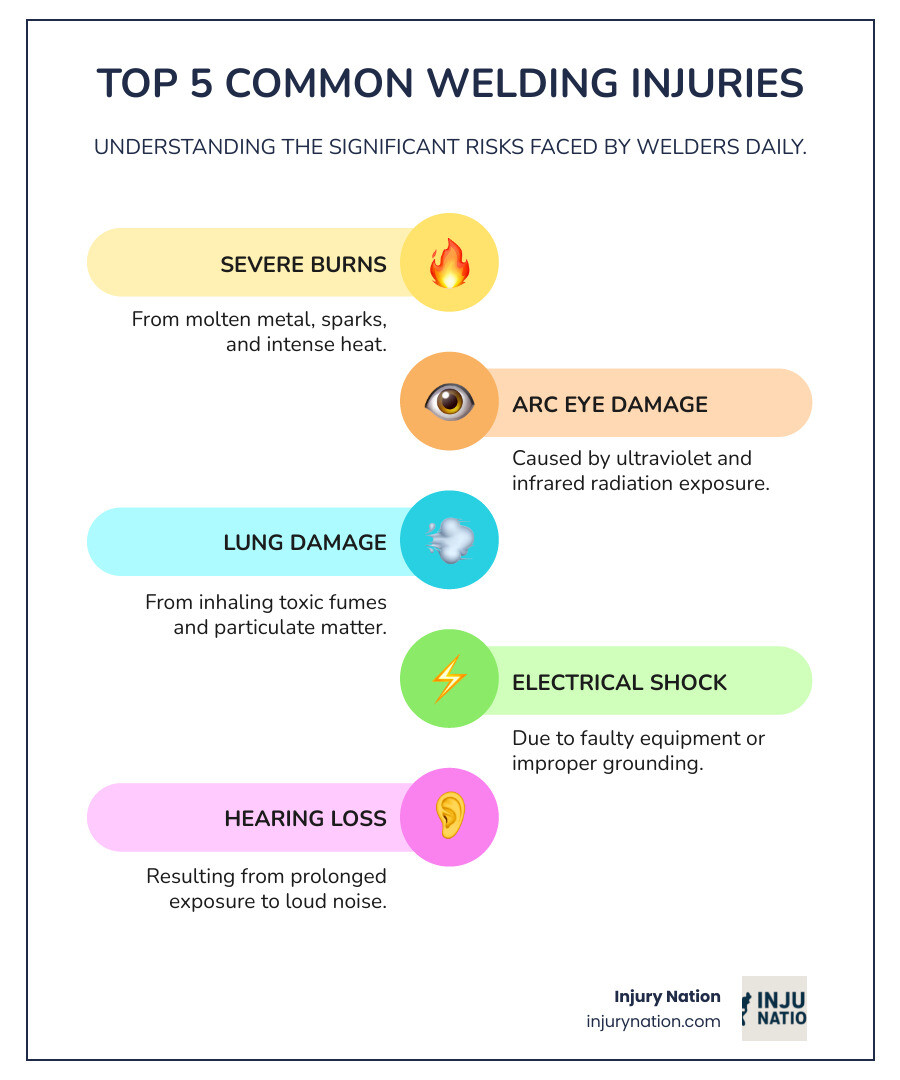
Understanding the Dangers: Common Welding Accidents and Injuries
Welding is one of America’s most dangerous jobs, involving extreme heat, toxic fumes, electrical currents, and explosive materials. Accidents are rarely bad luck; they usually stem from inadequate training, defective equipment, and insufficient ventilation. When employers neglect safety, workers suffer.

Toxic fumes in poorly ventilated areas cause serious respiratory issues. Sparks can ignite fires and explosions if flammable materials are nearby. High-voltage equipment poses a constant threat of electrical shock if poorly maintained. These are life-threatening dangers, and failed safety protocols can be catastrophic. For more on how construction accidents affect workers, see our construction accident resources.
Common Causes of Welding Accidents
Understanding accident causes is key to a legal case, as they often point to preventable safety failures.
Fatigue from long hours and few breaks impairs judgment, leading to equipment mistakes, missed safety steps, and slower emergency reactions.
Improper PPE use is a major factor. Sometimes employers fail to provide it, or workers skip it due to discomfort or perceived job simplicity. A recent study on welder safety confirms these reasons for non-compliance.
The lack of a fire watch is a huge risk. Welding sparks can travel up to 35 feet. Without a dedicated person to monitor for fire, small sparks can become major disasters.
Flammable materials like paint, solvents, or wood must be kept at least 35 feet from welding. When this rule is ignored, fires and explosions are almost inevitable.
Poor supervision allows unsafe practices to persist. When supervisors don’t enforce rules or pressure workers to cut corners, accidents are more likely.
Devastating Injuries Sustained by Welders
Welding injuries are often severe. The U.S. Bureau of Labor Statistics reports that welding accidents cause one-third of all work-related amputations and dozens of deaths annually.
Severe burns from molten metal, slag, or the arc itself are common, often requiring skin grafts and leaving permanent scars.
Eye damage from arc flash is devastating. The intense UV radiation causes a painful condition called “welder’s flash” and can lead to cataracts, retinal damage, or blindness. Learn more about radiation eye damage.
Lung damage from inhaling toxic fumes (manganese, lead, etc.) is a serious, often overlooked risk, leading to metal fume fever, chronic lung disease, and cancer.
Hearing loss is common for welders who work without proper ear protection, potentially causing permanent damage or deafness.
Electrocution from contact with live electrical parts can cause cardiac arrest, internal organ damage, and death.
Amputations can result from equipment malfunctions, getting caught in machinery, or explosions.
Neurological damage from manganese exposure can cause Manganism, a disorder with symptoms similar to Parkinson’s disease.
If you’ve suffered these injuries, a welding accident lawyer can help you pursue the compensation you deserve.
Your Legal Rights and Employer Safety Obligations
If you were hurt in a welding accident, it was likely a preventable workplace failure. You have fundamental legal rights, and your employer has strict legal duties to keep you safe.
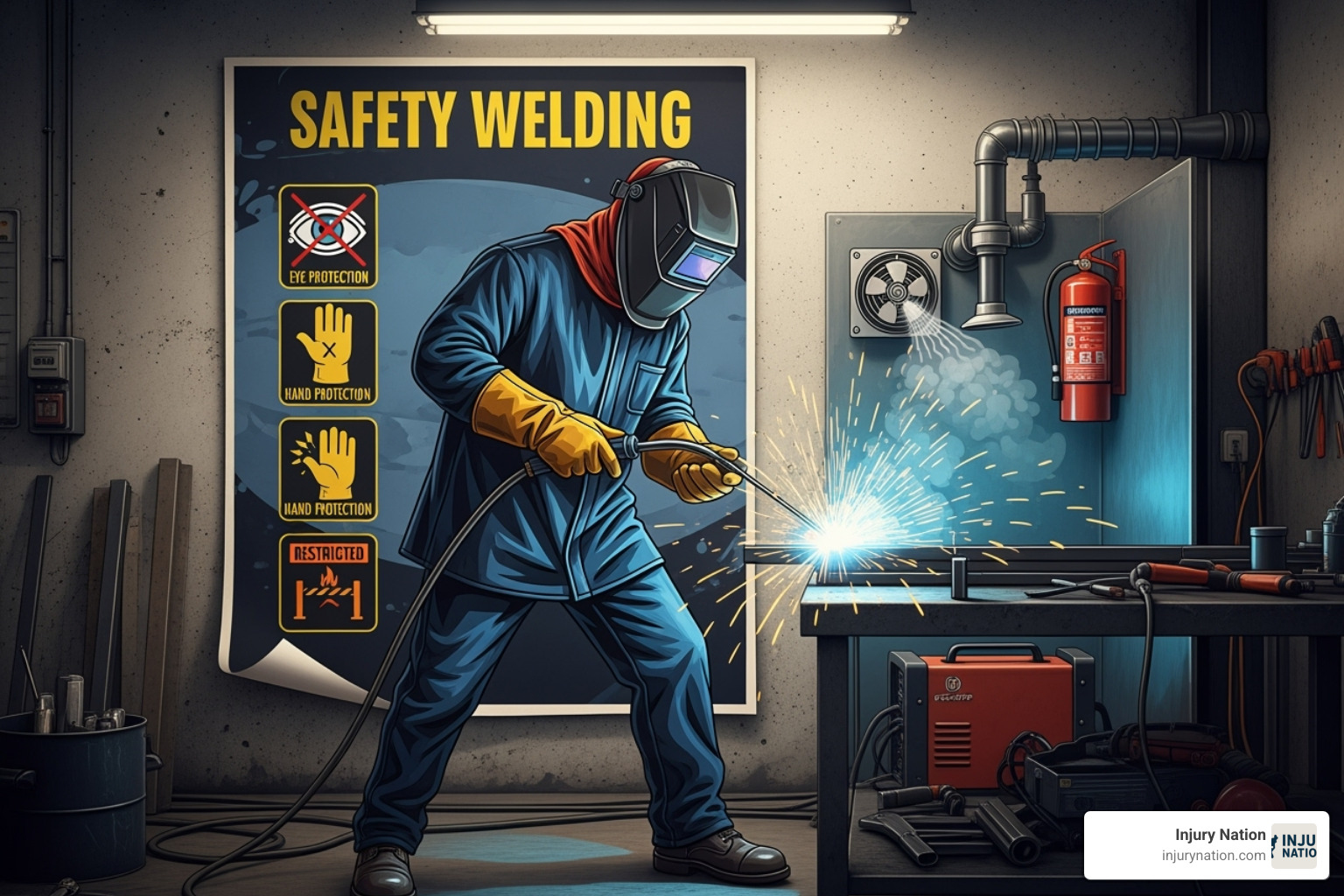
Your employer is legally required to provide a safe environment, proper training, and maintained equipment. When they fail this duty, they can be held accountable. The Occupational Safety and Health Administration sets these rules. If your employer’s negligence caused your injury, a welding accident lawyer can help you fight for compensation. Start by exploring our Find a Lawyer directory.
The Role of OSHA in Welder Safety
OSHA’s mission is to ensure workers get home safely. For welders, this means comprehensive, enforceable safety standards that employers must follow. These regulations are specific to the industry, such as general industry (29 CFR 1910), maritime (29 CFR 1915, 1917, 1918), and construction (29 CFR 1926).
OSHA also conducts workplace inspections to find violations and investigates accidents to prevent future incidents. Crucially, OSHA provides anti-retaliation protection, meaning you can report unsafe conditions without fear of being fired. You can learn more about OSHA’s specific welding standards to understand your protections.
Required Safety Standards for Employers
Employers must follow specific, legally mandated safety standards.
Personal Protective Equipment (PPE) is the first line of defense, and your employer must provide it. This includes proper helmets, safety glasses, flame-resistant clothing, gloves, boots, and respirators. The gear must fit correctly.
Ventilation controls are critical for preventing lung damage from toxic fumes. Employers must ensure adequate general ventilation and provide local exhaust systems like fume extractor guns. PPE alone is not enough. OSHA offers guidance on controlling hazardous fumes.
Fire prevention protocols are mandatory. This includes removing combustible materials, providing fire blankets and extinguishers, and assigning a “fire watch” for hot work.
Employers must also implement hazard communication programs (Safety Data Sheets), maintain equipment, provide task-specific training, establish safe work practices, and keep work areas clean. When these standards are ignored, a welding accident lawyer can hold them accountable.
Critical Steps to Take Immediately After a Welding Accident
What you do in the hours and days after a welding accident can significantly impact your health and your ability to get compensation. While it’s hard to think clearly when you’re hurt, taking these steps is crucial.

Your first priority is your health. Seek medical attention immediately, even for what seem like minor injuries. Some welding injuries, like arc flash or fume exposure, can be deceptive. Once you are safe, take action to protect your legal rights. The process is similar to other workplace accidents, and understanding how an Attorney for Slip and Fall Cases handles documentation highlights the importance of these steps.
Reporting Your Injury
Properly reporting your injury is your lifeline to benefits. Deadlines are strict and start the moment the accident occurs.
Notify your supervisor immediately. Most states give you only 30 days to report a workplace injury for workers’ compensation. Stick to the facts of what happened without admitting fault or speculating on the cause.
Insist on a formal incident report. Your employer should complete an official report. Review it carefully before signing and request a copy for your records.
File your workers’ compensation claim within your state’s deadline, typically one year from the accident. Workers’ comp provides medical and wage benefits, often without needing to prove employer negligence. California’s information for an injured worker offers helpful guidance.
Preserving Evidence for Your Case
Evidence is critical, and it can disappear quickly. Act fast to preserve it.
Document everything with photos and videos if it’s safe. Capture the accident scene, hazardous conditions, involved equipment, your injuries, and damaged gear.
Do not let anyone touch faulty equipment. If defective equipment caused your injury, it is crucial evidence. Do not allow it to be repaired or moved. A welding accident lawyer will want an expert to examine it.
Save everything related to the accident, including damaged PPE, medical records, prescriptions, and therapy documentation.
Track your financial losses. Document missed work, lost income, and any impact on future earning ability. Keep pay stubs and employment records.
Get witness information. Collect names and phone numbers from anyone who saw the accident or the conditions leading to it. Ask them to write down what they remember.
An experienced welding accident lawyer can guide you through this process to ensure nothing is overlooked.
How a Welding Accident Lawyer Can Maximize Your Claim
After a welding accident, you’re dealing with pain, medical bills, and financial worries. A skilled welding accident lawyer can handle the legal battle while you focus on recovery. Just as a Bike Crash Attorney understands traffic accidents, a welding accident lawyer knows the specifics of workplace injury claims.
Your lawyer will conduct a thorough case evaluation, perform in-depth evidence gathering, and handle all negotiations with insurers. They will properly calculate all damages to ensure nothing is missed. If a fair settlement isn’t offered, your lawyer will provide litigation support and take your case to court.
Why You Need a Welding Accident Lawyer
Handling a claim yourself is risky. Insurance companies have legal teams dedicated to minimizing payouts. A lawyer levels the playing field.
Navigating legal complexity: Workplace injury laws and workers’ comp rules are complicated. Your lawyer knows how to steer these systems effectively.
Protecting your rights: An insurer’s goal is to close your case cheaply. Your lawyer acts as your shield against lowball offers and unfair tactics.
Maximizing compensation: An experienced lawyer understands the true value of your claim, including future medical needs and lost earning capacity, and will fight for a full and fair settlement.
Fighting insurance companies: Your lawyer manages all communication, paperwork, and negotiations, allowing you to focus on healing.
Access to experts: Lawyers have networks of medical, vocational, and accident reconstruction experts who can provide crucial testimony to strengthen your case.
Recoverable Compensation in a Welding Accident Case
Compensation is meant to help you rebuild your life. It falls into several categories.
Economic damages cover tangible financial losses. This includes all medical bills (past and future), lost income, and compensation for diminished future earnings if you cannot return to your previous job.
Non-economic damages address intangible suffering. This includes pain and suffering for your physical pain and emotional distress, as well as loss of enjoyment of life if your injuries prevent you from participating in activities you once loved.
In rare cases of extreme recklessness, punitive damages may be awarded to punish the wrongdoer and deter similar conduct.
Hiring the Right Welding Accident Lawyer
Choosing the right lawyer is critical. Look for these key qualities:
Experience with work injuries: You need a lawyer who has specifically handled welding accident cases and understands both workers’ compensation and personal injury law.
Contingency fee basis: Reputable lawyers work on a contingency fee, meaning you pay nothing upfront. They only get paid if they win your case.
Proven track record: Look for a history of significant settlements and verdicts in similar cases. Past success demonstrates their ability to get results.
Client testimonials: See what previous clients say about their communication, dedication, and effectiveness.
Free consultation: A good lawyer will offer a free, no-obligation consultation to discuss your case and answer your questions.
You are choosing a partner to fight for your future. Take the time to find the right one.
Frequently Asked Questions about Welding Accident Claims
If you’ve been hurt in a welding accident, you likely have many questions. Here are answers to the most common ones we hear from injured welders.
What is the difference between a workers’ compensation claim and a personal injury lawsuit?
Understanding this distinction is crucial, as they are different paths to compensation.
Workers’ compensation is a no-fault insurance system for on-the-job injuries. You don’t have to prove your employer was negligent. In exchange, you generally cannot sue your employer directly, and the benefits are limited.
A personal injury lawsuit is fault-based. You must prove that a third party’s negligence caused your injury. You can’t usually sue your employer this way, but you can sue other parties like equipment manufacturers or subcontractors.
| Feature | Workers’ Compensation Claim | Personal Injury Lawsuit |
|---|---|---|
| Basis | No-fault: An insurance system for on-the-job injuries. | Fault-based: You must prove another party’s negligence caused your injury. |
| Who You Sue | Your employer’s workers’ compensation insurance carrier. You generally cannot sue your employer directly. | A negligent third party, such as an equipment manufacturer or subcontractor (not your direct employer). |
| Types of Compensation | Medical expenses, a portion of lost wages (e.g., 2/3), and permanent impairment benefits. No pain and suffering. | Full compensation for medical bills, lost wages (past and future), pain and suffering, and potentially punitive damages. |
| Legal Process | Administrative process through a state workers’ comp board. | Civil lawsuit in the court system. |
| Third-Party Liability | If a third party is at fault, you can file a personal injury lawsuit against them in addition to your workers’ comp claim. | Focuses on holding the negligent third party accountable. |
You may be able to pursue both. For example, if a defective welding torch exploded, you could file for workers’ comp and also sue the manufacturer. This is called a third-party liability claim and can significantly increase your total recovery. A skilled welding accident lawyer can determine the best strategy for you.
How long do I have to file a welding accident claim?
Time is limited. States have strict deadlines called statutes of limitations. Missing them means losing your right to compensation.
For workers’ compensation, you must typically notify your employer within 30 days and then file a formal claim within one year.
For personal injury lawsuits, the deadline is often longer, but just as strict. Many states, like Georgia, give you two years from the accident date to file against a third party.
For injuries that appear later, like lung damage from fumes, the clock may start when the injury is finded. Don’t wait. Evidence disappears and memories fade. Contact a welding accident lawyer as soon as possible.
How much does it cost to hire a lawyer for my welding accident?
You likely don’t need any money upfront. Most personal injury lawyers work on a contingency fee basis.
No upfront costs: You don’t pay a retainer or hourly fees to hire the lawyer. They invest their own time and resources.
You only pay if you win: If your lawyer doesn’t secure a settlement or win a verdict, you owe no attorney fees. This aligns your lawyer’s interests with yours.
When you win, the lawyer’s fee is a percentage of the recovery, typically 25% to 40%. This should be clearly explained in your agreement. This system ensures everyone has access to quality legal help, regardless of their financial situation.
Conclusion
An injury from a welding accident brings overwhelming physical, financial, and emotional challenges. It’s vital to know that you have legal rights and don’t have to face this difficult journey alone.
The statistics are clear: welding is a dangerous profession, with accidents causing 25% of workplace fatalities and one-third of all work-related amputations. Your employer has a legal duty to protect you from these risks. When they fail through inadequate training, faulty equipment, or poor safety protocols, you deserve to be compensated.
Your path forward may include a workers’ compensation claim and potentially a personal injury lawsuit against a negligent third party. A lawsuit can provide more comprehensive compensation, including for full lost wages and pain and suffering.
Time is critical due to statutes of limitations, so acting quickly is essential to preserve evidence and protect your rights. A qualified welding accident lawyer is your strongest advocate, navigating complex laws and fighting for your interests. They work on a contingency fee basis, so you pay nothing unless they win your case.
Don’t let an insurance company devalue your claim. Take the first step to protect your future. Explore our Injury Nation directory to find top-rated personal injury lawyers near you who help welding accident victims get the justice they deserve.