

When Slip and Fall Accidents Turn Your World Upside Down
An attorney for slip and fall cases is essential for proving property owner negligence, calculating fair compensation, and navigating insurance negotiations. However, not every fall requires legal help.
When You Need Legal Help:
- Serious injuries with ongoing medical needs
- Clear property owner negligence (e.g., wet floors without warnings, broken stairs)
- Insurance company disputes or offers a low settlement
- Permanent disability or disfigurement
- Medical bills over $10,000
When You Might Handle It Yourself:
- Minor injuries with a full recovery
- A cooperative insurance company accepts clear liability
- Small medical bills under $3,000
- Simple case with obvious fault
A slip and fall can happen in an instant, but recovery can take months or years. The legal process hinges on proving premises liability—that the property owner failed to keep their property safe. With over 800,000 hospitalizations from falls each year according to the CDC’s injury data, these cases are common.
The challenge is proving the owner knew (or should have known) about a hazard and failed to act. Insurance companies often fight these claims, trying to blame the victim. Time is also critical, as states limit your time to file a lawsuit to just a few years, and evidence can disappear quickly.
Understanding the Foundations of a Slip and Fall Claim
A slip and fall is any incident where you slip, trip, or fall due to a dangerous condition on someone else’s property, resulting in injury. This can happen anywhere, from grocery stores to sidewalks, and includes falls from wet floors, broken pavement, or poorly maintained stairs.

The legal basis for these claims is premises liability, which holds property owners responsible for keeping their property reasonably safe for visitors. This doesn’t mean they are liable for every accident, but they must address known dangers or warn people about them.
Common Causes and Potential Injuries
Most slip and falls are preventable and caused by hazards like:
- Wet or slippery surfaces: Spills, mopped floors, or tracked-in rain/snow.
- Uneven or damaged surfaces: Cracked sidewalks, potholes, loose tiles, or bunched-up rugs.
- Poor lighting: Dark stairwells, parking lots, or hallways that hide dangers.
- Obstacles and debris: Cords, merchandise, or materials left in walkways.
- Missing or broken handrails on stairs and ramps.
- Icy or snowy conditions that are not cleared in a reasonable time.
The resulting injuries can be severe. Falls are a leading cause of hospitalization, leading to:
- Fractures: Broken hips, wrists, and ankles are common. Hip fractures can be devastating, especially for older adults.
- Head injuries: Concussions or traumatic brain injuries (TBIs) with lasting cognitive effects.
- Spinal cord injuries: Herniated discs, fractured vertebrae, and chronic pain.
- Soft tissue injuries: Serious sprains, strains, and bruising that cause significant pain and limitations.
A Property Owner’s Duty of Care
Laws like the Occupiers’ Liability Act require property owners to take reasonable steps to maintain safe conditions. This means performing regular maintenance, making prompt repairs, and posting clear warnings. When an attorney for slip and fall cases evaluates your claim, they determine if the owner met this standard of care. If not, you may have a valid claim. For more information about premises liability laws, see the National Safety Council’s overview.
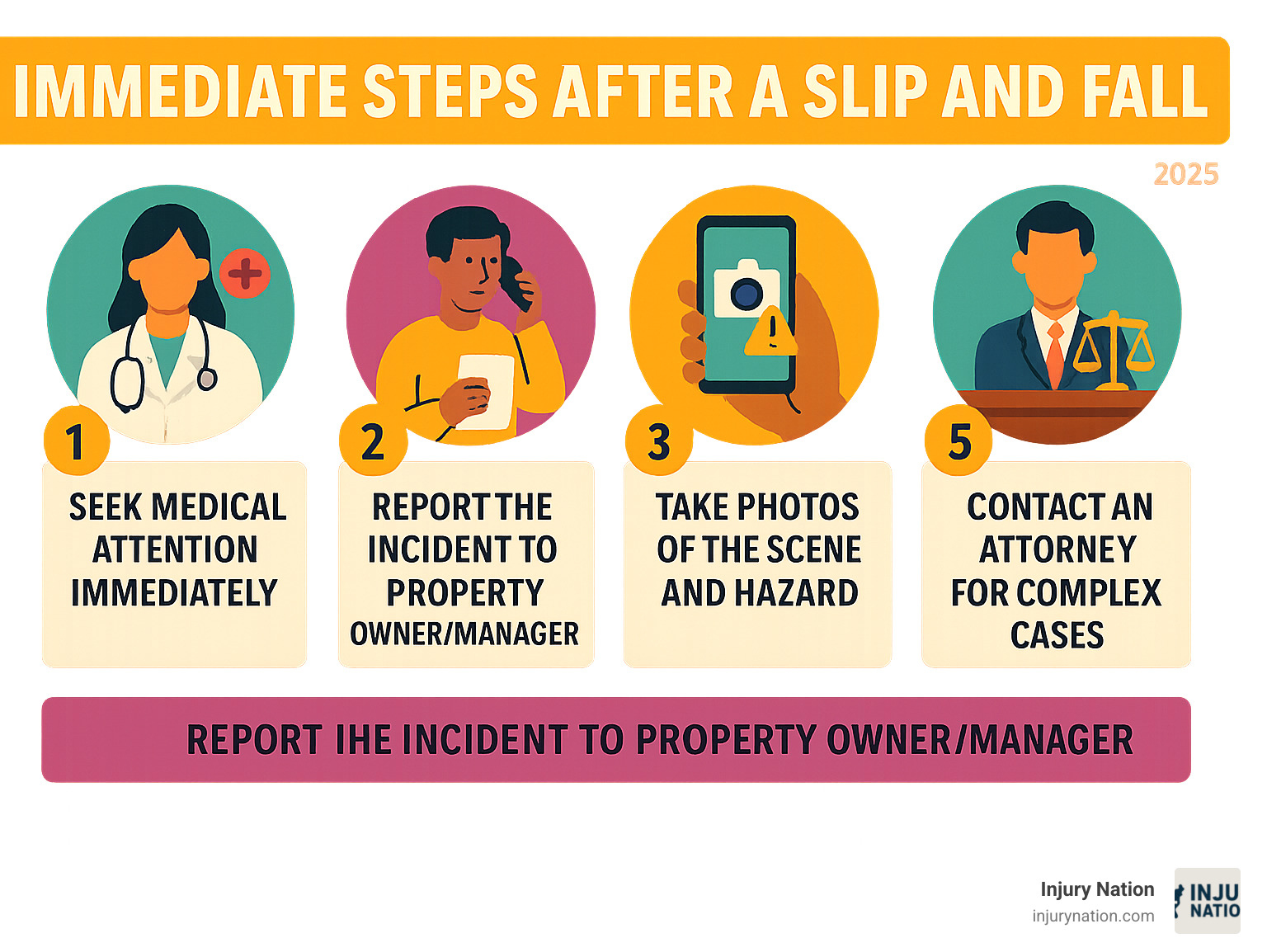
Your First Moves: What to Do Immediately After an Accident
The moments after a fall are confusing, but your actions can determine the outcome of your claim. It’s hard to think clearly when you’re hurt, but these steps are crucial.

- Seek Medical Attention: Your health is the priority. Get checked by a doctor, even if you feel fine. Some serious injuries, like head trauma, have delayed symptoms. Medical records are vital for proving your case.
- Report the Incident: Inform the property owner or manager about your fall. Insist on an official accident report and get a copy.
- Document Everything: Use your phone to take photos and videos of the scene. Capture the specific hazard that caused your fall (e.g., the puddle, cracked tile) and the surrounding area, noting poor lighting or lack of warning signs.
- Get Witness Information: If anyone saw you fall, get their name, phone number, and email address. Their testimony can be invaluable.
- Preserve Evidence: Keep the clothes and shoes you were wearing in a safe place without washing them. They may be important evidence.
- Be Careful What You Say: Stick to the facts. Do not admit fault or speculate on the cause of the fall. Be cautious when speaking to insurance adjusters without legal advice.
Understanding the Statute of Limitations
Every state has a statute of limitations, which is a legal deadline for filing a lawsuit. If you miss it, your case is void. The clock starts from the date of your fall.
Most states allow two or three years, but it varies. In Nevada, you have two years for personal injury claims. Acting quickly is essential not just for legal deadlines but because evidence like surveillance footage and witness memories disappears over time.
Consulting an attorney for slip and fall cases early ensures you meet all deadlines while you focus on recovery. Don’t let a valid case expire because you waited too long.
The Legal Hurdle: Proving Negligence and Fault
Getting hurt in a fall doesn’t automatically guarantee compensation. You must prove that someone else was legally responsible, or negligent. An attorney for slip and fall cases builds your claim on four key elements:
- Duty: The property owner had a legal obligation to keep the premises reasonably safe for visitors.
- Breach: The owner failed to meet that duty (e.g., didn’t clean a spill or fix a broken step).
- Causation: The owner’s failure directly caused your fall and subsequent injuries.
- Damages: You suffered actual losses, such as medical bills, lost income, and pain.
The “Notice” Concept: Actual vs. Constructive Knowledge
A critical part of proving negligence is showing the property owner had “notice” of the dangerous condition.
- Actual notice means the owner or an employee knew about the specific hazard (e.g., a customer reported a spill).
- Constructive notice means the hazard existed long enough that a reasonable owner should have finded and fixed it (e.g., a spill that was on the floor for hours).
Your lawyer will use evidence like surveillance video, maintenance logs, and witness statements to establish notice.
Contributory Negligence Explained
Insurance companies will often argue you were partially at fault for your accident—this is called contributory negligence. They might claim you were distracted by your phone or wearing inappropriate shoes to reduce their liability.
How this affects your claim depends on your state. Most states, including Nevada, use a “comparative negligence” rule. This means your compensation is reduced by your percentage of fault. For example, if your damages are $50,000 and you are found 20% at fault, your award is reduced to $40,000.
An experienced attorney for slip and fall cases knows how to counter these tactics and prove the property owner was primarily responsible.
More info about the legal process on our Blog.
The Role of an Attorney for Slip and Fall Cases
After a fall, you’re dealing with injuries, medical bills, and insurance calls. An attorney for slip and fall cases acts as your advocate and guide through the complex legal system. Their involvement from day one is crucial, as the property owner’s insurance company already has a legal team working to minimize your claim.
Building Your Case and Maximizing Compensation
A skilled attorney provides comprehensive support:
- Investigation and Evidence Gathering: They investigate the accident, obtain surveillance footage before it’s erased, secure maintenance records, and find witnesses.
- Calculating Total Damages: They go beyond current medical bills to calculate future medical needs, lost earning capacity, and non-economic damages like pain and suffering.
- Hiring Expert Witnesses: For complex cases, they bring in accident reconstruction specialists or medical professionals to provide clear proof of liability and the extent of your injuries.
- Negotiating with Insurers: Attorneys speak the language of insurance adjusters and are not intimidated by their tactics. They know how to counter lowball offers and fight for the full value of your claim.
Insurance companies often offer quick, low settlements, hoping you’ll accept before you know the true cost of your injuries. An attorney protects you from this by accurately calculating future costs and advising you on whether to settle or proceed to trial.
| Settling Out of Court | Going to Trial |
|---|---|
| Faster resolution (usually months) | Longer process (often a year or more) |
| Lower legal costs and less stress | Higher expenses but potentially larger awards |
| Guaranteed outcome you control | Uncertain result decided by judge or jury |
| Private agreement kept confidential | Public record of proceedings |
Proving Liability and Increasing Your Payout
Statistics show that clients represented by attorneys typically receive significantly higher settlements. This is because lawyers have the negotiation skills, legal resources, and experience to build a powerful case. They prove the property owner was negligent by organizing evidence into a compelling narrative. They also effectively counter claims of contributory negligence, where the defense tries to blame you for the fall.
For cases involving catastrophic injuries, an attorney’s access to life care planners and economic experts is invaluable for projecting lifetime costs. Hiring an attorney for slip and fall cases levels the playing field and significantly increases your chances of receiving fair compensation.
Frequently Asked Questions About Slip and Fall Claims
It’s natural to have questions after a slip and fall injury. Here are answers to some of the most common concerns.
What types of damages can be recovered in a slip and fall case?
The goal is to recover compensation for all your losses. These damages are typically divided into two categories:
- Economic Damages: These are your calculable financial losses, including current and future medical bills, lost wages, lost earning capacity, and rehabilitation costs.
- Non-Economic Damages: These compensate you for non-financial losses that impact your quality of life, such as pain and suffering, emotional distress, and loss of enjoyment of life.
An experienced attorney for slip and fall cases ensures all damages are properly calculated and included in your claim.
How long does a slip and fall case take to resolve?
The timeline varies for every case. A straightforward case that settles might resolve in several months to a year. If a case goes to trial, it can take a year or more. Factors that influence the duration include the severity of your injuries (your claim can’t be valued until you reach maximum medical improvement), the complexity of the case, and the insurance company’s willingness to negotiate fairly. Your attorney will work to resolve your case efficiently while protecting your right to full compensation.
What if I fell on a friend’s or neighbor’s property?
This is an emotionally difficult situation, but it’s important to know that you are not suing your friend or neighbor personally. The claim is filed against their homeowner’s insurance policy. This is precisely why they have insurance—to cover accidents and protect both the homeowner and their guests from financial hardship. The insurance company handles the claim and pays for your damages. An attorney for slip and fall cases can help steer this sensitive process to preserve your relationship while securing the compensation you need.
Conclusion: Making the Right Decision for Your Case
Slip and fall cases are more complex than they seem. Proving liability involves navigating legal requirements, procedural deadlines, and insurance company tactics designed to minimize your payout. The stakes are high, with mounting medical bills, lost income, and significant pain and suffering.
This is where an attorney for slip and fall cases provides immense value. They are advocates who understand the system, know how to build a strong case, and can negotiate effectively with insurers. While some minor falls may not require legal help, professional guidance is critical for serious injuries, disputed liability, or unfair settlement offers.
Many attorneys offer free consultations to review your case and provide honest feedback. This initial conversation can give you valuable insight, even if you decide not to hire them.
At Injury Nation, we understand every situation is unique. Our directory connects you with experienced legal professionals who have handled cases just like yours and are committed to protecting your rights. Don’t make this decision alone.
Find top-rated personal injury lawyers in your area to discuss your case