

What Happens After Your Employer Denies a Workplace Injury Report in Charlotte?
If you were hurt at work and your employer says the injury did not happen the way you reported it, or refuses to acknowledge the report at all, you may feel stuck, angry, and unsure what to do next. This situation is more common than many workers expect. A denial at the employer-report stage does not automatically mean your injury is not real, and it does not mean you should stop documenting what happened.
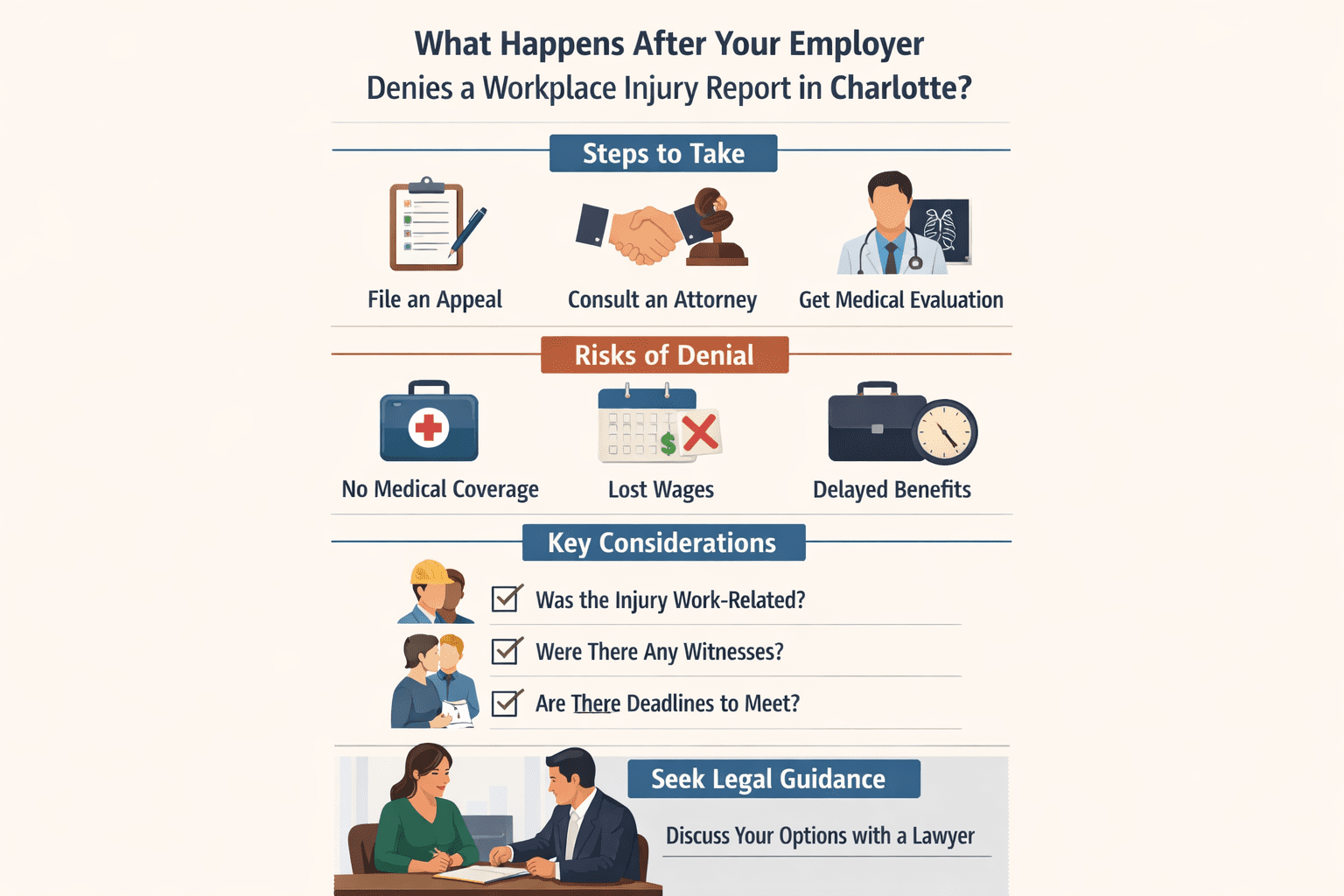
When people search for charlotte workers comp employer denies injury report, they are usually looking for one thing: practical next steps. If that is your situation, the most important move is to stay calm, protect your medical record, preserve evidence, and get clear guidance before your claim becomes harder to prove. In Charlotte, workers across construction sites, warehouses, hospitals, restaurants, office settings, delivery jobs, and transportation roles can all face injury-report disputes. The path forward often depends on what you do in the first hours and days after the denial.
This guide explains what to do immediately, why employers sometimes dispute workplace injuries, how notice and medical care usually fit into the process, when legal help becomes important, and what practical next actions can protect your claim.
Start With This: A Denied Injury Report Is Not the End of the Story
Many injured workers hear something like:
- “You never told us about the injury.”
- “That did not happen at work.”
- “You must have been hurt somewhere else.”
- “There were no witnesses.”
- “You finished your shift, so it cannot be serious.”
- “This sounds like a preexisting condition.”
Statements like these can make people assume they have no claim. That is often not true. Employers and insurance carriers may question whether the injury happened at work, whether it was reported on time, whether the medical problem is connected to the job, or whether the injury is severe enough to justify benefits. Those are disputes. A dispute is not the same thing as a final defeat.
What matters now is whether you can create a clear record showing:
- When and where the injury happened
- How it happened
- Who you told and when
- What symptoms you had right away
- What medical care you received
- How the injury affected your ability to work
The sooner you build that record, the better.
Immediate Documentation Steps After an Employer Denies Your Workplace Injury Report
If your employer denies your report, your first priority is documentation. Do not rely on memory alone. Create a paper trail and keep it organized.
1. Write down exactly what happened
As soon as possible, prepare a detailed written account of the incident. Include:
- The date and approximate time of the injury
- The job site, building, floor, vehicle, or work area
- The task you were performing
- What equipment, machinery, tools, or materials were involved
- What went wrong
- What body parts were affected
- What symptoms began immediately
- Whether you stopped working, slowed down, or finished the shift in pain
Keep the facts straightforward. Avoid exaggeration. Specific details tend to be more helpful than emotional statements.
2. List every person you notified
Make a list of everyone you told about the injury, including:
- Your direct supervisor
- A lead worker or manager on duty
- Human resources
- A safety officer
- A dispatcher or scheduler
- Co-workers who saw your condition change
For each person, write down the date, time, method of communication, and what was said. If the conversation happened by text, email, app message, or voicemail, save screenshots and backups.
3. Save any written communications
Preserve all communications related to the injury, including:
- Text messages with supervisors or co-workers
- Emails to management or HR
- Accident-report forms
- Shift logs
- Schedule changes after the injury
- Messages telling you not to report or not to seek treatment
Store copies somewhere outside your work device, such as a personal email folder, cloud drive, or printed file. If access to your work phone or account is cut off later, you do not want to lose key evidence.
4. Identify witnesses
Even if no one saw the exact moment of injury, there may still be witnesses who can support your claim. Helpful witnesses may include people who:

- Saw the accident occur
- Heard you report the injury right away
- Noticed you limping, holding your back, or leaving early
- Helped you after the incident
- Know about unsafe conditions at the job site
Write down their names, job titles if known, and contact information if you have it.
5. Take photographs if you can do so safely and lawfully
If possible, document:
- The area where the injury happened
- Wet floors, broken steps, faulty equipment, or other hazards
- Visible injuries such as cuts, swelling, bruising, or burns
- Torn clothing, damaged gear, or defective tools
Do not put yourself at risk to get photos. If you cannot access the area later, your early photos may become very important.
6. Start a symptom journal
Use a notebook, notes app, or dated document to track:
- Pain levels
- Mobility problems
- Headaches, numbness, dizziness, or sleep issues
- Days missed from work
- Trouble driving, lifting, standing, or sitting
- Medical appointments and treatment recommendations
This journal can help show the progression of your condition, especially when the injury is not dramatic on day one but gets worse over time.
7. Keep copies of medical records and bills
Ask for copies of:
- Urgent care records
- Emergency room paperwork
- Doctor visit summaries
- Work restrictions
- Imaging reports
- Prescriptions
- Physical therapy recommendations
Medical records are often the backbone of a workplace injury claim. They can link your symptoms to the work incident and show that you acted promptly.
Notice Basics: Why Reporting Promptly Still Matters Even After a Denial
One of the most common issues in any workplace injury dispute is notice. In simple terms, “notice” means telling the employer that you were hurt on the job. Employers and insurers often look for inconsistencies in when and how the injury was reported.
Even if your first report was brushed aside, denied, or ignored, continue to create a clear record that notice was given. That usually means:
- Reporting the injury in writing if you have not already
- Describing the event clearly and consistently
- Keeping proof of when your written notice was sent
- Saving responses from HR, supervisors, or claims staff
A simple written notice might include:
- Your name and position
- The date of injury
- The location of the incident
- A brief description of what happened
- The body parts injured
- A statement that you are requesting the report be documented
If you already gave verbal notice, written follow-up can help confirm it. For example, you may send an email stating that you are documenting the workplace injury you reported earlier to your supervisor. Keep the tone professional and factual. Do not argue. Do not make threats. The goal is to preserve evidence that notice was provided.
Medical Care Basics: What to Do If Your Employer Does Not Help
Medical documentation can make or break a disputed injury claim. If your employer denies the report, delays action, or tells you to “wait and see,” do not ignore symptoms that need evaluation.
Tell the provider it happened at work
At your medical visit, explain clearly that the injury happened while performing job duties. Describe:
- What task you were doing
- How the injury occurred
- When symptoms started
- Whether symptoms have worsened
If you leave out the work connection, the medical record may later look inconsistent. The chart should ideally reflect that the injury is job-related if that is what happened.
Be accurate about prior issues
If you had a previous injury or chronic pain in the same area, do not hide it. Instead, explain the difference between prior symptoms and what changed after the workplace incident. Many claims become more difficult when a worker says there was never any prior issue, only for records to show otherwise. Accuracy builds credibility.
Follow medical advice
If a doctor recommends rest, imaging, follow-up visits, or therapy, take those instructions seriously. Gaps in treatment can give the insurer room to argue that you were not really hurt or that something else caused the problem.
Ask for work restrictions in writing
If you cannot lift, bend, drive, stand for long periods, or perform other tasks, ask the provider to document restrictions. This can help if your employer later claims you were able to work normally.
Do not minimize pain just to look tough
Many workers in Charlotte industries like construction, manufacturing, delivery, logistics, food service, and healthcare try to push through pain because they need the paycheck. That instinct is understandable, but it can hurt a claim if your records make it seem like the injury was minor when it was not.
Claim Filing Basics When an Employer Disputes the Injury
A denied report often creates confusion about whether a claim has actually been opened. Workers sometimes assume the employer will take care of everything. When the employer disputes the injury, that assumption can be costly.
At a basic level, a workplace injury claim usually involves several moving parts:
- Your report of the injury
- The employer’s internal report
- The insurance carrier’s claim file
- Your medical documentation
- Any formal paperwork needed to request benefits or pursue the claim
If your employer says there is no report, says it is not work-related, or refuses to move the matter forward, you may need to confirm whether a claim was actually submitted to the workers’ compensation insurance carrier and whether additional filing steps are needed on your end. This is where getting timely legal guidance can be especially helpful. A local lawyer or legal resource can identify whether the dispute is at the reporting stage, insurance stage, medical stage, or formal claim stage.
The key takeaway is simple: do not assume the process is moving just because you told a supervisor. Verify what has actually been done and preserve proof of every step you take.
Why Employers Dispute Workplace Injury Reports
Understanding why disputes happen can help you respond more effectively. It is not always personal, but it is always serious.
The employer says the injury was not reported on time
This is one of the most frequent reasons for a dispute. Maybe you told a co-worker but not a supervisor. Maybe you mentioned pain but did not say clearly it came from a work incident. Maybe symptoms developed after a lifting injury and you did not realize how serious it was until later. Delayed reporting often leads to credibility challenges.
The employer argues the injury happened outside of work
If your injury could also happen in everyday life, such as a back strain, knee injury, or shoulder problem, the employer or insurer may claim it happened at home, at the gym, or during some non-work activity.
There were no witnesses
Many legitimate workplace injuries happen when no one is looking. A warehouse worker may twist while moving inventory alone. A nurse may strain a back helping a patient. A driver may feel sudden neck pain loading cargo. Lack of witnesses does not mean the claim is false, but it often leads to closer scrutiny.
The employer points to a preexisting condition
If you had previous treatment for the same body part, the employer may say the current condition is unrelated to work. This is a common issue in repetitive stress injuries, back claims, shoulder injuries, and knee claims.
The facts changed between reports
If your first version says one thing and your later version says another, the employer or insurer may use that inconsistency against you. This is why careful documentation matters from day one.
The injury developed over time
Not every workplace injury is a sudden fall or machine accident. Some come from repetitive lifting, awkward posture, constant driving, keyboard strain, vibration exposure, or repeated physical tasks. Gradual injuries can be harder to prove because there is no single dramatic incident.
The employer fears increased insurance costs or scrutiny
In some cases, employers may be motivated to challenge a claim because workplace injuries affect internal records, insurance relationships, safety investigations, or management reviews. You do not need to prove why they are resistant in order to protect yourself. You just need to recognize that denial can happen even when the injury is real.

Common Charlotte Workplace Injury Scenarios That Often Lead to Denials
Charlotte has a broad employment base, and workplace injury disputes can arise in many settings. While each case is different, certain patterns show up often.
Warehouse and logistics injuries
Workers in fulfillment, loading, shipping, and delivery roles may suffer back strains, shoulder tears, knee injuries, or crush injuries. Employers may argue the worker used improper lifting technique, failed to report immediately, or had prior symptoms.
Construction and trade injuries
Falls, ladder incidents, tool accidents, repetitive strain, and overexertion are common. Disputes may center on whether the injury happened on that site, whether a subcontractor relationship affects the claim, or whether the worker waited too long to seek care.
Healthcare worker injuries
Nurses, aides, technicians, and support staff often suffer lifting injuries, slip and falls, and repetitive-use conditions. Because these workers frequently try to finish the shift despite pain, employers sometimes say the injury could not have been serious if the worker kept working.
Restaurant and hospitality injuries
Burns, falls, cuts, carrying injuries, and repetitive strain are common. High turnover, fast-paced operations, and informal reporting habits can lead to missing or disputed incident records.
Office and corporate environment injuries
Not all workplace injuries involve heavy labor. Slip and falls, stair injuries, ergonomic problems, and repetitive stress conditions happen in office settings too. These claims are sometimes doubted because the workplace seems “safe” on the surface.
Transportation and delivery injuries
Drivers and route workers may be injured entering or exiting vehicles, loading cargo, making deliveries, or being involved in collisions while working. Employers may dispute whether the worker was acting within job duties at the time.
What Not to Do After Your Employer Denies the Report
When workers panic, they sometimes make the case harder without meaning to. Try to avoid these common mistakes.
Do not stop documenting
Some people give up after hearing “we are denying it.” That is exactly when documentation becomes more important, not less.
Do not skip medical care because you assume it will not be covered
If you need treatment, get evaluated. Delaying care can damage both your health and your claim.
Do not exaggerate symptoms
Be honest and specific. Overstatement can undermine credibility.
Do not post casually on social media
Photos, comments, check-ins, or jokes can be taken out of context. If your physical condition is disputed, even harmless posts may be misread.
Do not rely only on verbal conversations
Follow up important communications in writing whenever possible.
Do not assume HR is acting as your advocate
HR may be professional and helpful, but their role is not the same as independent legal guidance. Treat every conversation seriously and keep records.

Do not confront your employer angrily
It is understandable to feel frustrated, but heated exchanges rarely improve a disputed claim. Stay factual, organized, and focused on preserving your rights.
Signs You May Need Legal Help Sooner Rather Than Later
Not every workplace injury dispute requires immediate legal involvement, but many do. When an employer denies the injury report, the risk of delay and evidence loss increases quickly.
Legal help may become especially important if:
- Your employer says no report was ever made
- You were discouraged from seeking medical treatment
- You were told to use personal health insurance without noting it was work-related
- You were pressured to say the injury happened outside of work
- Your injury caused lost time from work
- Your condition is serious, involves surgery, or may cause long-term limitations
- The insurance carrier denies the claim or delays a decision
- You have a preexisting condition the employer is using against you
- There are witness disputes or missing incident records
- You are receiving conflicting information from supervisors, HR, and the insurer
A local personal injury or workers’ compensation lawyer resource in Charlotte can help you understand what stage your claim is in, what records matter most, and what steps should happen next. Early guidance can be especially valuable if you are worried about saying the wrong thing or missing a required deadline.
Practical Next Actions for the First 24 Hours, First Week, and After
Breaking the process into stages can make it easier to manage.
In the first 24 hours
- Write your detailed incident summary
- Report the injury in writing if you have not done so already
- Save all messages and communications
- Photograph injuries and the scene if available
- Seek medical care if needed
- Tell the provider the injury happened at work
- Identify witnesses
In the first week
- Follow up with the employer or HR in writing
- Confirm whether an insurance claim has been opened
- Continue treatment and keep copies of records
- Track missed work and restrictions
- Update your symptom journal daily
- Gather pay records if lost wages may become an issue
- Consider speaking with a lawyer if the report remains denied
In the weeks after
- Stay consistent in all descriptions of the injury
- Attend medical appointments
- Keep records of any claim numbers, adjuster names, and correspondence
- Document any changes in work duties or scheduling
- Get guidance if benefits are delayed, treatment is denied, or you cannot return to work
How a Denied Injury Report Can Affect Your Finances
One reason these disputes feel so urgent is that the consequences are immediate. A denied report can lead to:
- Delayed medical treatment
- Unpaid time off work
- Out-of-pocket expenses
- Confusion over which insurance should be billed
- Pressure to return before you are ready
- Fear of losing your job
If your injury prevents you from working, the stakes are even higher. That is another reason documentation matters so much. Accurate records of missed work, restrictions, and treatment can become essential if the dispute grows more formal.
What to Expect If the Employer Keeps Disputing the Claim
If the employer sticks to the denial, the next stage often involves the insurance carrier and formal claim handling. What happens from there can vary based on the facts, the medical evidence, and the procedures that apply to your claim. Without promising any state-specific outcome, you should generally expect that disputed claims may involve:
- Requests for recorded statements or additional documentation
- Review of medical records
- Questions about prior injuries
- Witness interviews
- Investigation of the accident details
- Potential disputes over treatment, wage benefits, or work status
This is often the point where having legal guidance is especially useful. Disputed claims can turn on small details, and what seems minor to you may be important evidence.
Example Situations That Show Why Details Matter
Example 1: The worker finished the shift
A Charlotte warehouse employee feels a sharp back pain while lifting inventory but keeps working because the shift is busy. The next morning, the pain is much worse. The employer later argues that if the worker really got hurt at work, the worker would have gone home immediately. In this situation, texts to a co-worker, a dated note describing the lift, and prompt medical records can help explain why the worker pushed through the pain at first.
Example 2: No one saw the exact incident
A hospital employee hurts a shoulder repositioning a patient alone in a room. There are no direct witnesses. But a nearby co-worker saw the employee immediately afterward struggling to raise the arm, and the employee reported it before the end of the shift. That witness and the prompt report may matter greatly.
Example 3: The employer says it is an old injury
A delivery worker had mild knee pain months earlier but was performing full job duties. After a work-related twist exiting the truck, the pain becomes severe and swelling starts. Prior records may show the earlier issue was manageable and distinct, while current records show a significant change after the work incident.
These examples are not guarantees of any result. They show why preserving the timeline, medical record, and witness information is so important.
Questions to Ask Yourself Right Now
If your employer denied your workplace injury report in Charlotte, ask yourself:
- Do I have written proof that I notified someone?
- Did I tell my doctor it happened at work?
- Do I have names of witnesses or people I told right away?
- Have I saved texts, emails, or app messages?
- Do my records clearly describe what body part was injured and how?
- Have I tracked missed work and restrictions?
- Do I know whether an insurance claim was actually opened?
- Do I need legal guidance before this gets more complicated?
If several of those answers are “no,” that does not mean the claim is lost. It means now is the time to get organized.

FAQ: Charlotte Workplace Injury Report Denials
Can my employer just refuse to believe my workplace injury happened?
An employer can dispute a report, but that does not automatically decide the claim. Disputes usually turn on evidence such as notice, medical records, witness accounts, and documentation of what happened.
What if I reported the injury verbally but nothing was written down?
Send a written follow-up as soon as possible and keep proof that you sent it. Include the date, time, location, and nature of the injury. Also document who received your verbal report and when.
What if my symptoms started small and got worse later?
That happens often, especially with back, neck, shoulder, and repetitive-use injuries. The important thing is to document when the work event happened, when symptoms started, and how they progressed.
Should I still get medical treatment if my employer denies the report?
If you need treatment, yes. Your health comes first, and prompt medical records can also help document the injury. Make sure the provider knows the injury is work-related if that is accurate.
What if there were no witnesses?
You may still have a valid claim. Many legitimate workplace injuries occur without direct witnesses. Other evidence, such as prompt notice, medical records, texts, and circumstantial witnesses, may still be important.
Can a preexisting condition ruin my claim?
Not necessarily. The key issue is often whether work caused a new injury, worsened an old one, or significantly changed your condition. Honest medical history and strong documentation matter.
When should I talk to a lawyer?
If your employer denies the injury report, your treatment is delayed, your wages are affected, or you are getting mixed information about the claim, it is wise to seek legal guidance promptly.
Local Relevance: Why Charlotte Workers Should Move Quickly
Charlotte’s workforce includes major employers and dense employment corridors across healthcare, transportation, construction, warehousing, finance, hospitality, retail, and service industries. In fast-moving workplaces, injuries may be underreported, brushed aside, or discussed informally instead of documented properly. That can create problems later, especially when shifts are busy, supervisors change, or communication happens by text and app rather than formal paperwork.
Charlotte workers also often commute, work long shifts, and juggle multiple responsibilities outside of work. That can make it tempting to delay treatment or postpone follow-up. But when an employer has already denied the report, time rarely helps the worker. Medical records get harder to connect, memories fade, witnesses become harder to reach, and electronic communications can disappear.
That is why practical next actions matter so much. The goal is not to escalate conflict. The goal is to protect the truth of what happened.
When the Situation Feels Overwhelming, Focus on the Basics
If you are in pain and worried about your job, legal terms and claim procedures can feel like too much. Bring the problem back to the essentials:
- Document the injury clearly.
- Give written notice if needed.
- Get medical care and make sure the work connection is recorded.
- Preserve evidence.
- Track missed work and restrictions.
- Get legal guidance if the denial continues or the claim stalls.
Those steps will not solve every dispute instantly, but they put you in a stronger position than doing nothing.
Conclusion: Take the Next Step if Your Employer Denied Your Workplace Injury Report
When an employer denies a workplace injury report, it can feel like the system is closing its doors on you before your claim even begins. But a denial at that stage is not the final word. If you are dealing with a charlotte workers comp employer denies injury report problem, your next moves matter: document everything, seek appropriate medical care, preserve all communications, and confirm whether a claim has actually been opened.
Most of all, do not wait for the situation to fix itself. Delays can make legitimate workplace injury claims much harder to prove. If your report was denied, your treatment is being delayed, or you are unsure how to move forward, contact a local personal injury lawyer for a free consultation today. Injury Nation helps connect injured people with trusted legal guidance and local lawyer resources when practical answers are needed most.