

Why Expert Witness Fees Matter for Your Personal Injury Case
Expert witness fees are the costs for professionals with specialized knowledge to review your case, provide testimony, and help prove your claim. Here’s a look at typical charges for 2024:
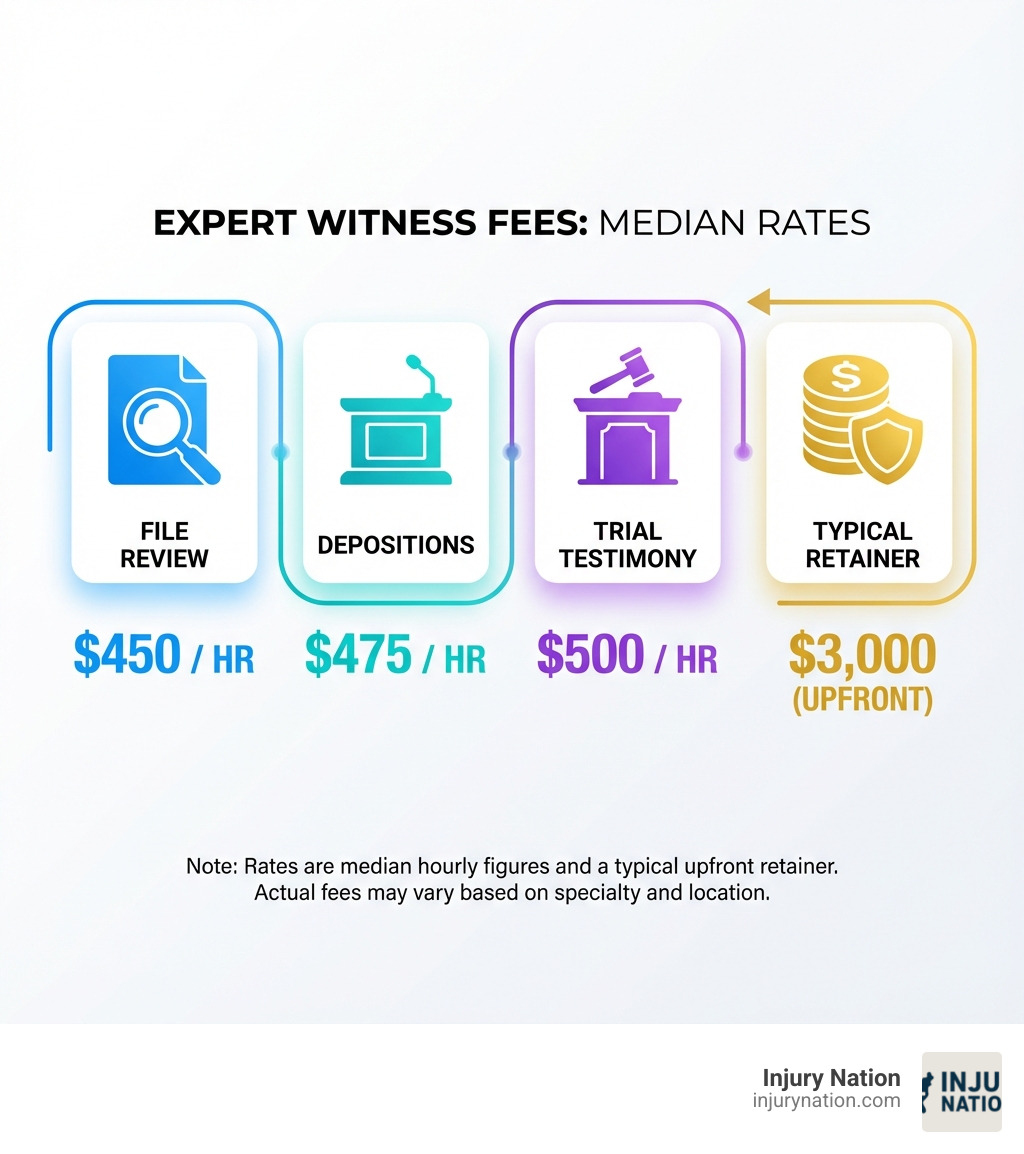
Typical Expert Witness Fees (2024):
- File Review/Case Preparation: $450/hour (median)
- Deposition Testimony: $475/hour (median)
- Court Testimony: $500/hour (median)
- Retainer Fee: $3,000 (median upfront payment)
When pursuing compensation for an injury, you often need an expert to explain complex medical issues, reconstruct an accident, or calculate long-term financial losses.
While these specialists aren’t cheap, understanding their fees prevents surprises. Fortunately, over 70% of experts collect all their fees, and many personal injury attorneys work on contingency, covering these costs upfront.
Costs vary widely based on specialty (a neurosurgeon costs more than a general practitioner) and location, with fees in major cities typically running higher.
A written agreement, required by 64% of experts, is crucial. It protects both parties by defining services, payment terms, and the scope of work, preventing unexpected charges.
Understanding the Numbers: Typical Expert Witness Fee Structures
When engaging an expert witness for a personal injury case in Las Vegas, understanding the financial landscape is crucial. These professionals bring invaluable insights, but their time comes at a price. Generally, expert witness fees are structured around hourly rates that vary by task.
Average Hourly Rates by Task
Data from SEAK’s 2024 Expert Witness Fee Study provides a clear picture:
- File Review and Case Preparation: For reviewing documents and forming initial opinions, the median fee is $450/hour.
- Deposition Testimony: Given the preparation and stress involved, the median fee for deposition testimony is $475/hour.
- Court Testimony: Reflecting the high pressure and commitment of a trial, the median fee for court testimony is $500/hour.
These figures show that the more public and high-stakes the task, the higher the hourly rate. Testifying in court demands the most rigorous preparation and thus commands the highest fee.
How Fees Have Changed Over Time
Expert witness fees have shown a steady increase in recent years.
Since 2021, median fees for file review have risen 12.5% and deposition fees are up 5.3%, while trial testimony fees have remained stable. This upward trend isn’t new; a significant 68% of experts raised their rates in the last five years, a move almost all found beneficial. This suggests the market supports these increases, which have outpaced inflation since 2017.
Conversely, 32% of experts haven’t raised their rates in five years, potentially eroding their purchasing power. Attorneys should be prepared for evolving costs, viewing expert services as a key investment in their case.
What Factors Influence Expert Witness Fees?
Just like a custom-built car, the price of an expert witness isn’t one-size-fits-all. Several factors shape their compensation, reflecting their unique skills and the demands of the legal arena.

Key Factors That Drive Expert Witness Fees
- Specialty: Highly specialized fields command higher rates. Medical experts, particularly specialists like neurosurgeons or orthopedic surgeons, often charge more than non-medical experts due to the complexity of their knowledge.
- Experience and Reputation: An expert with decades of experience and a strong track record will charge more. Their reputation for clarity and resilience under cross-examination adds significant value.
- Geographic Location: Fees vary by region. In busy legal markets like Las Vegas, high demand can lead to rates that meet or exceed national averages.
- Case Complexity and Time Commitment: Cases requiring extensive research, multiple reports, or lengthy testimony will have higher overall costs.
- Urgency: Rush jobs often incur a premium, as the expert may need to reschedule other work to meet a tight deadline.
Differences in Rates Between Specialties
The disparity in expert witness fees across different fields is pronounced, with medical experts often leading the pack. In Nevada personal injury cases, a diverse range of experts can be crucial:
- Medical Experts: Crucial for establishing the nature, cause, and prognosis of injuries. Their fees reflect extensive education and specialized training.
- Accident Reconstruction Experts: Use physics and engineering to determine how an accident occurred, which is vital for proving fault.
- Engineering Experts: For product or premises liability cases, engineers analyze product defects or structural issues.
- Financial Experts (Accountants/Economists): Calculate economic damages like lost wages and future earning capacity.
- Vocational Rehabilitation Experts: Assess an injured person’s ability to return to work and future earning potential.
While median hourly fees provide a general benchmark, a highly sought-after expert in a niche field, especially one with extensive testimonial experience in Nevada courts, might command fees significantly higher than the median.
The Nuts and Bolts of Engagement: Retainers, Agreements, and Expenses
Engaging an expert witness involves a clear understanding of financial commitments, contractual obligations, and potential additional expenses. It’s the foundation for a strong partnership that will support your case.

Retainers and Upfront Costs
A retainer is an initial, often non-refundable, payment to secure an expert’s services, covering their initial time and commitment.
- Median Retainer: The median retainer for expert witnesses is $3,000, a 15% increase since 2021, showing a trend toward more substantial upfront commitments.
- Purpose: The retainer usually covers the initial case review and acts as a minimum fee, ensuring the expert is compensated even if the case settles or is dropped early.
- Replenishing Retainers: Attorneys often provide an initial retainer and then replenish it as work progresses. This ensures the expert is consistently paid without invoicing delays.
The Importance of a Written Retention Agreement
The golden rule is to get it in writing. While 64% of experts require a written retention agreement, it’s a best practice in all cases.
Why is a written agreement so crucial?
- Clarity and Expectations: It defines the scope of work, fees, and payment terms to prevent misunderstandings.
- Risk Mitigation: It protects both parties by outlining procedures for cancellations, rescheduling, or overdue fees. For example, some agreements specify cancellation fees for testimony (e.g., 25% for 1-2 days’ notice, 100% for same-day cancellation).
- Payment Assurance: It specifies due dates and consequences for non-payment, such as interest on overdue payments.
- Legal Protection: It serves as a binding legal document in case of a dispute.
Common Expenses Beyond the Hourly Rate
Experts often charge for various expenses beyond their hourly rate, which should be outlined in the retention agreement:
- Travel Costs: Includes airfare, hotels, and ground transportation for site visits, depositions, or court appearances. Some experts charge their hourly rate for travel time, while others bill for expenses.
- Report Writing: While often part of the hourly “case preparation” rate, complex reports may be itemized separately.
- Administrative Fees: Costs for secretarial support, copying, scanning, and secure evidence storage.
- Testing and Research Costs: Billed for specific lab work or specialized research required for the case.
- Per Diems: A daily allowance for meals and incidentals, particularly during travel.
Legal and Jurisdictional Differences
The world of expert witness fees isn’t governed by a single rulebook. Compensation can vary significantly depending on the jurisdiction and whether the expert is retained privately or by a government entity.
Government vs. Privately Retained Experts
When the Federal Government engages witnesses, fee structures differ significantly.
- Fact Witnesses: In federal proceedings, fact witnesses testify about personal observations and are paid a fixed statutory rate of $40 per day plus travel costs.
- Expert Witnesses for the Federal Government: Experts hired by agencies like the Department of Justice (DOJ) are compensated based on negotiations with the government attorney. This allows the government to secure specialized knowledge for complex cases.
Court-Appointed vs. Party-Hired Experts
Another important distinction lies between experts hired by a party and those appointed by the court.
- Party-Hired Experts: These are experts retained by the plaintiff or defendant, with fees negotiated and paid by the retaining party.
- Court-Appointed Expert Witnesses: Under Federal Rule of Evidence 706, a judge can appoint an expert to provide impartial testimony on complex matters, helping to avoid bias from “hired guns.”
- Compensation: The court sets “reasonable compensation,” which is typically paid by the parties in a civil case as directed by the court.
- Impartiality: A court-appointed expert can have a “sobering effect” on party-hired experts, and their testimony may carry more weight with a jury, ensuring fairness in technical disputes.
State and International Fee Structures
Individual states like Nevada have their own laws governing expert compensation.
- Nevada’s Approach: Unlike states that use the federal Daubert standard, Nevada follows Nevada Revised Statute § 50.275. This statute allows expert testimony if it helps in understanding the evidence and the expert has specialized knowledge. The Nevada Supreme Court has clarified that testimony is admissible as long as the expert is qualified and their opinion is helpful, which can be a more permissive standard. This means expert testimony must be relevant, reliable, and necessary. The judge acts as a gatekeeper, ensuring the expert’s methods are sound and accepted in their field.
- Other State Examples: While specific regulations like California Government Code § 68092.5 don’t apply in Nevada, the core principles of reasonableness and clear agreements are universal in U.S. law.
Challenges and Best Practices for Attorneys and Experts
Managing expert witness fees effectively requires diligence and clear communication to avoid friction. Adhering to best practices is key for both experts and attorneys.
Common Challenges in Fee Collection
While 71% of experts collect all fees, a significant 29% have experienced non-payment, creating issues for both experts and attorneys.
Several factors contribute to collection difficulties:
- Vague or non-existent written agreements.
- Attorneys underestimating the time required.
- Reluctance to pay after a loss or small settlement.
- Experts for plaintiffs report more collection issues, possibly due to contingency fee structures.
- Slow adoption of modern payment methods like credit cards (25% of experts) and electronic invoicing (33%).
Best Practices for Managing Expert Witness Fees
To ensure a smooth engagement, we recommend the following best practices:
For Experts:
- Review Fees Annually: Regularly adjust rates to match inflation and market value.
- Require Written Agreements: Always use a comprehensive contract detailing scope, fees, and payment terms.
- Be Transparent About Expenses: Clearly list all potential costs beyond the hourly rate in the agreement.
- Offer Diverse Payment Options: Accept credit cards, ACH, and wire transfers to facilitate payment.
- Communicate Promptly: Be responsive to inquiries to secure more engagements.
For Attorneys:
- Provide Upfront Retainers: Offer an initial retainer and be prepared to replenish it as work progresses.
- Insist on a Written Agreement: Protect your client and ensure clarity with a detailed contract.
- Understand All Costs: Thoroughly review the expert’s full fee schedule before signing.
- Communicate Clearly: Keep the expert updated on case progress and deadlines.
- Pay Promptly: Adhere to the payment schedule to maintain a good working relationship.
By following these practices, legal teams and expert witnesses can foster stronger relationships, ensuring financial collaboration is clear and straightforward.
Frequently Asked Questions about Expert Witness Fees
Navigating the financial aspects of expert witness engagement can bring up many questions. Here are some of the most common inquiries.
Who is responsible for paying the expert witness fees?
The party that hires the expert is responsible for payment. In personal injury cases, the plaintiff’s law firm typically covers these costs upfront, especially on a contingency basis. The contract is with the firm, not the client.
- Prevailing Party: In some jurisdictions, the winning party may be able to recover expert witness fees from the losing party as part of litigation “costs.”
- Court-Ordered: A court may order a specific party to pay, especially for court-appointed experts.
- Specific State Laws: Rules vary by state. For example, California’s Government Code § 68092.5 has detailed rules on who pays. This highlights the importance of understanding local laws in your jurisdiction, like Nevada.
Are expert witness fees negotiable?
Yes, fees are often negotiable, though flexibility varies.
- What’s Negotiable: Retainer amounts, payment schedules, travel expense handling, and the scope of work are often flexible. A phased approach can also help manage costs.
- What’s Less Negotiable: An expert’s core hourly rate is less flexible, as it reflects their experience and market demand. Top experts in niche fields often have firm rates.
- Best Practice: Always discuss fees and payment terms upfront. Open communication can lead to mutually agreeable terms.
What happens if an expert’s fee is deemed unreasonable by the court?
If a court finds a fee unreasonable, it can intervene and set a fair one.
- Challenging the Fee: A party can file a motion with the court to challenge the fee’s reasonableness.
- Informal Resolution First: Parties are usually required to first attempt to resolve the issue directly with the expert.
- Court’s Determination: The court will consider factors like the expert’s customary rates, prevailing community rates (e.g., in Las Vegas), case complexity, and the expert’s qualifications to determine a reasonable fee.
- Nevada Context: In Nevada, courts ensure expert compensation is fair and justifiable. This prevents excessive charges and underscores the need for experts to justify their rates and for attorneys to vet them carefully.
Win Your Case with the Right Legal and Expert Team
Navigating the complexities of a personal injury claim, especially those involving significant injuries or technical details, often hinges on the quality of your expert testimony. These professionals are not just witnesses; they are crucial members of your legal strategy team, helping to build a compelling narrative that proves causation, establishes liability, and quantifies damages.
By understanding the landscape of expert witness fees, from typical hourly rates and retainers to the factors that influence costs and the best practices for engagement, you can make informed decisions that strengthen your case. In Las Vegas, where robust legal representation is key to securing fair compensation, the right expert can be the difference between a good settlement and a great one.
We at Injury Nation are dedicated to connecting victims with top-rated personal injury lawyers who understand the critical role of expert witnesses. Our network of attorneys in Las Vegas and across the country works tirelessly to ensure that every aspect of your case, including expert testimony, is handled with the utmost professionalism and strategic insight.
Don’t let the complexities of expert witness compensation deter you. Focus on finding the right legal and expert team to fight for the justice you deserve.