

Why a Car Accident Claim in Houston May Slow Down While Doctors Rule Out Long-Term Injuries
If your case seems to be moving more slowly than you expected, you are not alone. A houston car accident claim delayed medical evaluation situation is common when doctors are still trying to understand how serious an injury really is. That can be frustrating, especially when bills are arriving, work has been disrupted, and the insurance company keeps asking for updates.
In many Houston car accident cases, a slower claim does not automatically mean something is wrong. It often means the medical picture is still developing. Before a claim can be properly valued, doctors may need time to monitor symptoms, order imaging, refer you to specialists, and determine whether you are improving or whether the crash caused long-term problems.
This article explains why treatment progress affects claim timing, how to tell the difference between an unnecessary delay and necessary case development, what role record requests and insurer review play, and what you can do to stay organized while your case is still taking shape.
Why Medical Evaluation Matters So Much in a Houston Car Accident Claim
After a crash, it is natural to focus first on the vehicles, the police report, and immediate insurance questions. But in most injury claims, the medical evidence ends up driving the timeline.
That is because compensation is usually tied to questions like:
- What injuries did you suffer?
- Were those injuries caused by the crash?
- What treatment was necessary?
- How long did recovery take?
- Did you miss work or lose earning capacity?
- Will you need future care?
- Did the injuries leave any lasting limitations or pain?
Those questions often cannot be answered accurately in the first days or weeks after a collision. Some injuries look minor at first and become more serious later. Others improve steadily. Some symptoms are obvious on day one, while others take time to appear or to connect to a specific diagnosis.
In Houston, where crashes on I-10, I-45, Loop 610, Beltway 8, US-59, and busy local roads can involve hard impacts, chain reactions, and delayed symptom onset, it is not unusual for a claim to pause while doctors try to determine the full extent of the damage. Waiting for that medical clarity can feel slow, but it often protects the value and accuracy of the claim.
A Slower Claim Is Not Always a Bad Sign
Many injured people assume that if a claim is not moving fast, the insurance company must be ignoring it or the case must be weak. Sometimes that is true. But often, a slower pace simply means the case is not ready to be evaluated fairly.
There is a major difference between:
Necessary case development
This happens when records are still coming in, treatment is ongoing, specialists have not finished evaluating you, or the long-term impact of the injury is still unclear. In that setting, moving too fast can hurt the claim because key damages are still unknown.
Unnecessary delay
This happens when calls go unanswered, records are not requested promptly, insurer requests sit unresolved for long periods, or no one is actively tracking what is missing. This kind of delay can often be reduced with better communication and organization.
The hard part for injured clients is that both situations can look similar from the outside. In both, the claim may seem to be “waiting.” The real question is whether it is waiting for a valid reason and whether someone is actively managing the next steps.
Why Treatment Progress Affects Claim Timing
Treatment progress affects nearly every part of a personal injury claim. Until your doctors have a clearer picture of how you are healing, it is difficult to calculate damages with confidence.
Early symptoms do not always show the full injury
After a collision, adrenaline can mask pain. You may feel sore but assume it will pass. Then, days later, your neck stiffens, headaches worsen, numbness develops, or back pain starts interfering with sleep and work. Soft tissue injuries, concussions, disc injuries, shoulder damage, and nerve issues may not be fully understood right away.
If a claim is pushed toward resolution before those symptoms are fully documented, the final value may not reflect what you are actually dealing with.
Doctors may need time to see whether symptoms resolve
One of the biggest reasons a claim slows down is that doctors often cannot say immediately whether a condition will heal with conservative care or become a long-term problem. They may begin with rest, medication, physical therapy, and follow-up monitoring. If that works, the claim may remain relatively straightforward. If it does not, more testing or specialist care may be needed.

This period of observation is often medically appropriate. It is not just “waiting around.” It is part of understanding the real prognosis.
Maximum improvement is not always immediate
In many claims, a key issue is whether the injured person has reached a stable point in recovery. That does not mean perfect healing. It means the doctors have enough information to say where things stand now, what permanent issues may remain, and whether future treatment is likely. Until that point, the claim may be difficult to value with accuracy.
Future damages depend on medical clarity
If you may need injections, surgery, extended therapy, neurological care, orthopedic treatment, or pain management later, that affects the claim. But those future damages need support. A lawyer or insurer generally cannot just guess. They need records, recommendations, and medical opinions that connect future care to the crash.
Common Medical Reasons a Houston Car Accident Claim May Be Delayed
When people hear “medical delay,” they sometimes picture one single issue. In reality, several moving parts may be involved at once.
1. Ongoing physical therapy or conservative treatment
Many crash victims start with physical therapy, chiropractic care, primary care follow-ups, or pain management. This phase may last weeks or months depending on symptoms and response. The purpose is not just treatment. It also helps establish whether the injury is improving, plateauing, or worsening.
2. Waiting on diagnostic imaging
X-rays may show one thing, while an MRI may reveal something more significant. If your doctor suspects a disc problem, ligament damage, joint injury, or internal issue, imaging may be needed before the full injury picture is clear.
3. Specialist referrals
A referral to an orthopedist, neurologist, pain specialist, spine specialist, or other provider can add time. Appointments may not be immediate, especially in busy metro areas like Houston. But those referrals often help answer critical questions about permanence, causation, and future treatment needs.
4. Concussion or traumatic brain injury evaluation
Head injury symptoms may be subtle at first. Problems with concentration, headaches, dizziness, light sensitivity, sleep disruption, mood changes, or memory may require follow-up before a diagnosis becomes clearer. Claims involving possible brain injury often need careful medical development.
5. Preexisting condition review
Insurance companies commonly examine whether the injured person had prior back pain, prior neck issues, arthritis, prior surgeries, or past treatment for similar complaints. That does not mean your claim fails. It does mean doctors and lawyers may need records to distinguish what was preexisting from what the crash worsened.
6. Unclear prognosis
Sometimes the issue is not diagnosis but outlook. A doctor may know you have a certain injury but may not yet know whether it will resolve completely, require restrictions, or lead to chronic pain. That uncertainty affects settlement evaluation.
7. New symptoms appearing later
A claim can also slow down if a person who initially thought they were recovering begins experiencing new symptoms, such as radiating pain, reduced range of motion, numbness, migraines, or psychological distress. When the medical picture changes, the claim may need to change with it.
The Role of Record Requests in Claim Delays
Medical treatment is one part of the timeline. Gathering proof of that treatment is another. Even when you are doing everything right, record requests can slow progress.
Why records matter
To evaluate a claim, the insurer and your legal team may need:
- Emergency room records
- Ambulance records
- Imaging reports
- Primary care notes
- Specialist records
- Physical therapy records
- Billing statements
- Itemized charges
- Work restrictions
- Disability notes
- Prescription records
Each provider may have a different release form, processing system, response time, and billing procedure for records. Some send records quickly. Others take repeated follow-up. If treatment occurred at multiple facilities across the Houston area, collecting everything can take time.
Why record requests can be slower than people expect
Medical offices are focused on patient care first, not legal claim turnaround. Some outsource record fulfillment. Some require exact forms. Some need identity verification. Others separate records from billing, which means two requests instead of one. If anything is incomplete, the request may be delayed or rejected.
This is one reason a claim may feel stalled even though work is happening behind the scenes. Until records arrive, a legal team may not be able to prepare a complete demand package or respond effectively to insurer questions.
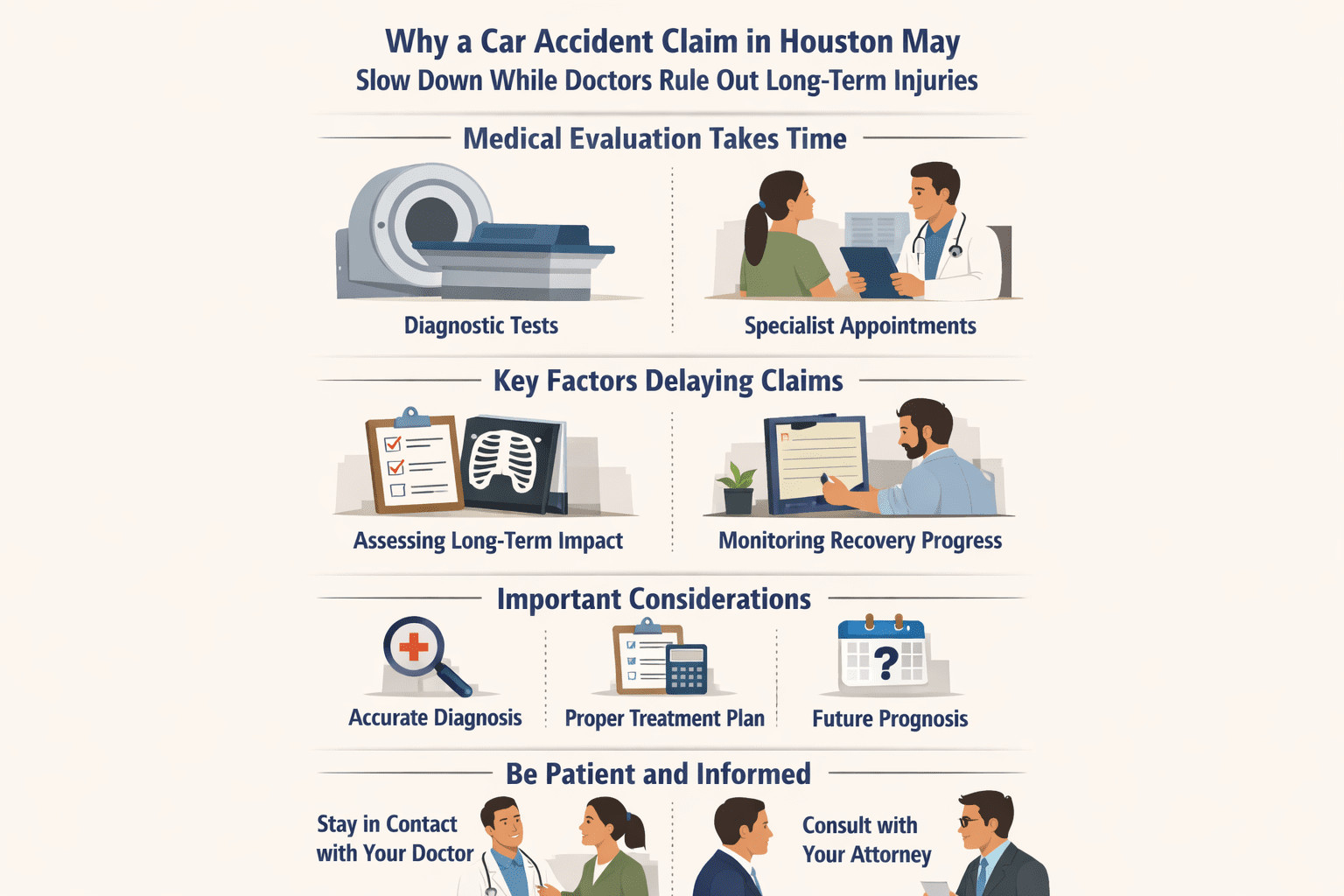
How Specialist Referrals Affect Case Timing
Specialist referrals are one of the clearest examples of necessary case development. They can add time, but they often add clarity too.
Why specialists are important
A specialist may be the provider best qualified to confirm:
- Whether a disc herniation is clinically significant
- Whether nerve compression is present
- Whether surgery is being considered
- Whether a shoulder, knee, or spine injury is likely to leave permanent impairment
- Whether ongoing pain has a documented source
- Whether future treatment is medically reasonable
That information may significantly affect claim value. Without it, the insurer may argue that the injury is temporary, minor, or unsupported.
Why referrals create delays that may still be worth it
Specialists often have longer wait times. They may order additional tests, want follow-up visits, or recommend trying conservative care before giving a final opinion. From the client’s perspective, this can feel like the claim is being dragged out. But in many cases, those extra steps are what turn a vague injury story into a documented one.
How Insurance Company Review Slows Claims
Even after treatment records begin coming in, the insurance review process can create another layer of delay.
Insurers usually want a more complete medical picture
An insurance adjuster evaluating an injury claim often wants to know whether treatment has ended or at least stabilized. If the file shows that you are still actively treating, still undergoing testing, or still awaiting a specialist opinion, the insurer may take the position that it cannot fully evaluate the claim yet.
That can be frustrating, but from a claim valuation standpoint it is not surprising. The insurer is trying to assess exposure based on the available records, diagnoses, medical costs, and expected future damages.
Adjusters look for consistency
Insurance review also involves checking whether the records line up. They may compare:
- The crash report
- Your statement
- Vehicle damage information
- Emergency room complaints
- Primary care notes
- Specialist findings
- Gaps in treatment
- Prior injury history
If there are inconsistencies, missing records, long gaps, or unclear diagnoses, the insurer may request more information rather than moving quickly toward resolution.
Review can become more layered in larger injury claims
When injuries appear more serious, insurer review may involve supervisors, outside consultants, or more detailed analysis of medical records and billing. That does not automatically mean denial. It may simply mean the file is being reviewed more carefully because more money may be at stake.
Difference Between a Real Delay and Necessary Case Development
This distinction matters because not every slow case is being mishandled.
Signs of necessary case development
- You are still actively treating or waiting on follow-up appointments
- Your doctor has not yet determined whether the injury is long term
- Imaging or specialist evaluation is pending
- Records and billing are still being collected from multiple providers
- Your legal team is updating the file as new information arrives
- The insurer is waiting on a complete demand package or final records
Signs of possible unnecessary delay
- No one can tell you what records are still missing
- You are not getting returned calls or clear updates
- Long periods pass with no action and no explanation
- Requested forms or authorizations were never sent
- The claim status has been unclear for an extended time
- You do not know whether the insurer has the documents it requested
If your case is moving slowly, ask specific process questions rather than assuming the worst. For example:
- What records are still outstanding?
- Are we waiting on any specialist reports?
- Has the insurer asked for anything else?
- Are there any treatment gaps we need to explain?
- What is the next major milestone in the claim?
These questions can help you understand whether your case is progressing normally or whether there is a fixable communication problem.
Why Settling Too Early Can Be Risky
When financial pressure is high, a quick settlement can sound appealing. But if doctors are still ruling out long-term injuries, settling too early can create serious problems.
You may not know the full cost of your injury yet
If additional treatment becomes necessary after settlement, you may be responsible for those costs yourself. A claim generally should reflect not only what has already happened, but also credible future losses when they can be documented.
Your symptoms may worsen after the first offer arrives
It is common for people to think they are improving, only to discover that pain returns when they go back to full work duty, driving, lifting, childcare, or normal daily routines. Once a case is resolved, reopening it is usually not an option.

Temporary-looking injuries sometimes are not temporary
Some crash injuries begin as “strain” or “sprain” complaints but later show deeper structural issues or more persistent limitations. This is one reason a careful claims process often takes longer than injured people hope.
What Houston Clients Can Do to Keep Updates Organized
You cannot control every part of a medical timeline, but you can make the claims process easier to manage. Staying organized helps reduce avoidable delays and gives your legal team or insurer better information.
Keep a treatment calendar
Write down every appointment, provider, referral, imaging date, therapy session, prescription change, and follow-up recommendation. Include missed appointments and why they were missed. This can help identify gaps, show treatment consistency, and make it easier to answer questions quickly.
Maintain one folder for claim documents
Store these items in one place, whether digital or paper:
- Crash report
- Claim number
- Insurance contact information
- Medical bills
- Visit summaries
- Work notes
- Receipts for prescriptions and out-of-pocket expenses
- Photos of injuries and vehicle damage
- Any letters or emails from insurers
Track symptoms in plain language
You do not need to write a novel every day. Just note things like pain level, sleep disruption, headaches, driving difficulty, inability to lift, missed work tasks, or household limitations. These practical details can help connect the injury to real-life impact.
Respond quickly to forms and authorizations
If your lawyer or insurer needs a signed release, wage verification, insurance declaration page, or provider information, return it promptly. Small paperwork delays can stretch into larger ones if the file cannot move forward without your signature.
Keep your provider list current
If you begin seeing a new doctor, therapist, or specialist, update your legal team right away. A case can slow down if records are requested from only some providers and a major part of treatment is missed.
Save mileage and expense information
Even modest costs add up. Parking, rideshare trips, over-the-counter supports, pharmacy expenses, and travel to appointments may matter. Keep receipts when possible.
Use one communication method when possible
If you are calling one day, emailing the next, and texting through another number after that, details can get lost. Pick the communication method your legal team prefers and use it consistently unless there is an emergency.
Practical Example: Why a “Simple” Claim May Stop Feeling Simple
Imagine a Houston driver is rear-ended near the Katy Freeway during stop-and-go traffic. At first, the person assumes they just have soreness. They go to urgent care, then physical therapy. Two weeks later, they still have neck pain, headaches, and numbness into the arm. Their doctor refers them for an MRI and then to a spine specialist.
At that point, the claim that initially looked minor now involves:
- Initial urgent care records
- Therapy notes
- Imaging orders and reports
- A specialist consultation
- Questions about future treatment
- A developing picture of whether the injury is temporary or lasting
From the outside, it may look like the claim “slowed down.” In reality, the case is becoming more complete. Moving too quickly before that information is available could mean undervaluing the injury.
What to Expect While Doctors Are Still Evaluating Long-Term Injury Risk
If your doctors are still ruling out long-term effects, it helps to know what this stage may involve.
Ongoing symptom monitoring
Your providers may compare your current condition to prior visits, watching for improvement, setbacks, or new symptoms.
Conservative treatment first
Doctors often begin with less invasive care before deciding whether stronger interventions are necessary.

Repeat follow-ups
One visit may not answer everything. Follow-up appointments help determine whether progress is real and lasting.
Possible change in diagnosis or treatment plan
As more information comes in, the original diagnosis may be refined. Treatment may become more targeted, or additional referrals may be recommended.
Insurance requests for updates
The insurer may ask whether treatment is ongoing, whether a specialist has been seen, and whether additional records are available. That can feel repetitive, but it is part of file evaluation.
Houston-Specific Realities That Can Affect Claim Development
Local context matters. Houston is a large, heavily traveled city with complex traffic patterns, long commute routes, and busy medical systems. Those realities can influence both treatment and claims handling.
High-volume crash environment
Houston’s freeways and major corridors see frequent collisions ranging from rear-end crashes to multi-vehicle accidents. In a high-volume claims environment, police reports, insurer response, body shop records, and provider scheduling may all take time to coordinate.
Large medical network, but not always instant access
Houston has many medical providers and specialists, but that does not guarantee immediate appointments. Depending on the specialty, location, insurance issues, and whether a referral is required, wait times can still affect claim progress.
Commute demands can complicate recovery
Long drives, traffic stress, and return-to-work pressure can reveal or aggravate injuries that seemed manageable at first. This is another reason doctors may need time before deciding whether an injury is likely to have lasting effects.
Warning Signs That You Should Raise Questions About the Claim Process
While many delays are legitimate, you should pay attention if the process feels disorganized rather than simply incomplete.
- You are repeatedly asked for the same information
- No one knows whether records were requested
- Your treatment has progressed significantly, but the claim file has not been updated
- You learned the insurer never received key records
- You have changed providers and no one followed up on that change
- You have serious symptoms, but no one has discussed whether specialist evaluation is needed
- You do not understand the next step after asking directly
These signs do not always mean your case is being mishandled, but they do justify a clearer conversation.
How a Local Personal Injury Lawyer Can Help With a Medically Developing Claim
When a claim involves ongoing medical evaluation, legal help is often less about speed for its own sake and more about keeping the case on track.
Organizing records and billing
A lawyer can help identify what records are missing, request them, and assemble the case in a way the insurer can review more efficiently.
Monitoring treatment progress
As your medical picture changes, your lawyer can adjust claim strategy rather than treating the case as if nothing has changed.
Watching for valuation mistakes
If the insurer tries to evaluate the claim before the long-term injury issue is reasonably understood, legal guidance can help you avoid settling based on an incomplete medical record.
Explaining the process in plain terms
One of the most helpful things a lawyer can do is tell you what is actually happening, what the file is waiting on, and whether the delay appears normal or avoidable.
Realistic Expectations Without False Promises
It is understandable to want certainty. Unfortunately, medically developing injury claims do not always move in a straight line. Some resolve after conservative treatment works. Others become more involved after imaging, referrals, or new symptoms. The key is not to expect a rigid schedule that applies to every Houston crash case.
A more realistic approach is to think in stages:

- Initial emergency and diagnostic care
- Follow-up and conservative treatment
- Specialist review if needed
- Record and billing collection
- Claim evaluation and insurer review
- Negotiation or further legal action if necessary
Some stages move quickly. Others depend on your medical progress and how complete the records are. A slower case is not necessarily a weaker case. Sometimes it is simply a case that is not yet medically finished.
Frequently Asked Questions
Why is my Houston car accident claim delayed if liability seems clear?
Even when fault seems straightforward, the injury side of the claim may still be unclear. The insurer may accept that the crash happened but still need more information about diagnosis, causation, treatment, and long-term effects before valuing damages.
Can a claim move forward while I am still treating?
In some situations, parts of the claim may move forward, but full injury valuation is often harder while treatment is ongoing. If doctors are still determining whether your condition will resolve or require future care, that uncertainty can slow settlement discussions.
Do specialist referrals usually mean my case is more serious?
Not always, but they often mean your regular provider wants a more focused evaluation. A specialist may help determine whether there is a structural injury, nerve issue, permanent impairment, or future treatment need.
Is a delay always caused by the insurance company?
No. Delays can result from ongoing treatment, late-arising symptoms, scheduling issues, record requests, billing collection, referral wait times, or questions about prior conditions. Sometimes the insurer is the source of delay, but often the process is slowed by multiple factors at once.
Should I worry if my doctor has not given a final opinion yet?
Not necessarily. Many doctors need time to see how you respond to treatment before offering a prognosis. That is especially common with back, neck, nerve, and head injury symptoms.
What if I had a prior injury to the same body part?
A prior injury does not automatically defeat your claim. But it may require more record review and clearer medical analysis to show what the crash caused or worsened. That can add time to the process.
How can I help prevent avoidable delays?
Attend appointments consistently, follow through on referrals, provide requested forms quickly, keep your provider list updated, save your records and receipts, and ask for clear status updates on what the claim is waiting for.
What if I feel like no one is explaining the delay?
Ask direct questions about missing records, pending reports, insurer requests, and the next milestone in the case. If you still cannot get clear answers, speaking with a local personal injury lawyer may help you understand whether the delay is normal or needs attention.
Key Takeaways for Houston Injury Victims
If your claim is moving more slowly because doctors are still evaluating whether your injuries are long term, that can be frustrating, but it is often a normal part of building a strong case. Treatment progress affects claim timing because medical evidence shapes diagnosis, prognosis, future care, and overall value.
Record requests, specialist referrals, and insurer review can all add time even when the claim is being handled appropriately. The important question is whether the delay reflects necessary case development or preventable disorganization.
You can help by keeping updates organized, responding quickly to requests, tracking treatment, and asking specific questions about what is still pending. Most of all, try not to assume that a slower claim means a hopeless one. In many cases, it simply means the medical picture is not finished yet.
Conclusion
A houston car accident claim delayed medical evaluation issue can feel discouraging when you are trying to recover physically, manage bills, and plan your next steps. But many claims slow down for legitimate reasons while doctors rule out long-term injuries, gather imaging, make specialist referrals, and document how the crash has affected your life.
The goal is not just speed. The goal is getting enough medical clarity to understand what your case is really worth and what support you may need moving forward. If you are unsure whether your claim is progressing normally or whether avoidable delays are hurting your case, it may be time to get local guidance.
Contact a local personal injury lawyer for a free consultation today. Injury Nation helps connect injured people with local personal injury lawyer resources, car accident claims assistance, and clear next-step guidance when the process starts feeling uncertain.