

Why Construction Accident Compensation Matters When You’re Injured on the Job
Construction accident compensation provides financial recovery for workers injured on job sites through two primary avenues: workers’ compensation benefits and personal injury lawsuits against negligent third parties.
Quick Answer: Your Compensation Options
- Workers’ Compensation: No-fault benefits covering medical expenses and two-thirds of lost wages (can’t sue your employer)
- Third-Party Lawsuit: Sue contractors, property owners, or manufacturers for full damages including pain and suffering
- Economic Damages: Medical bills, lost wages, rehabilitation costs, home modifications
- Non-Economic Damages: Pain, suffering, emotional distress, loss of life enjoyment
- Average Settlements: Range from $15,000 for minor injuries to $2 million+ for severe disabilities
Construction sites are inherently dangerous places. One in five worker deaths in the U.S. happens in construction. In 2023 alone, over 130,000 construction workers missed more than a day of work due to non-fatal injuries. Falls, being struck by objects, electrocutions, and caught-in/between accidents—known as the “Fatal Four”—make up nearly 60% of construction fatalities.
When you’re injured on a construction site, the financial burden hits immediately. Medical bills pile up. You can’t work. Your family worries about how to pay rent. The good news? You have legal options for compensation that go beyond what many workers realize.
This isn’t just about getting a check. It’s about covering your medical treatment, replacing your lost income, and securing your financial future if you can’t return to the same type of work. Some injuries heal in weeks; others change your life forever.
The challenge is knowing which path to take. Workers’ compensation provides quick benefits but limited amounts. A personal injury lawsuit takes longer but can recover much more—especially if someone other than your employer was negligent. Understanding both options is critical to getting every dollar you deserve.
Construction accident compensation word roundup:
Understanding Your Primary Compensation Paths: Workers’ Comp vs. Third-Party Lawsuits
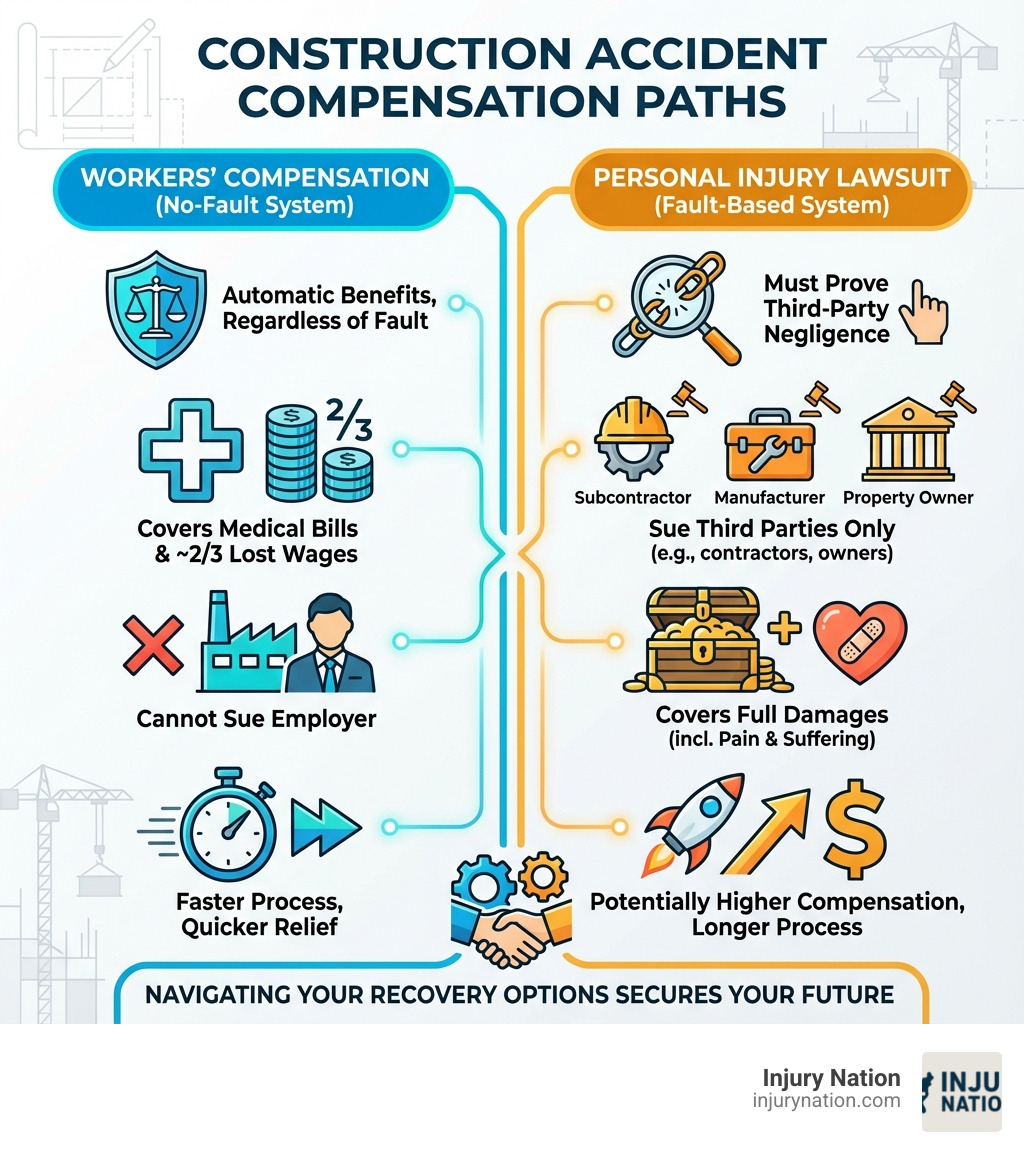
When a construction accident strikes, the legal system offers two main avenues for securing construction accident compensation: the workers’ compensation system and personal injury lawsuits against negligent third parties. Understanding the distinctions between these paths is crucial for maximizing your recovery.

The workers’ compensation system is a no-fault system, meaning you don’t need to prove your employer was at fault to receive benefits. The trade-off is that you typically cannot sue your employer directly for your injuries. This employer immunity is a cornerstone of workers’ compensation laws.
However, if a party other than your employer or a co-worker caused your injury, you might have grounds for a personal injury lawsuit against that “third party.” This is where the potential for much greater compensation often lies.
Here’s a quick comparison of these two vital compensation paths:
| Factor | Workers’ Compensation | Personal Injury Lawsuit (Third-Party) |
|---|---|---|
| Who you can sue | Your employer (indirectly, via claim) | General contractors, subcontractors, property owners, manufacturers, etc. |
| Proof required | Injury occurred on the job (no fault needed) | Negligence of the third party |
| Types of damages | Medical expenses, 2/3 lost wages, disability benefits | Medical expenses, full lost wages, pain & suffering, emotional distress, punitive damages |
| Process | Administrative claim, generally faster | Civil lawsuit, can be more complex and lengthy |
| Employer immunity | Generally prevents suing your employer directly | Does not apply; allows lawsuits against other negligent parties |
The Workers’ Compensation System
Workers’ compensation provides essential support for injured construction workers. In states like Nevada, this system ensures that employees injured in the course of employment can receive benefits without proving fault. These benefits typically include:
- Medical Treatment Coverage: Workers’ comp covers necessary medical expenses, from emergency care to ongoing therapy. This coverage continues until you reach maximum medical improvement (MMI).
- Lost Wages: If your injury prevents you from working, workers’ comp provides partial wage replacement, usually about two-thirds of your average weekly wages. If you return to a lower-paying light-duty job, it may cover a portion of the wage difference.
- Disability Benefits: Depending on the severity and permanence of your injury, you may be eligible for temporary or permanent disability benefits.
- Vocational Rehabilitation: If your injury prevents you from returning to your previous job, benefits may be available for retraining.
Filing a claim involves strict procedures and deadlines. You must report the accident to your employer and seek medical attention immediately. An attorney can help steer this process, especially with claim denials or complications. Be aware that in states like Nevada, a positive drug test can create a presumption that substance use caused the injury, potentially jeopardizing your claim.
While workers’ compensation provides a vital safety net, it has limitations. For comprehensive support, workers’ compensation benefits provide essential support. If you’re looking for expert legal guidance, you can find a specialist with our Best Workmans Comp Attorneys guide.
When to File a Personal Injury Lawsuit
Workers’ compensation has significant limitations. It covers only a portion of your lost income and, crucially, provides nothing for non-economic losses like pain and suffering. It also prevents you from suing your employer for additional damages.
This is where a personal injury lawsuit becomes a critical option. If your accident was caused by the negligence of a “third party”—someone other than your direct employer or a co-worker—you can pursue a claim against them. These third parties could include:
- A general contractor (if they weren’t your direct employer)
- A subcontractor
- The property owner
- An architect or engineer
- The manufacturer of a defective piece of equipment
In a lawsuit, you must prove the third party’s negligence caused your injuries. A successful claim can recover a broader range of compensation, including full lost wages, all medical expenses, and non-economic damages like pain and suffering, allowing you to seek the full amount you deserve.
To understand all your options and determine if a personal injury lawsuit is appropriate for your situation, learn more with our Personal Injury Lawyer Guide.
A Full Breakdown of Construction Accident Compensation
Understanding the full spectrum of damages is key when pursuing construction accident compensation. Settlement values aren’t arbitrary; they are determined by numerous factors unique to each case, including the extent of your losses and future needs. While “average” settlement ranges exist, they are highly individualized.
For instance, minor injuries might result in settlements from $15,000 to $50,000. Moderate injuries could see settlements between $50,000 and $250,000. For severe injuries, such as permanent disability or wrongful death, settlements can range from $500,000 to $2 million or more.

Factors that significantly impact your construction accident compensation include:
- Severity and Type of Injury: More severe injuries, like traumatic brain or spinal cord damage, command higher compensation.
- Lost Wages and Earning Capacity: Income you’ve already lost and your diminished ability to earn in the future.
- Long-Term Medical Care: The projected costs of future medical treatments, therapies, and assistive devices.
- Disfigurement and Scarring: Permanent changes to your appearance can increase non-economic damages.
- Pain and Suffering: The physical pain and emotional distress you endure.
- How the Injury Happened: Extreme negligence or safety violations can significantly impact liability and potential damages.
These are general guidelines. Your case is unique, and you deserve a result that reflects your hardship. To learn more about potential case value, you can explore resources like How Much Are Construction Accident Settlements Worth?.
Economic Damages: Covering Your Financial Losses
Economic damages are the quantifiable financial losses resulting from your accident. These tangible costs form a significant part of your construction accident compensation.
Here’s a list of common economic damages we help clients recover:
- Medical Bills (Current & Future): Covers all medical care, from ER visits and surgery to prescriptions and projected costs for future treatment.
- Lost Wages: The income you’ve already lost because you were unable to work.
- Loss of Earning Capacity: If your injury permanently affects your ability to work, this covers the projected lifetime difference in your earnings.
- Rehabilitation Costs: Expenses for physical, occupational, and other rehabilitative therapies.
- Home and Vehicle Modifications: Costs to make your home or vehicle accessible for a disability.
- Out-of-Pocket Expenses: Other direct costs like transportation to appointments, medical equipment, and household help.
- Vocational Rehabilitation: Costs for retraining or education if you need to switch careers.
- Loss of Retirement Benefits: Compensation for lost pension or retirement contributions if the injury shortens your career.
Documenting all these expenses is vital. Keep all receipts, invoices, and records related to your injury.
Non-Economic Damages: Compensation for Your Suffering
Non-economic damages address the intangible, personal consequences of your injury. While harder to quantify, they are critical to your quality of life. A personal injury lawsuit, unlike workers’ comp, allows you to seek compensation for:
- Pain and Suffering: The physical pain and discomfort you experience from your injury.
- Emotional Distress: The psychological impact, including anxiety, depression, and PTSD.
- Loss of Enjoyment of Life: Compensation if your injury prevents you from enjoying hobbies, activities, or daily routines.
- Disfigurement and Scarring: For permanent scarring or other physical disfigurements that affect your appearance.
- Loss of Consortium: A spouse’s claim for the loss of companionship, affection, and support due to the partner’s injury.
These damages acknowledge that an injury is not just a financial burden but a deeply personal one. To understand how these damages are assessed, you might find our insights on Explore options for a Slip and Fall Concussion Settlement helpful.
Punitive Damages and Wrongful Death Claims
In rare cases, punitive damages may be awarded. Unlike compensatory damages, these are meant to punish the at-fault party for egregious conduct and deter future wrongdoing. They apply in cases of extreme recklessness, intentional harm, or gross negligence.
When a construction accident is fatal, surviving family members can file a wrongful death claim. This lawsuit seeks compensation for losses due to a loved one’s death, including:
- Survivor Benefits: Financial support the deceased would have provided.
- Funeral and Burial Expenses: Costs to lay your loved one to rest.
- Medical Expenses: Any medical costs incurred between the injury and death.
- Loss of Companionship and Support: The emotional and practical losses experienced by family members.
Wrongful death claims are complex and deeply personal. For more detailed information, we offer a comprehensive resource: Read our Wrongful Death Lawsuit Complete Guide.
Who is Liable? Identifying Responsible Parties Beyond Your Employer
Construction sites are complex, with multiple employers working together. This can make liability for an accident unclear. While workers’ comp protects your employer from a lawsuit, other parties on site may be held responsible. Identifying all liable parties is critical for maximizing your construction accident compensation.
Proving negligence is key in these third-party claims. Negligence means a party failed to exercise reasonable care, and this failure directly led to your injury. This can range from a general contractor failing to oversee safety to a manufacturer selling defective equipment. general contractors have duties to protect all workers on a project, not just their own employees.
Common Liable Third Parties
Several entities beyond your employer could be held responsible for your accident:
- General Contractors: If they control site safety, they have a duty to protect all workers. Negligence in safety protocols, coordination, or inspections can lead to liability.
- Subcontractors: Another subcontractor whose negligence (e.g., creating a hazard) caused your injury.
- Property Owners: Liable if they retained project control or failed to warn of known hidden dangers on the property.
- Architects and Engineers: If a design flaw or structural defect in their plans led to the accident.
- Equipment Manufacturers (Product Liability): If a defective tool or machine caused your injury due to a design flaw, manufacturing defect, or inadequate warnings.
Identifying these parties requires a thorough investigation. Our Premises Liability Lawyer guide can offer more insights into owner liability.
The Role of OSHA and Comparative Negligence
The Occupational Safety and Health Administration (OSHA) sets and enforces construction site safety standards. While an OSHA violation doesn’t automatically create a right to sue, it can be powerful evidence of a third party’s negligence in your lawsuit. Frequent violations, like those for fall protection, highlight common dangers.
The construction industry remains one of the most dangerous professions. The “Fatal Four” — falls, being struck by objects, electrocutions, and caught-in/between accidents — account for nearly 60% of construction fatalities, highlighting the importance of safety regulations. You can view the full Census of Fatal Occupational Injuries (CFOI) report for more details.
Understanding comparative negligence is also key. In states like Nevada, if you are found partially at fault, your compensation is reduced by your percentage of fault. For instance, being 20% at fault for a $100,000 award means you receive $80,000. This highlights the need to prove the third party’s primary fault.
Critical Steps to Take Immediately After a Construction Accident
The actions you take immediately after a construction accident are crucial for preserving your claim for construction accident compensation. What you do in this critical window can significantly impact your recovery.
The Process for Filing for Construction Accident Compensation
Here are the essential steps to take:
- Report the Accident Immediately: Inform your supervisor immediately, preferably in writing. This creates an official record and is required for workers’ compensation.
- Seek Immediate Medical Attention: Prioritize your health. Get a medical evaluation immediately, as some injuries aren’t apparent. This creates a medical record linking your injuries to the accident, and be sure to follow all treatment plans.
- Document Everything:
- Photos and Videos: If safe, take pictures of the scene, your injuries, and any hazardous conditions or equipment.
- Witness Information: Get names and contact information from anyone who saw the accident.
- Accident Reports: Request a copy of any official accident reports.
- Keep Records: Maintain a journal of your symptoms, appointments, and how the injuries affect your life. Keep all bills, receipts, and records of lost wages.
- Avoid Giving Recorded Statements Without Legal Counsel: Politely decline to give recorded statements to any insurance adjuster until you’ve spoken with an attorney. These statements can be used against you.
- Adhere to the Statute of Limitations: Strict deadlines, or “statutes of limitations,” apply to both workers’ comp claims and lawsuits. Missing them can bar you from compensation, so acting quickly is essential.
Navigating these steps can be daunting while recovering. For guidance on securing your rights, find Accident Victim Legal Help.
How a Construction Accident Lawyer Can Help
An experienced construction accident lawyer can be your most valuable ally, handling the legal burdens while you focus on recovery. Here’s how we can help:
- Investigating the Accident: We investigate the accident, gather evidence, interview witnesses, and consult experts to build a strong case.
- Identifying All Liable Parties: We identify all negligent third parties to maximize your potential compensation.
- Calculating Total Damages: We work with experts to accurately calculate your total current and future damages.
- Negotiating with Insurance Companies: We handle all negotiations with insurance companies, who often try to minimize payouts, to protect you from lowball offers.
- Representing You in Court: If a fair settlement isn’t reached, we are prepared to represent you at trial.
An attorney’s expertise is crucial for navigating workers’ compensation, state laws, and third-party claims. For comprehensive assistance, consult our Construction Accident Lawyer Guide.
Frequently Asked Questions about Construction Accident Claims
We understand you likely have many questions about construction accident compensation. Here are answers to some of the most common inquiries:
How much is a typical construction accident settlement?
There is no “typical” settlement, as each case is unique. However, general ranges based on injury severity are:
- Minor Injuries: For sprains or cuts with brief time off work, settlements can range from $15,000 to $50,000.
- Moderate Injuries: Cases involving broken bones or surgery might see settlements between $50,000 and $250,000.
- Severe Injuries: For catastrophic injuries like amputations, permanent disability, or wrongful death, settlements can range from $500,000 to $2 million+.
These figures are influenced by economic and non-economic damages and the strength of the negligence evidence.
How long do I have to file a construction accident claim?
The time limit to file, known as the statute of limitations, varies by state and claim type.
- Workers’ Compensation Claims: These have shorter deadlines. You may have only 30 days to report the accident and one year to file the claim. Check your state’s specific deadlines immediately.
- Personal Injury Lawsuits (Third-Party Claims): The statute of limitations is generally longer, often two to three years from the accident date. However, claims against government entities can have much shorter deadlines.
Due to these strict deadlines, consulting an attorney promptly is vital to ensure all paperwork is filed on time.
Can I still get compensation if I was partially at fault?
Yes, in many states like Nevada, you can still receive compensation if partially at fault, based on comparative negligence laws.
Under these rules, your compensation is reduced by your percentage of fault. For example, if you are 20% at fault for a $100,000 award, you would receive $80,000.
Nevada uses a “modified comparative negligence” rule, meaning you can recover damages only if you are less than 51% at fault. If you are found 51% or more responsible, you may be barred from recovering any damages. An attorney can explain how this complex rule applies to your case.
Conclusion: Securing the Compensation You Deserve
A construction accident injury can be devastating, with immense financial and personal challenges. However, there are clear paths to securing the construction accident compensation you need to rebuild.
Understanding your rights—whether through workers’ compensation or a third-party lawsuit—is the first step. Workers’ comp is limited and doesn’t cover pain and suffering, while a lawsuit can provide broader damages. Identifying liable parties, meeting deadlines, and documenting everything are paramount.
This legal landscape is complex. An experienced construction accident lawyer is indispensable for investigating your case, identifying all liable parties, calculating full damages, and negotiating with insurers on your behalf.
At Injury Nation, our mission is to connect you with top-rated personal injury lawyers who can help you understand your options and fight for the compensation you deserve. Don’t face this challenge alone. Find a qualified personal injury lawyer in your area to evaluate your case and guide you toward a secure future.