Why Finding Personal Injury Law Near Me Matters After an Accident
Personal injury law near me searches spike after an accident for good reason. When you’re hurt, overwhelmed, and facing medical bills, the right legal help can mean the difference between fair compensation and financial hardship.
Quick Answer: How to Find Personal Injury Legal Help:
- Call local personal injury lawyers for free consultations within 24-48 hours
- Look for contingency fee arrangements – you pay nothing unless you win
- Prioritize experience in your specific type of accident case
- Check client reviews and track records of successful settlements
- Ensure they handle cases in your jurisdiction and know local courts
The aftermath of an accident is confusing and painful. As one victim shared: “Dealing with a personal injury can be a painful, confusing time. Medical bills start piling up, you may be missing work, and insurance companies aren’t exactly rushing to help.”
Local expertise matters. Lawyers in your area know the local courts, insurance adjusters, and state laws that impact your case value. They can meet you at home, in the hospital, or at their office.
Time is critical. States have a statute of limitations, often just two to three years, for filing claims. Evidence disappears and witnesses forget, making your case harder to prove over time.
This guide explains how to get a personal injury consultation, what to expect, and how to choose the right lawyer for you.
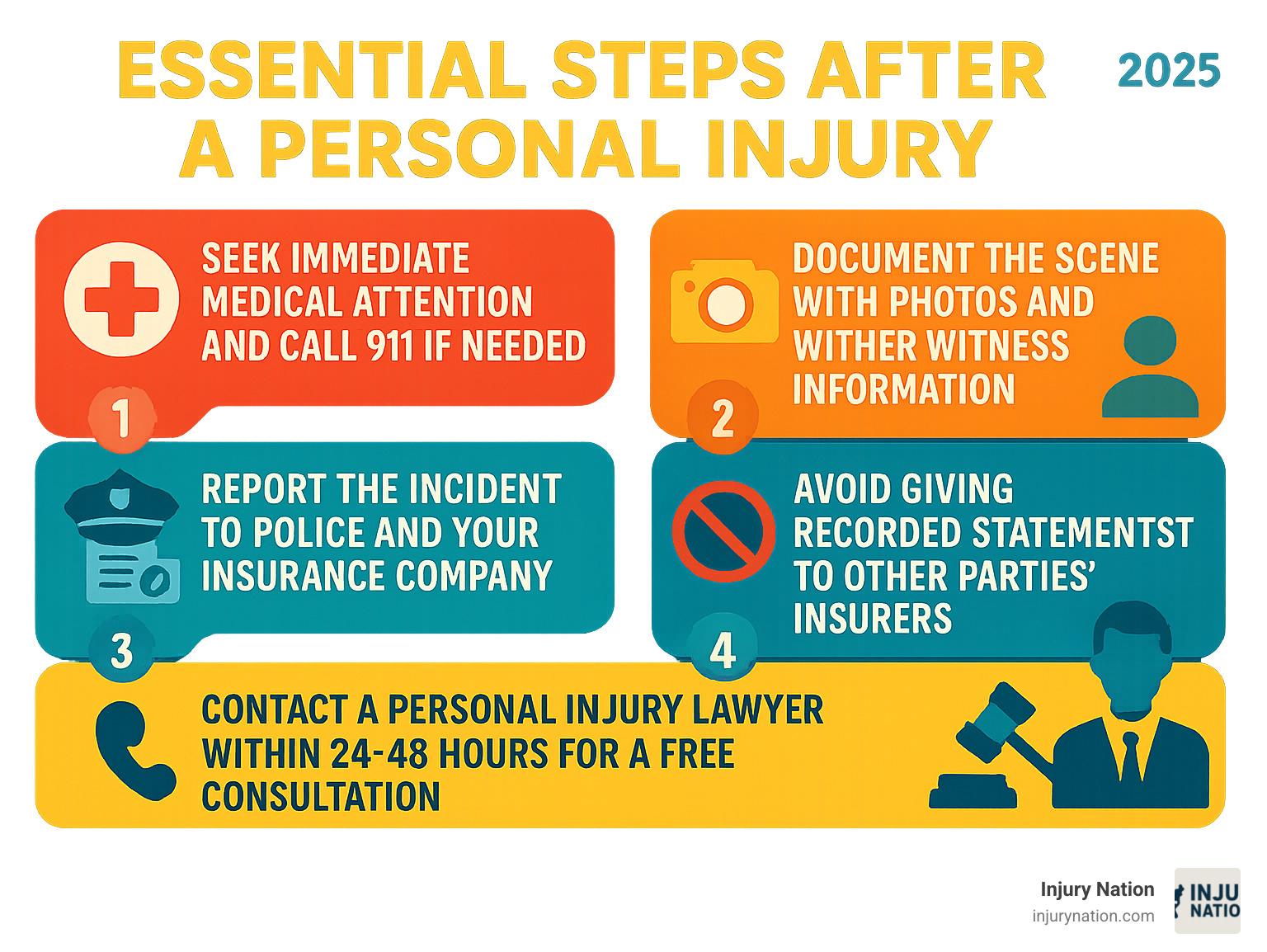
What to Do Immediately After an Accident
The moments after an accident are overwhelming. Here are the essential steps to protect both your health and your rights.
First Steps for Your Safety and Claim
Your safety comes first. If you’re hurt, call 911. Adrenaline can mask serious injuries like concussions or internal bleeding that may not show symptoms for hours or days. Getting immediate medical attention ensures you get care and creates medical records that directly link your injuries to the accident—crucial evidence for your claim.
After addressing medical needs, preserve the scene by gathering evidence. Take photos and videos of vehicle damage, skid marks, road conditions, and the overall scene. For specific advice on bike crashes, see our Bike Wreck Attorney Ultimate Guide.
Get witness contact information. Their unbiased accounts are incredibly valuable.

Critical Information to Collect at the Scene:
- Full names and contact information of all parties involved and witnesses
- Driver’s license numbers, insurance details, and license plates
- Vehicle makes, models, and years
- Exact accident location with street names and landmarks
- Date, time, and weather conditions
- Photos of damage, injuries, and road conditions
- Police officer names and badge numbers
Reporting the Incident
Call the police, even for minor accidents. An official police report provides an unbiased account that becomes key evidence.
Next, report the accident to your insurance company. Stick to the basic facts and avoid speculation or admitting fault. Let professionals determine fault based on the evidence.
Avoid giving recorded statements to the other party’s insurance company without first speaking to a personal injury law near me professional. Adjusters are trained to ask questions that could minimize your claim or get you to accept blame.
For incidents on someone else’s property, like a slip and fall, similar rules apply. Our Homeowners Insurance Claims Lawyer Guide offers insights for these cases. Be cooperative but don’t volunteer extra information. Save detailed conversations for your legal team.
Understanding Your Case: Types and Value
To have a successful personal injury case, you usually must prove negligence—that someone didn’t act as carefully as they should have. This requires showing four elements: the other party had a duty to keep you safe, they breached that duty, their actions caused your injury, and you suffered damages. Some cases operate on strict liability, where you only need to prove the other party caused the accident.
Understanding liability (fault) and damages (losses) is key. The clearer the other party’s fault, the stronger your case.

Common Types of Personal Injury Cases
Personal injury law near me covers many situations. Common cases include:
- Motor vehicle accidents: Crashes involving cars, trucks, motorcycles, and pedestrians.
- Slip and fall accidents: Injuries from unsafe conditions like wet floors or broken stairs. See our Attorney for Slip and Fall Cases guide for more.
- Medical malpractice: Harm caused by mistakes from healthcare professionals.
- Wrongful death: Fatal accidents leading to complex legal claims for families. A Wrongful Death Law Firm can provide support.
- Product liability: Injuries caused by defective products.
- Dog bites: These can cause serious physical and emotional trauma. Our Dog Bite Lawyers Near Me resource can help.
- Workplace accidents: Claims beyond workers’ comp, often involving third parties.
How is the Value of a Personal Injury Case Determined?
Determining a case’s value is complex. The law uses financial compensation to make you “whole” again. Key factors include:
- Medical expenses: All costs from ambulance rides to future surgeries and therapy.
- Lost wages: Paychecks missed during recovery.
- Future earnings: How the injury impacts your long-term earning potential.
- Pain and suffering: Compensation for physical pain, emotional distress, and loss of enjoyment in life.
- Property damage: Repair or replacement of items like your car.
- Severity of injury: A life-altering injury is valued higher than one that fully heals.
- Impact on quality of life: How the injury affects your daily activities, hobbies, and relationships.
Case value also depends on the clarity of fault, insurance coverage, and local legal precedents, which is why a local lawyer is so valuable.
The Process of Filing a Claim and Finding a Personal Injury Law Firm Near Me
Understanding the legal process can reduce anxiety. In Nevada, you generally have a two-year statute of limitations to file a personal injury or wrongful death claim. Missing this deadline means losing your right to compensation, so contacting a personal injury law firm near me quickly is vital.
The legal journey typically follows these stages:
- Investigation: Your lawyer gathers police reports, medical records, and witness statements to identify all responsible parties.
- Demand and Negotiation: Your attorney sends a demand letter to the insurer, which kicks off settlement talks.
- Filing a Lawsuit: If negotiations stall, your lawyer may file a lawsuit to gain leverage. Most cases still settle before trial.
- Findy: Both sides formally exchange information through depositions and document requests.
- Mediation/Arbitration: Many cases are resolved here, avoiding a trial.
- Trial: If no settlement is reached, a judge or jury will decide the outcome.

What to Look for in a Personal Injury Law Firm Near Me
The right advocate is crucial. Look for:
- Experience and Track Record: Seek firms with proven success in cases like yours that know how to win against insurance companies.
- Client Testimonials: Reviews reveal if past clients felt heard, supported, and well-informed.
- Personal Attention: You want a firm where you receive dedicated focus, not just a case number.
- Communication Style: A good firm communicates clearly, explains legal concepts simply, and responds promptly.
- Specialized Expertise: For complex injuries like a traumatic brain injury, you need an attorney with specific knowledge. The Brain Injury Association offers helpful resources.
- Local Knowledge: Local attorneys understand the courts, judges, and adjusters in your area, which benefits your case.
Our lawyer directory can connect you with qualified attorneys who meet these criteria.
Preparing for Your Consultation with a Personal Injury Law Firm Near Me
Being prepared for your initial consultation helps the attorney assess your case. Bring the following:
- Medical Documentation: Hospital records, doctor’s notes, and bills related to your injury.
- Police Report: This provides an objective account of the incident.
- Photos and Evidence: Pictures from the scene, including damage and injuries, plus witness contact info.
- Insurance Correspondence: Any letters or emails from insurance companies.
- Employment Information: Details on lost wages and how the injury affects your job.
- A List of Questions: Ask about their experience, fees, communication style, and assessment of your case.
This preparation allows the attorney to provide the most accurate assessment of your legal options.
Explaining Legal Costs: Contingency Fees and Expenses
After an accident, money is a major worry. The last thing you need is the stress of paying a lawyer by the hour. This is why most personal injury lawyers work on a contingency fee basis, a game-changer for victims who can’t afford upfront legal costs.
What is a Contingency Fee Arrangement?
A contingency fee means you don’t pay unless you win. This arrangement removes the financial stress of getting legal help. Your lawyer agrees to represent you with no money upfront.
If your lawyer wins your case, they take an agreed-upon percentage of the recovery, typically 25% to 40%, depending on case complexity. If you lose, you pay nothing for their time. Your lawyer absorbs the loss.
Beyond the lawyer’s fee, there are also case expenses like court filing fees and expert witness costs. Most firms advance these costs and then subtract them from your settlement. Everything is spelled out in a written retainer agreement before work begins.
This system aligns your interests with your lawyer’s—they only get paid when you do. It makes justice accessible to everyone, regardless of their financial situation, as explained in this overview of Understanding contingency fees.
The difference between contingency fees and hourly billing is striking.
| Contingency Fee | Hourly Rate |
|---|---|
| No upfront cost – You pay nothing to get started | Large retainer required – Often thousands of dollars upfront |
| Pay only if you win – No recovery means no fee | Pay regardless of outcome – Bills keep coming win or lose |
| Low financial risk – Your lawyer absorbs the loss if unsuccessful | High financial risk – You can rack up huge bills even if you lose |
| Lawyer motivated for results – They only get paid when you do | Paid for time spent – Compensation isn’t tied to your outcome |
The contingency fee system lets you focus on healing while your lawyer focuses on building the strongest possible case.
Frequently Asked Questions about Personal Injury Cases
It’s natural to have questions after a personal injury. Here are answers to the most common concerns for those searching for personal injury law near me.
How long does a personal injury case typically take to resolve?
Every case is different; some resolve in months, while others can take years. The timeline depends on case complexity, the investigation period, and negotiation. Over 90% of cases resolve through settlement negotiations, which is much faster than a trial. It’s often best to wait until you reach Maximum Medical Improvement before settling to ensure your long-term medical needs are known. Court backlogs can also cause delays.
How can a personal injury lawyer help with insurance claims and negotiations?
Dealing with insurance companies is an uphill battle, as their goal is to pay as little as possible. A personal injury lawyer levels the playing field. They handle all communication with insurance adjusters, protecting you from tactics like payment delays, liability denial, and lowball offers.
Your lawyer understands the true value of your claim, including future medical costs and lost earning capacity, and fights to maximize your settlement. They manage all the paperwork and deadlines, protect your rights, and reduce your stress, allowing you to focus on recovery.
Can I still recover compensation if I was partially at fault?
Yes. In Nevada and many other states, being partially at fault doesn’t automatically prevent you from receiving compensation. Nevada follows a modified comparative negligence rule, also known as the 50% rule. As long as you are found to be 50% or less responsible for the accident, you can still recover damages.
Your compensation is simply reduced by your percentage of fault. For example, if your damages are $100,000 and you are 20% at fault, your award under Nevada’s comparative negligence statute would be reduced to $80,000. If you are found more than 50% at fault, you cannot recover anything.
Insurance companies will try to assign you as much blame as possible. An experienced lawyer is crucial for challenging these claims and minimizing your share of the fault.
Find the Right Legal Advocate for Your Recovery
The aftermath of a personal injury is overwhelming, but you don’t have to go through this alone. Taking quick action and finding the right legal support can transform your recovery.
The search for “personal injury law near me” is about finding your advocate—a local expert who genuinely cares about getting you the compensation you deserve. The right attorney handles the legal complexities so you can focus on getting better.
The right partner works on a contingency fee basis, communicates clearly, and sees you as more than a case number. Your lawyer is your shield against insurance companies, your voice when you’re overwhelmed, and your guide through the complex legal system.
At Injury Nation, we believe every accident victim deserves an experienced advocate who will fight for maximum compensation. Our directory connects you with lawyers who have proven track records, genuine compassion, and the expertise to handle your specific case.
Ready to take control? Your recovery starts with the right legal partner.