

Introduction: Explaining Your Claim’s Value
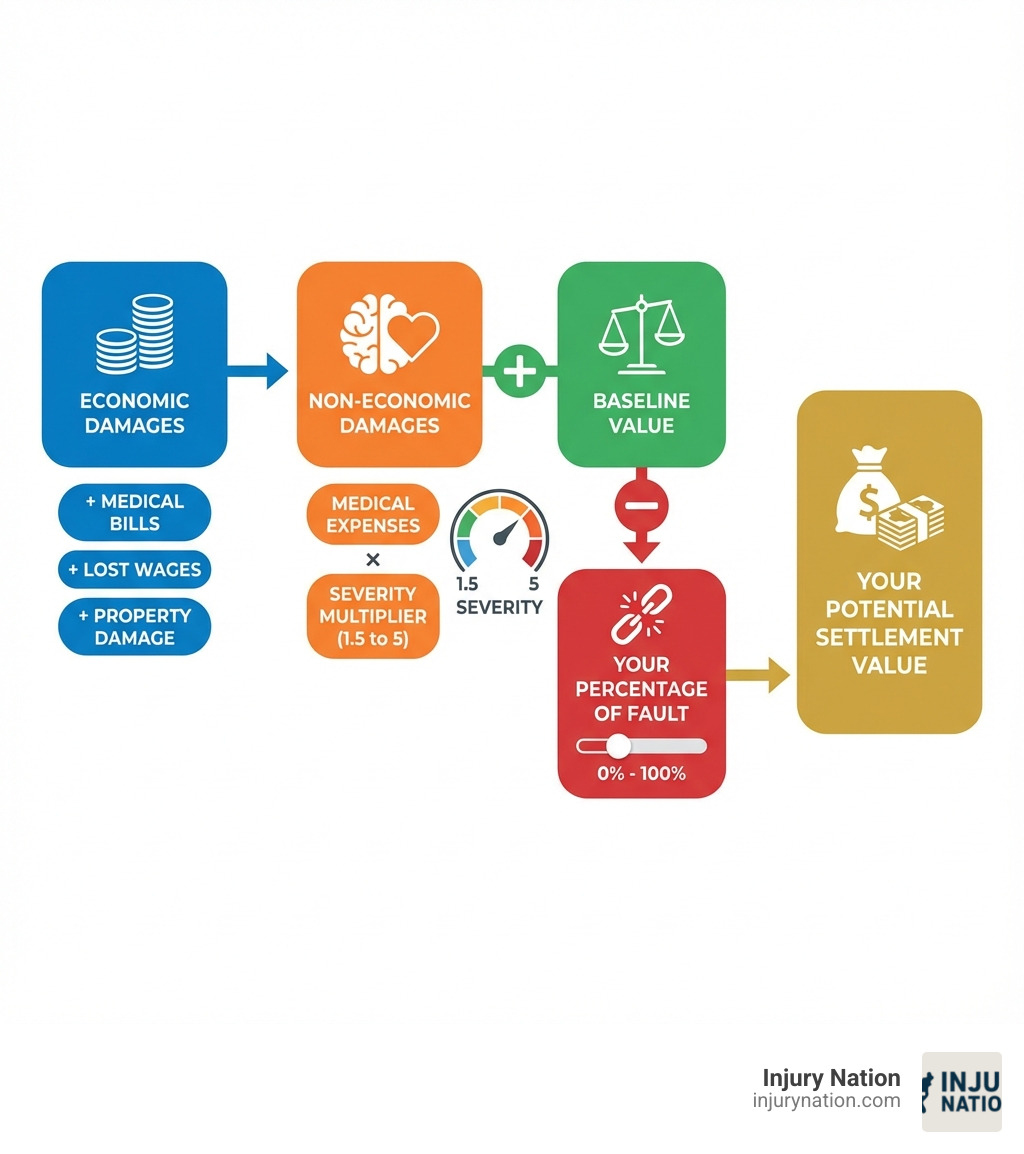
Calculate injury settlement amounts by following this proven formula:
Quick Answer:
- Add all economic damages (medical bills, lost wages, property damage)
- Multiply medical expenses by 1.5 to 5 (based on injury severity) for pain and suffering
- Add both totals together for your baseline value
- Subtract your percentage of fault (if any) from the total
- Check insurance policy limits that may cap your recovery
After an accident, one of the biggest questions is, “How much is my claim worth?” This guide breaks down the process, changing a complex legal question into a clear, step-by-step method.
The truth is, there’s no exact formula that works for every case. As one insurance expert puts it, “valuing a personal injury claim isn’t an exact science.” But that doesn’t mean you’re left in the dark.
Insurance adjusters and attorneys use common methods to estimate settlement values. These calculations consider both the hard costs you can prove with receipts (medical bills, lost paychecks) and the intangible losses like pain, suffering, and life disruption.
While every case is unique, understanding the core components empowers you to steer your claim with confidence. You’ll learn what factors increase or decrease settlement offers, how your state’s laws affect compensation, and why that initial number is just the starting point for negotiations.
Most personal injury cases settle out of court. The average settlement ranges from $3,000 to $75,000, though severe injuries can reach hundreds of thousands. Your specific value depends on injury severity, medical treatment, clear evidence, and several other factors we’ll explore.
The Two Pillars of Compensation: Economic vs. Non-Economic Damages
When we calculate injury settlement, we’re primarily looking at two main categories of damages: economic and non-economic. Think of them as the two pillars holding up your claim. One is about easily quantifiable financial losses, while the other addresses the deeply personal, intangible costs of your suffering. Our goal is to make you “whole” again, as much as money can.
For a deeper dive into these concepts, check out this guide on Calculating Personal Injury Damages.
Economic (Pecuniary) Damages: The Tangible Costs
Economic damages, also known as “special damages” or “pecuniary damages,” are the measurable financial losses you’ve incurred due to your injury. These are the easiest to tally because they come with receipts, invoices, and pay stubs. These are your “out-of-pocket expenses” that directly resulted from the accident.
Here’s what typically falls into this category:
- Medical Bills: This includes everything from ambulance rides, emergency room visits, doctor appointments, surgeries, medications, rehabilitation, physical therapy, and even future medical care that a doctor can confirm you’ll need. It’s crucial to keep every single bill, even if your insurance covered part of it.
- Lost Wages: If your injury prevented you from working, you’re entitled to compensation for the income you lost. This isn’t just your base salary; it includes overtime, bonuses, tips, and even the value of paid time off (PTO) you had to use instead of earning money. For those with long-term injuries, future lost income or diminished earning capacity can also be calculated, often requiring expert testimony.
- Property Damage: While often associated with car accidents, property damage can extend to other personal belongings damaged in an incident. This covers the cost to repair or replace your vehicle or other property. In some cases, it can also include the “loss of use” of your damaged property, such as rental car fees while your vehicle is being repaired.
- Out-of-Pocket Expenses: Don’t forget the smaller costs that add up quickly! This can include transportation to medical appointments, childcare expenses incurred because you couldn’t care for yourself, or assistive devices like crutches or wheelchairs.
Thorough documentation of all these expenses is key to maximizing your economic damages. For more information on related claims, you might find our guide on Homeowners Insurance Claims helpful.
Non-Economic (Non-Pecuniary) Damages: The Human Cost
Non-economic damages, often called “general damages” or “non-pecuniary damages,” are the more subjective and challenging aspect of a personal injury claim. These compensate you for the intangible suffering and disruption your injury has caused in your life. While they don’t come with a bill, their impact is very real.
Common non-economic damages include:
- Pain and Suffering: This is the physical discomfort and emotional distress you endure because of your injury. It’s about the daily pain, the sleepless nights, and the general misery the accident inflicted.
- Emotional Distress & Mental Anguish: Accidents can leave lasting psychological scars. This includes anxiety, depression, fear, PTSD, and other mental health challenges that arise from the trauma.
- Loss of Enjoyment of Life: Did your injury prevent you from participating in hobbies, sports, or family activities you once loved? This category compensates for the inability to enjoy life’s pleasures.
- Disfigurement: If your injury resulted in scarring, burns, or other permanent changes to your appearance, this is a significant non-economic damage.
- Permanent Disability: When an injury leads to long-term or lifelong limitations, such as paralysis, brain damage, or lost limbs, the impact on your independence and quality of life is immense. These are often referred to as “catastrophic injuries.”
Estimating these damages is less about simple arithmetic and more about demonstrating the profound effect the injury has had on your existence. For those facing such profound challenges, our resources on Catastrophic Injury Attorneys can provide guidance.
How to Calculate Injury Settlement: The Core Formula

The most common approach used by insurance adjusters and attorneys involves a formula to estimate a starting value for negotiations. This isn’t a magic number, but a tool to establish a reasonable range. It’s a way to put a dollar figure on your overall damages, especially the elusive “pain and suffering.” Think of it as a baseline from which negotiations can begin.
Step 1: Tally Your Economic Damages
First things first: add up every single penny of your economic damages. This includes all your:
- Medical Specials: Every doctor’s visit, every prescription, every therapy session. Collect all bills and statements.
- Lost Earnings Calculation: The wages, bonuses, tips, and even used PTO you missed out on. Document your income history and the time you were unable to work.
- Property Repair Costs: If your car was damaged in an accident, or other personal property was ruined, include the repair or replacement costs, along with any “loss of use” expenses.
Keep meticulous records, including receipts and invoices, for everything. This concrete evidence is your strongest ally when we calculate injury settlement. For victims of car accidents, understanding these costs is paramount; learn more in our Auto Accidents guide.
Step 2: Apply the “Multiplier” for Non-Economic Damages
Here’s where it gets a little less concrete but still follows a widely accepted method. To estimate your non-economic damages (pain and suffering), attorneys and insurance companies often use a “multiplier” on your medical expenses.
The “multiplier” is a number, typically ranging from 1.5 to 5. You take your total medical bills (your “medical specials”) and multiply them by this number. The higher the multiplier, the more severe your non-economic damages are considered.
For instance, if your medical bills are $10,000 and you use a multiplier of 3, your estimated pain and suffering would be $30,000.
What determines the multiplier? Several factors come into play:
- Injury Severity: Is it a minor sprain or a broken bone? The more serious the injury, the higher the multiplier.
- Recovery Time: A quick recovery versus months or years of rehabilitation will impact the multiplier.
- Treatment Invasiveness: Did you undergo surgery, or was it just a few chiropractic sessions? More invasive treatments suggest a higher multiplier.
- Long-Term Effects: Are there any permanent disabilities, disfigurement, or ongoing pain? These factors significantly increase the multiplier.
- Impact on Daily Life: How much has the injury disrupted your daily routines, hobbies, and overall quality of life?
- Clarity of Medical Evidence: Clear, consistent medical records supporting your injury and treatment will strengthen your case for a higher multiplier.
Essentially, the more your injury has impacted your life, the higher the multiplier you can argue for. For more on this critical component, read about the multiplier.
Here’s a list of factors that typically increase your multiplier:
- Permanent injury or disability
- Long recovery period
- Severe and constant pain
- Multiple surgeries or invasive medical procedures
- Significant emotional distress (e.g., PTSD, anxiety)
- Visible scarring or disfigurement
- Inability to return to previous work or activities
Step 3: Add It All Together for Your Initial Value
Once you have both your total economic damages and your estimated non-economic damages, you simply add them together. This sum gives you your initial base negotiation figure.
Economic Damages + Non-Economic Damages (Medical Bills x Multiplier) = Initial Settlement Value
This figure serves as a strong starting point for discussions with insurance adjusters. This is an estimate, and the actual negotiated settlement can vary. For those dealing with slip and fall accidents, calculating this initial value is a crucial first step; find more detailed information in our guide to Slip and Fall Lawsuits.
Critical Factors That Adjust Your Final Settlement Value

Your initial calculation is just the start. While it gives us a great idea of your claim’s potential, several external factors can significantly increase or decrease the amount you ultimately receive. It’s like baking a cake – you have your base ingredients, but the temperature of the oven, the altitude, and even the baker’s mood can all affect the final outcome!
Shared Fault: The Impact of Comparative Negligence
One of the most significant factors that can reduce your settlement is if you are found to be partially at fault for the accident. This concept is called “comparative negligence” (or “contributory negligence” in some states).
In Nevada, we operate under a modified comparative negligence rule. What does this mean for you? It means you can still recover damages even if you were partially to blame, as long as your fault is less than 50%. However, your compensation will be reduced by your percentage of fault.
For example, if a jury awards you $100,000 but finds you were 10% at fault for the accident, your final settlement would be $90,000 ($100,000 – 10%). If you were found to be 50% or more at fault, you would be barred from recovering any damages. This is why it’s crucial to be honest with your attorney about the accident details, as your degree of fault can have a substantial impact on your final compensation.
Insurance Policy Limits: The Practical Cap on Recovery
Another critical factor, and sometimes a harsh reality, is the at-fault party’s insurance policy limits. No matter how high your damages are, the insurance company will only pay up to the maximum amount specified in their policy.
For instance, if your calculated damages are $150,000, but the at-fault driver only has a policy with a $100,000 liability limit, their insurance company will only pay $100,000. This can be incredibly frustrating, as it means you might not receive full compensation for your injuries, even if the other driver was entirely at fault.
In such cases, your own uninsured/underinsured motorist (UM/UIM) coverage can become invaluable. This coverage is designed to protect you if the at-fault driver doesn’t have enough insurance (or any insurance) to cover your damages. Without it, your options to recover the remaining amount might be limited to pursuing the at-fault individual’s personal assets, which can be a challenging and often unfruitful endeavor.
Understanding these limits is vital, especially in complex cases like those involving large commercial vehicles. Explore more about this in our Semi-Truck Accident Lawyer Guide.
Legal Limitations and Thresholds
While Nevada does not impose specific statutory caps on general non-economic damages in personal injury cases (unlike some other jurisdictions), it’s important to understand that certain legal frameworks can influence settlements.
Every jurisdiction has its own set of rules and precedents that impact how damages are calculated and awarded. These can include:
- Injury Thresholds: While not a “cap,” some states might have specific criteria that must be met for certain types of damages, particularly for soft tissue injuries. In Nevada, the severity and impact of your injury are paramount.
- “Soft Tissue” vs. “Hard” Injuries: Insurance adjusters often try to devalue claims involving soft tissue injuries (like sprains and strains) compared to “hard” injuries (like broken bones or catastrophic injuries). Clear medical documentation and consistent treatment are essential to prove the severity and impact of soft tissue injuries.
These legal nuances underscore the importance of having an attorney familiar with Nevada law to steer the complexities and ensure your claim is valued correctly.
Frequently Asked Questions about Injury Settlement Calculations
Are personal injury settlements taxable?
This is a common and excellent question! In most situations in Nevada, personal injury settlements are not taxable. The Internal Revenue Service (IRS) generally does not consider compensation received for physical injuries or sickness as taxable income. This applies to economic damages like medical expenses and non-economic damages like pain and suffering.
However, there are a couple of important exceptions:
- Punitive Damages: These are damages awarded to punish the at-fault party for egregious behavior, not to compensate you for your losses. Punitive damages are typically taxable.
- Lost Wages/Lost Earnings: While the portion of your settlement specifically for physical injuries is tax-exempt, any amount awarded for lost wages or lost earning capacity may be subject to income tax. It’s crucial to consult with a tax professional to understand the specific implications for your settlement.
What is the statute of limitations for a personal injury claim?
The “statute of limitations” is a strict legal deadline for filing a lawsuit. If you miss this deadline, you generally lose your right to pursue your claim in court, regardless of how strong your case might be. It’s a bit like a ticking clock, and once it hits zero, your claim can effectively vanish.
In Nevada, you generally have two years from the date of the accident to file a personal injury claim. This period can vary depending on the specific circumstances of your case (e.g., medical malpractice or claims against a government entity might have different timelines).
The clock usually starts ticking from the date the injury occurred or, in some cases, when the injury was finded (the “findy rule”). Missing this deadline can be catastrophic for your claim, as it gives the at-fault party and their insurance company a complete defense. This is why acting quickly after an injury is so important.
For specific legal timelines, especially in complex fields like medical errors, our Medical Malpractice Attorney Las Vegas Guide offers further insights. You can also refer to Nevada Revised Statutes, Chapter 11 for more details on civil actions, which outlines the two years limit.
What is the difference between a settlement and a court award?
While both settlements and court awards provide compensation for your injuries, they represent two very different paths to resolution.
- Settlement: This is a negotiated agreement reached out of court between you (or your attorney) and the at-fault party (usually their insurance company). It’s a voluntary agreement where both sides compromise to avoid the uncertainties and costs of a trial. Most personal injury cases, in fact, are resolved through settlement. The advantages include a faster resolution, more control over the outcome, and reduced legal fees and stress.
- Court Award: If a settlement cannot be reached, your case may proceed to trial. A court award (or verdict) is the compensation amount decided by a judge or jury after hearing all the evidence and arguments. While a court award can sometimes be higher than a settlement offer, it comes with significant risks, including the possibility of receiving less than offered in settlement, or even nothing at all. Trials are also typically much longer, more expensive, and emotionally taxing.
Choosing between a settlement and a trial depends on many factors, including the strength of your evidence, the offers on the table, and your willingness to take risks.
Conclusion: From Calculation to Compensation
Learning to calculate injury settlement values is an empowering step on your journey to recovery. It provides a powerful starting point for negotiations, changing what feels like an abstract concept into tangible numbers. However, as you’ve seen, the nuances of multipliers, comparative fault, and insurance limits make it a complex process that rarely boils down to a simple equation.
While online calculators and formulas offer a useful estimation, they are no substitute for personalized legal advice. An experienced attorney can steer these factors to ensure you don’t leave money on the table. They understand the intricacies of Nevada law, know how to effectively negotiate with insurance adjusters, and are adept at proving both your economic and non-economic damages. They fight to maximize your claim’s value, handling the adjusters while you focus on recovery.
Don’t steer this complex landscape alone. Find a top-rated lawyer in your area through the Injury Nation directory to get a professional evaluation of your case and secure the compensation you deserve.