

Understanding the True Cost of Legal Representation
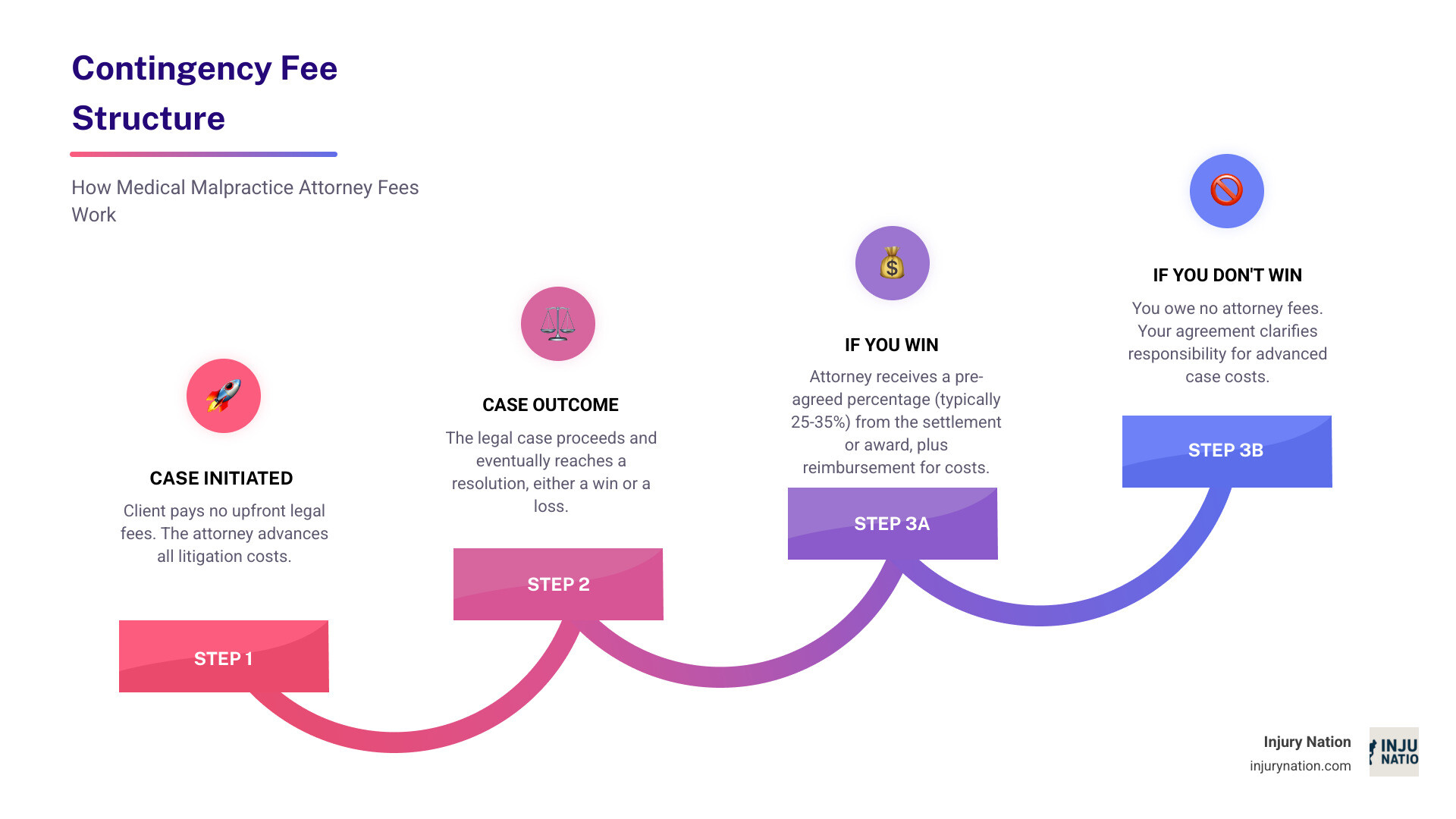
Medical malpractice attorney fees are typically structured as contingency fees, meaning you pay nothing upfront and the lawyer only gets paid if you win your case. Most medical malpractice attorneys charge 25-35% of your settlement or award, with the exact percentage depending on your case’s complexity and whether it goes to trial.
Key Facts About Medical Malpractice Attorney Fees:
- No Win, No Fee: You only pay if your case is successful
- Standard Range: 25-35% of your final recovery (33% is most common)
- Costs Are Separate: Expert witnesses, medical records, and court fees are additional
- State Caps May Apply: Some states limit how much attorneys can charge
- Sliding Scales: Fees may increase if your case goes to trial
- Written Agreement Required: All terms must be clearly documented
If you’ve been harmed by a medical professional, the thought of legal bills might feel overwhelming. You’re already dealing with physical pain, emotional trauma, and mounting medical expenses. The last thing you need is another financial burden.
Here’s the good news: you don’t need money upfront to hire a top medical malpractice attorney.
Most medical malpractice lawyers work on a contingency fee basis. This means they only get paid if they win compensation for you. As one attorney put it, “Contingency fees are really the great equalizer. It’s what permits people to retain the best lawyer that they can find.”
This arrangement removes the financial barrier between you and justice. You won’t face hourly bills or retainer fees. Instead, your attorney shares the risk with you and has every incentive to maximize your recovery.
This guide will walk you through exactly how these fees work, what you’ll actually pay, and what to watch out for in your agreement. We’ll break down real examples, explain state-by-state differences, and help you understand the total cost of pursuing your claim.
Understanding the Contingency Fee Agreement
When it comes to pursuing a medical malpractice claim, the term “contingency fee” is your new best friend. Simply put, a contingency fee is a legal fee that is contingent upon the successful outcome of your case. This means our legal team only gets paid if we secure a settlement or win a verdict that provides you with compensation. If we don’t win, you don’t owe us a dime in attorney fees. It’s truly a “no win, no fee” arrangement.
This model is often hailed as “the great equalizer” because it ensures that everyone, regardless of their current financial situation, can access high-quality legal representation. Medical malpractice cases are notoriously complex and expensive to litigate, often requiring significant upfront investment. Without contingency fees, many deserving victims would be left without recourse, unable to challenge powerful healthcare institutions and their well-funded defense teams.
So, what’s the typical percentage? While a common contingency fee for personal injury cases generally hovers around 33% of the award or settlement, medical malpractice attorney fees often fall within a slightly different range. For medical malpractice matters, you can typically expect the contingency fee percentage to range between 25% and 35%, depending on the specific circumstances of your case. This percentage can be influenced by factors such as the anticipated work involved, the complexity of the legal and medical issues, and the expected results.
Some lawyers also use a “sliding scale” approach. This means the percentage they take might be lower if a settlement is reached early in the process (before a lawsuit is filed) and higher if the case proceeds to trial. For example, a fee might be 25% for a pre-lawsuit settlement, 33% if a lawsuit is filed, and up to 45% if the case goes all the way to trial. This structure reflects the increased time, resources, and risk involved as a case progresses.
For the attorney, this arrangement represents a significant risk. They invest their time, expertise, and often their own capital to cover case expenses, with no guarantee of payment. For you, the client, the benefit is clear: you gain access to justice without the burden of upfront legal costs, allowing you to focus on your recovery and well-being.
For more detailed information on the types of compensation you might be eligible for, explore our guide on Medical Malpractice Damages.
How Contingency Fees Ensure Access to Justice
Imagine facing a powerful hospital or a well-funded insurance company after a life-altering medical error. Without a contingency fee arrangement, who could afford to take them on? This is precisely where the “great equalizer” aspect shines.
Contingency fees level the playing field, making it possible for ordinary individuals to pursue justice against formidable opponents. They remove the financial barriers that would otherwise prevent victims from hiring experienced and skilled legal professionals. Instead of worrying about hourly rates that can quickly spiral into hundreds of thousands of dollars, you can retain top-tier lawyers who have the resources and expertise to handle complex medical malpractice litigation.
This financial model empowers you to focus on what truly matters: your physical and emotional recovery. You won’t be distracted by constant bills or the pressure to settle quickly just to avoid mounting legal costs. Your attorney is motivated to achieve the best possible outcome, knowing their compensation is directly tied to your success.
Risks and Benefits of a Contingency Arrangement

Like any agreement, contingency fees come with their own set of risks and benefits for both you and your legal team. Understanding these can help you make an informed decision.
Benefits for the Client:
- No Upfront Costs: This is the most significant benefit. You don’t pay any attorney fees unless your case is successful. This is especially crucial in medical malpractice cases where victims are often facing severe financial strain due to medical bills and lost income.
- Access to High-Quality Representation: You can afford to hire experienced and specialized medical malpractice attorneys who would otherwise be out of reach if they charged hourly rates.
- Shared Risk: Your attorney has a vested interest in the outcome of your case, as their payment depends on winning. This aligns their goals with yours.
- Focus on Recovery: Without the pressure of legal bills, you can dedicate your energy to healing and rebuilding your life.
Risks for the Client:
- Percentage of Recovery: If your case is successful, a significant portion of your settlement or award will go towards attorney fees. While this is the trade-off for no upfront cost, it means you won’t receive 100% of the gross recovery.
- Liability for Costs (Even if Unsuccessful): While you typically won’t owe attorney fees if you lose, you might still be responsible for case-related expenses, known as “disbursements.” We’ll dig deeper into these costs shortly, but clarify this in your written agreement.
- Less Control Over Settlement Value: While your attorney works in your best interest, the financial incentive for both parties to settle can sometimes influence decision-making. However, the final decision to accept or reject a settlement always rests with you.
Risks for the Attorney:
- No Guarantee of Payment: Attorneys invest hundreds, if not thousands, of hours and significant financial resources into a case with no assurance of getting paid. Medical malpractice cases are notoriously difficult and expensive, and many are unsuccessful.
- High Upfront Costs: As we’ll discuss, medical malpractice cases incur substantial disbursements, especially for expert witnesses. Attorneys often advance these costs, meaning they pay out of pocket for months or years, hoping for reimbursement.
- Long Timeframes: These cases can drag on for several years, tying up an attorney’s resources and capital for extended periods.
A contingency fee arrangement creates a powerful shared incentive. Your attorney is motivated to achieve the maximum possible recovery because their compensation directly reflects your success.
How Medical Malpractice Attorney Fees Are Calculated and Capped
Understanding how your final payout is determined is crucial. It’s not as simple as taking a percentage off the top. The process involves distinguishing between the gross recovery (the total amount won) and the net recovery (what’s left after certain deductions). Your medical malpractice attorney fees will be calculated based on one of these figures, as clearly outlined in your written agreement.
In Nevada, state law requires that all contingency fee agreements be in writing and signed by both parties. This agreement must specify how the fee is determined, the exact percentage of the recovery, whether expenses are deducted before or after the lawyer’s fee, and whether you, as the client, are liable for any expenses even if your case is not successful. This transparency is key to protecting your interests.
We can’t stress enough the importance of a clear, written agreement. This document is your roadmap to understanding your financial obligations and entitlements. For a comprehensive overview of the legal process, refer to our Medical Malpractice Guide.
The Calculation: What Your Final Payout Looks Like
Let’s walk through a hypothetical example to illustrate how a settlement payout might be calculated, keeping in mind that your specific agreement will dictate the exact order of deductions.
Imagine your medical malpractice case results in a $100,000 settlement. This is your gross recovery.
Before you see any of that money, several deductions typically occur:
- Liens: Any outstanding medical liens (e.g., from health insurance providers, Medicare/Medicaid, or medical providers who treated you on a lien basis) or other liens (like child support or workers’ compensation) are usually paid first from the gross settlement. Let’s assume for our example there are no significant liens.
- Case Costs/Disbursements: These are the expenses your attorney advanced to litigate your case. Let’s say these costs totaled $10,000. These costs are typically reimbursed to the law firm from the settlement.
- So, after costs, the remaining amount is $100,000 – $10,000 = $90,000. This is often referred to as the net recovery for fee calculation purposes, though some agreements might calculate fees on the gross amount. Your written agreement will specify this.
- Attorney Fees: Now, the contingency fee is applied. If your agreement specifies a 33% contingency fee based on the net recovery (after costs are reimbursed), the calculation would be:
- 33% of $90,000 = $29,700 in attorney fees.
Your Final Payout:
After all these deductions, what’s left for you?
$90,000 (net recovery) – $29,700 (attorney fees) = $60,300.
So, from a $100,000 settlement, you would receive $60,300. While the attorney’s percentage might seem substantial, remember they took on all the financial risk and invested considerable resources to achieve that $100,000 recovery for you.
State-Mandated Caps on Medical Malpractice Attorney Fees

To protect plaintiffs from potentially excessive fees and as part of broader tort reform efforts aimed at controlling healthcare costs, many states have enacted laws that place limits or caps on medical malpractice attorney fees. These caps vary significantly from state to state and are often structured as tiered or sliding scale systems.
For us, here in Nevada, there are specific regulations governing these fees. Under Nevada Revised Statutes (NRS) 7.095, a private attorney “shall not contract for or collect a contingency fee for the representation of a client in an action for medical malpractice in excess of 35 percent of the net amount recovered.” This means that in Nevada, your attorney’s contingency fee for a medical malpractice case cannot exceed 35% of the amount recovered after all costs and disbursements have been deducted. This cap applies to the “net amount recovered,” which is the total recovery less any expenses and disbursements.
These state-mandated caps are designed to strike a balance: ensuring attorneys are fairly compensated for their significant efforts and risks, while also ensuring that a substantial portion of the recovery goes directly to the injured patient to cover their damages. It’s a critical component of consumer protection within the legal system.
Can You Negotiate Your Medical Malpractice Attorney Fees?
It’s a common misconception that attorney fees are set in stone. While there are standard ranges and, in Nevada, a statutory cap, the answer is often yes, you can negotiate certain aspects of your medical malpractice attorney fees.
The fee percentage itself might be negotiable, especially if your case is particularly strong, straightforward, or likely to settle quickly without extensive litigation. If you have a very compelling case with clear liability and significant damages, a lawyer might be willing to take a slightly lower percentage because their risk is reduced.
Beyond the percentage, you might also negotiate terms related to the handling of costs and disbursements. For instance, clarifying who covers upfront costs, when they are reimbursed, and your liability for these costs if the case is unsuccessful are all important points to discuss.
However, it’s crucial to approach negotiation with a realistic understanding. Medical malpractice cases are inherently complex, time-consuming, and expensive. An attorney’s willingness to negotiate will often depend on the perceived strength and complexity of your case, their experience level, and their firm’s specific policies. Prioritizing saving a few percentage points over hiring the most experienced and reputable attorney might not be the best strategy. A skilled lawyer can often secure a much larger settlement, even after their fee, than a less experienced one might.
For more information on the complexities of these cases and why specialized legal help is essential, visit our Medical Malpractice Las Vegas Guide.
Beyond the Fee: Understanding Case Costs and Disbursements
When discussing medical malpractice attorney fees, understand that “fees” and “costs” (often called “disbursements”) are two distinct financial components of your case. The attorney’s fee is their compensation for their legal services, typically a percentage of your recovery. Disbursements, on the other hand, are the out-of-pocket expenses incurred during the litigation process.
Think of it this way: the fee is what you pay the chef for cooking your meal, while disbursements are the cost of the ingredients. These costs are necessary to properly investigate, prepare, and present your case. Your contingency fee agreement should clearly differentiate between these two and provide an itemized list of potential disbursements. Transparency here is key, so don’t hesitate to ask for a detailed breakdown of what these costs entail.
Common (and Costly) Disbursements in a Malpractice Case
Medical malpractice cases are among the most expensive types of personal injury claims to litigate, largely due to the extensive and specialized evidence required. The disbursements can quickly add up, often reaching tens or even hundreds of thousands of dollars.
Here are some of the most common, and often costly, disbursements you might encounter:
- Expert Witness Fees: This is almost always the most significant expense. To prove medical malpractice, you need other medical professionals to testify that the defendant deviated from the accepted standard of care and that this deviation caused your injury. These experts are highly specialized and command high hourly rates, often hundreds or thousands of dollars per hour. It’s not uncommon for an expert to spend 20 to 30 hours on a single case, and a complex case might require multiple experts (e.g., a surgeon, a neurologist, a nurse). Overall, the disbursements associated with a typical medical malpractice lawsuit can range from $50,000 to $200,000, with expert witness fees making up the bulk of this.
- Court Filing Fees: These are fees paid to the court to initiate and pursue your lawsuit. While generally not exorbitant, they typically range from $100 to $500.
- Medical Record Retrieval: Obtaining all relevant medical records can be a surprisingly time-consuming and costly process, especially for complex cases spanning many years and multiple healthcare providers.
- Deposition Costs: Depositions involve questioning witnesses under oath before trial. This requires court reporter fees, transcription costs, and sometimes videographers, all of which can be substantial.
- Investigation Expenses: This can include costs for private investigators, accident reconstructionists, or other specialists needed to gather evidence.
Who Pays for Costs and What Happens if You Lose?
In most medical malpractice attorney fees agreements, particularly those on a contingency basis, your law firm will advance the costs and disbursements upfront. This means they pay these expenses out of their own pocket as the case progresses. This is a huge benefit to you, as it alleviates the immediate financial burden of pursuing a complex and costly lawsuit.
If your case is successful, these advanced costs are typically reimbursed to the law firm directly from the settlement or award before the attorney’s contingency fee is calculated and before you receive your portion. The exact order of these deductions (e.g., costs first, then fees, or vice-versa) should be explicitly detailed in your written contingency fee agreement.
But what happens if your medical malpractice case is unsuccessful? This is a critical point that must be clear in your agreement. While you generally won’t owe any attorney fees if you lose (the “no win, no fee” principle), you may still be responsible for the advanced costs and disbursements. Some firms may agree to waive these costs if the case is lost, but many do not. It’s imperative to discuss this possibility with your attorney during your initial consultation and ensure it’s clearly spelled out in your signed agreement. This is part of the risk you undertake in a contingency arrangement.
Why These Cases Are So Complex and Expensive
Medical malpractice cases are infamous for being both incredibly difficult and extraordinarily expensive. This isn’t just lawyer talk; it’s a reflection of the inherent challenges in proving negligence against highly skilled professionals and well-resourced institutions.
First, proving medical negligence requires demonstrating four key elements:
- Duty of Care: The healthcare provider owed you a professional duty.
- Breach of Duty: The provider failed to meet the accepted “standard of care” (what a reasonably prudent medical professional would have done in similar circumstances).
- Causation: This breach directly caused your injury.
- Damages: You suffered actual harm as a result.
Establishing the “standard of care” and “causation” almost always requires the testimony of expert medical witnesses, as judges and juries cannot infer negligence without it. As we’ve seen, these experts are incredibly expensive.
Second, you’re often up against aggressive defense tactics. Healthcare providers and hospitals are typically insured by large, well-funded medical malpractice insurance companies, or they have their own powerful in-house legal teams. These defense teams are prepared to vigorously contest every aspect of your claim, often employing their own cadre of expert witnesses to counter your evidence. They have virtually unlimited resources and are not afraid to use them, making the litigation process lengthy and arduous.
Finally, there’s the element of court scrutiny. Even after a successful outcome, courts, especially when dealing with vulnerable plaintiffs or minors, will carefully review medical malpractice attorney fees and disbursements. This oversight ensures that the fees are fair and reasonable and that the client’s recovery is maximized. This means attorneys must maintain meticulous records and be prepared to justify all their hours and expenses, adding another layer of complexity to these cases.
Frequently Asked Questions about Attorney Fees
We understand you have many questions about the financial side of pursuing a medical malpractice claim. Here are some of the most common ones we encounter:
Are initial consultations with medical malpractice lawyers free?
Yes, almost universally! Most reputable medical malpractice law firms, including those we connect you with, offer free, no-obligation initial consultations. This is your opportunity to discuss the details of your potential case, have your questions answered, and understand your legal options without any financial commitment. It’s also a chance for the attorney to evaluate the merits of your case.
What are the alternatives to a contingency fee?
While contingency fees are the standard for medical malpractice cases, other fee arrangements exist in the legal world, such as:
- Hourly Rates: The client pays the attorney a set rate for every hour worked.
- Retainers: An upfront payment made to the attorney, which is then drawn down against their hourly rate.
- Flat Fees: A single, fixed payment for a specific legal service.
However, these alternatives are exceedingly rare in medical malpractice cases. Why? Because these cases are incredibly unpredictable in terms of duration and complexity. An hourly rate or retainer would quickly become unaffordable for most individuals, potentially reaching hundreds of thousands of dollars before a resolution is even in sight. The contingency fee model is the only practical way to ensure access to justice for the vast majority of medical malpractice victims.
What happens to attorney fees and costs if my case is unsuccessful?
If your medical malpractice case does not result in a settlement or award, the “no win, no fee” principle of a contingency agreement means you will not owe any attorney fees for the legal services provided. Your attorney has absorbed that risk.
However, as discussed earlier, you may still be responsible for the out-of-pocket costs and disbursements that the law firm advanced on your behalf. This is a critical distinction and one that must be clearly outlined in your written contingency fee agreement. Some firms might have clauses that waive these costs if the case is lost, but this is not universal. Always review your agreement thoroughly and ask specific questions about your liability for costs in the event of an unsuccessful outcome.
Finding the Right Representation for Your Claim
Navigating the complexities of medical malpractice attorney fees and the legal process itself can be daunting. But with the right information and the right legal team, you can pursue the justice and compensation you deserve.
The most important step is to find an experienced medical malpractice attorney who understands the unique challenges of these cases, especially here in Las Vegas, Nevada. When you meet with potential lawyers, ensure you:
- Understand the Agreement: Ask for a clear explanation of the contingency fee percentage, how it’s calculated (gross vs. net recovery), and what happens with costs and disbursements, especially if the case is unsuccessful. Don’t sign anything until you’re completely clear.
- Prioritize Experience: Medical malpractice is a highly specialized field. Look for attorneys with a proven track record in these specific types of cases.
- Ask the Right Questions: Inquire about their experience, their firm’s resources for handling costly disbursements, and their communication style.
At Injury Nation, we understand the critical need for victims to find compassionate and effective legal representation. Our goal is to connect you with top-rated personal injury lawyers who specialize in medical malpractice claims and work on a contingency fee basis. This ensures that your focus remains on recovery, while your legal team tirelessly fights for your rights.
Don’t let financial concerns prevent you from seeking justice. Take the first step today.