

Understanding Your Rights After a Slip and Fall
Lawyers for slip and fall accidents help injury victims steer complex premises liability claims and secure compensation for medical bills, lost wages, and pain and suffering. Here’s what you need to know:
Top reasons to hire a slip and fall lawyer:
- Prove negligence – Establish that property owners failed their duty of care.
- Handle insurance companies – Negotiate fair settlements and counter lowball offers.
- Meet strict deadlines – Steer statutes of limitations and notice requirements.
- Maximize compensation – Recover damages for medical costs, lost income, and suffering.
- Work on contingency – No upfront fees; they only get paid if you win.
Slip and fall accidents are a leading cause of accidental injury, forcing thousands of people to miss work every year. What makes these cases challenging is proving that property owners knew or should have known about dangerous conditions. Whether it’s a wet floor without warning signs, icy sidewalks, or broken stairs, victims must show the property owner breached their legal duty to maintain safe premises.
The financial strain can be overwhelming. Medical expenses, lost wages, and ongoing rehabilitation costs pile up quickly. Meanwhile, insurance companies often try to minimize payouts or shift blame to the victim.
Time is critical. The general statute of limitations is typically two years, but waiting reduces your chances of gathering crucial evidence. Some claims, especially against government bodies, have much shorter notice deadlines, sometimes only a matter of days or weeks. That’s where experienced slip and fall attorneys make the difference. They investigate liability, gather evidence, handle insurance negotiations, and fight for maximum compensation while you focus on recovery.
Proving Your Case: How Liability is Determined in a Slip and Fall Accident

When you’re injured in a slip and fall, your legal claim centers on premises liability. This area of law holds property owners responsible for injuries caused by unsafe conditions. However, simply falling doesn’t guarantee a case. You must prove the property owner was negligent in their duty to keep the premises reasonably safe.
Liability hinges on whether the owner knew or should have known about the hazard and failed to fix it or provide adequate warning. This involves “foreseeability”—could a reasonable owner have anticipated an injury from the hazard? For example, a store that fails to clean a spill in a reasonable time could be liable. This is known as “actual notice” (they knew) or “implied notice” (they should have known).
According to the Consumer Product Safety Commission (CPSC), floors and flooring materials contribute directly to more than 2 million fall injuries each year. This statistic highlights the importance of property owner vigilance. For more in-depth information, you can explore premises liability cases on our blog.
The Property Owner’s Legal Duty of Care
Every property owner has a legal “duty of care” to ensure their premises are reasonably safe for visitors. They must take reasonable steps to prevent foreseeable harm. While specific laws vary by state (like in Nevada), the principle of a property owner’s responsibility is consistent across the U.S.
The level of duty owed can depend on the visitor’s status:
- Invitees: Customers in a store are owed the highest duty. Owners must actively inspect for, fix, and warn of hazards.
- Licensees: Social guests are owed a duty to be warned of known, non-obvious hazards.
- Trespassers: Owners generally only owe a duty to avoid intentionally harming trespassers, with exceptions for children.
This duty of care requires regular maintenance, inspections, and clear warnings (like “wet floor” signs) for dangers that can’t be fixed immediately. A failure in this duty that leads to injury can result in liability.
Common Causes and Critical Evidence for Your Claim
Slip and fall accidents stem from various dangerous conditions, including:
- Wet or slippery floors: Spills or mopping without warning signs.
- Ice and snow: Unshoveled sidewalks or uncleared parking lots.
- Poor lighting: Dimly lit stairwells, hallways, or parking lots.
- Uneven surfaces: Cracked sidewalks, potholes, or damaged flooring.
- Debris or clutter: Objects or trash left in walkways.
- Loose carpeting or rugs: Wrinkled or unsecured mats and carpets.
- Broken stairs or handrails: Damaged steps or unstable railings.
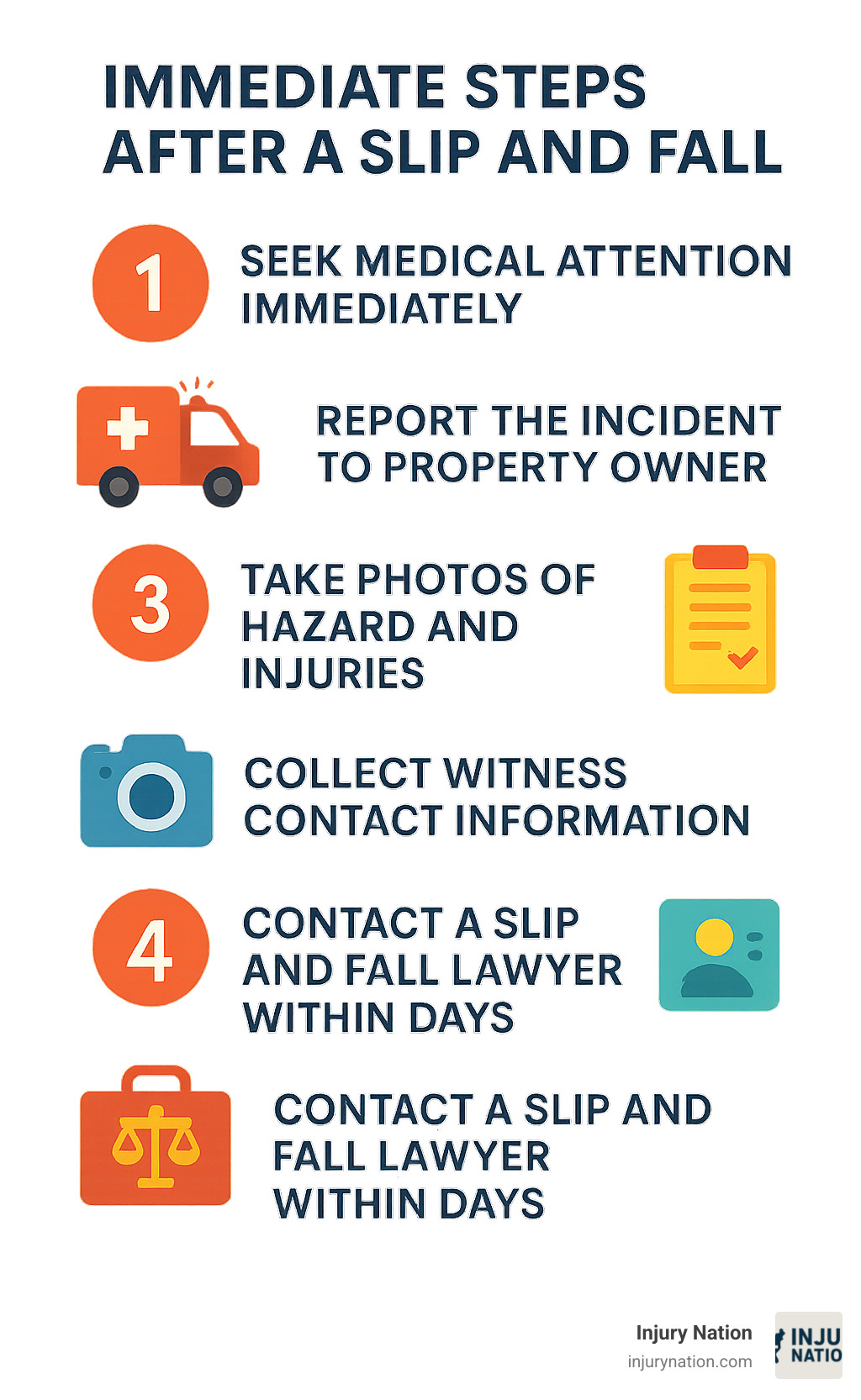
Acting quickly to gather evidence is crucial. Be sure to collect:
- Photo documentation: Pictures of the hazard, the surrounding area, and your injuries.
- Witness statements: Names and contact information from anyone who saw the fall.
- Incident reports: If at a business, file a report and get a copy.
- Medical records: Seek immediate medical attention to document your injuries and link them to the fall.
- Preserving footwear and clothing: Keep the shoes and clothes you were wearing as potential evidence.
Special Considerations for Public vs. Private Property
The property type affects your claim, especially regarding deadlines and standards of proof.
Public Property (Municipal Liability): If you fall on government property (like a city sidewalk or park), the rules are much stricter. You may have a very short window—sometimes just days or weeks—to provide formal notice of your claim. Furthermore, you often must prove “gross negligence,” a higher standard than ordinary negligence, meaning the government showed a reckless disregard for safety. This is why having lawyers for slip and fall accidents who understand these nuances is critical.
Private Property (Residential & Commercial):
- Private Residences: A fall at someone’s home is typically covered by their homeowner’s insurance. The claim is against the policy, not their personal assets.
- Commercial Properties: Businesses like stores, hotels, and restaurants have a high duty of care and are expected to have regular inspection and maintenance procedures.
The Role of Top Lawyers for Slip and Fall Accidents
When you’ve suffered a slip and fall injury, navigating the legal aftermath is daunting. This is where experienced lawyers for slip and fall accidents become your indispensable guides, acting as your advocates, strategists, and negotiators.
Most personal injury lawyers work on a contingency fee basis, meaning you pay nothing upfront. Legal fees are a percentage of the settlement or judgment we secure for you. If we don’t win, you don’t pay. This ensures quality legal representation is accessible to everyone.
Our legal expertise is crucial. Property owners and their insurers have legal teams dedicated to minimizing payouts. We level the playing field, applying our knowledge of complex negligence standards to your case.
Many claims are settled out of court. However, if a fair settlement isn’t possible, we are prepared to take your case to trial. We will accurately assess your case’s value to ensure you don’t settle for less than you deserve.
What an Attorney Does to Build Your Case
When you hire us, we begin a comprehensive process to build the strongest possible case:
- Liability Investigation: We investigate the accident scene, interview witnesses, and identify all responsible parties (e.g., owner, manager, maintenance company).
- Evidence Gathering: We obtain surveillance footage, maintenance logs, and expert reports from accident reconstructionists or medical specialists.
- Witness Interviews: We conduct thorough interviews with eyewitnesses and anyone else with relevant information.
- Expert Consultation: We work with medical and financial experts to detail the full impact of your injuries and calculate lost earnings.
- Filing Legal Documents: We handle all paperwork, ensuring documents are prepared and filed correctly and on time.
- Proving Negligence: This is the cornerstone of your claim. We work to demonstrate that the property owner’s breach of duty directly caused your fall and subsequent damages.
For an example of a firm that excels in such detailed case building, you can learn more about Adam S. Kutner Injury Attorneys.
Maximizing Your Compensation: What Can You Claim?
Our primary goal is to secure full compensation for all your losses. Damages we seek include:
- Medical Expenses: All current and future medical costs, from ER visits to long-term physical therapy.
- Lost Wages: Income, bonuses, and benefits lost from missing work.
- Future Income Loss: Compensation if your injury reduces your long-term earning capacity.
- Pain and Suffering: For the physical pain and emotional distress caused by the injury.
- Loss of Enjoyment of Life: For the inability to participate in hobbies and activities you once enjoyed.
- Disability and Disfigurement: For any permanent impairment or scarring.
- Rehabilitation Costs: Expenses for therapies, vocational training, and necessary home modifications.
- Out-of-Court Settlements: Most cases are resolved through negotiated settlements that cover these damages.
How Lawyers Leverage Technology in Handling Slip and Fall Cases
In today’s legal landscape, technology is a critical tool that allows lawyers for slip and fall accidents to handle cases more effectively. We leverage cutting-edge technology to streamline processes and strengthen your case.
Technology empowers us through:
- Case Management Software: To organize vast amounts of information and track deadlines.
- Digital Evidence Analysis: To collect and analyze surveillance footage, social media data, and other digital evidence.
- Accident Reconstruction: Using 3D modeling to visually recreate the accident for a judge or jury.
- E-Findy: Efficiently searching through large volumes of electronic documents from defendants.
- Virtual Communication: Using virtual meetings and secure client portals for convenient and confidential communication.
This technological edge, as highlighted by legal professionals, allows us to build stronger cases and achieve better outcomes. You can see an example of this commitment to innovation in action here.
Critical Deadlines and Legal Problems in a Slip and Fall Case
While you’re recovering from a slip and fall, the legal system’s clock keeps ticking. There are strict time limits that can make or break your case, regardless of the severity of your injury or the owner’s clear negligence.
Missing these deadlines often means losing your right to compensation entirely. Beyond the deadlines, slip and fall cases present unique challenges. Insurance companies will look for ways to blame you, arguing you were distracted or wearing the wrong shoes. Proving the property owner’s negligence caused your injuries requires legal expertise.
This is why having experienced lawyers for slip and fall accidents is essential. We know these deadlines and understand how to steer the complex legal landscape while you focus on getting better.
Understanding Your State’s Statute of Limitations
The statute of limitations is the most critical deadline. It’s a legal expiration date on your right to file a lawsuit. Once it passes, your claim is void.
In many states, including Nevada, you have two years from the date of your accident to file a lawsuit. This might sound like a long time, but it can pass quickly during a complicated recovery.
The clock typically starts on the day you fell. In rare cases, the timeline might begin when you reasonably finded the injury and its link to the fall, but you should not rely on this exception. Courts are often strict.
Different defendants can also have different deadlines. A claim against a private business might have a two-year limit, while an accident on government property could have much shorter notice requirements.
The bottom line? Don’t wait. The sooner you consult an attorney, the better. Firms like Shook Stone Injury Lawyers understand just how critical these time-sensitive elements are to your case’s success.
Why you need lawyers for slip and fall accidents when suing the government
If you fell on government property—like a city sidewalk or public building—you face a different set of rules. Suing the government is challenging due to a concept called sovereign immunity, which historically protected governments from lawsuits.
While these protections have been relaxed, they’ve been replaced with strict conditions:
- Brutally Short Notice Deadlines: In some places, you have as little as 10 days to provide written notice of your claim to the correct government office. Miss this window, and your case is likely over.
- Higher Burden of Proof: You usually can’t just prove ordinary negligence. Instead, you must demonstrate gross negligence—that the government’s actions were reckless and showed a marked departure from the standard of care.
- Complex Procedures: There are specific forms, notice requirements, and administrative processes you must follow before you can even file a lawsuit.
These rules are designed to protect government budgets, not injury victims. Attempting to handle a government slip and fall claim without experienced lawyers for slip and fall accidents is nearly impossible. We know the procedures and deadlines to build the strongest possible case.
Frequently Asked Questions
We know that dealing with a slip and fall injury brings up many questions. Let’s address the most common concerns we hear.
How much does it cost to hire a lawyer for a slip and fall?
The good news is that hiring lawyers for slip and fall accidents costs nothing upfront. Most personal injury attorneys work on a contingency fee basis, meaning we only get paid if we win your case.
Our fee is a percentage of the settlement or court award we secure for you. We also typically advance litigation costs, like filing and expert witness fees, which are reimbursed from your settlement only if we win.
Your initial consultation is always free. We’ll evaluate your case and explain your options with no pressure or obligation. If we don’t win your case, you owe us nothing.
What is a typical settlement for a slip and fall?
This is a common question, but there’s no such thing as a “typical” settlement. Every case is unique, and we’ve seen settlements range from thousands of dollars to millions for severe, life-altering injuries.
Your case’s value depends on your specific circumstances. The key factors include:
- The severity of your injuries and their impact on your daily life.
- The strength of your case and the clarity of the property owner’s negligence.
- Your total medical expenses, both past and future.
- Your lost wages and any impact on your long-term earning ability.
- Your pain and suffering, which includes physical discomfort and emotional distress.
An experienced attorney can evaluate these factors to give you a better idea of what your specific case might be worth.
Can I file a claim if I was partially at fault?
Yes, you can absolutely pursue compensation even if you believe you share some of the blame. Most states, including Nevada, follow comparative negligence laws.
This means that even if you were partly responsible, you can still recover damages. Your compensation is simply reduced by your percentage of fault. For example, if your damages are $100,000 and you are found 20% at fault, you could still recover $80,000.
Be aware that some states have a cutoff point. If you’re found to be 50% or 51% or more at fault (depending on the state), you may not be able to recover anything. Insurance companies will try to shift as much blame onto you as possible.
This is why you need experienced lawyers for slip and fall accidents on your side. We know how to counter unfair attempts to blame you. Don’t let concerns about shared fault stop you from seeking the compensation you deserve.
Conclusion: Find the Right Legal Partner for Your Recovery
When a slip and fall accident happens, your world can be turned upside down by painful injuries, overwhelming medical bills, and the stress of what comes next. We understand this is a difficult situation, but you have rights, and you don’t have to handle this alone.
The steps we’ve covered are your lifeline to getting the compensation you deserve. Seeking immediate medical attention protects your health and your case. Documenting everything gives your attorney the evidence they need. And acting quickly ensures you don’t miss critical deadlines, especially the short notice periods required for claims against government entities.
Property owners and their insurance companies have one goal: to pay you as little as possible. They have experienced legal teams working to protect their interests. Shouldn’t you have someone fighting just as hard for yours?
That’s where lawyers for slip and fall accidents become your strongest advocates. We investigate what happened, gather evidence, and negotiate aggressively with insurance companies. While you focus on getting better, we handle the legal battle.
At Injury Nation, we connect injury victims with attorneys who care about getting results. We understand that behind every case is a real person dealing with real pain and financial stress.
Don’t let an insurance company convince you that your injuries aren’t serious or that you were at fault. Don’t accept a quick settlement that won’t cover your long-term needs. Your recovery is our priority. Let us help you find an experienced attorney who will fight for the compensation you deserve, so you can get your life back on track.