What You’re About to Find: Your Free Legal Consultation Decoded
What to expect during free consultation with personal injury attorney is a confidential, no-obligation conversation where you share your story, the attorney evaluates your case, and you both decide if working together is the right move. Here’s what happens:
During Your Free Consultation:
- You Tell Your Story: The attorney listens to the details of your accident, your injuries, and the impact on your life.
- The Attorney Assesses Your Case: They evaluate fault, damages, and the strength of your evidence to see if they can help.
- You Ask Questions: This is your chance to inquire about their experience, fees, and case strategy.
- Legal Options Are Explained: You’ll learn about the legal process, potential outcomes, and the next steps.
- No Pressure, No Cost: The meeting is confidential, you are not obligated to hire them, and it is completely free.
After an accident, many victims worry about the cost of a lawyer. The good news is that a free consultation is truly free—no strings attached. This meeting is a two-way interview. While the attorney evaluates your case, you are interviewing them to see if they are experienced, trustworthy, and a good fit for you.
Knowing what to expect can ease the stress of meeting a lawyer for the first time, especially when you’re already dealing with medical bills and insurance adjusters. Most personal injury lawyers also work on a contingency fee basis, which means they only get paid if you win your case. If you don’t get a settlement or award, you owe no attorney fees.
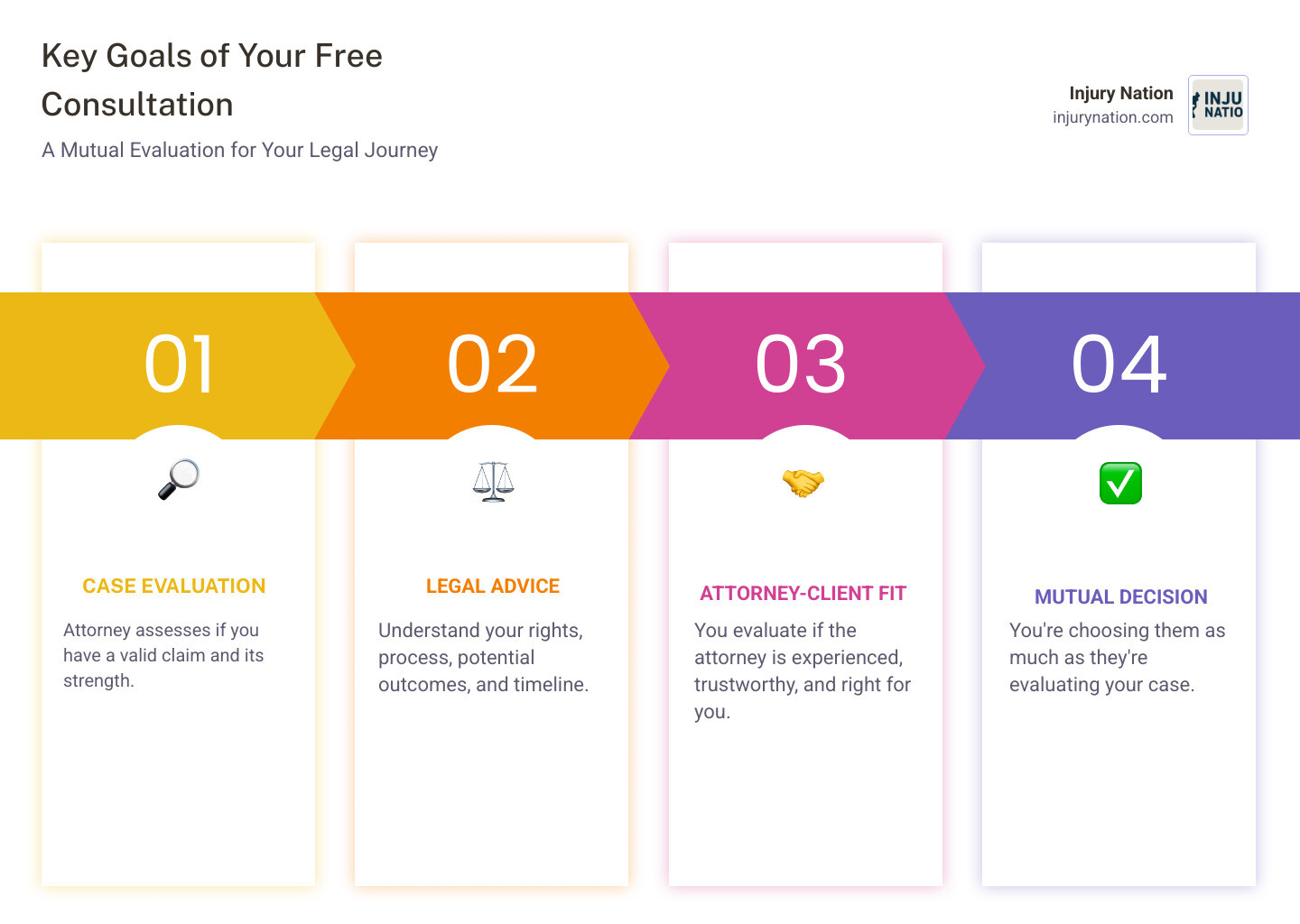
Infographic Details: A three-column visual showing “The 3 Purposes of Your Free Consultation” – Column 1: “Case Evaluation” with an icon of a magnifying glass over a document, text reads “Attorney assesses if you have a valid claim and how strong it is”; Column 2: “Get Legal Advice” with an icon of a speech bubble containing a scale of justice, text reads “Understand your rights, legal process, potential outcomes, and timeline”; Column 3: “Attorney-Client Fit” with an icon of two people shaking hands, text reads “You evaluate if the attorney is experienced, trustworthy, and right for you”. Bottom text: “Remember: This is a two-way interview. You’re choosing them as much as they’re evaluating your case.”
The Two-Way Interview: Preparing for Your Free Consultation
Think of your meeting with a personal injury attorney as a two-way interview. It’s not just about them evaluating your case—it’s about you deciding if you trust them to fight for your recovery. A little preparation can make this meeting empowering. Walking in organized shows you’re in control of a difficult situation.

Gathering Your Evidence: What to Bring to the Meeting
The documents you bring help the attorney quickly and accurately assess your case. Don’t worry if you don’t have everything; a good attorney can help you track down missing items later. The important thing is not to delay your consultation. Bring what you can from this list:
- Police or Accident Report: This official document is crucial, as it often includes an officer’s assessment of fault and witness statements.
- Medical Records and Bills: Bring discharge papers, doctor’s notes, and bills. These documents connect the accident to your injuries and the cost of your treatment.
- Photos and Videos: Visual evidence of the accident scene, vehicle damage, and your injuries can be incredibly powerful.
- Insurance Information: Your own policy details and any information you have about the at-fault party’s insurance.
- Correspondence with Insurance Adjusters: Bring any emails, letters, or notes from calls with an insurance adjuster. Your attorney needs to know what has already been said.
- Witness Information: The names and contact details for anyone who saw the accident.
- Proof of Lost Wages: Pay stubs or a letter from your employer can document income you’ve lost due to your injuries.
- Your Own Notes: A simple timeline of events, treatments, and how your life has been affected can help you remember key details.
Don’t delay your consultation just because you’re missing a document. Time is critical, especially with legal deadlines (statutes of limitations) approaching.
Crafting Your Narrative: What the Attorney Will Ask You
This is a confidential conversation to understand your story, not an interrogation. Be completely honest, even about potential weaknesses in your case. The attorney needs the full picture to help you effectively. Expect questions about:
- The Accident: The basic facts—who, what, where, when, and how.
- Your Injuries and Their Impact: Beyond medical diagnoses, how have your injuries affected your daily life, work, and ability to enjoy activities?
- Medical Treatment: Your diagnosis, treatments received, and what doctors say about your recovery. They will also ask about pre-existing conditions to anticipate the insurance company’s arguments.
- Insurance Company Communications: What did you tell the adjuster? Did you give a recorded statement or sign any documents?
- Your Goals: What do you hope to achieve? Understanding your needs helps the attorney determine if they can realistically help you.
They may also ask about weaknesses, like if you were partially at fault or delayed treatment. This isn’t to judge you, but to build a strategy that accounts for these challenges.
Taking Control: Questions You Should Ask the Attorney
Now, it’s your turn to ask questions. You are hiring a professional for a critical task, and you deserve answers. Here are some key questions to ask:
- Experience: “How many cases like mine have you handled?” Experience with similar cases means they understand the specific challenges. Our Personal Injury Lawyer Guide can help you understand different case types.
- Success and Trial Experience: “What is your success rate, and how often do you go to trial?” An attorney known for winning at trial often gets better settlement offers.
- Case Management: “Will you personally handle my case, or will it be an associate?” You deserve to know who your primary contact will be.
- Communication: “How often will I receive updates, and what is the best way to reach you?” A clear communication plan prevents frustration.
- Timeline: “How long do you estimate my case will take?” While not a guarantee, a realistic range helps you plan.
- Fees and Costs: “How do you charge, and what other expenses might I be responsible for?” Understand the financial arrangement completely.
- Statute of Limitations: “How much time do I have to file my case?” Missing this deadline can end your claim.
Feel free to Compare Lawyers by meeting with more than one. What to expect during free consultation with personal injury attorney includes the freedom to find the right fit for you. This is your chance to choose a partner for this journey, so ask the questions that matter and trust your instincts.
What to Expect During the Free Consultation with a Personal Injury Attorney
This is the core of the meeting, where you tell your story and get an initial legal assessment. The conversation is designed to be comfortable and informative.

The Conversation Flow: From Your Story to Legal Strategy
What to expect during free consultation with personal injury attorney is a structured conversation, typically lasting 30 to 60 minutes. A good attorney will give you the time you need.
The meeting generally follows this flow:
- Introductions: The attorney or a team member will explain how the consultation works and help you feel at ease.
- Your Story: This is the most important part. You’ll explain the accident, your injuries, and how your life has been affected. Be thorough and honest.
- Clarifying Questions: The attorney will ask questions to fill in gaps and analyze your case from a legal perspective. This is where details about negligence and your losses are crucial.
- Your Questions: You’ll have the opportunity to ask the questions you prepared about their experience, strategy, and fees.
- Legal Options and Strategy: The attorney will explain your rights, the legal process, and a realistic assessment of your situation, including potential damages and timelines.
- Next Steps: If you both agree to move forward, the attorney will outline the next steps, such as signing a representation agreement.
Is It Really Confidential? Understanding Attorney-Client Privilege
Yes, your conversation is genuinely confidential. Attorneys are bound by confidentiality rules that protect everything you discuss, even if you don’t hire them. This protection applies to prospective clients, so you can be completely honest.
Honesty is crucial. Whether you apologized at the scene or delayed seeing a doctor, tell your attorney. They have seen it all and are there to help, not judge. Withholding information is like lying to your doctor; it prevents them from giving you the best possible help. Your attorney needs to know about any potential weaknesses to prepare for them, rather than being surprised later.
How an Attorney Evaluates Your Case
While you talk, the attorney is mentally assessing your case based on several key factors:
- Liability: Who was at fault? They will review your evidence (police reports, photos) and your account to determine who is legally responsible. The role of official reports and witnesses is very important in proving liability.
- Damages: This includes economic damages like medical bills and lost wages, as well as non-economic damages like pain and suffering and loss of enjoyment of life. They need to understand the full impact the accident has had on you.
- Evidence: How strong is your documentation? Prompt medical treatment, credible witnesses, and clear records make for a stronger case.
- Statute of Limitations: This is the legal deadline for filing a claim. For example, New York has a three-year statute of limitations for many personal injury claims. If the deadline has passed, you may lose your right to compensation.
Why might an attorney decline your case? It’s not personal. It could be due to weak evidence, the statute of limitations having passed, or if the potential damages are too low to justify a lawsuit. If an attorney declines your case, consider getting a second opinion. You can Compare Lawyers to find another professional who may be a better fit.
Understanding the Financials: Fees, Costs, and Contingency
After an injury, the last thing you need is another bill. Most personal injury lawyers use a fee structure that eliminates financial risk for clients, so you can pursue justice without upfront costs.

“No Fee Unless You Win”: How Contingency Fees Work
When wondering what to expect during free consultation with personal injury attorney, you’ll be relieved to learn that most work on a contingency basis. This means you owe no attorney fees unless they win your case through a settlement or court award. If you don’t win, you don’t pay them a fee.
The typical contingency fee is 30% to 40% of the total recovery. For instance, on a $100,000 settlement with a 33% fee, the attorney receives $33,000. This model allows anyone, regardless of their financial situation, to access quality legal representation. It also aligns your attorney’s interests with yours: they are motivated to get you the best possible outcome because they don’t get paid unless you do.
Are There Other Costs? Attorney Fees vs. Case Expenses
It’s important to distinguish between attorney fees and case expenses (or “costs”).
- Attorney Fees: This is the percentage the lawyer earns for their work. It is contingent on winning.
- Case Expenses: These are the out-of-pocket costs required to pursue your claim, such as court filing fees, expert witness fees, deposition costs, and fees for obtaining medical records.
During your consultation, ask two critical questions:
- “How are case expenses handled?” Most firms advance these costs, meaning they pay them for you, and then deduct them from your settlement.
- “If we lose the case, am I responsible for repaying these expenses?” Many reputable firms will absorb these costs if the case is unsuccessful, meaning you truly pay nothing. Others may require reimbursement.
Get clarity on this upfront. A good attorney will be transparent, and all financial details should be clearly stated in your written representation agreement.
After the Handshake: Next Steps and Making Your Decision
The consultation is over. What happens now? This is the phase where you make your decision and, if you move forward, the real work on your case begins.
What to expect after the free consultation with a personal injury attorney
After the meeting, the attorney will review your case. If they believe they can help, they will offer to represent you. If not, a good attorney will explain why and may refer you to someone else.
If you both agree to work together, the process is straightforward:
- Sign a Representation Agreement: This is the formal contract that outlines the contingency fee, how expenses are handled, and the scope of the attorney’s services. Read it carefully and ask questions before you sign.
- The Investigation Begins: Your legal team will immediately start gathering evidence, including police reports, medical records, and witness statements. For a deeper look at this process, see our Vehicle Injury Attorney Complete Guide.
- Attorney Takes Over Communications: One of the biggest reliefs is that your attorney will handle all communication with insurance companies. No more stressful calls from adjusters.
- You Focus on Recovery: With the legal burden lifted, you can concentrate on your medical treatment and getting your life back on track.
You are under no obligation to hire an attorney after a free consultation. Take your time to make the right decision for you.
How to Choose the Right Attorney for You
Choosing an attorney is a critical decision. This person will be your partner and advocate during a challenging time. Here’s what to look for:
- Experience and Specialization: You want a lawyer with a proven track record in cases like yours. An expert in car accidents may not be the best fit for a medical malpractice claim.
- Communication Style: Did the attorney listen to you? Did they explain things clearly? You need to feel comfortable and respected. A good rapport is essential for a long-term professional relationship.
- Firm Resources: Does the firm have the financial strength to take on powerful insurance companies, hire experts, and go to trial if needed? A well-established firm often has more resources.
- Trust Your Gut: Your intuition is valuable. If you felt a genuine connection and sense of trust, that’s a positive sign. If something felt off, pay attention to that feeling.
- Meet with More Than One Lawyer: It’s smart to get a few perspectives. You can Compare Lawyers to see how different firms stack up. This helps you choose a partner whose strategy and personality align with your goals.
Take your time with this decision. The right attorney can make a significant difference in both the outcome of your case and your experience throughout the process.
Frequently Asked Questions about Free Legal Consultations
How long do I have to file a personal injury claim?
Every state has a statute of limitations, which is a strict deadline for filing a lawsuit. If you miss this deadline, you will likely lose your right to compensation forever. The clock usually starts on the date of your injury.
For example, New York generally gives you three years from the date of injury for most personal injury claims. However, this timeframe can be much shorter for certain cases, like claims against a government entity. Waiting is never a good idea. Evidence disappears, witness memories fade, and security footage is erased. Contacting an attorney as soon as possible is the best way to protect your rights and preserve crucial evidence.
What makes a personal injury case “strong”?
A strong case typically has several key elements:
- Clear Liability: There is solid evidence that someone else’s negligence caused your injuries.
- Significant, Documented Injuries: Your injuries are medically documented through X-rays, MRIs, and treatment plans from qualified professionals. The more severe the injury, the stronger the claim.
- Strong Evidence: This includes official police reports, unbiased witness statements, and photos or videos of the scene and your injuries.
- Credibility: Your story is consistent and honest. Any exaggeration or inconsistency can undermine your entire case.
- Ability to Pay: The at-fault party has insurance or assets to cover your damages. This is why having uninsured/underinsured motorist coverage on your own policy is so important.
An attorney can assess these factors during your free consultation with a personal injury attorney and give you an honest opinion on your case’s strength.
Can I handle my claim without a lawyer?
Technically, yes, for very minor claims with no injuries. However, for any case involving significant injury, it’s a major risk. Insurance companies are businesses focused on minimizing payouts. Their adjusters are trained to get you to accept a lowball offer or say something that hurts your claim.
Studies consistently show that accident victims who hire an attorney receive significantly higher settlements—often several times more—than those who go it alone. An attorney understands the full value of your claim, including pain and suffering, and knows how to counter the insurance company’s tactics. They level the playing field and signal to the insurer that you are serious.
While our guide on How to Negotiate a Car Accident Settlement Without a Lawyer offers insights, the truth is that for any serious claim, an attorney is essential. Since most work on contingency, you have nothing to lose by getting a professional opinion.
Conclusion: Your First Step Toward Justice
You’ve made it through this guide, and by now, you should have a clear picture of what to expect during free consultation with personal injury attorney. But more importantly, you should feel empowered.
A free consultation is a genuine, no-risk opportunity to understand your legal rights, get professional advice about your situation, and take your first real step toward recovery. After an accident, when you’re dealing with injuries, medical bills, and the stress of not knowing what comes next, that first conversation with an attorney can be a turning point. It’s where confusion starts to turn into clarity, and where you begin to feel like you’re not alone in this fight.
Preparation is your secret weapon. By gathering your documents, organizing your thoughts, and coming prepared with questions, you walk into that meeting as an informed, empowered person—not just a victim. You’re interviewing them as much as they’re evaluating your case. You’re choosing a partner for what might be a long journey, and that choice matters.
The right personal injury attorney does more than just file paperwork and negotiate with insurance companies. They become your advocate, your guide through a complex legal system, and your voice when you’re too overwhelmed to speak for yourself. They handle the legal complexities, deal with the insurance adjusters, and fight for the compensation you deserve—all while you focus on what truly matters: your physical and emotional healing.
You don’t have to face this alone. Injury Nation exists to connect accident victims like you with top-rated, experienced attorneys who genuinely care about getting you the justice and compensation you deserve. These are lawyers who understand what you’re going through, who have successfully handled cases like yours, and who are ready to fight for you.
If you’re still on the fence, remember this: the consultation is free, confidential, and comes with zero obligation. You have absolutely nothing to lose by having that conversation, and potentially everything to gain. The statute of limitations is ticking, evidence can disappear, and memories can fade. The sooner you speak with an attorney, the stronger your case will be.
Take control of your situation today. You’ve already taken the first step by educating yourself. Now take the next one. Find a Lawyer in your area and schedule your free consultation. Your path to justice and recovery starts with a single conversation. You deserve answers, you deserve justice, and you deserve someone fighting in your corner.