When Healthcare Causes Harm
A medical error attorney represents patients harmed by preventable mistakes from healthcare providers. They help victims prove negligence, steer complex laws, and recover compensation for their injuries by investigating the case, hiring medical experts, handling all legal procedures, and fighting to maximize compensation.
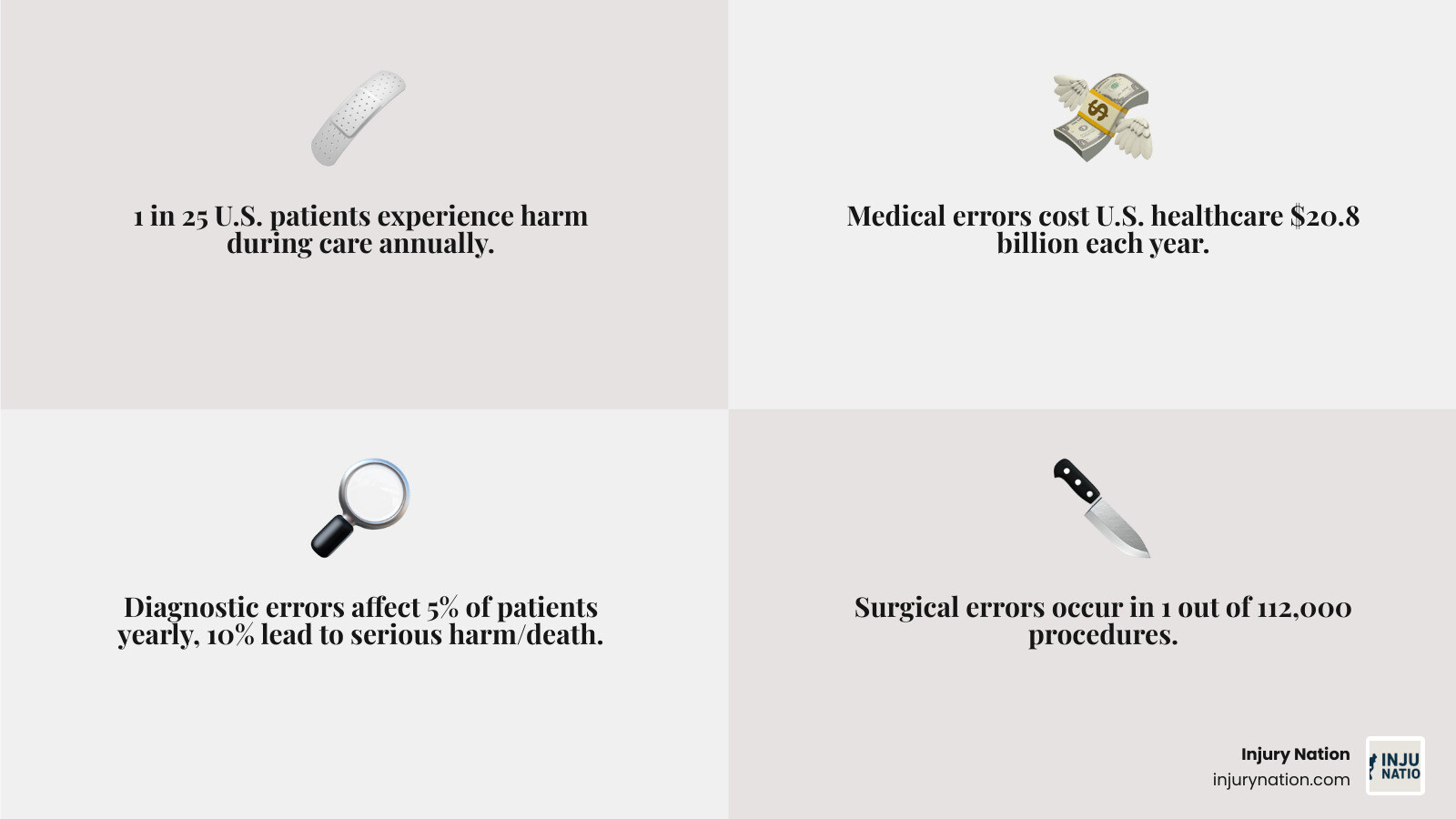
When you seek medical care, you trust you’ll be helped, but that trust is sometimes broken. Medical errors are shockingly common. In the U.S., they cost the healthcare system over $20.8 billion annually and harm an estimated 1 in 25 patients. In Canada, medical errors are a leading cause of death, responsible for thousands of fatalities each year.
Behind these numbers are real people left with permanent injuries, disabilities, or the loss of a loved one. If you’ve been harmed, you’re likely facing physical pain, emotional trauma, and mounting bills. Taking on a hospital or doctor can feel overwhelming, but a specialized medical error attorney can be your advocate, fighting to hold negligent providers accountable.
This guide explains what medical malpractice is, when you might have a claim, and how to find the right attorney to represent you.
What Constitutes Medical Malpractice?
Medical negligence, or malpractice, occurs when a healthcare professional’s care falls below the accepted standard, causing harm. It’s not just a mistake; it’s a preventable error that a reasonably competent provider would have avoided.
A key point is that not every bad outcome is malpractice. Medicine is unpredictable, and complications can happen even with excellent care. The difference is whether the harm was preventable. If a provider breached their duty by deviating from the standard of care—the benchmark for all medical treatment—and you were injured as a direct result, you may have a malpractice claim.
| Feature | Medical Error | Unavoidable Bad Outcome |
|---|---|---|
| Definition | A preventable mistake in medical care. | An adverse event that occurred despite proper care. |
| Standard of Care | Care fell below accepted professional standards. | Care met accepted professional standards. |
| Preventability | Could have been avoided with reasonable diligence. | Often an inherent risk of the procedure or condition. |
| Negligence Involved? | Yes, implies a breach of duty. | No, usually not due to negligence. |
| Example | Operating on the wrong limb. | A known complication of surgery that occurs. |
Common Types of Medical Errors
Medical errors take many forms. Recognizing them can help you know if you have a claim.
- Surgical errors include wrong-site surgery, performing the wrong procedure, or leaving retained surgical items like sponges inside a patient.
- Diagnostic errors are the most common type of claim and include misdiagnosis or a delayed diagnosis. A missed cancer or a heart attack dismissed as indigestion can have tragic consequences.
- Medication errors can happen during prescribing, dispensing, or administration. The wrong drug, dose, or a missed drug interaction can cause severe harm, especially to children and the elderly.
- Birth injuries occur when mistakes during pregnancy, labor, or delivery cause lifelong disabilities like Cerebral Palsy, which is often linked to preventable oxygen deprivation.
- Anesthesia errors, such as incorrect dosing or poor monitoring, can lead to brain damage, coma, or death.
- Hospital-acquired infections often stem from poor sanitation or hygiene, representing a clear form of negligence when they are preventable.
The Ethical and Legal Obligations of Healthcare Professionals
Healthcare providers have profound ethical and legal duties. They must provide competent care, meeting the skill and diligence expected of a professional in their field.
Informed consent is another cornerstone. Before any treatment, you have the right to understand the proposed procedure, its risks, benefits, and alternatives. Providers must clearly communicate all significant risks so you can make an informed decision.
Additionally, providers are bound by patient confidentiality and have an obligation of means, not results. This means they must use accepted practices to treat you but do not guarantee a cure. When these obligations are not met and harm occurs, you have the right to seek justice.
The Legal Framework for a Malpractice Claim
Proving a medical error case requires solid evidence, expert testimony, and a clear understanding of complex state laws. The burden of proof is on you, the patient, to show that the harm you suffered was due to negligence. This is why an experienced medical error attorney is essential.

The Four Key Elements of a Malpractice Case
To win a malpractice case, you must prove four essential elements:
- Doctor-Patient Relationship: You must show the healthcare provider agreed to treat you, establishing a duty of care.
- Breach of the Standard of Care: You must prove the provider’s care deviated from the standard that a reasonably competent professional would have provided in similar circumstances. This is negligence.
- Causation: You must establish a direct link between the provider’s negligence and your injury. The mistake must be the reason you were harmed.
- Damages: You must demonstrate actual, measurable harm, such as physical injury, financial loss, or other quantifiable damages.
If any one of these elements is missing, your case will not succeed.
The Crucial Role of Medical Experts
Medical malpractice cases are nearly impossible to win without expert testimony. Medical experts are needed to establish the standard of care, explain how it was breached, and confirm that the breach caused your injury. They translate complex medical information for judges and juries.
Both sides hire their own experts, so your case often becomes a battle of credible medical opinions. In some states, an Affidavit of Merit—a document signed by a medical expert confirming your claim has merit—is required just to file the lawsuit. This makes expert involvement critical from the very beginning.
Understanding the Statute of Limitations
The clock is ticking. Every state has a statute of limitations—a strict deadline for filing a lawsuit. If you miss this deadline, your right to sue is lost, no matter how severe your injury.
These time limits vary by state and can be complex. Many states use a “findy rule,” where the clock starts when you find (or reasonably should have finded) the injury, not necessarily when the malpractice occurred. For example, Nevada has a complex system of deadlines that was recently updated by Assembly Bill No. 404 in 2023.
Factors like the patient being a minor or fraudulent concealment by the provider can sometimes extend the deadline. The most important takeaway is to contact a medical error attorney as soon as you suspect something is wrong. Don’t wait and risk losing your right to compensation.
Why You Need a Specialized Medical Error Attorney
When you’re dealing with the aftermath of a medical error, you’re already carrying an enormous burden. You’re managing your physical recovery, processing the emotional trauma, and likely facing mounting medical bills. The last thing you need is to steer the complex legal system alone while fighting against powerful hospitals and their well-funded insurance companies.
This is exactly why you need a specialized medical error attorney on your side.

A specialized attorney levels that playing field. They speak the language of medicine and law fluently. They understand how to read medical charts, interpret complex procedures, and spot deviations from accepted standards of care. More importantly, they’re not intimidated by the opposition. They’ve fought these battles before and know exactly what it takes to win.
How a Medical Error Attorney Can Help Your Case
The right attorney becomes your advocate, investigator, and guide through every step of the legal process. Here’s what that actually looks like in practice.
- Investigate your case by carefully reviewing medical records to build a clear narrative of negligence.
- Gather crucial evidence, including expert opinions and witness testimony, to support your claim.
- Hire respected medical experts who can explain complex medical concepts to a judge and jury.
- Negotiate settlements with insurance companies, fighting for fair compensation that covers all your losses.
- Represent you in court if a fair settlement isn’t reached, using their trial experience to argue passionately on your behalf.
- Handle all legal procedures, from filing deadlines to court documents, including state-specific requirements like Nevada’s Affidavit of Merit. If you’re in the Las Vegas area and need dedicated support, our directory can connect you with experienced advocates who can serve as your Medical Malpractice Las Vegas representatives.
The Advantage of Specialization
Medical malpractice cases are uniquely complex and require more than a general personal injury lawyer. A specialist focuses on areas like birth injuries, surgical errors, brain injuries, cancer misdiagnosis, medication errors, and emergency room errors.
This deep focus gives them an insider’s understanding of healthcare protocols. They have established networks of top medical experts and a track record of securing substantial compensation for clients because they know how to value cases properly and are prepared to go to trial.
How Do Attorneys Handle Fees in These Cases?
Most medical error attorneys work on a contingency fee basis. This means you pay no legal fees unless your attorney wins your case.
If they secure a settlement or verdict for you, they receive an agreed-upon percentage of the recovery. This system ensures their interests are aligned with yours—they are motivated to get you the maximum compensation possible. While you may be responsible for case expenses like expert witness fees, the contingency structure makes justice accessible to everyone, regardless of their financial situation.
From Injury to Compensation: The Claims Process
The path from experiencing a medical error to finally receiving compensation isn’t always straightforward, but understanding what to expect can help you feel more prepared and less overwhelmed. While every case is unique, there are common steps that most victims will go through on their journey to justice.

Initial Steps for Victims
If you suspect you’ve been harmed by a medical error, take these steps immediately to protect your health and legal rights:
- Get proper medical treatment. See a different provider to address your injuries and create a clear medical record.
- Document everything. Keep a journal of your symptoms, and save all medical bills, receipts, and communications with providers.
- Contact a medical error attorney. Don’t delay. Statutes of limitations are strict, and a free consultation can determine if you have a case.
Your attorney will then take over, investigating your claim, consulting experts, and handling all communications, allowing you to focus on your recovery.
What Types of Compensation Can You Seek?
While no amount of money can truly undo the harm, compensation helps manage the financial and personal burdens. Damages are typically divided into three categories:
- Economic Damages: These cover tangible financial losses, including past and future medical bills, lost wages, and rehabilitation costs.
- Non-Economic Damages: This compensates for non-financial losses like physical pain, emotional distress, and loss of enjoyment of life.
- Punitive Damages: Awarded in rare cases of extreme recklessness or malicious conduct, these are intended to punish the wrongdoer and deter future misconduct.
A Closer Look: Medication Errors and Patient Safety
Medication errors are a common and preventable cause of harm. They can occur when a doctor prescribes the wrong drug, a pharmacist dispenses it incorrectly, or a nurse administers it improperly. According to health authorities, children, the elderly, and those with complex medication needs are at the highest risk.
To protect yourself, you can take several steps:
- Keep a current list of all your medications and share it with every provider.
- Ask questions about new prescriptions to understand their purpose and side effects.
- Review your medications regularly with a pharmacist.
- Double-check prescriptions at the pharmacy counter.
Being an engaged patient can reduce your risk. If an error has already harmed you or a loved one, you have the right to hold the responsible parties accountable.
Frequently Asked Questions about Medical Malpractice Claims
We know you’re going through an incredibly difficult time right now. When a healthcare provider harms you instead of healing you, it’s natural to feel confused, angry, and overwhelmed with questions. You’re not alone in this—we’ve heard these concerns from countless people who’ve been in your shoes. Let’s address some of the most common questions we receive about medical malpractice claims.
What is the difference between a medical error and medical malpractice?
A medical error is any mistake made during medical care. Medical malpractice is a legal term for a specific type of error that meets four criteria: it involves a provider who had a duty to care for you, their care fell below the professional standard (negligence), that negligence directly caused you harm, and you suffered actual damages as a result. In short, all malpractice involves an error, but not all errors are malpractice. A medical error attorney can review your situation and help you understand whether what happened to you meets the legal definition of malpractice.
How long does a medical malpractice lawsuit take?
The timeline varies greatly. Some cases settle in months, while others can take several years, especially if they go to trial. Factors include the complexity of the case, state laws, and the willingness of the insurance company to negotiate a fair settlement. Many cases that don’t settle early take between 18 to 24 months to resolve. Your attorney will work to move your case forward as efficiently as possible while building the strongest claim.
Can I sue a hospital for a medical error?
Yes. Hospitals can be held liable for medical errors in several ways. Under the principle of vicarious liability, a hospital is responsible for the negligence of its employees, such as nurses and staff physicians. A hospital can also be sued directly for its own negligence, such as negligent hiring of unqualified staff, inadequate staffing that leads to patient harm, or failing to maintain a safe environment (e.g., allowing the spread of preventable infections). Your medical error attorney will investigate all responsible parties, which may include both the individual provider and the hospital.
Find Your Advocate and Start Your Path to Recovery
When healthcare causes harm instead of healing, the aftermath can shake you to your core. The physical pain, the emotional weight of feeling betrayed by those you trusted, the mounting medical bills—it’s overwhelming. But here’s what we want you to know: you are not alone, and you don’t have to face this fight by yourself.
Throughout this guide, we’ve walked through the realities of medical malpractice—what it is, how to prove it, and what you deserve. We’ve explored how a specialized medical error attorney becomes your voice when you’re facing powerful hospitals and their well-funded insurance companies. These attorneys understand both the medicine and the law. They know how to gather the evidence, work with medical experts, and build a case that holds negligent providers accountable.
The legal system can feel intimidating, especially when you’re still healing. But understanding your rights is the first step toward empowerment. You’ve learned about the four key elements needed to prove malpractice, the crucial role of expert witnesses, and the types of compensation available to you—from medical bills and lost wages to pain and suffering. You’ve also learned that time matters, with statutes of limitations varying by state, making it essential to act quickly.
Expert legal help isn’t just helpful—it’s essential. The right attorney handles all the complex legal procedures, fights the insurance companies, and maximizes your compensation, all while working on a contingency fee basis. You pay nothing unless they win your case. This means financial barriers don’t have to stand between you and justice.
Taking that first step might feel daunting, but it’s also empowering. Every day you wait is a day closer to potential deadlines, and a day you carry this burden alone. You deserve to have someone fight for you, to hold those responsible accountable, and to secure the compensation that can help you rebuild your life.
The path to recovery—both physical and financial—begins with finding the right advocate. Someone who will listen to your story, understand your pain, and commit to getting you the justice you deserve.
Find a qualified medical error attorney in your area today. Your journey toward healing and justice starts now.