

Why Your Choice of Personal Injury Attorney Could Mean Tens of Thousands of Dollars to Your Recovery
A personal injury attorney is a specialized lawyer who provides legal representation to individuals who have been injured, physically or psychologically, as a result of the carelessness or wrongdoing of another person, company, government agency, or other entity. Their primary goal is to help you recover fair compensation for medical bills, lost wages, pain and suffering, and other damages. This area of law is built on the legal principle of negligence, which requires your attorney to prove that the at-fault party failed to exercise a reasonable level of care, directly causing your injuries. But not all personal injury attorneys are created equal—and choosing the wrong one could cost you dearly, both financially and emotionally.
Quick Answer: Finding a Qualified Personal Injury Attorney
- Look for specialization: A dedicated personal injury attorney should have at least 50% of their practice focused on injury law. This ensures they have deep, current knowledge of the legal landscape.
- Check their track record: Don’t be shy. Ask about recent settlements and verdicts in cases similar to yours. A confident attorney will have these results ready to share.
- Verify trial experience: Insurance companies know which lawyers avoid court. You need an attorney who is willing and able to take your case to trial if a fair settlement isn’t offered.
- Confirm fee structure: Reputable attorneys work on a contingency fee basis, meaning there’s no fee unless you win. This aligns their interests with yours.
- Assess communication: During your initial consultation, gauge their responsiveness. They should explain complex legal concepts clearly and make you feel heard.
- Meet in person: Take advantage of free consultations to get a feel for their personality, their office’s professionalism, and their commitment to your case.
When your world is turned upside down by an accident, the stakes couldn’t be higher. You’re dealing with physical pain, mounting medical bills, lost income, and an uncertain future. Insurance companies are for-profit businesses, and they know this vulnerability—and they will use it against you. Their adjusters are trained negotiators whose primary job is to minimize payouts. They might offer a quick, lowball settlement before you even know the full extent of your injuries, hoping you’ll take the money out of desperation.
Research from the Insurance Research Council (IRC) shows that people who hire a personal injury attorney win 31% higher settlements on average compared to those who go it alone. Even more striking: 84% of people working with a lawyer receive compensation, compared to just 56% without legal help. But here’s the catch: these statistics only hold true when you hire a good attorney. A great lawyer levels the playing field, forcing the insurance company to negotiate in good faith.
The difference between a qualified personal injury attorney and a mediocre one isn’t just about money—though that matters enormously. It’s about whether someone fights for your full recovery or pushes you to settle quickly for a fraction of what you deserve. It’s about whether they have the resources to hire experts and take on insurance giants or if they fold at the first sign of resistance. It’s about whether they treat you like family or just another case number in a high-volume settlement mill.
Over the past three decades, personal injury law has become increasingly complex. Insurance companies have refined their tactics, using sophisticated software to lowball claims and armies of lawyers to fight legitimate ones. Medical documentation requirements have grown more stringent, and the legal landscape of liability and damages varies significantly from state to state. In this challenging environment, your attorney’s expertise, dedication, and resources make all the difference between a settlement that covers your losses and one that leaves you in debt.
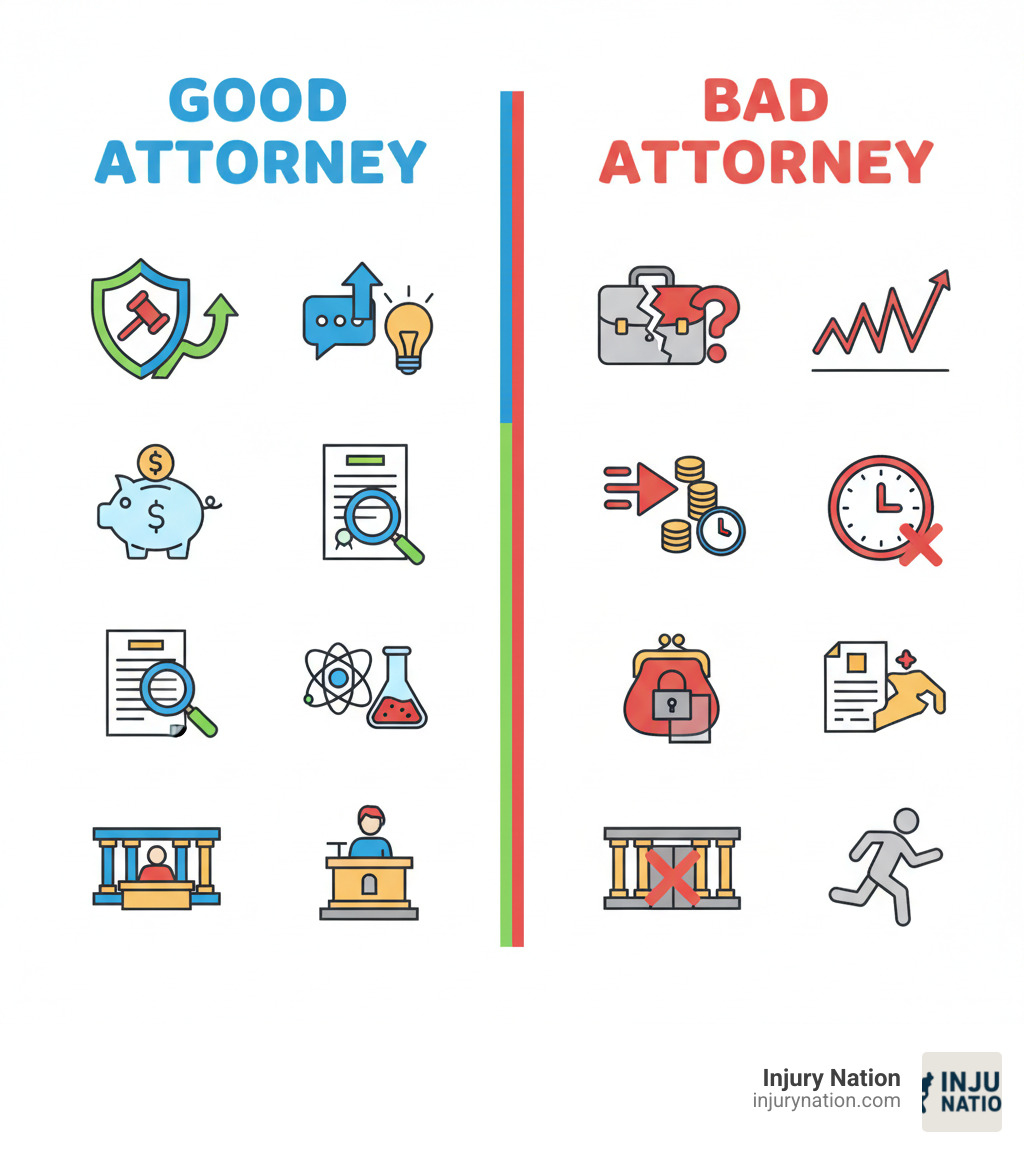
Personal injury attorney terms simplified:
The Defining Traits: Good vs. Bad Attorney Checklist
When you’re hurting and overwhelmed, how do you spot the difference between a personal injury attorney who’ll fight for every dollar you deserve and one who’ll settle for pennies on the dollar?
The truth is, the gap between an exceptional attorney and a mediocre one isn’t subtle—it’s a chasm. And understanding these differences before you sign anything could be worth tens of thousands, or even hundreds of thousands, of dollars to your recovery.
Think of it this way: a great personal injury attorney treats your case like it’s the most important one they’ve ever handled. They lose sleep over your settlement. They know your kids’ names. They understand that behind every medical bill and police report is a real person whose life has been turned upside down.
A bad attorney? They’re already thinking about their next case before they’ve finished your consultation. They see a file, not a family.
Let’s break down exactly what you should look for—and what should send you running for the door.
Specialization matters more than you think.
The best personal injury attorneys dedicate at least half their practice exclusively to injury cases. They live and breathe this area of law. They know the local judges, understand the tactics of specific insurance adjusters in your area, and stay current on the constantly changing laws and precedents that can affect your case. Even within personal injury, there are sub-specialties like medical malpractice, product liability, or commercial trucking accidents, each with its own unique complexities. A general practitioner who “does a little bit of everything”—divorces on Monday, DUIs on Tuesday, personal injury on Wednesday—simply can’t match that depth of expertise. Would you want a general family doctor performing your brain surgery? Of course not. The same logic applies to your financial and physical recovery.
Track records tell the truth.
A quality attorney will proudly and transparently share specific case results similar to yours, with actual dollar amounts and circumstances (while protecting client confidentiality). They can discuss both high-value settlements (negotiated agreements) and verdicts (won in court). This demonstrates a history of success. The warning sign? Vague, empty promises like “we’ll fight for you” or “we get maximum compensation” without any concrete examples to back it up. If an attorney is hesitant to discuss their past results or speaks only in generalities, it’s a major red flag. It often means they don’t have significant victories to point to.
Trial readiness separates the fighters from the settlers.
Here’s a secret insurance companies don’t want you to know: they keep internal scorecards on which attorneys will actually go to trial and which ones will always settle. Attorneys who are known to avoid the courtroom at all costs get consistently lower settlement offers. The best personal injury attorneys are not only willing to litigate—they’re eager to do so when it means getting you fair compensation. They prepare every case as if it’s going to trial. This trial-ready approach gives them immense leverage during negotiations, as the insurer knows they face a credible threat of a costly court battle and a potentially large jury verdict. Bad attorneys push for quick, low settlements because they lack the resources, experience, or courage to take your case before a jury.
Communication can make or break your experience.
Imagine calling your attorney with an urgent question about a medical bill or an insurance letter and getting radio silence for days, or only ever speaking to a paralegal who doesn’t have answers. Frustrating, right? Excellent attorneys and their staff respond promptly, explain complex legal concepts in plain English, and keep you proactively updated on your case’s progress without you having to chase them down. They make you feel like a partner in the process. Poor communicators hide behind legal jargon, make you feel stupid for asking questions, and disappear for weeks at a time, leaving you anxious and in the dark. Good communication is a sign of a well-run, client-focused practice.
Fee transparency protects your settlement.
Reputable personal injury attorneys work on a clear contingency fee basis. The contract should explicitly state the percentage they will take (typically 33-40%), and whether that percentage is calculated before or after case costs are deducted. It should also clearly outline what “case costs” (like expert witness fees, court filing fees, deposition transcripts) are covered and how they will be paid back from the settlement. There are no surprises. Unethical attorneys, on the other hand, may have confusing contracts with hidden fees, charge for routine administrative tasks, or add unexpected charges at the end, leaving you with far less of your settlement than you anticipated. Always read the fee agreement carefully before signing.
Client care extends beyond the courtroom.
A serious injury impacts every part of your life, including your ability to get and pay for medical treatment. The best attorneys understand this. They often have relationships with medical providers who will treat clients on a “medical lien” basis, meaning the doctor agrees to be paid directly from the future settlement. They help you connect with specialists, coordinate treatment, and ensure you’re getting the care you need to recover fully. This comprehensive support is invaluable when you’re unable to work and facing mounting bills. Hands-off attorneys? They just want your signature on the retainer and will leave you to figure out the complicated medical and financial logistics all by yourself.
Investigation quality determines case value.
A personal injury case is only as strong as the evidence supporting it. Top-tier personal injury attorneys conduct immediate, thorough investigations. They hire accident reconstruction experts to prove how a crash happened, track down and interview witnesses before their memories fade, subpoena surveillance footage, and preserve critical evidence. They invest their own money in building an ironclad case because they believe in it and know it’s necessary to maximize value. Attorneys who cut corners perform cursory investigations, fail to hire necessary expert witnesses, and hope the insurance company won’t notice the gaps in their evidence. This lazy approach almost always results in a lower settlement.
The bottom line? Trust your instincts. If an attorney makes you feel like just another case number, if they promise unrealistic outcomes, or if something feels off—keep looking. The right personal injury attorney will make you feel heard, respected, and confident that a capable champion is fighting for you.
Your choice of attorney is one of the most important decisions you’ll make after an accident. Choose wisely, and you’ll have a powerful advocate in your corner. Choose poorly, and you might end up with a settlement that doesn’t come close to covering your losses.