

If you were injured in New Orleans and are trying to decide who to call, one question often comes up early: should you choose a personal injury lawyer in New Orleans based on case type experience? In many situations, the answer is yes—but not in a simplistic way. Experience with your kind of accident can matter, but it should be weighed together with local familiarity, communication habits, responsiveness, and how clearly the firm explains its approach.
This guide is designed to help you make that decision thoughtfully. It is not about naming the best lawyer or ranking firms. Instead, it focuses on what to look for, what to ask, and how to tell whether a lawyer’s background is actually relevant to your situation. If you are comparing options after a car crash, a slip and fall, or a severe injury event in New Orleans, the details below can help you choose more confidently.
Why case type experience matters when you choose a personal injury lawyer in New Orleans
The phrase choose personal injury lawyer New Orleans case experience gets at a practical concern: you do not just want a lawyer who says they handle injuries in general. You want to know whether they understand the specific legal, factual, medical, and insurance issues that often appear in cases like yours.
That does not mean a lawyer must handle only one kind of case to be effective. Personal injury law overlaps in many ways. Evidence gathering, liability analysis, medical documentation, insurance negotiations, damage calculation, and litigation strategy are common across case types. But the source of the injury often changes what matters most.
For example:
- A car accident claim may turn heavily on police reports, traffic laws, vehicle damage, witness statements, electronic data, and insurance coverage questions.
- A slip and fall claim may depend more on proving notice, dangerous conditions, maintenance practices, store or property records, and whether the hazard existed long enough to be addressed.
- A severe injury case may require deeper work on life care needs, future treatment, long-term income loss, disability evidence, specialist opinions, and damages that extend well beyond the first few medical bills.
So yes, case type experience can matter. The key is understanding how it matters in your case, rather than assuming any lawyer who uses broad personal injury language will be the right fit.
FAQ: Should you pick a lawyer only because they handle your kind of accident?
No. Relevant experience is important, but it should not be the only factor. A lawyer may mention car accidents, premises liability, or catastrophic injuries on a website, but you still need to know:
- How often they handle cases like yours
- Whether they understand the typical proof issues involved
- Who will actually work on your file
- How they communicate with clients
- Whether they are familiar with the local courts, insurers, and claim patterns in the New Orleans area
- Whether they explain risks honestly instead of making promises
A better question than “Do they handle my case type?” is “Do they seem equipped to handle the actual issues my case presents?”
How car accident experience can matter differently from other injury experience
Car accident cases are common, but that does not mean they are always simple. A New Orleans crash can involve multiple vehicles, disputed fault, uninsured or underinsured drivers, commercial vehicles, roadway design issues, rideshare questions, or preexisting injury arguments from insurance companies.
What a lawyer with meaningful car accident experience may understand better
- How to use crash reports, scene photos, traffic camera footage, and witness accounts effectively
- How insurers evaluate rear-end collisions, intersection crashes, side-impact wrecks, and chain-reaction accidents
- How to address allegations that you were partly at fault
- How vehicle damage may or may not reflect the seriousness of physical injuries
- How to identify coverage issues early, including policy limits and possible additional insurance sources
- How treatment gaps, delayed symptoms, and soft tissue injuries are often challenged
In New Orleans, traffic congestion, tourism, commercial delivery activity, and densely traveled corridors can affect how crashes occur and how claims are investigated. A lawyer who regularly works on auto cases may be more comfortable sorting through fault disputes and insurance tactics specific to motor vehicle claims.
Questions to ask if your case is a car accident
- How do you typically investigate disputed-fault crashes?
- What evidence do you look for beyond the police report?
- How do you handle cases where the insurer says the injuries are minor or preexisting?
- Have you handled cases involving multiple vehicles, commercial drivers, or uninsured motorists?
- Who will communicate with the insurance company on my behalf?
These questions help you understand the lawyer’s process without asking for guarantees. A strong answer usually sounds specific and practical, not flashy.
How slip and fall experience can matter differently
Slip and fall claims often look easy from the outside. People assume that if someone fell on another person’s property, the owner must be responsible. In reality, these cases can be difficult. The main dispute is often not whether you were hurt, but whether the property owner knew or should have known about the dangerous condition and had a chance to fix it.
What a lawyer with relevant premises liability experience may focus on
- How long the hazard existed before the fall
- Whether surveillance footage may exist and needs to be preserved quickly
- Maintenance logs, inspection procedures, and cleaning records
- Whether there were warnings, cones, mats, handrails, lighting issues, or prior complaints
- Whether the dangerous condition was temporary, recurring, or structural
- How the property owner or business may argue that the hazard was open and obvious
In a city like New Orleans, premises issues can arise in restaurants, bars, hotels, apartment complexes, retail spaces, sidewalks, parking areas, and event venues. Weather, foot traffic, aging infrastructure, and heavy visitor activity can all play a role depending on where the incident happened.
Why broad personal injury experience may not be enough for some fall cases
If a lawyer mostly handles car accidents but rarely deals with property-condition evidence, they may still be capable. But you should ask enough questions to learn whether they know how to secure the right records and frame liability properly. Fall cases frequently turn on timing, preservation, and detailed factual development. A vague answer like “a fall is just another injury case” may be a warning sign.
Why severe injury or catastrophic injury experience can matter even more
When the injuries are severe, choosing counsel based on relevant experience can become especially important. Cases involving traumatic brain injury, spinal damage, amputation, multiple fractures, permanent impairment, extensive burns, or long-term disability often demand more than basic settlement handling.
What tends to be different in severe injury cases
- Medical records are more extensive and more complex
- Future treatment costs may be substantial
- The impact on work and earning ability may require deeper analysis
- Pain, suffering, and quality-of-life losses may be significant and must be documented carefully
- Experts may become more important
- The insurer may fight harder because the financial exposure is greater
Not every severe injury case goes to trial, but high-value cases often require stronger preparation from the start. A lawyer who understands how to document long-term damages may be better positioned to present the full picture of what the injury has changed in your life.
Questions to ask if your injuries are serious
- How do you evaluate long-term damages in serious injury cases?
- How do you work with treating doctors or outside experts when needed?
- What steps do you take to document future care needs or lost earning capacity?
- Have you handled cases involving permanent limitations or long recovery periods?
- How early do you begin building the damages portion of the case?
Again, do not look for a promise about result size. Look for evidence that the lawyer recognizes the complexity and has a structured way to approach it.
FAQ: Does a lawyer need to have handled your exact accident before?
Not necessarily. It helps if a lawyer has worked on similar matters, but your case does not need to be identical to prior files. The more useful question is whether they have handled the issues your case presents.
For example, a lawyer may not have had your exact intersection crash at the exact New Orleans location where it happened, but they may have substantial experience with:
- Disputed liability wrecks
- Commercial insurance claims
- Neck and back injury documentation
- Cases involving delayed onset symptoms
- Claims where surveillance or digital evidence mattered
Similarly, a lawyer may not have handled a fall in your exact building type, but they may know how to pursue notice evidence, preservation requests, incident reports, and maintenance records. Similar legal and factual experience can be enough when paired with sound judgment and a clear plan.

How to ask about similar case handling without expecting guarantees
Many injured people understandably want reassurance. They may ask, “Have you won a case exactly like mine?” or “What will my case be worth?” Those questions are common, but they can lead to unhelpful answers if they encourage overselling.
A better way to interview a lawyer is to ask process-based questions that reveal competence without inviting promises.
Helpful questions to ask
- Have you handled matters involving similar injuries or similar liability issues?
- What are the main challenges you see in a case like mine?
- What evidence would you want to gather first?
- What facts could strengthen or weaken my claim?
- What issues do insurers usually raise in cases like this?
- How do you approach settlement discussions in a case with these facts?
- At what point would you consider filing suit if needed?
These questions do two things. First, they encourage the lawyer to think concretely about your situation. Second, they help you judge whether the lawyer is being realistic, organized, and candid.
What a strong answer sounds like
A useful answer often includes:
- A description of the legal and factual issues likely to matter
- An explanation of what information is still needed
- A realistic discussion of risks and unknowns
- A plan for investigation and communication
For example, a helpful answer might be: “We would want to review the crash report, your treatment timeline, vehicle photos, and any witness information. If fault is disputed, we would look for additional scene evidence. The timing of medical treatment will matter, and we would want to assess available insurance coverage before talking seriously about value.”
That kind of answer is much more useful than a quick statement that your case is “worth a lot” or “easy to win.”
Red flags when a firm sounds too broad or too vague
Some firms market themselves as handling everything for everyone. Broad advertising is not automatically a problem, but it becomes one when the firm cannot explain how it would handle a case like yours.
Warning signs to watch for
- They speak only in generalities. If every answer is “we fight hard” or “we handle all injury cases,” you still do not know whether they understand your matter.
- They avoid specifics about process. If they cannot tell you what evidence they would seek or what steps come next, that is concerning.
- They make fast promises about results. No lawyer can responsibly guarantee a settlement amount or a timeline at the first conversation.
- They seem unfamiliar with the claim type. If you ask about a premises issue, serious injury issue, or coverage issue and the answer feels improvised, pay attention.
- They cannot explain who will handle your case. Intake staff may be helpful, but you should understand whether an attorney will actually direct the file.
- They push you to sign before answering questions. Pressure without clarity is not a good sign.
- They downplay challenges too quickly. Every injury case has facts that need review. If the firm acts as though nothing could go wrong, that may reflect sales tactics rather than sound legal analysis.
What “too broad” can look like in practice
Suppose you call about a hotel slip and fall in New Orleans with a knee injury requiring surgery. You ask how the firm would prove the property owner knew about the hazard. If the answer immediately shifts to how “insurance companies always pay when people are hurt,” that does not address your concern. In a premises case, the question of notice can be central. If the firm cannot speak directly to that issue, their broad personal injury pitch may not tell you much about fit.
Why communication style and responsiveness matter more than many people expect
People often focus first on a lawyer’s website, years in practice, or advertising presence. Those things may matter, but communication style and responsiveness can shape your experience far more than you expect.
Personal injury claims take time. During that period, you may be dealing with treatment, missed work, vehicle problems, insurance calls, stress, and uncertainty. If the lawyer or team is difficult to reach, slow to explain things, or unclear about next steps, the process becomes harder.
Good communication is not a luxury
It affects practical outcomes too. Delayed responses can lead to missed paperwork, misunderstandings about treatment updates, confusion over documents, or frustration that undermines trust. You should understand:
- Who your main contact will be
- How quickly the office usually responds
- Whether updates are proactive or only provided when you call
- How major decisions will be discussed
- Whether explanations are clear and understandable
Questions to ask about communication
- If I have a question, who should I contact?
- How often should I expect updates?
- Will I speak directly with a lawyer when important decisions come up?
- How do you prefer clients send medical updates or bills?
- What happens if my treatment changes or I cannot work?
A firm does not have to be available every minute of the day to communicate well. But it should have a clear system and set reasonable expectations. Because Injury Nation highlights free consultations and 24/7 emergency legal help, many injured people will first reach out during stressful off-hours. That initial response can be important, but the ongoing communication process matters even more.
FAQ: How can you tell if a lawyer will actually communicate well?
Pay attention to the consultation itself. The first conversation often gives you meaningful clues.
Positive signs
- They listen before giving conclusions
- They ask organized questions about your accident, treatment, and concerns
- They explain legal concepts in plain language
- They admit what they do not know yet
- They outline what happens next
- They do not make you feel rushed for asking practical questions
Negative signs
- They interrupt constantly
- They give a value estimate before hearing key facts
- They are hard to reach even before you sign up
- They pass you around without clarity
- They speak in scripted language that does not address your case
If communication feels confusing at the start, there is a fair chance it will feel worse once the case is underway.
Why local familiarity in New Orleans should be weighed alongside case background
Relevant case type experience is important, but local familiarity also deserves attention. New Orleans claims can involve local roads, neighborhoods, businesses, insurers, medical providers, court procedures, and case logistics that are easier to navigate when the lawyer knows the area.
This does not mean only one kind of local connection counts. The point is to understand whether the lawyer can work effectively within the local context of your claim.
What local familiarity may help with
- Understanding where and how certain types of crashes commonly happen
- Knowing the practical challenges of preserving evidence from local businesses or properties
- Being familiar with local filing practices, venues, and procedural expectations
- Recognizing common insurer tactics in the area
- Understanding how local traffic patterns, tourism, events, or commercial activity may affect liability facts
For example, a downtown crash, a French Quarter pedestrian incident, a hotel injury, or a fall in a busy hospitality setting may present factual details tied to the local environment. A lawyer with New Orleans familiarity may ask sharper questions sooner.
How to balance local familiarity with case experience
Think of these as two separate but related strengths:
- Case-specific experience helps with the legal and evidentiary mechanics of your claim type.
- Local familiarity helps with practical strategy, access, timing, and understanding how the case may unfold in the area.
Ideally, you want both. But if you have to weigh them, ask which factor is more important in your specific situation. A complex catastrophic injury case may require deeper subject-matter experience. A more fact-sensitive premises case may benefit heavily from someone who knows local patterns and procedures. The best answer is not one-size-fits-all.
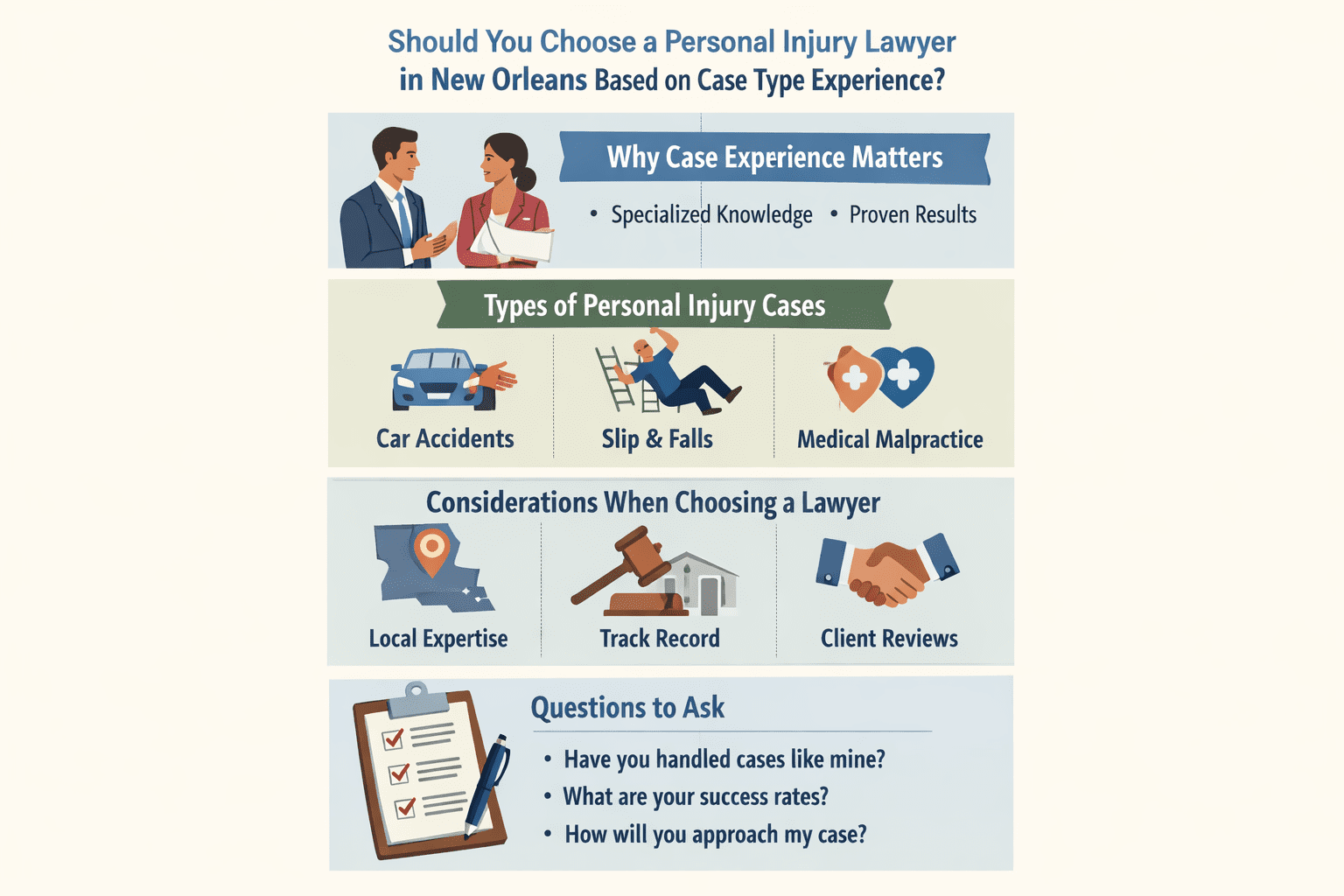
A practical framework for choosing the right fit
Instead of searching for the “best” lawyer in abstract terms, use a structured decision process. This helps you compare options without turning the decision into guesswork.
Step 1: Identify the core type of case
Ask yourself what the claim really is:
- Car accident
- Truck or commercial vehicle crash
- Motorcycle collision
- Pedestrian or bicycle injury
- Slip and fall or trip and fall
- Serious or catastrophic injury
- Multi-party or disputed-liability claim
This helps you focus on experience that is actually relevant.
Step 2: List the complications
Your case may involve factors that narrow what kind of lawyer background matters most:
- Serious long-term injuries
- Preexisting conditions
- Low property damage but significant pain
- Surveillance footage concerns
- No clear witness
- Commercial defendant
- Government-related issues
- Questions about who actually caused the accident
The more complications you have, the more important it becomes that the lawyer can discuss strategy with some precision.
Step 3: Ask focused consultation questions
Use the questions in this article. You do not need to ask all of them, but ask enough to learn how the lawyer thinks.
Step 4: Evaluate the answers for specificity
Did the lawyer explain what evidence matters? Did they mention likely obstacles? Did they discuss process instead of hype? Specificity is often a better sign than confidence alone.
Step 5: Compare communication style
Did they explain things in a way you understood? Did they seem patient? Did they answer your concerns directly? A lawyer may be experienced and still not be the right communication fit for you.
Step 6: Consider local relevance
Ask how familiar they are with handling injury claims connected to New Orleans. This does not need to be theatrical. You are looking for practical familiarity, not slogans.
Step 7: Decide based on fit, not pressure
If one firm pushes hard for a signature while another gives you a clearer understanding of your situation, the second may be the better choice even if the first advertises more aggressively.
What to expect during a consultation when you ask about case type experience
A strong consultation usually does not feel like a canned sales pitch. It should help you understand both your case and the lawyer’s approach.
You should expect questions about:
- When and where the incident happened
- How it happened
- Who may be at fault
- What injuries you suffered
- What treatment you have received
- Whether there are photos, reports, witnesses, or videos
- Whether insurance companies have contacted you
You should also expect some discussion of:
- What evidence may need to be preserved
- What challenges may come up
- Whether more facts are needed before any reliable evaluation
- How the representation process works
- How fees and costs are explained
If the lawyer discusses your matter this way, that often suggests a more thoughtful practice than one built only on broad advertising language.
Case examples of how experience should be weighed
These are not real case studies or promises of results. They are simple examples to show how the analysis changes depending on the facts.
Example 1: Rear-end collision with moderate injuries
You were rear-ended near a busy New Orleans corridor. Fault seems fairly clear, but the insurer argues your neck pain is minor and related to prior issues. In this situation, car accident experience matters because the lawyer should understand how insurers dispute treatment, symptom timing, and preexisting conditions. Communication also matters because you may need guidance on documenting ongoing care.
Example 2: Fall in a hotel lobby
You slipped in a hospitality setting and were taken for emergency care. There may have been a wet floor, but you do not know whether there was a warning sign. Here, premises liability experience may matter more than broad injury advertising. The lawyer should know to ask about surveillance, incident reports, maintenance practices, and notice evidence quickly.
Example 3: Severe crash with long-term disability concerns
You suffered major injuries in a multi-vehicle collision and may not be able to return to the same work. In this situation, severe injury experience can become central. The lawyer should be able to discuss long-term damages, documentation of future limitations, and the possibility that the case requires a more intensive build-out than a routine injury claim.
Example 4: Bicycle or pedestrian injury in a congested area
You were hit while crossing or riding in a dense urban area with unclear witness accounts. Here, both local familiarity and case-specific experience matter. The lawyer should understand traffic evidence, fault arguments, and how quickly digital or video evidence can disappear.
FAQ: Is a general personal injury lawyer ever enough?
Yes, sometimes. Not every case needs a highly narrow niche background. A straightforward injury claim with clear liability and manageable damages may be handled well by a solid general personal injury lawyer who communicates clearly and knows the local landscape.
The point is not to demand overspecialization. It is to avoid choosing based on general branding alone when your case has issues that call for more tailored experience.

How to tell whether “experience” is real or just marketing language
Many firms say they have extensive experience. That phrase by itself tells you almost nothing. The better question is whether the claimed experience shows up in the consultation.
Signs the experience may be real
- They can explain the likely pressure points in your case type
- They know what evidence could disappear and how to preserve it
- They discuss common defense or insurance arguments specific to your matter
- They ask smart follow-up questions instead of relying on buzzwords
- They are comfortable saying what still needs investigation
Signs it may be mostly marketing
- They repeat generic claims about fighting for victims without discussing substance
- They leap to value or victory talk too quickly
- They do not adapt the conversation to your accident type
- They seem unable to distinguish between car, premises, and severe injury strategy
Real experience usually sounds calm, specific, and methodical. Marketing-heavy answers often sound louder but thinner.
Questions you can bring to a free consultation in New Orleans
If you want a practical checklist, bring these questions with you and ask the ones that fit your situation:
- Have you handled cases involving this type of accident or similar injuries?
- What issues do you think will matter most in my case?
- What evidence should be gathered right away?
- Are there any facts that could make the claim harder to prove?
- How familiar are you with handling injury claims in New Orleans?
- Who would be my main contact if I hire your firm?
- How often do clients usually receive updates?
- What should I avoid doing while the claim is pending?
- What happens if the insurance company contacts me?
- At what stage would you know more about the case’s strengths and weaknesses?
You do not need dramatic answers. You need clear ones.
Buyer education: what should matter most when choosing a lawyer after an injury?
Since this article is meant to support buyer education, here is the short version: the right choice usually comes from a combination of factors rather than one headline trait.
What usually deserves the most weight
- Relevant experience with the issues your case raises
- Ability to explain a sensible process
- Clear and respectful communication
- Practical familiarity with New Orleans claim conditions
- Honesty about uncertainties and risks
What should matter less than many people assume
- Big slogans
- Instant value estimates
- Overly broad claims of handling everything
- Pressure to sign before your questions are answered
Choosing counsel is not just about who sounds confident. It is about who sounds prepared, relevant, and reliable.
FAQ: What if you are deciding between two lawyers?
If two options both seem capable, use this tie-breaker approach:
- Which one better understood the specific issues in your case?
- Which one gave clearer next steps?
- Which one seemed more candid about uncertainty?
- Which one made communication expectations easier to understand?
- Which one seemed to combine relevant experience with local practicality?
You are not looking for perfection. You are looking for a lawyer or legal team you trust to handle the actual substance of the claim and keep you informed along the way.
Common mistakes injured people make when evaluating case experience
Focusing only on years in practice
Long practice history can be helpful, but it does not automatically mean relevant experience with your kind of claim.
Assuming every personal injury case is basically the same
They are not. Core principles overlap, but proof problems can differ a lot between a crash, a property hazard, and a severe injury matter.
Looking for guarantees
Guarantees are not the right benchmark. A reliable lawyer should discuss risks, unknowns, and process.
Ignoring communication problems early
If getting answers is hard during intake, it may be harder after you hire the firm.
Undervaluing local context
Even strong legal analysis benefits from familiarity with New Orleans-specific claim realities.
Should you choose a personal injury lawyer in New Orleans based on case type experience?
In most cases, yes—you should give meaningful weight to case type experience. But you should not use it as the only test. The better approach is to ask whether the lawyer has experience with the kind of accident, injury, evidence, and challenges your claim involves, and then evaluate that experience alongside communication style, responsiveness, and local familiarity.
Car accident experience can matter because of fault analysis, coverage issues, and insurer tactics. Slip and fall experience can matter because proving notice and preserving property-related evidence often becomes central. Severe injury experience can matter because long-term damages, medical complexity, and future losses may require a more sophisticated approach. At the same time, even strong experience on paper is not enough if the lawyer is vague, hard to reach, or unable to explain how they would approach your case.
The best consultation is usually the one that leaves you more informed, not merely more impressed. If a lawyer can discuss your claim with clarity, identify likely issues, explain next steps, and show familiarity with handling similar matters in New Orleans, that is often a strong sign you are speaking with someone worth serious consideration.
Conclusion: choose based on relevant fit, not just broad claims
If you are trying to choose a personal injury lawyer in New Orleans, case experience should absolutely be part of the decision—but it should be the right kind of experience, applied to the right facts. Look for a lawyer who understands the type of accident involved, the evidence that matters, the challenges insurers may raise, and the practical realities of handling claims in New Orleans. Just as important, choose someone who communicates clearly, responds reasonably, and does not rely on vague promises.
If you were hurt in a car accident, slip and fall, or another injury incident, Injury Nation can help you connect with local personal injury lawyer resources and learn what to ask before moving forward. Contact a local personal injury lawyer for a free consultation today so you can better understand your options, protect your claim, and make an informed next step.