

Why Finding the Right Slip and Fall Lawyer Matters for Your Recovery
A slip and fall lawyer specializes in premises liability cases where property owners fail to maintain safe conditions, leading to injuries from falls on wet floors, broken stairs, or other hazards.
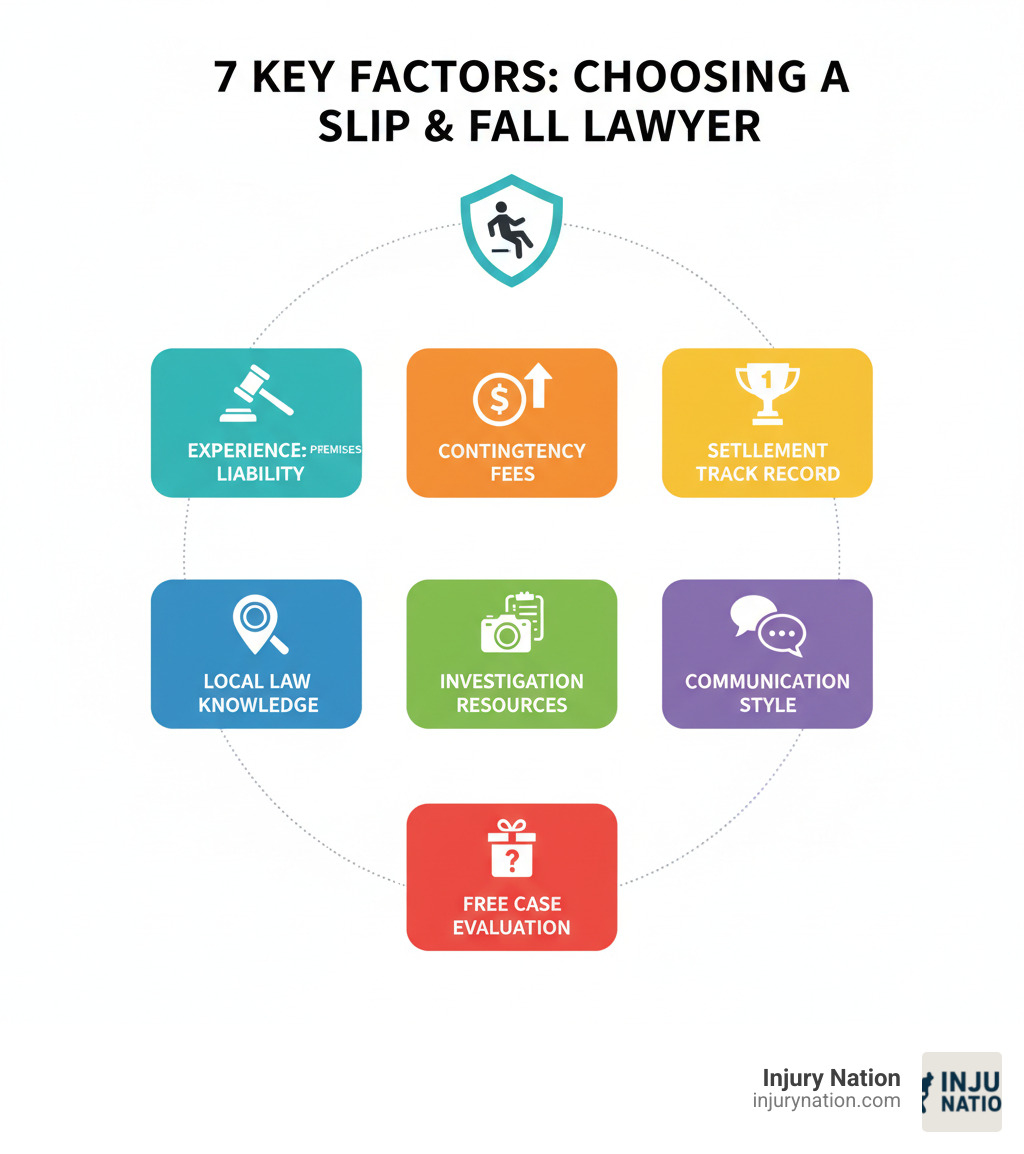
Quick Answer: What to Look for in a Slip and Fall Lawyer:
- Experience with premises liability cases – specifically slip and fall accidents
- Contingency fee structure – no upfront costs, only paid if you win
- Strong track record – proven success with similar cases and settlements
- Local knowledge – understands state laws and filing deadlines
- Resources for investigation – ability to gather evidence and expert testimony
- Clear communication – keeps you informed throughout the process
- Free consultation – evaluates your case at no cost
Slip and fall accidents can cause traumatic brain injuries, spinal cord damage, and broken bones, resulting in overwhelming medical bills and lost income. The legal process is complex, as property owners and their insurers often try to shift blame or offer low settlements.
Proving a case requires showing the property owner knew about a dangerous condition and failed to act. This involves gathering specific evidence and negotiating with adjusters who use tactics to minimize payouts. The stakes are high, and with statutes of limitations often as short as one or two years, time is of the essence.
Slip and fall lawyer vocab to learn:
1. Know if You Have a Valid Case
Before seeking a slip and fall lawyer, determine if you have a valid case. Not every fall qualifies for a lawsuit. The legal principle at play is “premises liability,” which means property owners have a duty of care to keep their spaces reasonably safe for visitors. When they fail in this duty and you get injured as a result, it may be negligence.

What constitutes a slip and fall case?
A valid slip and fall case requires four key elements:
- A Dangerous Condition: The property had a genuine hazard, such as a wet floor without a warning sign, an icy sidewalk, poor lighting, a broken stair, or a cluttered walkway.
- Owner’s Knowledge: The property owner created, knew about, or should have known about the hazard through reasonable maintenance and inspection.
- Causation: The dangerous condition directly caused your fall and subsequent injuries.
- Actual Damages: You suffered real harm, such as medical bills, lost wages, and pain and suffering.
Landlord liability typically covers common areas like lobbies, stairwells, and parking lots. Business owner liability is often stricter, as they have a high duty to ensure their premises are safe for customers through regular inspections and maintenance.
Common causes of slip and fall accidents
Most slip and fall accidents are preventable. Common causes include:
- Weather conditions: Property owners are expected to reasonably manage ice, snow, and water accumulation.
- Spills: Unattended liquid spills on floors are a primary culprit.
- Uneven surfaces: Cracked sidewalks, potholes, loose floorboards, or bunched-up carpets can easily trip someone.
- Inadequate lighting: Poorly lit stairwells, hallways, and parking garages can hide obstacles.
- Defective stairs: Missing handrails, broken steps, or stairs that violate building codes are extremely dangerous.
- Obstructed walkways: Clutter, boxes, or cords in pathways create tripping hazards.
If you were injured because a property owner failed to address these types of issues, a Slip and Fall Lawyer can help you determine if you have a case.
2. Understand What Your Claim is Worth
Understanding your claim’s potential value is crucial for your financial recovery. A slip and fall accident can have significant financial consequences, and you deserve compensation for all your losses. Your case value is determined by adding up all the ways the accident has impacted your life, which are categorized as economic and non-economic damages.

What types of injuries are common?
Slip and fall accidents can cause severe injuries. According to the CDC, falls are a leading cause of traumatic brain injuries (TBI). Other common and serious injuries include:
- Spinal cord injuries: A hard fall can damage vertebrae or the spinal cord itself, leading to chronic pain or paralysis.
- Broken bones: Hip fractures are especially common and debilitating for older adults. Wrist, ankle, and leg fractures are also frequent.
- Soft tissue damage: Injuries like torn ligaments or rotator cuffs can be extremely painful, require surgery, and lead to long-term issues.
For more information, you can review facts about fall injuries from the CDC.
What compensation can be recovered?
A slip and fall lawyer will seek compensation for all your damages to make you as “whole” as possible. This includes:
- Medical expenses: All costs for past, present, and future medical care, including ER visits, surgery, physical therapy, and medication.
- Lost wages: Compensation for the income you lost while unable to work.
- Diminished earning capacity: If your injuries prevent you from returning to your previous job or working full-time, you can be compensated for the loss of future income.
- Pain and suffering: Compensation for the physical pain and emotional distress caused by the accident.
- Loss of enjoyment of life: If your injuries prevent you from participating in hobbies and activities you once enjoyed.
- Punitive damages: In rare cases of extreme negligence, these may be awarded to punish the property owner.
Insurance companies often make low initial offers that don’t cover these damages. An experienced lawyer can fight for the full compensation you deserve.
3. Learn How to Prove the Property Owner Was Negligent
Proving negligence is the core of a slip and fall case and where a lawyer is invaluable. You must demonstrate that the property owner failed in their legal duty to keep you safe. This involves proving they knew, or should have known, about a dangerous condition and did nothing to fix it or warn you.
To win, you must establish four elements: the owner owed you a duty of care, they breached that duty, their breach caused your fall, and you suffered actual damages. The most challenging part is often proving the owner had “notice” of the hazard.

What evidence is needed to prove a slip and fall claim?
Solid evidence is critical. Key pieces of proof include:
- Photographs and videos: Immediately capture the hazard that caused your fall, the surrounding area, and the lighting conditions. Note the absence of any warning signs.
- Video surveillance footage: Businesses often have security cameras. A slip and fall lawyer can send a preservation letter to ensure this crucial evidence isn’t deleted.
- Witness testimony: Get contact information from anyone who saw the fall or the hazardous condition beforehand.
- Incident reports: Always report the accident to a manager and ask for a copy of the official report.
- Your clothing and shoes: Preserve the items you were wearing as they can serve as evidence.
- Medical documentation: Your medical records connect your injuries directly to the fall.
What should I do immediately after a slip and fall accident?
Your actions in the moments after a fall can significantly impact your case. Follow these steps:
- Get medical attention: Your health is the priority. Adrenaline can mask serious injuries, and delaying care can hurt your claim.
- Report the incident: Inform a manager or property owner immediately and insist on an official incident report.
- Document everything: Use your phone to take photos and videos of the scene, the hazard, and your injuries.
- Collect witness information: Get names and phone numbers from anyone who saw what happened.
- Watch what you say: Avoid apologizing or admitting fault. Stick to the facts.
- Do not talk to insurance companies: Politely decline to give a recorded statement or sign documents until you have spoken with a lawyer.
- Contact a lawyer promptly: An attorney can protect your rights and begin building your case while evidence is still fresh.
4. Realize How Your Own Actions Can Affect Your Claim
Even if you were injured, the property owner may not be 100% at fault. The legal concept of shared fault means your own actions could reduce the compensation you receive. Insurance companies are experts at finding ways to blame you, such as claiming you were distracted or ignored a warning sign.
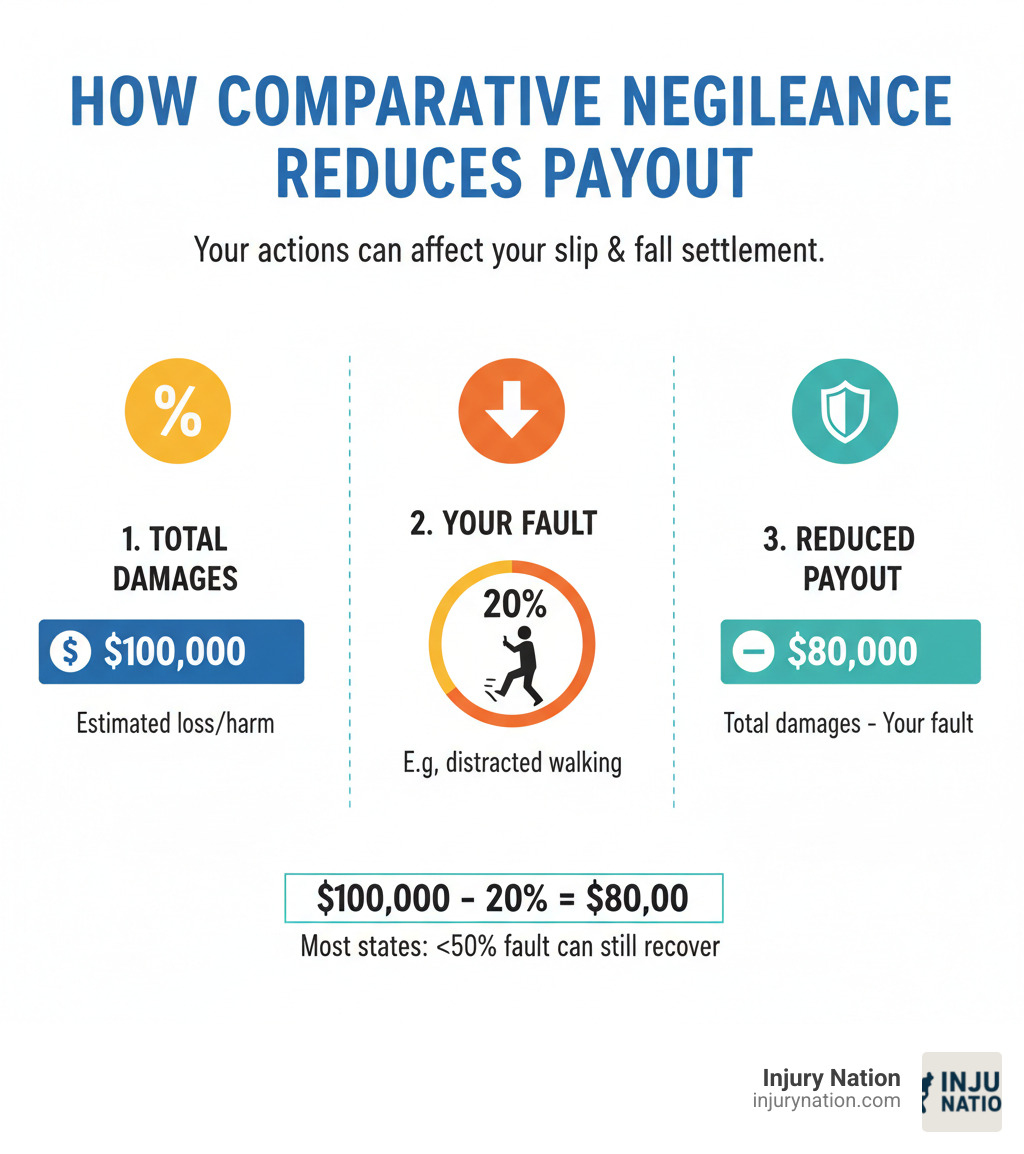
Most states use comparative negligence laws, which assign a percentage of fault to each party. This can impact your final award.
Can I file a claim if I was partially at fault?
Yes, in most states, you can still recover damages even if you were partially at fault. Under “modified comparative negligence” rules, if you are awarded $100,000 but found to be 20% at fault, your award is reduced to $80,000. You can typically recover damages as long as your share of the fault is less than 50% or 51%.
A few states use a harsh “contributory negligence” rule, where being even 1% at fault bars you from any compensation. Because state laws on shared fault vary, local legal expertise is essential.
Insurance adjusters are trained to ask leading questions to get you to admit fault. This is why you should never give a recorded statement without a lawyer. An experienced slip and fall lawyer knows how to counter these tactics, minimize your assigned fault, and protect your right to fair compensation. Even if you think you may have contributed to the accident, it is always wise to seek legal advice.
5. Don’t Miss the Critical Filing Deadlines
The clock on your legal rights starts ticking the moment you fall. The statute of limitations is a strict legal deadline for filing a lawsuit. If you miss it, your case will be dismissed, regardless of how strong it is. While you focus on healing, your slip and fall lawyer will manage these critical deadlines to protect your claim.

What is the statute of limitations for a slip and fall lawyer?
There is no single deadline; each state sets its own rules. Some states give you only one year to file, while others allow two or three years. For example, Pennsylvania’s two-year statute of limitations for personal injury is common, but states like Tennessee have a much shorter one-year deadline.
Claims against government entities have even stricter and shorter deadlines. You may need to file a special “notice of claim” within as little as 60 to 90 days. Missing this initial notice can completely bar your lawsuit.
While there are rare exceptions for minors or injuries finded later, you should never assume they apply to you. Acting quickly is crucial to preserving your rights.
How long does it take to resolve a claim?
The timeline for resolving a slip and fall claim varies widely.
- Simple cases with minor injuries and clear liability might settle in three to six months.
- Complex cases involving serious injuries like a TBI or spinal cord damage can take much longer, as the full extent of your damages may not be known for a year or more.
- Disputed liability, where the owner denies fault, will also extend the timeline as your lawyer investigates and builds a stronger case.
If negotiations fail and a lawsuit is filed, it could take 18 months to several years to reach a resolution. An experienced Slip and Fall Lawyer will help you steer these timing decisions, focusing on securing a fair and complete settlement rather than a quick, inadequate one.
6. See How a Slip and Fall Lawyer Fights for You (and How They Get Paid)
Handling a slip and fall claim alone is risky. Insurance companies have teams of lawyers and adjusters dedicated to minimizing payouts. They use proven tactics to devalue your claim or deny it outright. A slip and fall lawyer levels the playing field, bringing legal knowledge and negotiation skills to fight for the true value of your case.

How can a slip and fall lawyer help?
Your lawyer acts as your advocate, handling every aspect of your case so you can focus on recovery. They will:
- Investigate the accident: Gather evidence, interview witnesses, and consult experts to build a strong case.
- Calculate total damages: Account for all current and future medical bills, lost income, and non-economic damages like pain and suffering.
- Handle all communication: Manage all interactions with insurance companies to protect you from saying something that could harm your claim.
- Negotiate a fair settlement: Use their experience and leverage to counter lowball offers and demand the compensation you deserve.
- File a lawsuit if necessary: If the insurance company refuses to be fair, your lawyer will be prepared to take your case to court.
What are the costs of hiring a lawyer?
Most personal injury lawyers work on a contingency fee basis, which means there are no upfront costs to you.
This “no win, no fee” promise means you owe nothing for legal services unless your lawyer successfully recovers money for you. The fee is a pre-agreed percentage of your settlement or award, typically between 33% and 40%.
Studies show that clients with legal representation often recover significantly more compensation, even after legal fees. Most firms also offer a free case evaluation to review your situation and explain your options without any obligation. This structure ensures your lawyer is motivated to fight for the maximum compensation you deserve. If you’re ready to explore your options, consider consulting with a Slip and Fall Lawyer.
Frequently Asked Questions about Slip and Fall Cases
Here are answers to some of the most common questions we receive about slip and fall injuries.
Can I sue my landlord or a business owner for a slip and fall?
Yes. Under premises liability law, you can sue a landlord or business owner if their negligence caused your injury. Property owners have a legal duty to maintain a reasonably safe environment. For businesses, this duty is high because they invite customers onto their property for commercial gain. For landlords, this duty typically applies to common areas like hallways and parking lots. To win, you must prove they failed in this duty and that their failure led to your injuries.
Can I file a lawsuit if I didn’t report the accident immediately?
Yes, but it makes your case more challenging. An immediate incident report creates a crucial official record. Without it, you will need to rely on other evidence to prove your claim. Strong witness testimony, clear video footage, and immediate medical records that link your injuries to the fall become essential. The longer you wait to act, the harder it is to gather this evidence, so contacting a slip and fall lawyer quickly is vital.
Who is responsible if I slip and fall at an Airbnb?
Liability in an Airbnb accident can be complex. The responsible party could be:
- The host: As the property owner, they have the primary duty to ensure the space is safe for guests.
- Airbnb: The company’s Host Protection Insurance may provide coverage, meaning your claim could be against their insurer.
- A property management company: If a third party was responsible for maintenance and failed to fix a hazard, they could also be liable.
An experienced lawyer can investigate the situation to determine which party or parties should be held accountable and steer the specific insurance policies involved.
Find the Right Lawyer for Your Slip and Fall Case
We’ve covered the essentials: validating your case, understanding its value, proving negligence, and meeting deadlines. Most importantly, you’ve seen how a slip and fall lawyer is your advocate against insurance companies trained to pay as little as possible.
Slip and fall cases are complex legal battles. The injuries—from traumatic brain injuries to broken bones—can be life-altering, leading to massive medical bills and lost income. You deserve compensation that covers the full impact on your life.
Trying to handle a claim alone often leads to accepting a low settlement or missing critical deadlines. Legal guidance isn’t a luxury—it’s protection. An experienced lawyer investigates your accident, calculates your true damages, and negotiates aggressively on your behalf.
Most slip and fall lawyers work on a contingency fee basis, meaning no upfront costs and no fees unless you win. You get expert legal help without financial risk.
At Injury Nation, we connect people like you with top-rated personal injury lawyers who have proven track records in slip and fall cases. Don’t wait and wonder about your rights.
Take the first step toward your recovery. Find top-rated personal injury lawyers near you for a free case evaluation. The choices you make now can define your future—let us help you find an expert who will fight for the justice you deserve.