Why a Spinal Cord Accident Claim Can Change Your Life
A spinal cord accident claim is a legal process that allows you to seek compensation when someone else’s negligence causes a spinal cord injury. These claims help cover the massive costs of medical care, rehabilitation, lost income, and ongoing support that victims face for years—or even a lifetime.
Quick Overview: Spinal Cord Accident Claims
- What it is: A legal claim for compensation after a spinal cord injury caused by another party’s negligence
- Common causes: Car accidents (38% of cases), falls (30%), workplace accidents, medical malpractice
- What you can claim: Medical expenses, rehabilitation costs, lost wages, home modifications, pain and suffering
- Timeline: Typically 1-3 years to resolve, depending on case complexity
- Cost to you: Most spinal cord injury lawyers work on contingency (no fee unless you win)
- Time limit: Generally 3 years from the date of injury (varies by state)
Spinal cord injuries are devastating. A car crash, fall, or workplace accident can instantly cause paralysis, loss of bodily functions, chronic pain, and an inability to work or care for yourself. The emotional and financial burdens are staggering.
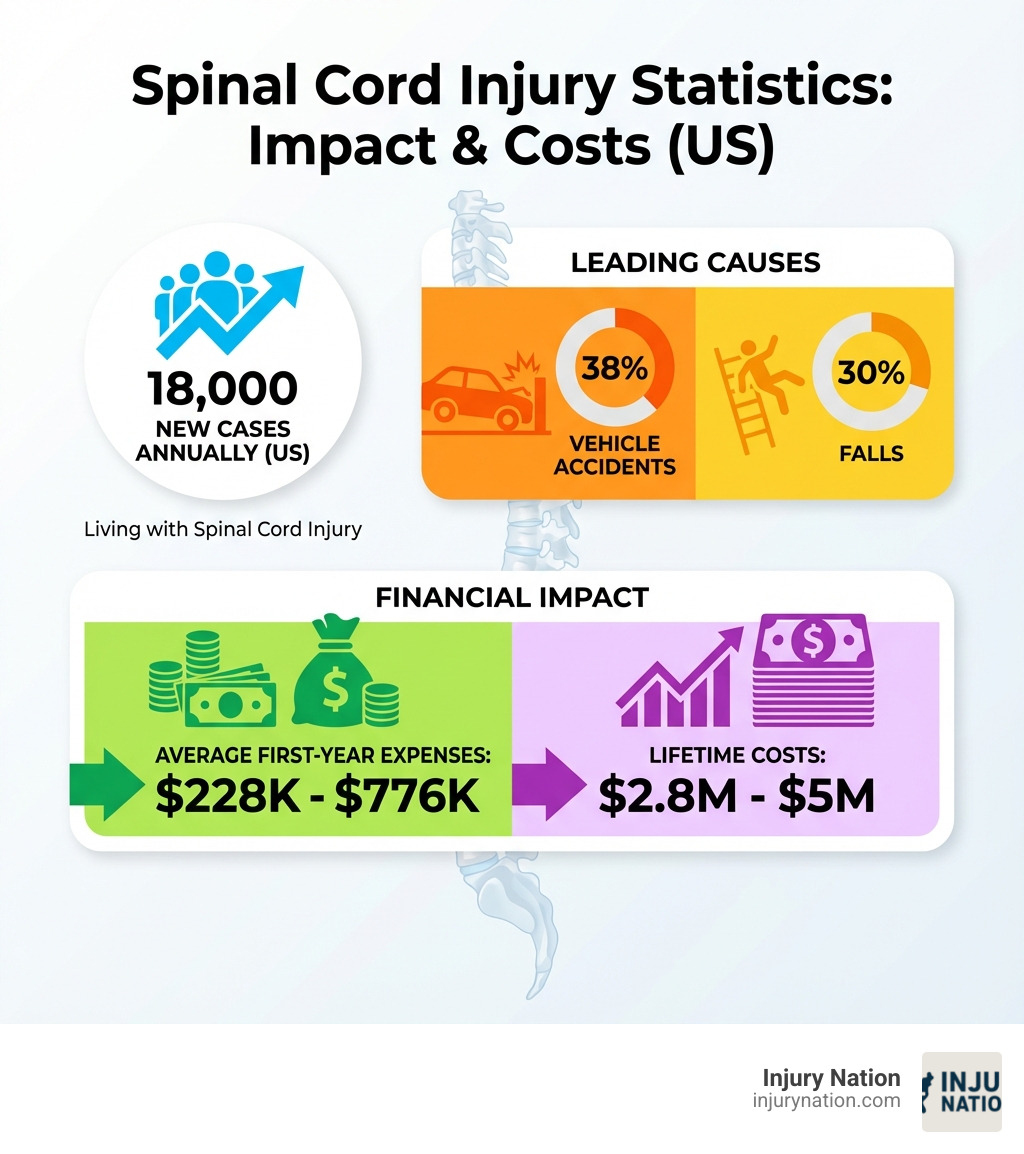
Over 300,000 people in the United States live with traumatic spinal cord injuries, with 18,000 new cases annually. Motor vehicle accidents (38%) and falls (30%) are the leading causes.
The costs are overwhelming. According to the Christopher and Dana Reeve Foundation, first-year expenses can range from $228,566 to $775,567, with lifetime costs reaching $2.8 million to $5 million, depending on the injury’s severity and your age.
But here’s what you need to know: if someone else’s negligence caused your injury, you shouldn’t have to bear these costs alone. A spinal cord accident claim helps you recover compensation for medical care, home adaptations, lost income, and your future.
This guide will walk you through everything you need to understand about spinal cord accident claims—from the types of injuries and their long-term effects, to how settlements are calculated, to finding the right legal team to fight for your rights.
Spinal cord accident claim further reading:
Understanding Your Spinal Cord Injury: Types, Causes, and Effects
A spinal cord injury (SCI) occurs when there’s damage to the bundle of nerves that carry impulses to and from your brain. This intricate network is protected by your spinal column and is essential for almost all bodily functions, communicating signals from your brain to every other part of your body. When this critical pathway is damaged, it can disrupt communication, leading to a loss of movement, sensation, and even essential bodily functions below the injury site.

For a medical overview of how the spinal cord works and how injuries are classified, you can also review this summary from the Mayo Clinic.
Common Causes of Spinal Cord Injuries in Accidents
Spinal cord injuries (SCIs) usually result from sudden, traumatic impacts. According to the National Spinal Cord Injury Statistical Center, motor vehicle accidents are the leading cause (38%), followed by falls (30%).
Beyond these, common causes of spinal cord injuries in accidents include:
- Motor Vehicle Accidents: Car crashes, truck accidents, motorcycle accidents, and bicycle accidents can cause fractured vertebrae or herniated discs that damage the spinal cord.
- Falls: Slip and fall accidents, falls from heights, or even simple falls can lead to severe spinal trauma, especially in older adults or those with pre-existing conditions.
- Sports Injuries: High-impact sports like football or activities such as diving can result in cervical spine fractures and acute spinal cord injuries.
- Acts of Violence: Gunshot wounds, stabbings, or other assaults can directly damage the spinal cord.
- Workplace Accidents: Industrial or construction accidents, particularly those involving falls, falling objects, or heavy machinery, can lead to devastating SCIs.
- Medical Malpractice: Errors during surgery or negligent medical care can sometimes cause spinal cord damage.
Immediate and Long-Term Effects of a Spinal Cord Injury
The effects of a spinal cord injury are profound and can manifest immediately. Symptoms vary depending on the severity and location of the damage, but often include:
- Weakness or total loss of movement in the arms or legs.
- Loss of sensation, or altered sensation like tingling or numbness.
- Loss of bladder or bowel control.
- Intense pain or pressure along the spine.
- Difficulty breathing or coughing.
- Changes in sexual function and sensitivity.
Seeking immediate medical attention for a suspected spinal cord injury is critical. It’s vital for stabilizing the spine to prevent further damage, minimizing complications like infections or blood clots, and initiating a treatment plan. Crucially for your claim, immediate medical documentation establishes a clear link between the accident and your injury.
Long-term, an SCI can cause lifelong physical, emotional, and financial challenges. Victims often face chronic pain, mobility issues, and psychological impacts like depression and anxiety, requiring a complete life adjustment.
Complete vs. Incomplete Spinal Cord Injuries
Understanding the distinction between complete and incomplete spinal cord injuries is fundamental, as it significantly impacts a victim’s prognosis and the nature of their spinal cord accident claim.
| Feature | Complete Spinal Cord Injury | Incomplete Spinal Cord Injury |
|---|---|---|
| Loss of Function | Total loss of motor function and sensation below the injury site. | Partial loss of motor function and sensation below the injury site. Some signals still pass. |
| Sensation | No sensation below the injury level. | Some sensation may be retained below the injury level. |
| Potential for Recovery | Generally, minimal to no recovery of function below the injury site. | Greater potential for some recovery, as some nerve pathways remain intact. |
| Impact on Claim | Typically leads to higher compensation due to comprehensive, lifelong care needs and profound life changes. | Compensation reflects the specific impact on function, rehabilitation needs, and potential for improvement. |
Medical professionals use tools like the American Spinal Injury Association (ASIA) scale to assess an SCI’s severity by evaluating sensory and motor function. You can view the standard worksheet here: American Spinal Injury Association scale. A more severe injury (e.g., a complete SCI) typically results in a higher spinal cord accident claim value due to greater needs for lifelong care, rehabilitation, and home modifications, and greater lost earning potential.
Levels of Injury: Tetraplegia and Paraplegia
The location of your spinal cord injury determines which body parts are affected and the type of paralysis.
- Cervical Injuries (C1-C7): Injuries to the neck. High cervical injuries (C1-C4) often cause tetraplegia (quadriplegia)—paralysis from the neck down—and can impair breathing. Lower cervical injuries (C5-C7) may allow some arm and hand movement but still cause extensive paralysis.
- Thoracic Injuries (T1-T12): Injuries to the upper/middle back, typically causing paraplegia (paralysis of the legs, trunk, and pelvic organs). Upper body function is often retained.
- Lumbar Injuries (L1-L5): Injuries to the lower back affecting the hips and legs. Paraplegia is common, but some may walk with assistance.
- Sacral Injuries (S1-S5): Injuries to the lowest part of the spine, affecting pelvic organs, bladder, bowel, and sexual function. Some leg function may be retained.
Any SCI can cause long-term disability. Higher and more complete injuries have a more profound impact, leading to higher-value claims due to the extensive care required.
The Legal Path: Navigating Your Spinal Cord Accident Claim
Suffering a spinal cord injury is life-altering, but if it was caused by someone else’s negligence, you have legal recourse. Navigating a spinal cord accident claim involves several critical legal steps designed to secure the compensation you need for your recovery and future.

The general legal steps include:
- Seeking Legal Counsel: The first and most crucial step is to contact a personal injury lawyer experienced in spinal cord injuries. We’ll discuss this in more detail later, but their expertise is invaluable.
- Case Investigation & Evidence Gathering: Your legal team will thoroughly investigate the accident, collect evidence, identify responsible parties, and assess the full extent of your damages.
- Filing a Claim: Once sufficient evidence is gathered, your lawyer will formally file a spinal cord accident claim with the at-fault party’s insurance company or initiate a lawsuit.
- Findy: This phase involves the exchange of information between all parties, including depositions, interrogatories, and requests for documents.
- Negotiation: Your lawyer will negotiate with the insurance company for a fair settlement.
- Litigation (if necessary): If a fair settlement cannot be reached, your case may proceed to trial.
Be aware of the statute of limitations—a strict deadline for filing a lawsuit. Deadlines vary by state, so consulting a Las Vegas, Nevada, attorney promptly is crucial to protect your rights.
The Critical Role of Fault Determination
Proving fault (liability) is paramount in a spinal cord accident claim. You must show that another party’s negligence—their careless action or failure to act with reasonable care—directly caused your injury.
Common examples of negligence that can lead to spinal cord injuries include:
- Distracted Driving: Texting while driving, using a phone, or other distractions.
- Reckless Driving: Speeding, aggressive driving, or driving under the influence.
- Unsafe Premises: Property owners failing to maintain their property, leading to slip and fall hazards.
- Workplace Safety Violations: Employers failing to provide a safe working environment or proper equipment.
- Medical Errors: Mistakes made by healthcare professionals during treatment or surgery.
Your legal team gathers evidence like police reports and witness statements to establish fault. We also address any claims of contributory negligence (where your actions may have contributed), such as not wearing a seatbelt, to minimize its impact on your settlement and prove the other party’s responsibility.
Protecting Your Spinal Cord Accident Claim from the Start
Immediately after sustaining a spinal cord injury, while your health is the top priority, there are crucial steps you can take to protect your future spinal cord accident claim:
- Seek Immediate Medical Attention: As discussed, this is vital for your health and creates official documentation of your injuries.
- Document Everything:
- Accident Scene: If possible and safe, take photos or videos of the accident scene, vehicle damage, environmental hazards, and any visible injuries.
- Medical Records: Keep meticulous records of all medical appointments, diagnoses, treatments, medications, and rehabilitation.
- Expenses: Track all injury-related expenses, including medical bills, prescription costs, travel to appointments, and any modifications you make to your home or vehicle.
- Personal Journal: Keep a daily journal detailing your pain, emotional struggles, and daily limitations. This is invaluable for proving non-economic damages.
- Avoid Recorded Statements to Insurers: The at-fault party’s insurer may contact you. Do not give a recorded statement or sign anything without consulting your attorney. Adjusters are trained to minimize payouts.
- Be Cautious with Social Media: Insurers monitor social media for posts that could contradict your injury’s severity. Limit your activity or set profiles to private during your claim.
- Preserve Evidence: Keep any damaged clothing, equipment, or other physical evidence from the accident.
Taking these steps helps build a strong foundation for your spinal cord accident claim, ensuring that critical evidence is preserved and your rights are protected.
Calculating Your Settlement: What Is Your Claim Worth?
One of the most common questions we hear is, “What is the average settlement for a spinal cord injury claim?” The honest answer is: there is no single “average” amount. Every spinal cord injury case is unique, and settlement figures are highly individualized. This is because the impact of an SCI varies so dramatically from person to person, making a fixed average impossible.
Your settlement will be calculated based on various damages, typically categorized as economic and non-economic.
- Economic Damages: These are quantifiable financial losses, such as medical bills, lost wages, and property damage.
- Non-Economic Damages: These compensate for subjective losses like pain and suffering, emotional distress, loss of enjoyment of life, and loss of consortium.
- Punitive Damages: In rare cases of extreme negligence or malicious intent, punitive damages may be awarded to punish the at-fault party and deter similar conduct.
Key Factors in a Spinal Cord Accident Claim Settlement
When determining the value of a spinal cord accident claim, we consider numerous factors to ensure we pursue full and fair compensation for our clients:
- Injury Severity: This is perhaps the most significant factor. A complete SCI leading to tetraplegia will naturally command a much higher settlement than an incomplete SCI with partial recovery, due to the vastly different levels of lifelong care and impact on independence. The ASIA scale assessment plays a crucial role here.
- Victim’s Age: A younger victim will likely receive more compensation for lost future earnings and lifetime care costs, as they will live longer with the injury and its associated expenses.
- Pre-existing Conditions: While an accident may not be the sole cause of your spinal issues, if it aggravated a pre-existing condition (like arthritis or osteoporosis), you can still claim for the worsening of your condition. The legal principle known as the “eggshell skull rule” states that the at-fault party takes the victim as they find them. However, clear medical records are essential to differentiate between pre-existing issues and new injuries or aggravations.
- Medical Costs: This includes all past and future medical expenses, from emergency care and surgeries to medications, therapies, and specialized treatments. The Christopher and Dana Reeve Foundation suggests first-year expenses can range from $228,566 to $775,567 (US).
- Long-Term Care Needs: Spinal cord injuries often necessitate lifelong care. This includes professional attendant care, home healthcare, specialized equipment (like wheelchairs and adapted vehicles), and home modifications (ramps, stairlifts, wider doorways).
- Lifetime Cost of Caring for an SCI: These costs are staggering. Depending on the type of injury and age, the lifetime cost of living with an SCI can range from $2.8 million to $5 million. We work with experts to project these costs accurately.
Accounting for Future Losses and Expenses
Beyond immediate medical bills, a spinal cord accident claim must comprehensively account for the profound impact on your future.
- Loss of Future Earnings and Earning Potential: If your injury prevents you from returning to your previous job or limits your ability to work, you are entitled to compensation for lost income. This includes potential promotions, raises, and benefits you would have earned. A younger victim, with a longer career ahead, typically receives more for this category.
- Diminished Earning Capacity: Even if you can return to some form of work, your injury may reduce your earning capacity. We’ll account for this reduction in your ability to generate income over your lifetime.
- Future Medical Treatments: This covers anticipated surgeries, ongoing medications, pain management, and routine medical check-ups related to your SCI.
- Rehabilitation Costs: Physical therapy, occupational therapy, speech therapy, and psychological counseling are often long-term necessities.
- Home Modifications: To accommodate mobility challenges, you may require significant changes to your home, such as accessible bathrooms, ramps, and widened doorways.
- Assistive Technology: This includes specialized wheelchairs, communication devices, electronic aids, and other equipment designed to improve independence and quality of life.
- Chronic Pain and Related Claims: Spinal cord injuries are a common cause of chronic pain syndrome. Compensation for chronic pain, its management, and its impact on your daily life is a significant component of many claims.
Assembling Your Support Team: Lawyers, Experts, and Financial Aid
Navigating a spinal cord accident claim is incredibly complex. It’s not just about legal procedures; it’s about securing a future for someone whose life has been irrevocably altered. This journey requires a dedicated support team, with a personal injury lawyer at its core.
How a Personal Injury Lawyer Maximizes Your Claim
We believe that if someone else’s negligence caused your spinal cord injury, you shouldn’t have to bear the financial burden alone. This is where an experienced personal injury lawyer specializing in spinal cord injuries becomes your most valuable advocate.
Here’s how we help maximize your spinal cord accident claim:
- Case Investigation: We carefully investigate the accident, gathering all necessary evidence, identifying all responsible parties, and reconstructing the events to prove negligence.
- Calculating Total Damages: We work with medical and financial experts to accurately assess all your current and future damages, ensuring no potential loss is overlooked. This includes complex projections for lifelong care, lost earnings, and non-economic damages.
- Negotiating with Insurers: Insurance companies are notorious for trying to settle claims for the lowest possible amount. We handle all communications and negotiations, protecting you from their tactics and advocating fiercely for the compensation you deserve.
- Court Representation: If a fair settlement cannot be reached through negotiation, we are prepared to take your case to court, presenting a compelling argument before a judge and jury.
- Access to Experts: We have established networks with top medical professionals, vocational experts, life care planners, and economists who can provide crucial testimony and documentation for your case.
- Contingency Fees: Most spinal cord injury lawyers work on a contingency fee basis. This means you don’t pay any upfront legal fees. We only get paid if we win your case, aligning our interests directly with yours.
At Injury Nation, we connect you with experienced attorneys in Las Vegas, Nevada, who understand the profound impact of spinal cord injuries and are committed to fighting for your rights.
The Role of Expert Witnesses and Interim Payments
In complex spinal cord accident claim cases, expert witnesses are indispensable. They provide specialized knowledge and testimony that can clarify intricate medical, vocational, and financial aspects of your injury and its long-term consequences.
- Medical Experts: These include neurologists, spinal surgeons, physical medicine and rehabilitation specialists, who can testify about the extent of your injury, prognosis, future medical needs, and the causal link between the accident and your condition.
- Vocational Experts: They assess your pre-injury earning capacity versus your post-injury earning capacity, helping to calculate lost wages and diminished earning potential.
- Life Care Planners: These professionals create a detailed report outlining all your anticipated future medical needs, therapies, equipment, home care, and other services for the rest of your life.
- Economists: They can project the financial impact of lost earnings, future medical costs, and other expenses, accounting for inflation and investment returns.
Another crucial aspect of supporting spinal cord injury victims is interim payments. These are partial payments made by the defendant’s insurance company before a final settlement or verdict. Interim payments can be invaluable, providing early financial relief to cover immediate medical expenses, rehabilitation costs, home modifications, and living expenses while your spinal cord accident claim is still ongoing. We advocate for these payments to alleviate immediate financial pressure, allowing you to focus on your recovery.
Frequently Asked Questions about Spinal Cord Injury Claims
We understand you likely have many questions about the legal process following such a devastating injury. Here are some of the most common inquiries we receive:
How long does a spinal cord injury claim typically take to resolve?
The timeline for resolving a spinal cord accident claim can vary significantly. While some less complex personal injury cases might settle in months, spinal cord injury claims are inherently complex due to the severity of the injuries and the extensive long-term costs involved. Generally, these claims can take anywhere from one to three years to resolve.
Factors influencing the duration include:
- Case Complexity: The more intricate the details of the accident, the more parties involved, or the more challenging it is to prove fault, the longer the process can take.
- Severity of Injuries: Cases involving lifelong care needs require more extensive documentation and expert testimony, which adds time.
- Negotiation vs. Trial: If a fair settlement can be reached through negotiation, the case will resolve faster than if it proceeds to a full trial.
- Jurisdiction: Court backlogs and legal procedures can vary by state.
Our priority is always to secure the best possible outcome for you, whether through negotiation or litigation, while working as efficiently as possible.
What are my legal rights as a spinal cord injury victim?
As a victim of a spinal cord injury caused by someone else’s negligence, you have several fundamental legal rights:
- Right to Compensation: You have the right to seek financial compensation for all damages related to your injury, including medical expenses, lost wages, pain and suffering, and future care costs.
- Right to Sue for Negligence: You have the right to file a lawsuit against the at-fault party to hold them accountable for their actions.
- Right to Legal Representation: You have the right to hire a qualified personal injury lawyer to advocate on your behalf, protect your interests, and steer the complex legal system.
- Protection from Insurers: You have the right to be protected from aggressive tactics by insurance companies that may try to deny or minimize your claim. Your lawyer will ensure your rights are upheld.
We will ensure your legal rights are vigorously protected throughout the entire spinal cord accident claim process.
Can I still file a claim if I had a pre-existing back condition?
Yes, you can absolutely still file a spinal cord accident claim even if you had a pre-existing back condition. This is a common scenario, and the law generally protects individuals in such situations through the “eggshell skull rule,” which states that a negligent party “takes their victim as they find them.”
This means that if someone’s negligence caused an accident that aggravated or worsened your pre-existing condition, they are responsible for all the injuries and damages that result, even if a healthier person might not have been as severely affected.
However, proving this requires meticulous documentation. It’s crucial to:
- Provide all medical records of your pre-existing condition to your attorney.
- Get a clear diagnosis from your doctors that differentiates between your pre-existing condition and the new injury or the aggravation caused by the accident.
- Have medical experts testify on how the accident impacted and worsened your prior condition.
While a pre-existing condition can add a layer of complexity to your claim, it certainly does not prevent you from seeking fair compensation.
Conclusion: Taking the First Step Towards Justice and Recovery
A spinal cord injury is a life-altering event, but if it happened due to someone else’s negligence, you have the right to seek justice and the compensation you need to rebuild your life. We’ve explored the profound impact of these injuries, the complexities of fault determination, the critical factors influencing settlement value, and the indispensable role of a dedicated legal team.
The path to recovery and fair compensation can be long and challenging, but you don’t have to walk it alone. Acting quickly is paramount—from seeking immediate medical attention to contacting an attorney to preserve crucial evidence and meet legal deadlines. Empower yourself by understanding your rights and taking decisive action.
At Injury Nation, we are committed to helping victims like you find the support and representation you deserve. We connect you with qualified, experienced attorneys in Las Vegas, Nevada, who specialize in catastrophic injuries and are ready to fight for the quality of life you deserve.
Don’t let the trauma and financial burden of a spinal cord injury define your future. Take the first step towards justice and recovery today.