When Dental Care Goes Wrong: Understanding Your Rights
What is dental malpractice occurs when a dentist or dental professional fails to provide the standard of care expected in their field, resulting in harm to the patient. It’s a serious breach of trust that goes far beyond an unsatisfactory cosmetic result or a complication that happens despite competent care. To have a valid claim, you must prove that the dentist’s actions were negligent and directly caused you a significant, measurable injury.
Understanding the legal framework is crucial. Every dental malpractice case must establish four specific elements to be successful:
Key Elements of Dental Malpractice:
- A dentist-patient relationship existed (Duty of Care): The moment a dentist agrees to treat you, they establish a professional relationship and assume a legal duty to provide care that meets accepted standards.
- The dentist breached the standard of care (Negligence): This is the core of the claim. You must show that the dentist actedor failed to actin a way that a reasonably competent dentist would not have under similar circumstances.
- You suffered measurable harm (Injury or Damages): The negligence must have resulted in a real injury. This can include physical harm like nerve damage or tooth loss, as well as financial harm from the cost of corrective procedures and lost wages.
- The breach directly caused your harm (Causation): There must be a clear and direct link between the dentist’s negligence and the injury you sustained. The harm would not have occurred but for the dentist’s breach of duty.
Going to the dentist requires a significant level of trust. You place your health and well-being in their hands, expecting competent, professional care. When that trust is shattered by a preventable error that causes you pain, significant expense, or permanent damage, you may have a valid case for dental malpractice. It’s important to distinguish this from a simple mistake; sometimes, complications arise even when the dentist does everything right. The critical difference is whether your dentist deviated from the accepted standard of care.
This is not a rare occurrence. According to industry data, one in every seven malpractice claims involves a dental professional. To put that in perspective, approximately 302 of Washington State’s 3,833 medical malpractice claims from 2016 to 2020 were filed against dentists. The average dentist is sued at least once during their career. These figures aren’t just abstract statisticsthey represent thousands of real people who suffered preventable harm and were forced to deal with the painful and costly consequences.
In Nevada and across the country, many people are unsure whether a bad dental experience is simply an unfortunate outcome or something more serious. You might be wondering:
- Is my ongoing pain normal, or did my dentist do something wrong?
- Should my implant, crown, or root canal have failed this quickly?
- Did my dentist ignore warning signs on my X-rays or during exams?
If you are living with ongoing pain, facing expensive corrective surgeries, or coping with permanent damage after a dental procedure, you are not alone and you deserve to understand your legal rights. This guide is designed to help you steer this difficult situation and determine whether what happened to you crosses the line from an unfortunate outcome into actionable malpractice.
Because Injury Nation connects injured patients with experienced personal injury and medical malpractice attorneysincluding lawyers who focus on dental malpractice in places like Las Vegas and throughout Nevadathis information can be the first step toward getting answers and, if appropriate, pursuing compensation for what you have been through.
What is Dental Malpractice and How is it Proven?
What is dental malpractice is a specific type of professional negligence that occurs when a dental healthcare provider causes injury to a patient through a negligent act or omission. This applies to a wide range of professionals, including a general dentist, oral surgeon, orthodontist, periodontist, prosthodontist, endodontist, or dental hygienist. It is a form of medical malpractice specific to the dental field. As the American Bar Association explains, medical malpractice happens when a healthcare provider deviates from the recognized standard of care in treating a patient. In Nevada, for instance, this legal principle holds that a professional is liable if they fail to use the reasonable care, skill, or knowledge ordinarily used under similar circumstances.
The cornerstone of any malpractice claim is this “standard of care.” This is not a rigid, black-and-white rulebook but rather a legal concept defining the level of competence and care that a reasonably prudent dental professional with similar training and experience would have provided in the same situation. It acknowledges that dentistry has inherent risks and doesn’t demand perfect outcomes. Instead, it asks: Did the professional’s actions or inactions fall below this accepted benchmark of competence? When a dental professional’s conduct deviates from this standard, and that deviation directly causes a patient harm, it constitutes professional negligence and forms the basis of a malpractice claim.
To understand this distinction better, it’s helpful to compare general dental negligence with actionable dental malpractice:
| Feature | Dental Negligence | Dental Malpractice |
|---|---|---|
| Level of Harm | Typically results in minor, temporary, or no significant injury. The consequences are often easily correctable. | Causes substantial, lasting, or serious harm, such as permanent nerve damage, loss of multiple teeth, chronic pain, or disfigurement. |
| Breach of Duty | A minor error or lapse in judgment that does not necessarily fall far below the accepted standard of care. | A significant and clear deviation from the accepted standard of care that a competent professional would have provided. |
| Legal Recourse | May lead to a refund, an apology, or a complimentary corrective procedure from the dentist. It rarely forms the basis of a lawsuit. | Is legally actionable and can be the foundation for a lawsuit to recover damages for medical bills, future care, lost wages, and pain and suffering. |
| Example | A filling that falls out prematurely due to a minor bonding error, which the dentist then fixes at no charge. | Extracting the wrong tooth, failing to diagnose visible signs of oral cancer on an X-ray, or causing permanent nerve damage during a routine wisdom tooth extraction. |
The Four Essential Elements of a Claim
No matter where you live, most dental malpractice cases are built around four essential legal elements. To succeed, you and your attorney typically must prove each of the following:
-
Duty of Care (Dentist-Patient Relationship)
You must show that a professional relationship existed between you and the dental provider. This is usually straightforward: if you scheduled an appointment, were examined, or treated by the provider, a duty of care likely existed. In a directory-based practice environment like Las Vegas, you might find a dentist online, make an appointment, and the moment the provider agrees to see you, the duty of care is created.
-
Breach of the Standard of Care
Next, you must establish that the dentist failed to meet the applicable standard of care. This means demonstrating that a reasonably competent dentist, with similar training and experience, would have acted differently under the same circumstances. Examples include:
- Ignoring clear signs of infection and sending a patient home without antibiotics or follow-up instructions.
- Failing to order additional imaging before extracting a tooth located near a major nerve.
- Not referring a patient to a specialist when the treatment clearly exceeded the general dentist’s experience.
Proving a breach almost always requires expert testimony from another dental professional who can explain what should have been done and how your provider fell short.
-
Causation (Link Between Breach and Injury)
It is not enough to show that your dentist was careless; that carelessness must be the direct cause of your injury. Lawyers and courts often ask, “Would this injury have happened if the dentist had followed the standard of care?” If the answer is no, causation may be established.
This can be complex in dentistry because many patients have preexisting conditions like gum disease, prior extractions, or bone loss. An experienced malpractice attorney can work with experts to sort out what damage was preexisting and what was caused or made worse by negligent treatment.
-
Damages (Actual, Measurable Harm)
Finally, you must demonstrate that you suffered real, measurable harm. In dental malpractice cases, damages might include:
- Additional procedures or surgeries to repair the damage.
- Permanent loss of sensation in the tongue, lips, or face.
- Loss of teeth that could have been saved with proper care.
- Significant scarring, disfigurement, or bite problems.
- Financial losses, such as time off work, travel to multiple specialists, or long-term rehabilitation.
Even emotional and psychological harmlike anxiety, loss of confidence in your appearance, or fear of future dental visitscan be part of your claim when properly documented.
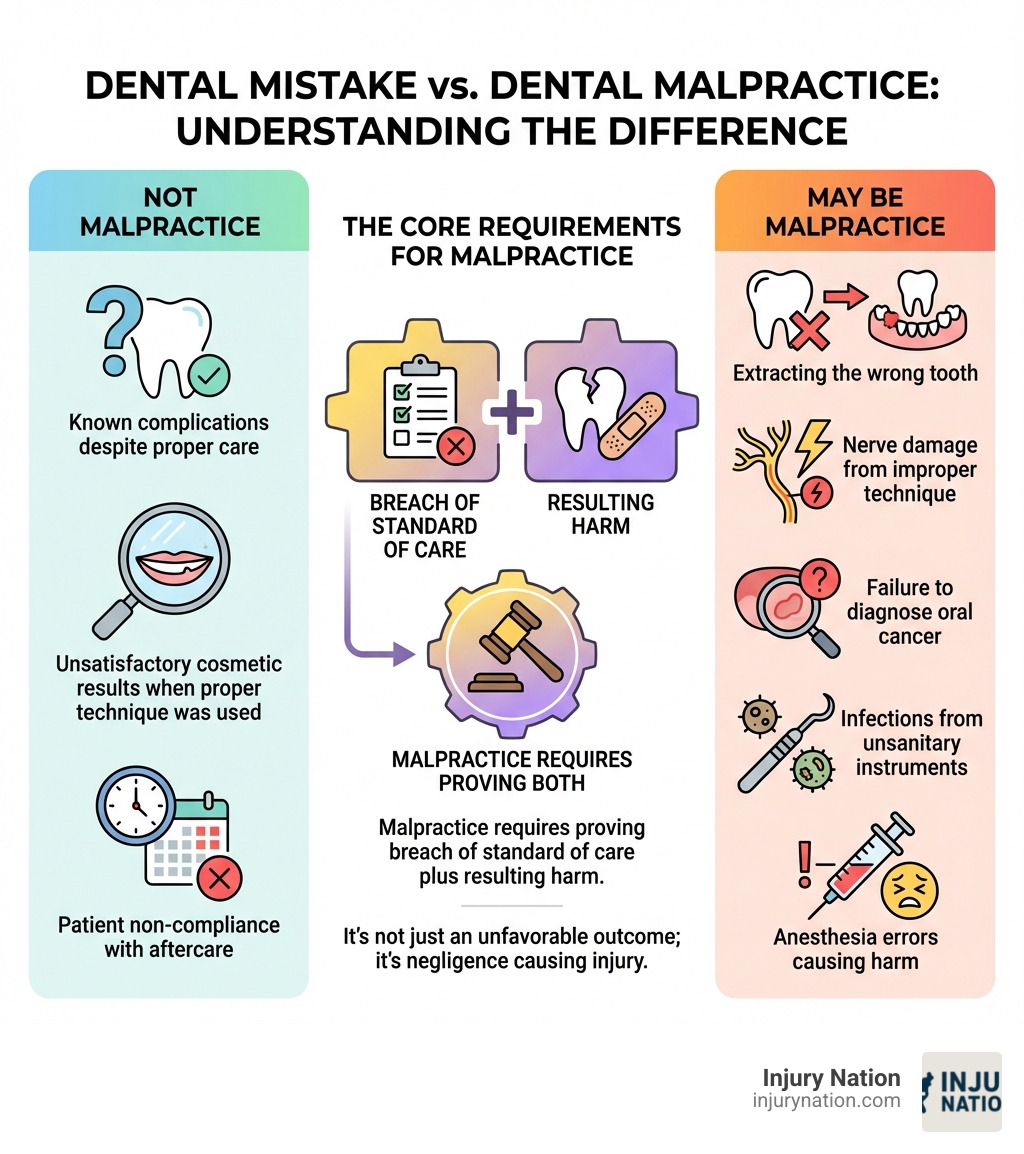
What is Dental Malpractice vs. a Poor Outcome?
Many patients hesitate to talk to a lawyer because they worry they are “overreacting” to a bad result. However, understanding the difference between an unavoidable complication and malpractice is critical.
A poor outcome or known complication might include:
- Temporary pain or swelling after a procedure, even when the dentist followed appropriate protocols.
- A crown that needs minor adjustment because your bite feels slightly off.
- A root canal that fails despite correct technique because of unusual tooth anatomy.
These situations can be frustrating but are not always grounds for a lawsuit. As long as the dentist followed the standard of care, the law usually treats these as risks that come with dental treatment.
By contrast, dental malpractice may exist when:
- The dentist ignores your medical history (such as blood thinners or heart conditions) and you suffer serious complications.
- A clearly visible cavity, infection, or suspicious lesion goes undiagnosed for months or years because your dentist failed to review X-rays carefully.
- The provider performs a procedure they are not trained or equipped to handle, leading to permanent harm.
In most states, including Nevada, you generally need expert testimony to prove that your case rises to the level of malpractice instead of a simple mistake. That is why early consultation with a malpractice attorney, who can connect with qualified dental experts, is so important.
An Injury Nation-listed lawyer can help you evaluate whether your experience is likely to meet these legal standards, explain relevant Nevada law (such as damage caps and procedural requirements), and advise you on whether it makes sense to move forward with a claim based on the severity of your injuries and the available evidence.