

Why Understanding Your Bicycle Accident Claim Matters
A bicycle accident claim is your legal path to compensation for injuries and losses caused by someone else’s negligence. It helps you recover costs for medical bills, lost wages, bike repairs, and physical pain.
Key Components of a Bicycle Accident Claim:
- Proving Negligence – Showing the other party breached their duty of care and caused your injuries
- Documenting Damages – Gathering evidence of medical expenses, lost income, and property damage
- Navigating Insurance – Filing with the at-fault driver’s insurance or your own coverage (PIP, UM/UIM)
- Calculating Compensation – Adding up economic damages (bills, wages) and non-economic damages (pain, suffering)
- Meeting Deadlines – Filing within your state’s statute of limitations (typically 2-3 years)
A cycling accident can instantly turn your life upside down, causing physical injuries, financial burdens, and emotional distress. The good news? You have rights. If someone else’s carelessness caused your accident—whether a distracted driver, a “dooring” incident, or a failure to yield—you can seek compensation through a bicycle accident claim.
This guide explains every step, from the first 24 hours to negotiating with insurers and calculating your claim’s value. We’ll cover your rights, how to prove fault, the evidence you need, and when to hire an attorney.
Understanding the claims process empowers you to protect your rights and pursue the full compensation you deserve for your recovery.
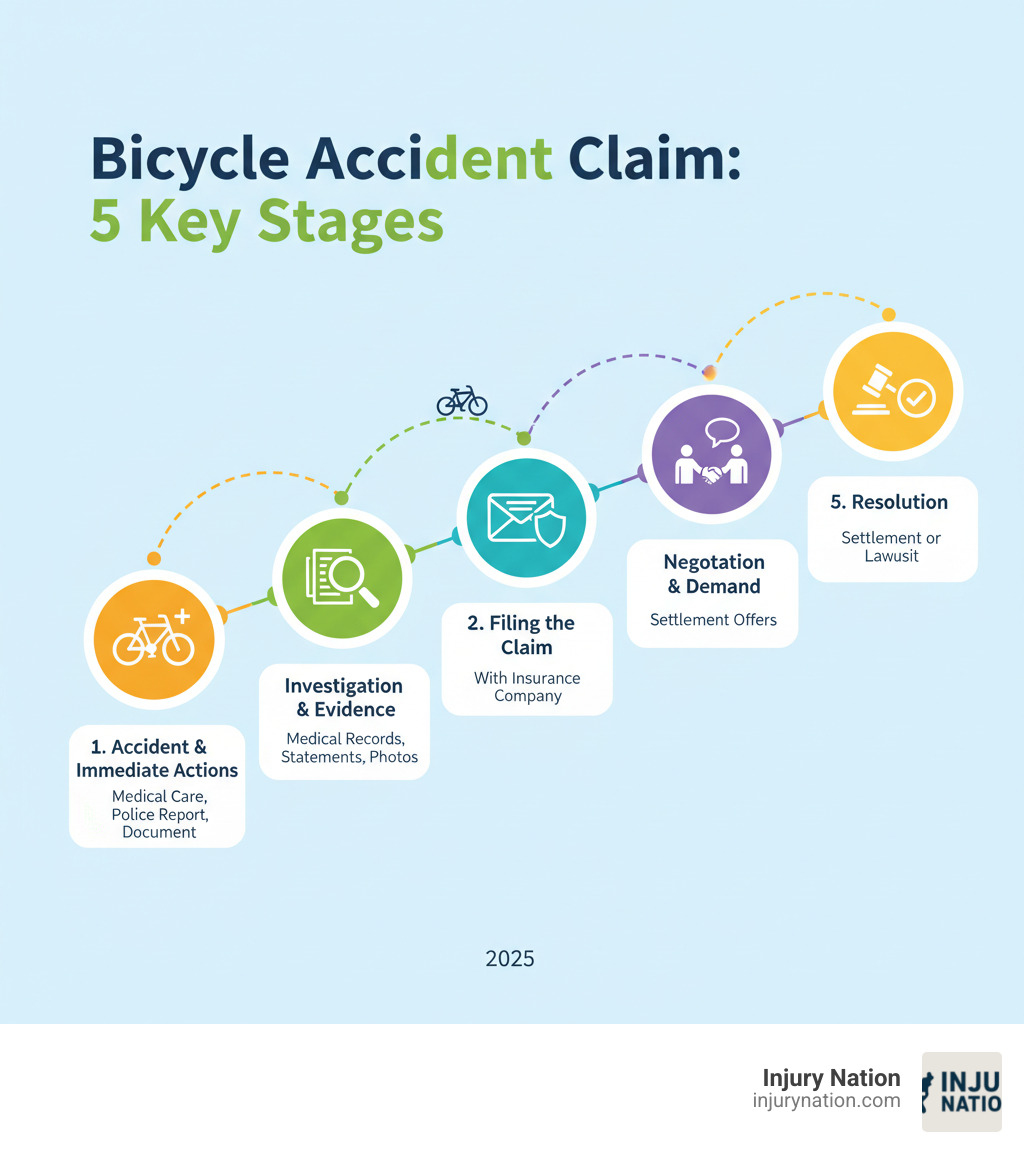
The First 24 Hours: Critical Steps After a Bicycle Accident
What you do in the first 24 hours after a bicycle crash can make or break your bicycle accident claim. Your first priority is always safety. If possible, move yourself and your bike out of traffic to prevent further harm.
Call 911 immediately, even for minor accidents. Shock and adrenaline can mask serious injuries like concussions or internal damage. A police report and paramedic evaluation create official records that are critical for your claim later. Seeking immediate medical attention creates an official record linking your injuries to the accident, preventing insurers from arguing they happened elsewhere.
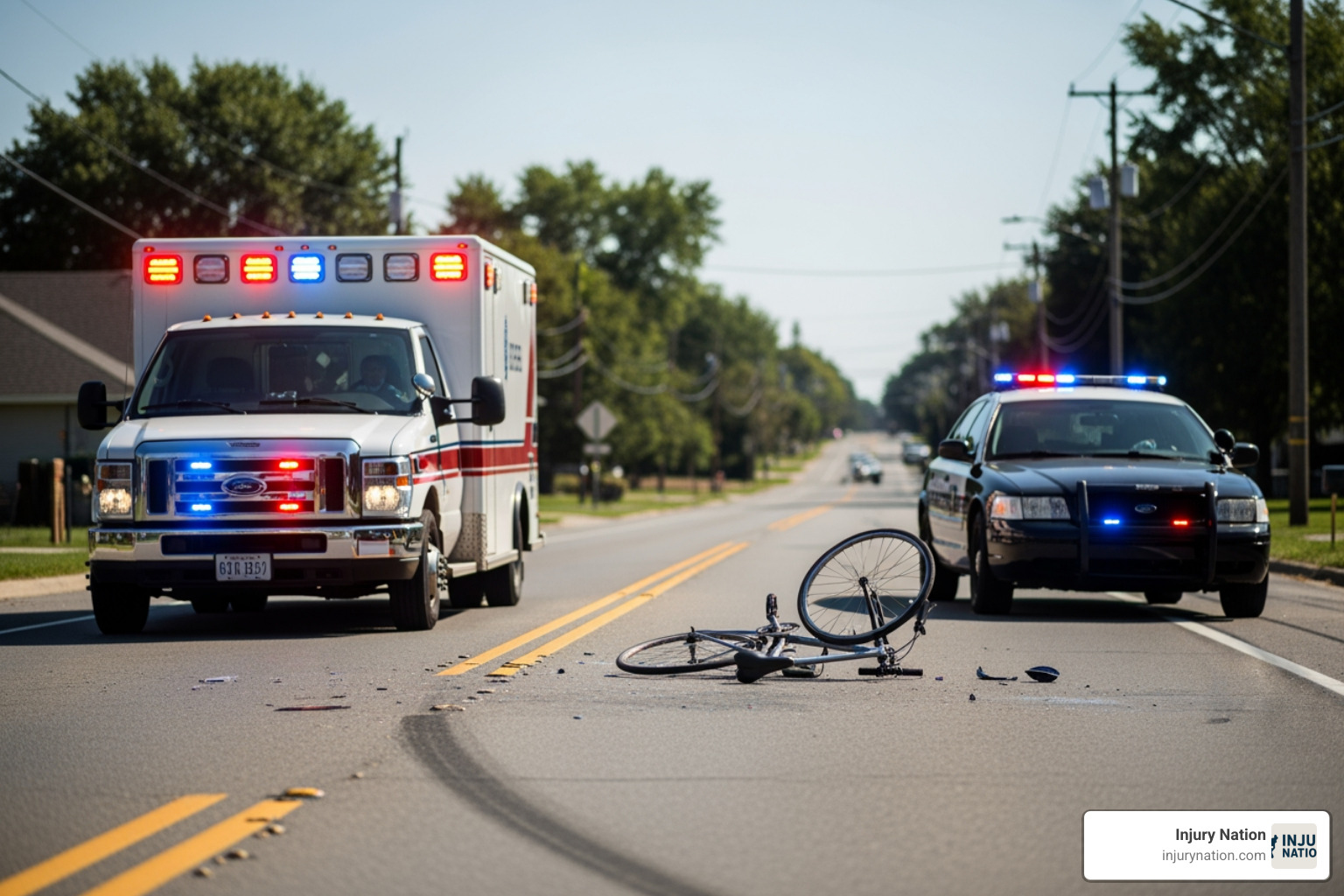
While waiting for help, use your smartphone to document everything. Take photos and videos of the vehicle damage, your bike damage, your injuries, the road conditions, all license plates, and the entire scene, including traffic signals and road markings.
Next, gather information. Get the driver’s name, phone number, address, and insurance details. If witnesses stopped, ask for their contact information; their unbiased accounts are invaluable for proving fault.
Ensure the police file an official report, as it’s the foundation of your bicycle accident claim. Obtain a copy as soon as it’s available.
Finally, notify your insurance provider, but be careful. Stick to basic facts and avoid admitting fault or speculating. Do not say things like, “I should have been more careful,” as insurers will use these statements against you.
Your Legal Rights and Responsibilities as a Cyclist
On the road, you have the same rights and responsibilities as drivers. You must obey all traffic laws, such as stopping at red lights, following lane markings, and signaling turns. Failing to do so can negatively impact your claim.
While Nevada doesn’t have a statewide helmet law for adults, local ordinances in cities like Las Vegas or Henderson may require them. Insurance companies may try to use non-compliance with local rules against you.
Understanding these rules is vital for your bicycle accident claim. If the other party can prove you broke a traffic law, it could reduce your compensation.
Want to learn more about your rights on the road? Check out state and local bicycle regulations or explore more info about bicycle law to understand exactly where you stand legally.
Building Your Case: How to Prove Negligence and Fault
To win a bicycle accident claim, you must prove that someone else’s negligence caused your injuries. This requires establishing four key elements.

- Duty of Care: The other person had a legal responsibility to act with reasonable care. All drivers owe this duty to cyclists.
- Breach of Duty: The driver failed to meet that duty, such as by running a red light or texting while driving.
- Causation: The driver’s breach directly caused your injuries. You must show the link between their action and the harm you suffered.
- Damages: You suffered actual harm, such as medical bills, lost income, and pain and suffering.
Common causes of bicycle accidents include distracted driving, failure to yield at intersections, “dooring” (opening a car door into a cyclist’s path), unsafe lane changes, speeding, and driving under the influence. Determining fault isn’t always simple, which is why evidence is so important. The police report offers an official account, while witness statements provide unbiased perspectives. In complex cases, accident reconstruction experts can scientifically determine how the collision occurred.
How to Solidify Your Bicycle Accident Claim with Strong Evidence
A strong bicycle accident claim is built on solid evidence. The more documentation you have, the harder it is for an insurer to deny your claim.
- Medical Records: Keep every bill, report, and prescription to prove the extent of your injuries and link them to the accident.
- Receipts for Expenses: Save receipts for everything related to the accident, including over-the-counter medications and transportation to appointments.
- Lost Wage Documentation: Gather pay stubs and a letter from your employer to prove the income you lost during recovery.
- Property Damage Estimates: Get estimates from bike shops for repairing or replacing your bicycle and any damaged gear.
- Personal Injury Journal: Document your daily pain levels, emotional state, and the ways the injury impacts your life. This is powerful evidence for non-economic damages.
- Photos and Videos: Continue to take pictures of your healing injuries and any medical equipment you use.
What if You Are Partially at Fault?
Sometimes, both parties share some blame. In Nevada, this doesn’t automatically prevent you from recovering compensation. Nevada uses a modified comparative fault system, also known as the “50% rule.”
This rule means you can still recover damages as long as you are not more than 50% responsible for the accident. However, your compensation will be reduced by your percentage of fault. For example, if your damages are $100,000 and you are found 20% at fault, you would receive $80,000.
If you are found 51% or more at fault, you recover nothing. This is why insurance companies will try to shift blame onto you. Strong evidence is your best defense against these tactics and helps maximize your compensation.
Navigating the Insurance Maze: The Bicycle Accident Claim Process
Dealing with insurance companies after a bicycle accident can be overwhelming. Understanding the process is key to securing the compensation you deserve. The journey begins by filing a bicycle accident claim with the at-fault driver’s insurance company.

First, identify which insurance policies may offer coverage. The at-fault driver’s liability insurance is the primary source for your medical bills, lost wages, and pain and suffering. If you have it, your own Personal Injury Protection (PIP) coverage can pay for medical expenses regardless of fault. Additionally, your uninsured/underinsured motorist (UM/UIM) coverage is a safety net if the at-fault driver has little or no insurance.
Your health insurance will also cover treatment, though it may seek reimbursement from your settlement. Check your homeowner’s or renter’s policy as well, as it might offer limited coverage for property damage.
When an insurance adjuster contacts you, be cautious. They work for the insurance company, and their goal is to minimize payouts. Avoid giving recorded statements without consulting an attorney. Stick to basic facts like the date and location, but do not discuss your injuries or accident details at length.
Common Insurance Company Tactics and How to Respond
Insurance companies use proven strategies to reduce what they pay on bicycle accident claims. Knowing these tactics helps you protect your rights.
- Lowball Settlement Offers: The first offer is almost always far less than what your claim is worth. They hope you’re desperate for cash and will accept it. Never take the first offer.
- Downplaying Your Injuries: Adjusters may suggest you’re exaggerating your pain or that your injuries aren’t serious. This is why detailed medical records are essential to prove the extent of your suffering.
- Blaming Pre-existing Conditions: Insurers may try to blame your current pain on a previous injury. Medical records from before and after the accident can disprove these claims.
- Delaying the Process: They might drag their feet, lose paperwork, or make repeated requests for the same documents. These stalling tactics are designed to wear you down until you accept a low offer.
If you receive a low offer or a denial, you have options. A well-crafted demand letter, which formally outlines your losses and demands fair compensation, can show the insurer you are serious. If negotiations fail, mediation or a personal injury lawsuit may be necessary. An experienced attorney understands the insurance company’s playbook and can counter their tactics, negotiate effectively, and protect you from being taken advantage of.
Calculating Your Losses: What Compensation Can You Recover?
One of the first questions from injured cyclists is, “How much is my bicycle accident claim worth?” The value of every case is unique and depends on several factors.
- Injury Severity: More serious injuries requiring extensive treatment will result in higher compensation.
- Insurance Policy Limits: The at-fault driver’s policy limits can cap your recovery. Your own UM/UIM coverage becomes critical in these situations.
- Strength of Evidence: Clear photos, detailed medical records, and witness statements make your claim stronger and harder to dispute.
- Impact on Quality of Life: The inability to enjoy hobbies, play with your kids, or sleep without pain are real losses that deserve compensation.
- Lost Income: This includes wages you’ve already missed and any reduction in your future earning capacity.
- Property Damage: The cost to repair or replace your bike, helmet, and other gear is included.
- Shared Blame: Under Nevada’s comparative negligence rule, your compensation is reduced by your percentage of fault.
For a deeper dive into understanding the full scope of potential damages, we recommend reviewing A comprehensive guide for bike wreck victims.
Understanding Compensation in Your Bicycle Accident Claim
Compensation is divided into economic and non-economic damages. Economic damages are tangible financial losses, while non-economic damages cover the personal, non-monetary impacts.
| Type of Damage | Definition | Examples |
|---|---|---|
| Economic Damages | Quantifiable financial losses incurred due to the accident. | Medical bills (current & future), lost wages, property damage, rehabilitation costs, loss of future earning capacity, out-of-pocket expenses. |
| Non-Economic Damages | Subjective, non-monetary losses that impact your quality of life. | Pain and suffering, emotional distress, loss of enjoyment of life, physical impairment, scarring, embarrassment, chronic pain, PTSD. |
Economic damages include all medical bills, lost wages (and loss of future earning capacity if your career is affected), and property damage to your bike and gear.
Non-economic damages address your human suffering. Pain and suffering compensates for physical agony and chronic pain. Emotional distress covers anxiety, depression, or PTSD resulting from the accident. Loss of enjoyment of life accounts for hobbies and activities your injuries have taken from you.
Punitive damages are rare and are intended to punish the at-fault party for extremely reckless behavior, like drunk driving, rather than to compensate the victim. We carefully document every loss to build the strongest possible bicycle accident claim.
Frequently Asked Questions about Bicycle Accident Claims
After a cycling accident, you likely have many questions about the legal process. Here are answers to some of the most common concerns.
How long do I have to file a bicycle accident claim?
In Nevada, you generally have two years from the date of the accident to file a personal injury lawsuit. This deadline is known as the statute of limitations. If you miss it, you will likely lose your right to seek compensation, regardless of how strong your case is.
While there are rare exceptions (such as for an injured child), you should not count on them. Waiting makes a case harder to prove, as evidence disappears and memories fade. It is crucial to start the process for your bicycle accident claim as soon as possible to protect your rights.
How much is my bicycle accident claim worth?
There is no “average” settlement amount, as every bicycle accident claim is unique. The value depends entirely on your specific losses.
A claim’s worth reflects the full extent of your damages, including current and future medical bills, lost income and earning capacity, property damage, physical pain, and emotional trauma. Insurance companies often make quick, low offers before you know the true long-term cost of your injuries. A thorough assessment is necessary to calculate what your claim is truly worth by considering all factors, including injury severity, strength of evidence, and any shared fault.
When should I hire a cycling accident attorney?
While not legally required, hiring an attorney for your bicycle accident claim is wise, as insurers have teams of professionals working to pay as little as possible. You should contact an attorney if:
- Your injuries are serious (e.g., broken bones, head trauma, or anything requiring surgery).
- Fault is being disputed by the other driver or their insurer.
- You receive a low settlement offer that doesn’t cover your losses.
- Your claim has been denied.
- You are feeling overwhelmed by the process and need to focus on your recovery.
An attorney handles the paperwork, negotiations, and legal strategy so you can focus on healing. Most personal injury attorneys offer free consultations and work on a contingency basis, meaning you don’t pay unless they win your case. You have nothing to lose by seeking legal advice.
To connect with a qualified attorney who understands bicycle accident cases, visit More info about finding a cycling accident attorney.
Conclusion
You now understand the key steps of a bicycle accident claim, from the initial aftermath to calculating your losses. This knowledge is the first step toward securing the justice you deserve.
Here’s what matters most: you have rights, and you deserve fair compensation. You shouldn’t have to shoulder the financial and emotional burden of someone else’s negligence alone.
We’ve covered the critical first steps, how to build a strong case, what to expect from insurers, and how your losses are valued. You also understand Nevada’s comparative negligence rule and the two-year statute of limitations.
But knowing this is just the beginning. The insurance companies have lawyers working to protect their interests; you deserve an expert fighting just as hard for yours. An experienced bicycle accident attorney knows how to counter insurer tactics, prove negligence, and fight for the full value of your claim.
At Injury Nation, we connect you with top-rated personal injury lawyers specializing in bicycle accident claims in Las Vegas, Henderson, and throughout Nevada. Let a skilled attorney handle the legal complexities while you focus on what really matters—getting better.
Your next step is simple: Find a top-rated bicycle accident lawyer in your area and schedule a free consultation. Most work on a contingency basis, so you pay nothing unless they win your case.
Don’t wait. The clock is ticking, and the sooner you act, the stronger your claim will be.