

When a Missed Diagnosis Changes Everything
Failure to diagnose is a devastating form of medical malpractice where a healthcare provider fails to identify a patient’s condition, leading to delayed treatment, worsening illness, or death.
What You Need to Know About Diagnostic Errors:
- Failure to Diagnose – No diagnosis is made; patient receives no treatment.
- Misdiagnosis – The wrong condition is identified, leading to incorrect treatment.
- Delayed Diagnosis – The correct diagnosis comes too late, allowing the condition to worsen.
- Legal Standard – A claim requires proving a doctor-patient relationship, breach of care, causation, and damages.
- Commonly Missed Conditions – Stroke, heart attack, cancer, sepsis, and infections.
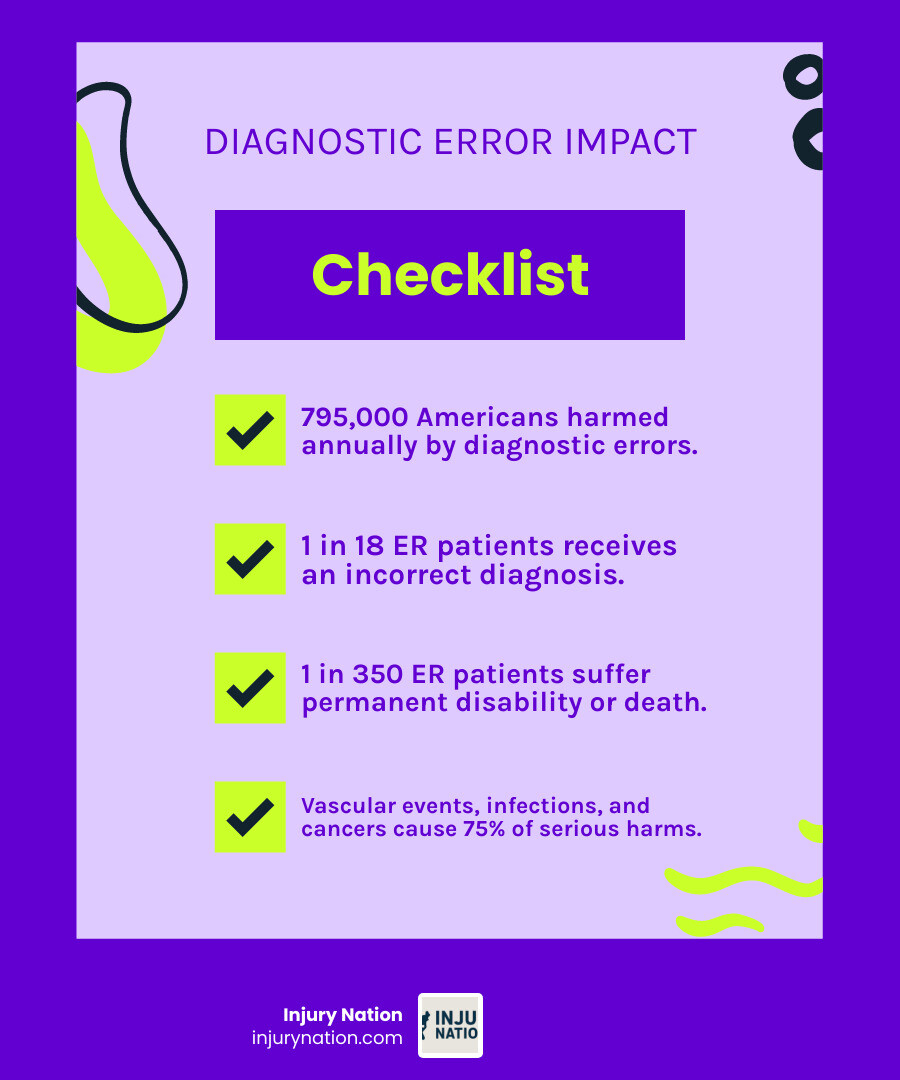
The numbers are staggering. Johns Hopkins Medicine estimates that 795,000 Americans die or are permanently disabled annually due to diagnostic errors. In emergency rooms, about 1 in 18 patients is misdiagnosed, with 1 in 350 suffering permanent harm or death.
You trusted your doctor, but your condition worsened. This isn’t just a medical failure; it’s a violation of trust. When that failure is due to negligence, you have legal rights.
Not every diagnostic error is malpractice. Medicine is complex. However, when a provider fails to meet the accepted standard of care—missing what a competent doctor would have caught—it becomes medical negligence. You deserve justice.
What is a Diagnostic Error in Medicine?
Not every bad medical outcome signifies negligence. Diseases can progress and complications can occur despite a doctor’s best efforts. A diagnostic error, however, is a specific mistake in identifying a patient’s condition. This could be a misread test, overlooked symptoms, or a failure to order appropriate tests.
While doctors are human and medicine involves judgment, the line is crossed into medical malpractice when a provider fails to meet the accepted standard of care. The key question is: Did the doctor act as a reasonably competent physician would have in the same situation? If they missed something obvious or ignored clear warning signs, it may be negligence.
Diagnostic errors generally fall into three categories:
| Type of Error | What Happens | Impact on Patient |
|---|---|---|
| Misdiagnosis | Wrong condition identified | Patient receives incorrect treatment while actual condition goes untreated |
| Delayed Diagnosis | Correct diagnosis made too late | Condition worsens; treatment becomes less effective or impossible |
| Failure to Diagnose | No diagnosis made at all | Patient receives no treatment; serious condition advances unchecked |
Each of these failures represents a breakdown in the diagnostic process. For example, a misdiagnosis might involve sending a heart attack patient home with antacids. A delayed diagnosis is common with cancers, where a treatable condition becomes terminal over time. A failure to diagnose is arguably the most dangerous, as the patient receives no treatment at all while a serious illness progresses.
When a doctor’s mistake causes preventable harm because they fell below the standard of care, a bad outcome becomes a breach of care. If a competent doctor would have caught what yours missed, and that failure directly harmed you, you may have grounds for a medical malpractice claim.
The Legal Framework of a Failure to Diagnose Claim
Not every medical mistake is grounds for a lawsuit. To qualify as medical malpractice, a failure to diagnose claim must prove four key elements:
- Doctor-Patient Relationship: You must show the provider agreed to treat you, establishing a professional duty of care. This is usually straightforward.
- Breach of the Standard of Care: This is the core of the case. You must prove the doctor’s actions fell below what a reasonably competent physician in a similar situation would have done.
- Causation: You must demonstrate a direct link between the doctor’s negligence and your injury. The error must have caused or significantly worsened your condition.
- Damages: You must have suffered actual, measurable harm, such as physical injuries, emotional trauma, or financial losses.
These legal requirements are why experienced representation is crucial. For more on medical malpractice claims, visit our dedicated page: More info about medical malpractice claims.
How is the Standard of Care Determined?
The “standard of care” is the level of skill and care that a reasonably competent healthcare professional in the same specialty and under similar circumstances would provide. It’s not about perfection, but competence. A family doctor and a cardiologist are held to different standards for a heart condition. A key part of this standard is the differential diagnosis method, where a doctor considers all possible causes for your symptoms and systematically rules them out. A failure to perform this process thoroughly can be a breach of care.
Proving Causation and the Role of Expert Witnesses
Proving that the diagnostic error caused your harm is often the biggest challenge. You must show that a timely diagnosis would have led to a significantly better outcome—this is often called a “lost chance of recovery.”
Expert witnesses are essential to make this connection. These are qualified medical professionals who:
- Establish the appropriate standard of care.
- Explain how your doctor breached that standard.
- Testify that the breach directly caused your harm.
Without expert testimony, most malpractice cases cannot proceed.
Can Hospitals Be Held Liable?
Yes, hospitals can often be held responsible for diagnostic errors.
- Employee Negligence: A hospital is generally liable for the negligence of its employees (doctors, nurses, technicians) under a principle called “respondeat superior.”
- Emergency Room Errors: Even if ER doctors are independent contractors, hospitals are often held liable for their mistakes under “apparent agency,” as patients reasonably assume they are hospital staff.
- Systemic Failures: Hospitals can be liable for institutional problems like understaffing, faulty equipment, or inadequate training that contribute to diagnostic failures.
Common Conditions and Devastating Consequences

Some illnesses are more prone to diagnostic errors, with catastrophic consequences. Researchers have identified “the big three”—vascular events, infections, and cancers—as accounting for 75% of serious harm from misdiagnosis.
Vascular Events: Strokes, Heart Attacks, and Aneurysms
When blood flow to vital organs is cut off, every minute counts.
- Strokes: Occur when blood flow to the brain is interrupted. Symptoms can be subtle, especially in younger patients and women, and are sometimes mistaken for migraines or vertigo. A missed diagnosis can lead to permanent brain damage. Strokes kill 137,000 Americans annually, according to the CDC.
- Heart Attacks: Happen when blood flow to the heart is blocked. Atypical symptoms, especially in women (nausea, fatigue, jaw pain), can lead to a misdiagnosis of indigestion or anxiety, resulting in irreversible heart damage or death. The CDC provides important information on heart attack symptoms.
- Aneurysms & Pulmonary Embolism: Aneurysms are bulges in blood vessels that can rupture fatally. A pulmonary embolism is a blood clot in the lungs whose symptoms (chest pain, shortness of breath) can mimic a panic attack. About 33% of untreated patients die from a pulmonary embolism, making prompt diagnosis critical. Penn Medicine offers detailed information on pulmonary embolism.
Infections: Sepsis, Meningitis, and Abscesses
Infections can quickly become life-threatening if missed.
- Sepsis: This is the body’s extreme, life-threatening response to an infection, where the immune system attacks its own tissues. Vague early symptoms (fever, confusion, rapid heart rate) are often missed, leading to organ failure and death. The CDC explains what sepsis is.
- Meningitis and Spinal Abscesses: Meningitis, an inflammation of the membranes around the brain and spinal cord, can be mistaken for the flu but can cause brain damage or death. Spinal abscesses can be dismissed as back pain, leading to permanent nerve damage.
- Hospital-Acquired Infections: About 1 in 10 hospital patients will contract an infection during their stay. A failure to diagnose these infections promptly can be fatal.
The Repercussions of a Failure to Diagnose Cancer
With cancer, timing is everything. A delayed diagnosis allows the cancer to grow and spread (metastasize), turning a treatable condition into a terminal one.
The lost treatment window is the cruelest consequence. Early-stage cancers often have high survival rates, but those odds drop dramatically with each delay.
- Commonly Misdiagnosed Cancers: Breast cancer is often missed when doctors dismiss a palpable lump after a negative mammogram. Lung and colorectal cancer symptoms are frequently attributed to less serious issues like allergies or hemorrhoids.
The emotional and physical toll is immense, involving more aggressive treatments, reduced quality of life, and lost time with loved ones. The National Cancer Institute provides comprehensive information on breast cancer treatment.
Pursuing a Claim: Damages, Deadlines, and Patient Roles

If a failure to diagnose has harmed you, a medical malpractice claim can help you recover what you’ve lost. However, pursuing a claim involves specific legal requirements and strict deadlines.
What Damages Can a Patient Recover?
Compensation, or damages, is divided into two categories:
- Economic Damages: These cover measurable financial losses, including past and future medical bills, lost wages, and reduced future earning capacity.
- Non-Economic Damages: These address intangible suffering like physical pain, emotional distress, and loss of enjoyment of life.
While settlements can be substantial (averaging around $425,000), many states cap non-economic damages. In Nevada, for example, this cap is $350,000, though economic damages have no limit.
Understanding the Statute of Limitations
You have a limited time to file a lawsuit. This deadline, called the statute of limitations, varies by state. Miss it, and you lose your right to sue. In Nevada, the deadline is generally three years from the date of injury or one year from the date you finded it, whichever is first.
The “findy rule” is key in failure to diagnose cases, as the clock may start when you reasonably should have known about the error, not when it happened. Because these rules are complex, consult an attorney quickly.
What Are a Patient’s Responsibilities?
While the focus is on the doctor’s negligence, patients have a role in their own care. To help ensure an accurate diagnosis and strengthen a potential legal claim, you should:
- Provide a complete and honest medical history.
- Report symptoms clearly and accurately.
- Ask questions if you don’t understand something.
- Follow the prescribed treatment plan.
- Seek a second opinion if you feel something is wrong.
Being an active participant in your healthcare is crucial. For more on medical malpractice, visit our page: More info about medical malpractice claims
What Steps Should You Take if You Suspect a Diagnostic Error?
Realizing your doctor may have missed a diagnosis is frightening. Taking swift, deliberate action can protect your health and your legal rights.
- Prioritize Your Health: Your health comes first. If you believe a serious condition was overlooked, seek immediate medical attention from a different provider or hospital. Don’t delay.
- Get a Second Opinion: A second opinion is essential. Another doctor can review your case with fresh eyes and may catch what was missed. Come prepared with your medical records and a detailed history of your symptoms.
- Gather Your Medical Records: You have a legal right to your complete medical file. Request all doctor’s notes, test results, imaging studies, and billing statements. These documents are critical evidence.
- Document Everything: Keep a detailed journal. Note your symptoms, medical appointments, conversations with providers, and how the error has impacted your daily life. This personal account is invaluable.
- Consult with a Medical Malpractice Attorney: These cases are incredibly complex. An experienced attorney can evaluate your case, consult with medical experts, and determine if you have a valid claim for negligence. They will review your records to see if the standard of care was breached and if that breach caused your harm.
If you have a case, your attorney will handle the entire legal process, from filing paperwork to negotiating a settlement or taking your case to trial. Most work on a contingency fee basis, meaning you pay nothing unless they win. This allows you to seek justice without upfront financial risk.
We can connect you with qualified attorneys who have the resources to handle these complex cases: Find experienced legal help
Conclusion
A failure to diagnose shatters the fundamental trust between a patient and a doctor. The statistics represent real people whose lives were changed by a preventable mistake.
We’ve covered how a diagnostic error becomes negligence, the legal framework for a claim, and the devastating consequences of missing conditions like vascular events, infections, and cancers.
The path to justice is complex, and legal deadlines are strict. In states like Nevada, you may have as little as one year from finding the injury to file a claim.
You don’t have to face this alone. An experienced medical malpractice attorney can steer the legal system for you, fighting for accountability and the compensation you deserve. This is about validation, closure, and preventing the same tragedy from happening to another family.
If you suspect a diagnostic error has harmed you or a loved one, don’t wait. The statute of limitations is unforgiving. Injury Nation connects victims with top-rated attorneys who have the expertise to fight for you.
Find a top-rated personal injury lawyer near you to get a free consultation and understand your options.