

When Life Changes in an Instant: Understanding Your Legal Rights After Paralysis
Paralysis injury lawsuit cases involve seeking compensation when someone becomes paralyzed due to another party’s negligence or wrongful actions. If you or a loved one has suffered paralysis, here’s what you need to know:
Key Facts About Paralysis Injury Lawsuits:
- Legal Basis: Claims are typically filed under negligence law, requiring proof that someone breached their duty of care and directly caused your injury
- Compensation Range: Settlements and awards can range from hundreds of thousands to millions of dollars, depending on injury severity
- Lifetime Costs: A 25-year-old with paraplegia faces approximately $2.3 million in lifetime costs; high quadriplegia can exceed $4.7 million
- Time Limits: Most states require filing within 2-3 years from the date of injury (statute of limitations varies by state)
- Recoverable Damages: Include medical expenses, lost wages, home modifications, assistive devices, pain and suffering, and loss of quality of life
Paralysis is one of the most catastrophic injuries a person can experience. It’s the loss of muscle function in part or all of your body, often resulting from trauma to the spinal cord or brain. According to the National Spinal Cord Injury Statistical Center, approximately 12,000 new cases of spinal cord injury occur in the U.S. each year, with between 250,000 to 400,000 people currently living with some form of paralysis.
The impact extends far beyond the physical disability. Paralysis affects every aspect of daily life—from the ability to work and earn a living to performing basic self-care tasks. Many victims require 24-hour assistance and face overwhelming medical bills that can easily reach into the millions over a lifetime.
When paralysis results from someone else’s negligence—whether in a car accident, medical malpractice incident, workplace accident, or other preventable situation—victims have the legal right to seek compensation. This isn’t just about holding responsible parties accountable. It’s about securing the financial resources you need to adapt to your new reality and maintain the best possible quality of life.
This guide will walk you through the legal process, help you understand what your claim may be worth, and explain how an experienced attorney can fight for the compensation you deserve.
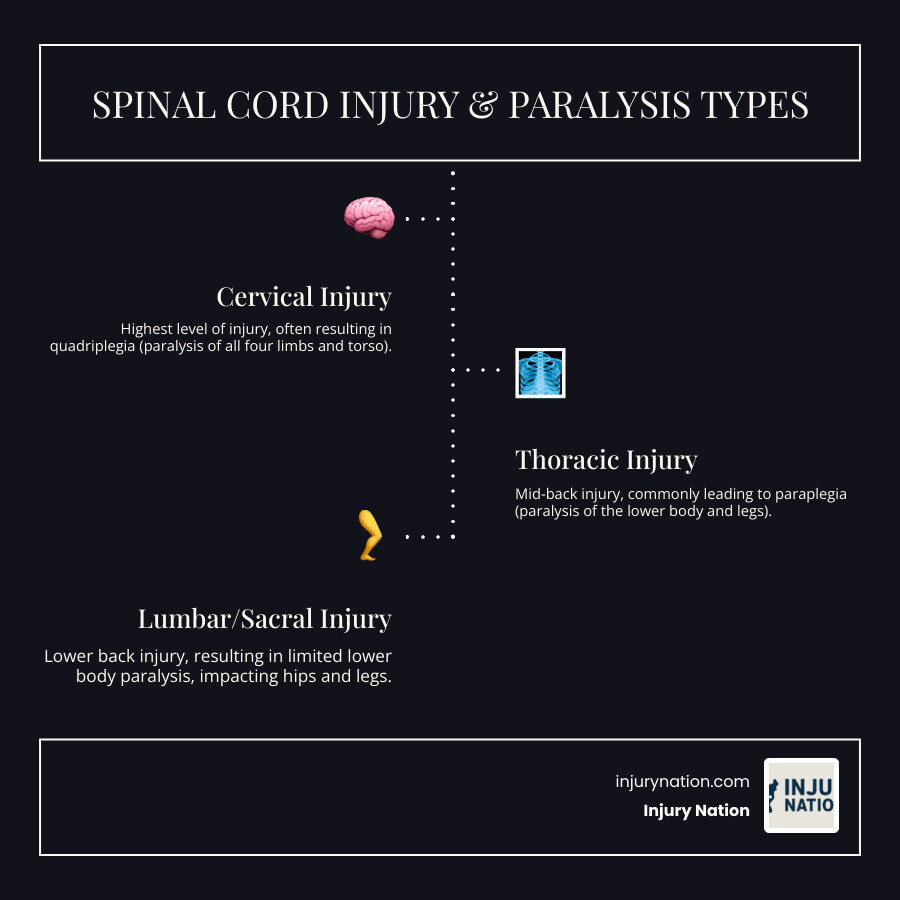
Paralysis injury lawsuit basics:
Understanding Paralysis and Its Devastating Impact
Paralysis, at its core, is the loss of muscle function in a part or the entirety of your body. This can manifest as a loss of sensation, voluntary movement, or both. It’s a condition that profoundly alters a person’s life, often requiring extensive medical care, rehabilitation, and lifestyle adjustments. While some forms of paralysis can be temporary or partial, many are permanent and complete, leaving individuals dependent on others for daily tasks. According to the National Spinal Cord Injury Statistical Center, fewer than 1 percent of those diagnosed with paraplegia or quadriplegia recover complete neurological function by the time they are discharged from the hospital.
The causes of paralysis are diverse, but in the context of personal injury lawsuits, they often stem from traumatic incidents where someone else’s negligence played a role. These can include:
- Spinal Cord Trauma: This is a leading cause, often resulting from direct blunt force, penetration, or oxygen deprivation to the spinal cord. The spinal cord is a delicate bundle of nerves that transmits signals between the brain and the rest of the body. Damage to this pathway can interrupt these signals, leading to paralysis below the point of injury.
- Traumatic Brain Injury (TBI): Damage to the brain can also result in paralysis, particularly if the areas controlling motor function are affected.
- Medical Errors: Sadly, medical malpractice can lead to paralysis. This might involve surgical errors, misdiagnosis or delayed diagnosis of conditions like strokes, or birth injuries where inappropriate use of instruments or delayed interventions cause spinal cord or brain damage to an infant.
- Nerve Damage: Localized nerve damage can also cause paralysis in specific body parts.
The health complications associated with paralysis are extensive and can significantly impact a person’s quality of life and overall health. These long-term issues underscore the immense financial burden and personal suffering that victims endure.
- Blood clots: Immobility significantly increases the risk of deep vein thrombosis (DVT) and pulmonary embolism.
- Bedsores (Pressure Ulcers): Constant pressure on certain areas of the body can lead to skin breakdown, which can become infected and require intensive treatment.
- Respiratory issues: Especially with high spinal cord injuries, breathing can be compromised, leading to increased risk of pneumonia and other lung conditions.
- Chronic pain: Nerve damage and muscle spasms can cause persistent and severe pain.
- Spasms: Uncontrolled reflex movements are common below the level of injury.
- Urinary and bowel problems: Loss of muscle control can lead to incontinence or retention, requiring catheters, special medications, or other management techniques.
- Muscle atrophy: Disuse of muscles below the injury site leads to their weakening and wasting.
- Increased susceptibility to infections: Due to compromised immune function and issues like bedsores or urinary catheters.
These complications necessitate ongoing medical care, specialized equipment, and often 24-hour assistance, contributing to the staggering financial burden that a paralysis injury lawsuit seeks to address.
The Different Types of Paralysis
Paralysis isn’t a one-size-fits-all condition; it presents in various forms depending on the location and severity of the nerve damage. Understanding these types is crucial for grasping the full scope of a victim’s challenges and the compensation they may require.
- Monoplegia: This refers to paralysis affecting a single limb, such as one arm or one leg.
- Hemiplegia: This type involves paralysis on one side of the body, meaning an arm and a leg on the same side are affected.
- Paraplegia: When paralysis occurs below the waist, affecting both legs and potentially the lower part of the trunk, it is known as paraplegia. This typically results from spinal cord injuries in the thoracic, lumbar, or sacral regions.
- Quadriplegia (Tetraplegia): This is perhaps the most severe form, involving paralysis of all four limbs (both arms and both legs) and often the torso, from the neck down. Quadriplegia usually stems from injuries to the cervical (neck) region of the spinal cord.
Beyond these classifications, paralysis can also be described as:
- Complete vs. Incomplete Paralysis: In complete paralysis, there is no motor or sensory function below the level of injury. In incomplete paralysis, some motor or sensory function remains below the injury level, even if minimal. This distinction significantly impacts a person’s prognosis and rehabilitation potential.
- Temporary vs. Permanent Paralysis: While many paralysis injuries are permanent, some can be temporary, with function returning over time through healing or rehabilitation. However, in the context of personal injury claims, we often deal with injuries that are life-altering and permanent.
An overview of spinal cord injuries and their effects highlights the direct link between the location of the injury and the resulting type of paralysis. For instance, a cervical injury (in the neck) is more likely to cause quadriplegia, while a thoracic injury (in the upper back) typically leads to paraplegia. This medical reality directly influences the nature of care needed and the value of a paralysis injury lawsuit.
Common Causes in Personal Injury Cases
When we talk about a paralysis injury lawsuit, we’re often looking at situations where someone else’s carelessness led to a life-altering injury. In Las Vegas and across Nevada, certain types of accidents are unfortunately common culprits.

- Car Accidents: Motor vehicle accidents are a leading cause of spinal cord injuries and paralysis. High-speed collisions, rear-end crashes, T-bone accidents, and rollovers can exert immense force on the body, leading to severe spinal trauma or traumatic brain injuries. Driver negligence, such as distracted driving, drunk driving, speeding, or reckless behavior, frequently underlies these catastrophic events.
- Truck Accidents: Due to their massive size and weight, collisions involving large commercial trucks often result in devastating injuries, including paralysis. These accidents can be caused by truck driver fatigue, improper loading, mechanical failures, or aggressive driving.
- Slip and Fall Accidents: While seemingly minor, a serious slip and fall can lead to significant head or spinal injuries, particularly for older individuals or those with pre-existing conditions. Property owners who fail to maintain safe premises (e.g., wet floors, uneven surfaces, poor lighting) can be held liable.
- Construction Site Accidents: Construction zones are inherently dangerous environments. Falls from heights, being struck by heavy equipment or falling objects, and trench collapses can all cause severe spinal cord or brain injuries resulting in paralysis. Employers and contractors have a duty to provide a safe working environment.
- Defective Products: Sometimes, paralysis results from a faulty product. This could be a defective car part that fails during a crash, unsafe medical equipment, or even a poorly designed piece of sports equipment that doesn’t provide adequate protection. Manufacturers can be held accountable for products that are unreasonably dangerous.
- Sports Injuries: High-impact sports, especially those involving collisions or falls, can lead to spinal cord injuries. While participants assume some risk, negligence can still play a role, such as in cases of illegal hits, defective protective gear, or inadequate safety protocols in organized sports.
- Acts of Violence: Tragically, acts of criminal violence, including assaults or firearm offenses, can result in paralysis. In such cases, victims may pursue a personal injury claim against the perpetrator, and sometimes against property owners if their negligence contributed to the violent act.
In Las Vegas, a busy city with heavy traffic and numerous construction projects, these types of accidents are a real concern. If your paralysis was caused by any of these scenarios due to someone else’s fault, we can help you explore your legal options.
The Staggering Costs of Living with Paralysis
One of the most critical aspects of any paralysis injury lawsuit is calculating the full extent of financial damages. The costs associated with living with paralysis are not just immediate; they are lifelong and can be truly staggering, easily reaching into the millions of dollars. These costs cover everything from ongoing medical care to necessary home modifications and lost income.
Let’s look at some of the lifetime cost estimates (as of 2021) for individuals who suffer spinal cord injuries leading to paralysis, according to the National Spinal Cord Injury Statistical Center and the Christopher & Dana Reeve Foundation:
- High (Complete) Quadriplegia:
- $1.6 million the first year post-injury.
- $185,000 each subsequent year.
- A person who suffers high quadriplegia at age 25 will incur a lifetime cost of approximately $4.7 million.
- A person with the same injury at age 50 incurs a lifetime cost of about $2.6 million.
- Low (Incomplete) Quadriplegia:
- $770,000 the first year post-injury.
- $114,000 each subsequent year.
- A person with low quadriplegia at 25 incurs a lifetime cost of approximately $3.5 million.
- A person at 50 with that same injury sustains about $2.1 million in costs.
- Paraplegia:
- $519,000 the first year post-injury.
- $69,000 each subsequent year.
- A patient diagnosed with paraplegia at age 25 will rack up about $2.3 million in costs over a lifetime.
- A person at 50 with the same injury will incur about $1.5 million.
These figures represent direct medical costs and living expenses but do not include wage losses, fringe benefits, and productivity losses, which average an additional $72,000 annually.
What do these costs cover?
- Medical Expenses: This includes emergency treatment, surgeries, hospital stays, medications, specialist consultations, and ongoing medical care for complications like infections or pressure sores. For many, this is a lifelong requirement.
- Rehabilitation Costs: Extensive physical, occupational, and speech therapy are often necessary to maximize function and independence. These therapies can be incredibly expensive and long-term.
- Assistive Technology and Equipment: Wheelchairs (manual and powered), adaptive equipment for daily living, communication devices, ventilators, and other specialized tools are essential but costly.
- Home and Vehicle Modifications: To accommodate a wheelchair and ensure accessibility, homes often require significant modifications, such as ramps, widened doorways, roll-in showers, and accessible kitchens. Vehicles may need to be adapted or replaced with specialized vans.
- Personal Assistance and Caregivers: Many individuals with paralysis require round-the-clock personal care, which can be provided by family members or professional caregivers. The cost of skilled nursing or home health aides can quickly accumulate.
- Lost Earning Capacity: Paralysis often prevents individuals from returning to their previous employment or working at all. This loss of income, including potential raises and benefits over a lifetime, is a major component of damages in a paralysis injury lawsuit. One year post-accident, less than 12 percent of those with a spinal cord injury are employed. Two decades post-accident, about 35 percent are employed.
Clearly, the financial impact of paralysis is immense. Without proper compensation, victims and their families can face impossible debt and a drastically diminished quality of life. Our goal at Injury Nation is to ensure that these costs are fully accounted for in your claim.
Building Your Case: Proving Negligence and Liability
At the heart of every paralysis injury lawsuit is the concept of negligence. To successfully recover compensation, we must establish that another party’s carelessness, recklessness, or wrongful action directly caused your paralysis. This isn’t just about showing that an accident happened; it’s about proving legal fault.
The legal basis for virtually every civil claim involving paralysis is negligence. This means we need to demonstrate that the at-fault party owed you a duty of care, breached that duty, and that breach directly led to your injuries. In Nevada, like most states, proving negligence involves specific elements that our legal team will carefully investigate.
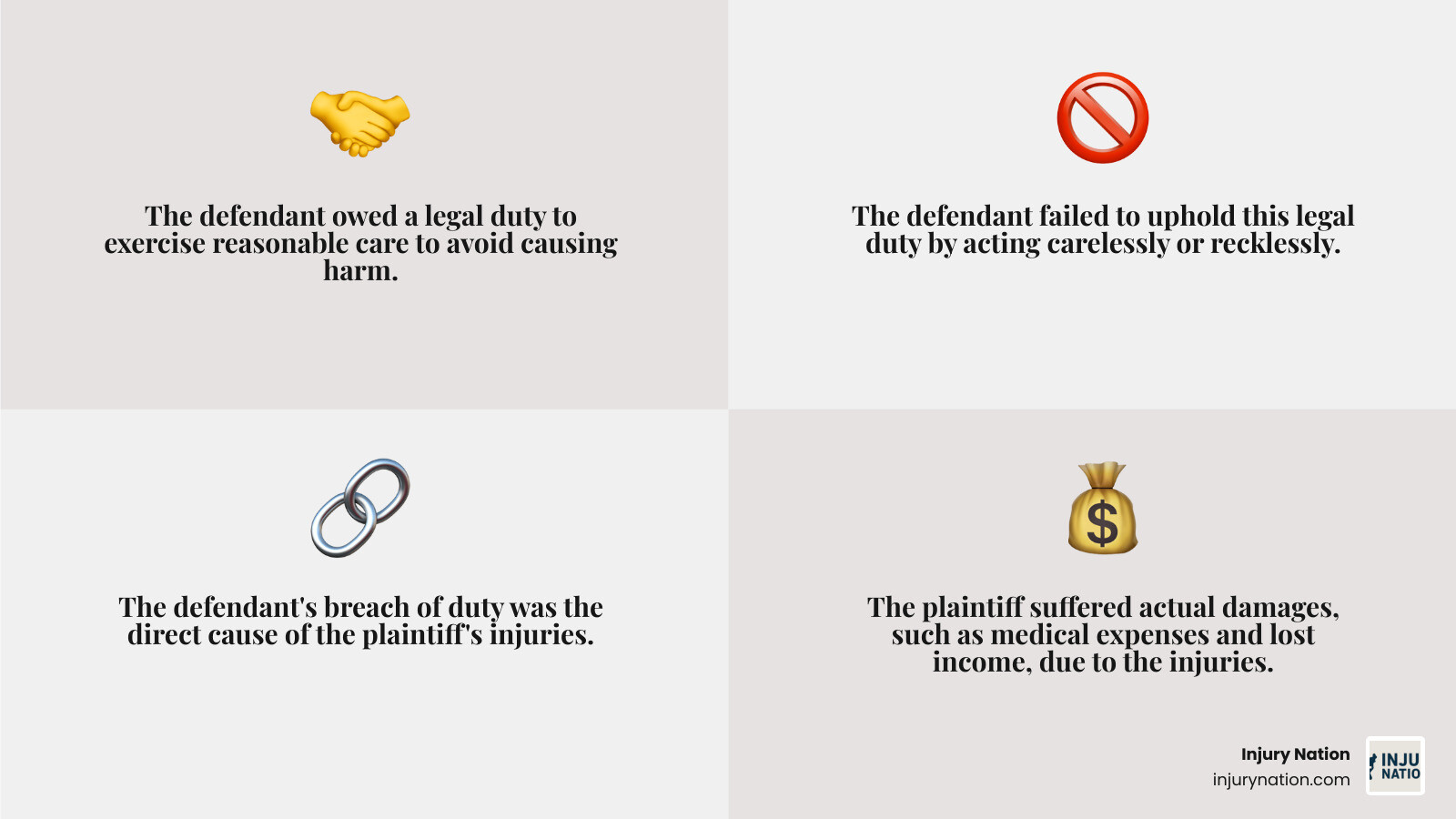
The Four Key Elements of Negligence
To prove negligence in a paralysis injury lawsuit, we must establish the following four elements:
- Duty of Care: The defendant (the at-fault party) owed you a legal duty to exercise reasonable care to avoid causing you harm. For example, a driver has a duty to obey traffic laws and drive safely, a property owner has a duty to maintain safe premises, and a doctor has a duty to provide a professional standard of care.
- Breach of Duty: The defendant failed to uphold that duty of care. This means their actions (or inactions) fell below the accepted standard of reasonable conduct. For instance, a distracted driver running a red light breaches their duty of care.
- Causation: This is often the most complex element in paralysis cases. We must prove two types of causation:
- Cause-in-Fact (Actual Cause): Your injury would not have occurred “but for” the defendant’s breach of duty.
- Proximate Cause (Legal Cause): The defendant’s breach was a direct and foreseeable cause of your paralysis. The injury must have been a reasonably predictable outcome of their negligent actions.
- Actual Damages: You must have suffered actual, quantifiable harm as a result of the defendant’s negligence. In a paralysis injury lawsuit, these damages are extensive, including medical expenses, lost wages, pain and suffering, and more.
Our experienced attorneys will gather evidence such as accident reports, medical records, eyewitness testimonies, expert opinions (from accident reconstructionists, medical specialists, etc.), and photographic evidence to carefully build your case and demonstrate each of these elements.
Navigating Comparative and Contributory Negligence
What happens if you were partially at fault for the accident that led to your paralysis? This is where the concepts of comparative and contributory negligence come into play, and they can significantly impact the compensation you can recover in a paralysis injury lawsuit.
In Nevada, the legal doctrine of comparative negligence (specifically, modified comparative negligence) is applied. This means that if you are found to be partially responsible for the accident, your recoverable damages will be reduced by your percentage of fault. However, there’s a crucial threshold:
- Modified Comparative Negligence (Nevada): Under Nevada Revised Statutes § 41.141, you can still recover damages even if you were partially at fault, as long as your negligence was not greater than the negligence of the defendant or combined negligence of multiple defendants. If you are found to be 50% or less at fault, you can recover compensation, but that amount will be reduced by your percentage of fault. If you are found to be more than 50% at fault, you cannot recover any damages.
For example, if a jury determines your total damages are $10 million, but you were 20% at fault for the accident, your award would be reduced by 20%, meaning you would receive $8 million. However, if you were found 51% at fault, you would receive nothing.
This system is different from contributory negligence, which is a harsher rule used in a few states, where if you are found even 1% at fault, you are completely barred from recovering any damages. Fortunately, Nevada operates under the more equitable modified comparative negligence rule.
Understanding how comparative negligence might affect your paralysis injury lawsuit is vital. The at-fault party’s insurance company will almost certainly try to shift some blame onto you to reduce their payout. Our attorneys are skilled at countering these tactics and protecting your right to maximum compensation.
Critical Deadlines: The Statute of Limitations
Time is of the essence when it comes to filing a paralysis injury lawsuit. Every state has a strict legal deadline, known as the statute of limitations, within which you must file your lawsuit. If you miss this deadline, you will likely lose your right to pursue compensation, regardless of the strength of your case.
In Nevada, the statute of limitations for most personal injury claims, including those involving paralysis, is typically two years from the date of the underlying accident or injury. This is codified in Nevada Revised Statutes § 11.190.
While two years might seem like a long time, the process of investigating a complex paralysis case, gathering evidence, identifying liable parties, and calculating extensive damages is time-consuming. Additionally, critical evidence can disappear, and witness memories can fade over time.
There can be rare exceptions to this two-year rule, such as cases involving minors, delayed findy of the injury (known as the “findy rule”), or claims against government entities (which often have much shorter notice requirements). However, relying on these exceptions is risky.
Therefore, the importance of acting quickly cannot be overstated. As soon as possible after a paralysis-causing accident, it is crucial to consult with an experienced personal injury attorney. This allows our team ample time to:
- Investigate the accident thoroughly.
- Preserve crucial evidence.
- Identify all responsible parties.
- Engage medical and financial experts.
- File your paralysis injury lawsuit within the statutory deadline.
Don’t let a legal deadline prevent you from seeking the justice and compensation you deserve.
The High Stakes of a Paralysis Injury Lawsuit: Calculating Compensation
The financial stakes in a paralysis injury lawsuit are incredibly high, reflecting the catastrophic and lifelong impact of the injury. When we pursue a claim, we’re not just looking at immediate bills; we’re calculating the full spectrum of damages you will incur over your entire lifetime. This comprehensive valuation is crucial because a paralysis injury affects every aspect of your existence.
The process involves careful assessment, often requiring expert testimony from medical professionals, life care planners, and economists to project future costs and losses accurately. Whether through settlement negotiations or a jury award at trial, our goal is to secure compensation that truly reflects your needs and losses.
Economic vs. Non-Economic Damages
In a paralysis injury lawsuit, damages are broadly categorized into two main types: economic and non-economic. Understanding the difference is key to comprehending the full scope of your potential compensation.
| Type of Damages | Description