

Why a Slip and Fall Attorney Can Make or Break Your Case
A slip and fall attorney specializes in helping injured victims prove property owner negligence, steer complex premises liability laws, and secure fair compensation for medical bills, lost wages, and pain and suffering—often on a “no win, no fee” contingency basis.
After a hard fall on a wet floor, broken stair, or icy parking lot, you’re left with medical bills, missed work, and persistent pain. These accidents are more common and serious than people think, leading to over 800,000 hospitalizations annually. While property owners have a legal duty to keep their premises safe, their insurance companies often try to shift blame or offer lowball settlements.
An experienced attorney fights for the compensation you truly deserve. They handle every aspect of your case, including:
- Investigating the accident and gathering critical evidence (photos, surveillance footage, witness statements)
- Proving the property owner knew or should have known about the hazard
- Negotiating with insurance companies who try to minimize payouts
- Calculating the full value of your claim, including future medical costs
- Representing you in court if a fair settlement cannot be reached
Understanding Slip and Fall Accidents and Liability
When property owners fail to keep their premises safe, they can be held legally responsible for your injuries. This area of law, known as premises liability, is based on the principle that owners have a duty of care to maintain safe conditions. When they are negligent and someone gets hurt, they may owe compensation.
These aren’t just minor stumbles. The CDC reports over 800,000 hospitalizations from falls each year, often involving devastating injuries like hip fractures and head trauma. These are life-changing events that can lead to months of recovery or permanent disability.

What Constitutes a Slip, Trip, and Fall?
A slip, trip, or fall is an unintentional fall on someone else’s property that results in injury. A slip typically involves losing traction (wet floors, ice), while a trip happens when an object catches your foot (uneven pavement, clutter). Legally, the key question is: Did a dangerous condition on the property cause your fall and injury? If so, you may have a valid claim. For information on other types of injury cases, check out our guide on burn injury lawsuits.
Common Causes and Resulting Injuries
Most slip and fall accidents are preventable. Common causes include:
- Wet or slippery floors from spills or mopping without warning signs.
- Uneven surfaces like cracked sidewalks, torn carpets, or broken tiles.
- Poor lighting in stairwells, hallways, or parking lots.
- Clutter and obstructions in walkways.
- Weather conditions like uncleared ice and snow.
The resulting injuries can be severe, including broken bones (wrists, hips, ankles), Traumatic Brain Injuries (TBIs), spinal cord damage, and painful soft tissue injuries like sprains and strains. According to The National Safety Council on fall safety, these falls cause over a million injuries annually.
When is a Property Owner Liable?
Just falling on someone’s property doesn’t automatically mean they are liable. A slip and fall attorney must prove the owner was negligent. This means showing one of the following:
- The owner created the hazardous condition (e.g., spilled liquid and didn’t clean it up).
- The owner knew about the hazard but did nothing to fix it or warn visitors.
- The owner should have known about the hazard through reasonable inspection and maintenance. This is called “constructive knowledge.”
An owner can’t just claim ignorance. If a hazard existed long enough that a responsible owner should have found and fixed it, they can be held liable. This is why evidence like surveillance footage and witness testimony is so critical to proving your case.
Building Your Case: Critical Steps and Evidence
The actions you take immediately after a slip and fall are crucial. Evidence disappears quickly—hazards get cleaned up, footage is erased, and memories fade. Acting fast is essential to building a strong case. For guidance on handling the aftermath of accidents, our auto accident guides offer helpful insights.

What to Do Immediately After a Fall
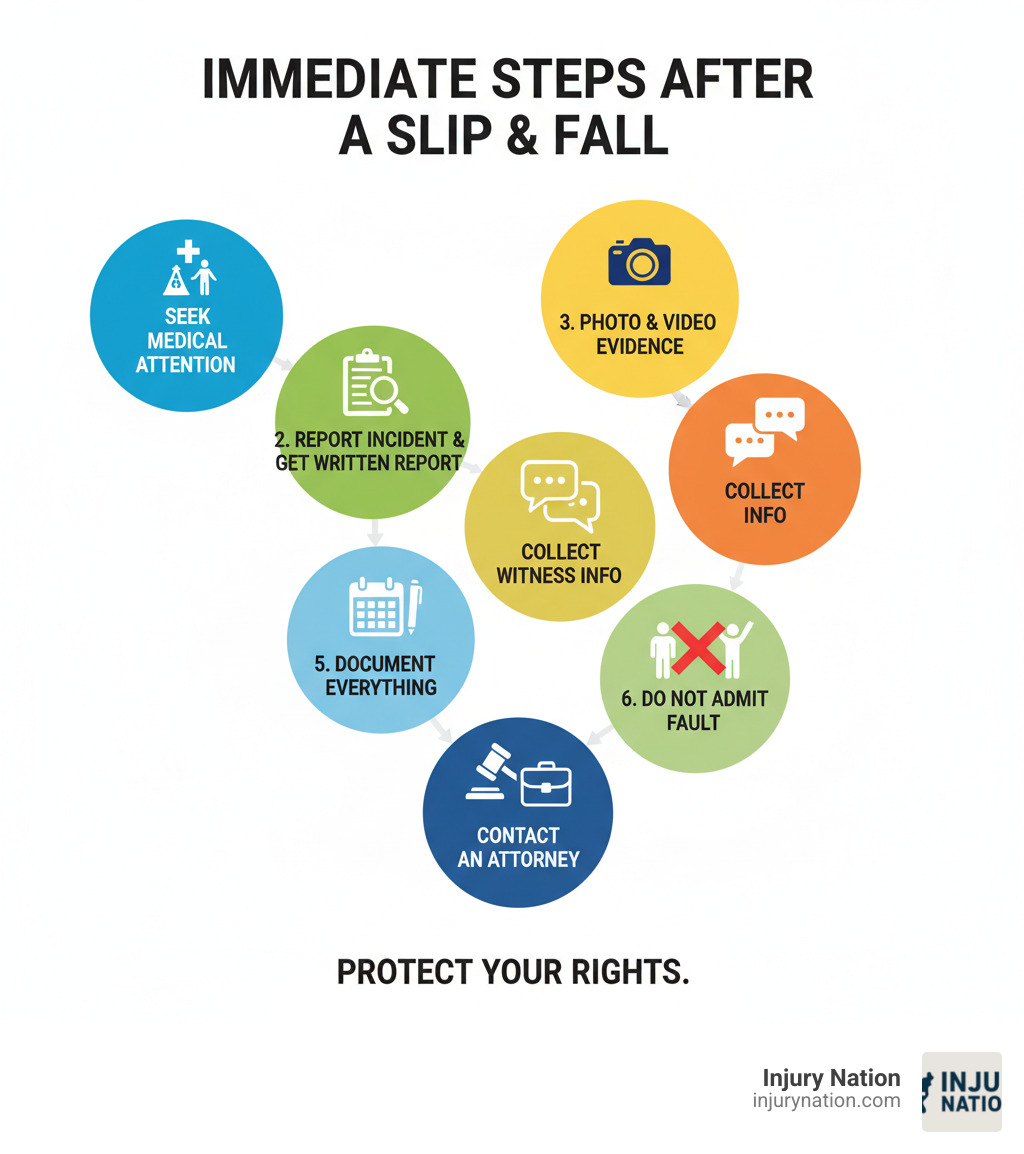
Your health and legal rights are the priority. Follow these steps:
- Seek Medical Attention: Get checked by a doctor, even if you feel fine. This protects your health and creates a medical record linking your injuries to the fall.
- Report the Incident: Inform the property owner or manager and ask for a written incident report. This creates an official record of the event.
- Document the Scene: Use your phone to take photos and videos of the hazard, the surrounding area, and your visible injuries.
- Get Witness Information: Ask anyone who saw you fall for their name and contact number. Their testimony can be invaluable.
- Do Not Admit Fault: Avoid saying things like “I’m sorry” or “I’m so clumsy.” Such statements can be used against you by insurance companies.
Gathering Evidence to Prove Negligence
An experienced slip and fall attorney knows what evidence is needed to prove negligence and how to obtain it. Key pieces of evidence include:
- Photographs and Videos: Time-stamped images that freeze the hazardous scene in time.
- Surveillance Footage: Often reveals how long a hazard existed and whether employees ignored it. An attorney can send a preservation letter to ensure it isn’t deleted.
- Witness Statements: Unbiased accounts that corroborate your version of events.
- Incident Reports: Official documentation of the fall, which may contain admissions from employees.
- Medical Records: Proof of your injuries, their severity, and the required treatment.
- Maintenance Logs: Records that can show a history of poor inspection or ignored complaints. An attorney can obtain these during the findy process.
- Expert Witnesses: Engineers or safety consultants who can testify about code violations or unsafe conditions.
Understanding the Statute of Limitations
You have a limited time to file a lawsuit. This legal deadline, known as the statute of limitations, varies by state. In Nevada, for example, you generally have two years from the date of the accident to file a personal injury lawsuit. If you fall on government property, the deadline can be much shorter, sometimes only six months to file a notice of claim.
Miss this deadline, and your right to sue is permanently lost. Insurance companies may try to delay your claim until time runs out. This is why contacting a slip and fall attorney immediately is so important. They ensure all deadlines are met while building the strongest possible case. For information about other time-sensitive claims, check out our resources on homeowners insurance claims.
Why You Need an Expert Slip and Fall Attorney
Trying to handle a slip and fall claim on your own is risky. Insurance companies are not on your side; their goal is to pay out as little as possible. They employ experienced adjusters and lawyers to find reasons to deny your claim or suggest you were at fault.
An expert slip and fall attorney levels the playing field. We know their tactics and how to counter them. We work on a contingency fee basis, meaning you pay no upfront costs and we only get paid if we win your case. This makes justice accessible to everyone. Learn more about the contingency fee explanation.

What a Slip and Fall Attorney Does for You
When you hire a dedicated attorney, you get a partner who handles every aspect of your case:
- Investigates your case by visiting the scene, interviewing witnesses, and uncovering evidence.
- Collects crucial evidence by subpoenaing documents and securing expert opinions.
- Handles all negotiations with the insurance company, protecting you from their tactics.
- Files a lawsuit and represents you in court if a fair settlement isn’t reached.
- Calculates the full value of your claim to ensure you seek comprehensive compensation.
Our goal is to take the legal burden off your shoulders so you can focus on your recovery.
How an Attorney Calculates and Recovers Your Compensation
Determining your claim’s true value goes beyond adding up current bills. A skilled slip and fall attorney calculates all your losses to ensure you don’t accept an unfair settlement. Compensation is designed to cover:
-
Economic Damages: These are your measurable financial losses.
- Medical Expenses: All costs for ER visits, surgery, hospital stays, medication, and future care like physical therapy.
- Lost Income: Wages you’ve already lost plus your future lost earning capacity if your ability to work is permanently affected.
- Other Costs: Transportation to appointments, home modifications, etc.
-
Non-Economic Damages: This compensates for the intangible, personal impact of your injuries.
- Pain and Suffering: For the physical pain and emotional distress you’ve endured.
- Loss of Enjoyment of Life: For the inability to participate in hobbies and activities you once loved.
- Permanent Disability or Disfigurement: For lifelong challenges, chronic pain, or visible scarring.
An attorney ensures that the compensation you receive reflects the full scope of your losses, both seen and unseen, so you can rebuild your life with financial security.
Navigating Complex Slip and Fall Scenarios
Not all slip and fall cases are the same. Liability rules change dramatically depending on where you fell—a friend’s house, a store, or a city sidewalk. An experienced slip and fall attorney is essential for navigating these tricky scenarios. For those in our local community, our guide on Las Vegas accident injuries offers additional insights.
Here’s how liability changes across different property types:
| Property Type | Duty of Care | Key Considerations |
|---|---|---|
| Private Property | Generally, a lower duty to licensees (social guests) and trespassers. Higher duty to invitees (e.g., mail carrier). | Owner must address known hazards or warn licensees. For trespassers, duty is usually only to avoid intentional harm, with exceptions for child trespassers. Proving owner knowledge is key. |
| Commercial Property | Highest duty of care to all lawful visitors (invitees). | Owners must regularly inspect, find, and remedy hazards, or provide adequate warnings. This includes stores, restaurants, hotels, casinos (common in Las Vegas), and workplaces. Negligence is easier to prove if the hazard existed for a long time or was obvious. |
| Government Property | Duty of care varies by jurisdiction and specific entity. Often protected by “sovereign immunity.” | Special rules and shorter deadlines (often 6 months to 1 year) apply. Requires filing a “notice of claim” before a lawsuit. Claims are complex and require an attorney experienced in government liability. |
Private vs. Commercial vs. Government Property
Where you fell determines the legal standard the owner must meet.
- Private Property: The duty of care depends on your status. A social guest (“licensee”) must be warned of known dangers, while a service provider (“invitee”) is owed a higher duty of care. Proving the owner knew about the hazard is often the biggest challenge.
- Commercial Property: Businesses (stores, hotels, casinos) owe the highest duty of care. They must actively and regularly inspect for, repair, and warn about dangers to keep customers safe.
- Government Property: These cases are complex due to “sovereign immunity.” You must follow strict procedures, including filing a formal “notice of claim” within a very short timeframe (often 6-12 months). Missing this deadline will bar your claim, making an experienced attorney essential.
Liability for Weather-Related Falls
Property owners aren’t liable for natural accumulations of ice and snow during a storm. However, they have a duty to take reasonable cleanup efforts within a reasonable time after the storm ends. Failing to shovel, salt, or warn of icy patches can be negligence. An attorney can prove negligence by showing the owner failed to act reasonably or created an unnatural hazard, like a poorly designed drainage system that caused ice to form.
Can You Sue Your Landlord?
Yes. Landlords are responsible for maintaining safe common areas like hallways, stairwells, and parking lots. If you fall due to a hazard in one of these areas (e.g., a broken step, poor lighting), the landlord may be liable. For issues inside your apartment, a landlord can be responsible if they failed to fix a defect you reported or if the condition violates building codes. Your lease agreement and repair request records are key evidence in these cases.
Frequently Asked Questions about Slip and Fall Claims
Navigating the legal process after a fall can be confusing. Here are answers to some of the most common questions we hear.
What if I am partially at fault for my accident?
Even if you think you were partially at fault—perhaps you were looking at your phone—you may still be able to recover compensation. Most states, including Nevada, use a “modified comparative negligence” rule. This means you can recover damages as long as you are found to be less than 51% responsible for the accident.
Your final compensation is simply reduced by your percentage of fault. For example, if you have $100,000 in damages and are found 20% at fault, you would receive $80,000. An insurance company will try to place as much blame on you as possible to reduce or eliminate their payout. A slip and fall attorney will fight to minimize your assigned fault and protect your right to compensation. You can read more about Nevada’s modified comparative negligence rule in the state law.
How much does it cost to hire a slip and fall lawyer?
Most personal injury lawyers work on a contingency fee basis. This means:
- You pay nothing upfront.
- All case costs (filing fees, expert witnesses, etc.) are covered by the law firm.
- The attorney’s fee is a pre-agreed percentage of the compensation they recover for you.
- If we don’t win your case, you owe us nothing.
This “no win, no fee” promise aligns our interests with yours and makes expert legal help accessible to everyone, regardless of their financial situation.
Can my case go to trial?
The vast majority of slip and fall cases are settled out of court. Settlements are generally faster and less stressful than a trial. Your slip and fall attorney will build a strong case and negotiate aggressively with the insurance company to achieve a fair settlement.
However, if the insurer refuses to offer what you deserve, we are fully prepared to take your case to trial. The litigation process involves several stages:
- Filing a Lawsuit: Officially starting the legal action.
- Findy: Both sides exchange information through written questions, document requests, and depositions (sworn testimony).
- Trial: If no settlement is reached, we present your case to a judge and jury to fight for a favorable verdict.
While most cases settle, having an attorney who is ready and willing to go to trial is a powerful negotiating tool that often convinces insurers to offer a fair settlement.
Find the Right Representation for Your Fall
You now understand that a slip and fall is a serious event with legal consequences. Property owners have a duty to keep you safe, and when their negligence causes you harm, they can be held liable. You’ve learned the critical steps to take after a fall, the importance of gathering evidence, and the unforgiving nature of legal deadlines like Nevada’s two-year statute of limitations.
But the most important takeaway is this: you should not face this fight alone. Insurance companies are already working to protect their bottom line, not your well-being. You need an advocate in your corner.
A skilled slip and fall attorney does more than file paperwork. They investigate your claim, stand up to insurance adjusters, calculate the full value of your losses—including future medical needs and lost earning capacity—and fight for the compensation you deserve. They steer complex scenarios, from falls on government property to landlord negligence, and work on a contingency fee, so you pay nothing unless you win.
Time is critical. Evidence disappears, and legal deadlines are approaching. Don’t let an insurance company pressure you into a lowball offer or let your right to compensation expire.
You’ve been through enough. Let an expert carry the legal burden while you focus on healing.
Find a top-rated slip and fall attorney near you through Injury Nation today. Get the representation you need and the peace of mind that comes from knowing a professional is fighting for you.